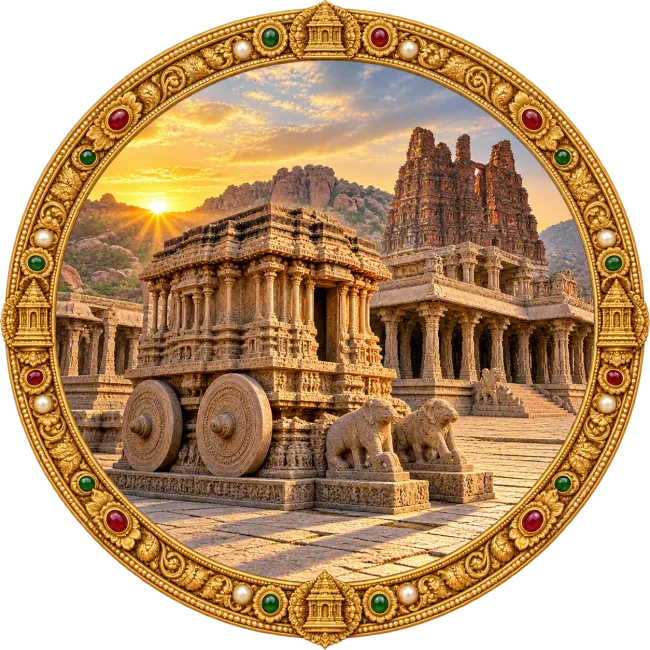
Vitthala Temple, Hampi
Vitthala Temple in Hampi, Karnataka, is one of the finest masterpieces of Vijayanagara architecture. Dedicated to Lord Vishnu as Vitthala, the temple is famous for its iconic Stone Chariot, musical pillars, expansive courtyards and beautifully carved halls.
Located within the UNESCO World Heritage Site of Hampi, the temple represents the wealth, artistic excellence and engineering knowledge of the Vijayanagara Empire. Although the temple no longer follows a regular daily worship schedule, it remains one of India’s most important sacred and historical monuments.
About Vitthala Temple
Vitthala Temple, also known as Vijaya Vitthala Temple, is situated near the banks of the Tungabhadra River in Hampi. Lord Vitthala is a form of Lord Vishnu closely associated with Lord Krishna.
The temple complex contains:
The famous Stone Chariot
Maha Mandapa
Ranga Mandapa
Musical pillars
Kalyana Mandapa
Utsava Mandapa
Devi shrine
Multiple entrance towers
Long pillared corridors
Sculptures of deities, animals and warriors
Vitthala Temple displays the mature phase of Vijayanagara architecture. Its builders transformed hard granite into complex pillars, miniature shrines, decorative wheels, horses, elephants and scenes from Hindu mythology.
The temple is presently maintained as a protected heritage monument. Visitors may offer silent prayers, but regular public Abhishekam, Puja and Aarti are not performed according to a fixed daily schedule.
When and Who Built Vitthala Temple?
Construction of Vitthala Temple began during the fifteenth century under the Vijayanagara ruler Devaraya II, who reigned from 1422 to 1446.
The temple was significantly expanded during the reign of Emperor Krishnadevaraya in the early sixteenth century. He and later Vijayanagara rulers contributed mandapams, gateways, sculptures and other ceremonial structures.
Krishnadevaraya’s queens and royal officers also supported temple construction and religious activities throughout the Vijayanagara capital.
The complex continued to receive additions under Achyuta Deva Raya and other rulers. Several sections remained unfinished, providing valuable evidence of the carving and construction techniques used by Vijayanagara artisans.
After the Battle of Talikota in 1565, Hampi was attacked and much of the capital was damaged. Vitthala Temple survived, but its regular worship and ceremonial activities gradually came to an end.
Who Is Lord Vitthala?
Vitthala, also called Vithoba or Panduranga, is a form of Lord Vishnu identified closely with Krishna.
The deity is generally shown standing with both hands placed on the hips. This form is especially famous at the Vitthal Rukmini Temple in Pandharpur, Maharashtra.
According to regional tradition, the Vijayanagara rulers were devoted to Vitthala and established a magnificent temple for him in their capital.
The worship of Vitthala emphasises devotion, humility, music and complete surrender to God. Saints and poets across Karnataka and Maharashtra composed devotional songs in his honour.
Religious Significance
Vitthala Temple was once a major centre of Vaishnavite worship within the Vijayanagara capital. The temple’s large ceremonial halls and processional streets show that important festivals, music, dance and royal ceremonies took place here.
The complex represents several spiritual ideas:
Devotion to Lord Vishnu
Music and dance as forms of worship
The relationship between royal authority and Dharma
Divine protection of the kingdom
The symbolic journey from the outer world to the sanctum
The union of architecture, sculpture and sacred sound
Even though regular worship is no longer performed, devotees and visitors continue to regard the site with reverence.
Architecture of Vitthala Temple
Vitthala Temple is built primarily from granite and follows the Dravidian architectural tradition as interpreted by Vijayanagara artists.
The complex is surrounded by high enclosure walls and covers a large rectangular area. Entrance gopurams lead into spacious courtyards containing various shrines and mandapams.
Important architectural characteristics include:
Tall entrance towers
Open pillared halls
Composite columns
Sculptures of yali, horses and elephants
Narrative panels from Hindu epics
Detailed ceiling carvings
Processional pathways
Geometric arrangements of pillars
Symbolic shrines and vehicles
The monument demonstrates how Vijayanagara architects combined religious function with visual grandeur.
Stone Chariot
The Stone Chariot is the most recognisable feature of Vitthala Temple and one of the most famous monuments in India.
Although it appears to be a chariot carved entirely from a single block, it was constructed from several carefully fitted granite pieces. The joints are skilfully concealed through carved details.
The structure is actually a shrine dedicated to Garuda, the divine vehicle of Lord Vishnu. It was positioned facing the main Vitthala sanctum.
Chariot Wheels
The chariot has four large stone wheels decorated with floral patterns. The wheels were designed with axles and may have had limited movement in an earlier period.
They are now secured to prevent damage. Visitors must not touch, push or climb onto the wheels.
Elephants and Horses
Stone elephants currently stand before the chariot. Archaeological evidence suggests that horses may originally have been depicted pulling it.
The compact proportions, decorated wheels and miniature tower create the appearance of a ceremonial wooden temple chariot transformed into stone.
Musical Pillars
The Ranga Mandapa contains the celebrated musical pillars of Vitthala Temple. The hall is supported by large primary columns, each surrounded by slender subsidiary pillars.
These pillars produce different resonant tones when gently struck. The sound is related to their dimensions, stone density and arrangement.
The collection is popularly associated with the seven musical notes and is therefore known as the Saregama pillars.
Visitors are prohibited from striking the pillars because repeated impact can cause irreversible damage. The acoustic qualities should be understood through authorised demonstrations, recordings or guide explanations.
Maha Mandapa
The Maha Mandapa is one of the principal ceremonial halls. It stands on an elevated platform reached by stone steps.
The pillars depict:
Yalis
Horse riders
Warriors
Musicians
Dancers
Deities
Mythological animals
Floral patterns
The hall would have been used for religious gatherings, royal ceremonies and devotional performances.
Some sections were damaged after the decline of Vijayanagara, but the surviving structure still displays exceptional workmanship.
Ranga Mandapa
The Ranga Mandapa served as a performance and ceremonial hall. Music and dance formed an important part of worship at Vijayanagara temples.
Its musical pillars, open design and decorative columns suggest that it was intended for devotional performances and festival activities.
The hall demonstrates that architecture was designed not only for visual beauty but also for sound, movement and community participation.
Kalyana Mandapa
The Kalyana Mandapa was used for the ceremonial celebration of the divine wedding.
Its pillars contain detailed images of gods, goddesses, attendants, musicians and dancers. The hall provided a sacred setting for annual Kalyanotsavam rituals.
The sculptures combine religious symbolism with scenes reflecting Vijayanagara clothing, jewellery and courtly culture.
Utsava Mandapa
The Utsava Mandapa was connected with festival celebrations and processional deities. The portable image of the deity would have been ceremonially worshipped here during special occasions.
Open pillared spaces allowed large numbers of devotees, priests and musicians to participate.
Main Sanctum
The principal sanctum was dedicated to Lord Vitthala. The original worshipped image is no longer present, and the sanctum does not function with a regular daily Puja schedule.
The sanctum’s location and architectural alignment demonstrate the traditional movement from the outer gateway through the ceremonial halls towards the deity.
Visitors should treat the empty sanctum respectfully and avoid entering restricted areas.
Gopurams and Enclosures
The temple complex has entrance towers on different sides. Some gopurams preserve their granite bases, while the brick and plaster superstructures have suffered deterioration.
The gateways contain carvings of deities, guardians and decorative motifs. Passing through each enclosure historically marked progress towards a more sacred zone.
Long pillared corridors along the compound walls provided spaces for pilgrims, merchants and ceremonial activities.
Vitthala Bazaar
A broad ceremonial street extends from the temple complex and is known as Vitthala Bazaar.
During the Vijayanagara period, the street contained shops, pillared pavilions and facilities for pilgrims. Goods, flowers, offerings and festival items were sold here.
The street was also used for temple processions. The large scale of the bazaar reflects Hampi’s former prosperity and international importance.
King’s Balance
The King’s Balance, also known as Tula Bhara, is located near the Vitthala Temple complex.
It consists of two tall stone pillars connected by a horizontal beam. According to tradition, Vijayanagara rulers weighed themselves against gold, jewels, grain or other valuable goods, which were then donated to priests or the poor.
The structure symbolises royal charity and the use of wealth for religious and social purposes.
Vitthala Temple Timings
Vitthala Temple is a protected heritage monument, so the schedule is based on visitor access rather than daily Puja.
Access may be restricted during conservation work, official events or severe weather. Visitors should arrive before 4:00 PM if they want sufficient time to explore the entire complex.
Puja and Aarti at Vitthala Temple
Vitthala Temple does not currently operate as a fully active temple with fixed public timings for:
Morning Puja
Abhishekam
Naivedyam
Evening Aarti
Deepa Aradhana
Ekanta Seva
The main deity is no longer installed in the central sanctum, and the complex is maintained principally as a protected historical monument.
Visitors may offer silent prayers from the permitted areas. Independent rituals, lighting lamps, placing offerings inside restricted sections or touching sculptures are not permitted.
The best time for a quiet devotional visit is between 8:30 AM and 10:00 AM.
Festivals and Cultural Importance
Vitthala Temple does not conduct a regular annual festival cycle comparable to an active pilgrimage shrine.
However, Hampi hosts important cultural and heritage programmes, including:
Hampi Utsav
Hampi Utsav celebrates the history, music, dance and cultural traditions of the Vijayanagara Empire.
Classical performances, folk arts, exhibitions and cultural programmes are organised at approved venues across Hampi. Access to individual monuments may be regulated during the event.
Purandara Dasa Aradhana
Purandara Dasa, one of Karnataka’s greatest devotional composers, is closely associated with Hampi. His Aradhana is observed near Purandara Mantapa beside the Tungabhadra River.
Heritage Programmes
Archaeological exhibitions, guided walks and educational activities may be organised to promote awareness of Hampi’s history.
These programmes do not create a fixed daily worship schedule at Vitthala Temple.
UNESCO World Heritage Significance
Vitthala Temple forms part of the Group of Monuments at Hampi, recognised as a UNESCO World Heritage Site.
Hampi was the capital of the Vijayanagara Empire and one of the world’s largest and wealthiest cities during the sixteenth century.
The protected area includes:
Temples
Palaces
Markets
Water systems
Fortifications
Royal platforms
Elephant stables
Monastic structures
Residential remains
Vitthala Temple is considered one of the finest expressions of the city’s architectural and artistic achievements.
Entry Fee and Visit Duration
Entry tickets are required according to the monument’s visitor categories. Indian and international visitors may have different ticket rates.
Additional charges may apply to parking, authorised guides and electric vehicle services.
A complete visit requires 2 to 3 hours. Visitors interested in architecture and photography may require additional time.
The access road from the parking area is restricted to protect the monument. Electric vehicles may operate between the parking zone and the temple entrance.
Dress Code and Visitor Rules
There is no strict ritual dress code because the temple functions mainly as a heritage monument. However, visitors should wear modest and respectful clothing.
Comfortable walking shoes, a hat and breathable clothing are recommended because the complex is large and exposed to the sun.
Visitors must not:
Strike the musical pillars
Touch or climb the Stone Chariot
Sit on fragile sculptures
Scratch or write on the walls
Cross protective barriers
Fly drones without permission
Conduct commercial photography without approval
Leave plastic or food waste
Remove stones or architectural fragments
Footwear may need to be removed before entering selected sacred halls if instructed by monument staff.
Photography Guidelines
Personal photography is generally possible in permitted exterior areas. Tripods, drones, professional equipment and commercial shoots may require prior permission.
The best light for photography is available between 8:30 AM and 10:30 AM or between 3:30 PM and 4:30 PM.
Visitors should not block pathways or step onto restricted platforms to obtain photographs.
Touching the Stone Chariot or musical pillars for photographs should be avoided.
Best Time to Visit
October to February is the most comfortable season for visiting Hampi. The weather is suitable for walking and exploring outdoor monuments.
The best morning period is from 8:30 AM to 11:00 AM. The best evening period is from 3:30 PM to 4:30 PM.
March to May can be extremely hot. During summer, visitors should carry water and avoid spending extended periods in direct sunlight.
The monsoon brings greenery and cooler conditions, but wet stone surfaces may become slippery.
How to Reach Vitthala Temple
By Air
Vidyanagar Airport near Ballari is the closest airport with limited flight connectivity. Hubballi Airport is another regional option.
Kempegowda International Airport in Bengaluru offers wider national and international connectivity.
By Train
Hosapete Junction is the nearest major railway station. It has connections with Bengaluru, Hyderabad, Hubballi, Goa and other cities.
Buses, taxis and auto-rickshaws are available from Hosapete to Hampi.
By Road
Hampi is connected by road with Hosapete, Ballari, Hubballi, Bengaluru and Hyderabad.
Government and private buses operate to Hosapete and Hampi. Visitors must use designated parking areas near the Vitthala Temple zone.
Nearby Places to Visit
Visitors may also explore:
Stone Chariot
King’s Balance
Purandara Mantapa
Achyutaraya Temple
Virupaksha Temple
Hampi Bazaar
Hemakuta Hill
Krishna Temple
Lakshmi Narasimha Statue
Badavilinga Temple
Lotus Mahal
Elephant Stables
Queen’s Bath
Hazara Rama Temple
Mahanavami Dibba
Tungabhadra River
Suggested Hampi Itinerary
A practical heritage itinerary can include:
Morning
Virupaksha Temple
Hampi Bazaar
Hemakuta Hill
Krishna Temple
Lakshmi Narasimha and Badavilinga
Afternoon
Royal Enclosure
Hazara Rama Temple
Lotus Mahal
Elephant Stables
Late Afternoon
Vitthala Temple
Stone Chariot
King’s Balance
Tungabhadra riverside
Vitthala Temple should be entered before 4:00 PM to allow enough time before closing.
Visitor Guidelines
Carry sufficient drinking water, sun protection and comfortable footwear. Food options are limited inside the protected monument area.
Use authorised guides if you want detailed explanations of the musical pillars, sculptures and Vijayanagara history.
Do not strike the musical pillars, even gently. Past contact has already contributed to the need for strict protection.
Use electric vehicles or designated walking routes from the parking area. Private vehicles are restricted near the monument.
Maintain silence inside the principal halls and treat the empty sanctum as a sacred space.
Conclusion
Vitthala Temple is one of the greatest surviving monuments of the Vijayanagara Empire. Begun under Devaraya II and expanded during the reign of Krishnadevaraya, it represents the highest level of Vijayanagara architecture and stone craftsmanship.
The Stone Chariot, musical pillars, ceremonial halls and expansive courtyards make the temple an unforgettable heritage destination. Although regular Puja and Aarti are no longer performed, the monument continues to express the devotion, creativity and cultural achievements of medieval South India.