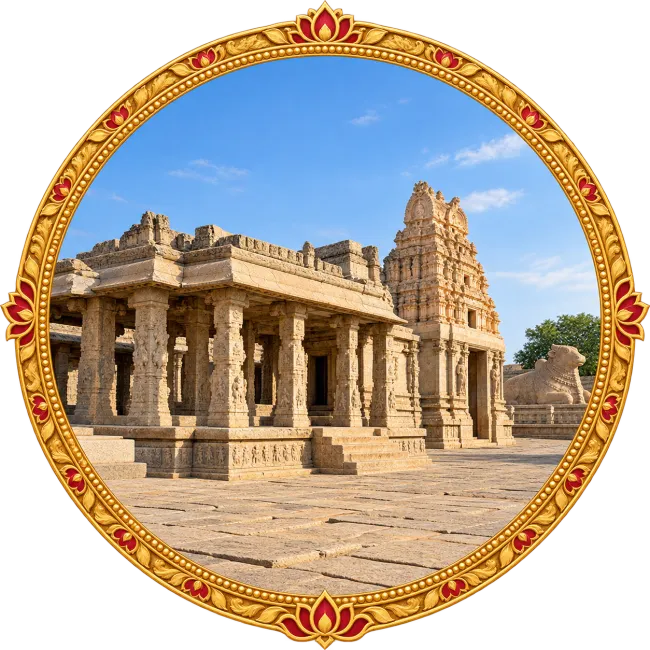
Veerabhadra Temple, Lepakshi
Veerabhadra Temple in Lepakshi, Andhra Pradesh, is one of the finest surviving examples of Vijayanagara architecture. Dedicated to Lord Veerabhadra, a powerful form of Lord Shiva, the temple is famous for its hanging pillar, detailed stone sculptures, colourful ceiling paintings, enormous Nagalinga and unfinished Kalyana Mandapa.
Constructed during the sixteenth century, the temple stands on a low rocky hill called Kurmasaila, meaning the tortoise-shaped hill. Its architecture, legends and artistic details make it an important destination for pilgrims, historians, architects and heritage travellers.
About Veerabhadra Temple
Veerabhadra Temple is situated in Lepakshi village in Sri Sathya Sai district of Andhra Pradesh. The principal deity is Lord Veerabhadra, the fierce warrior form of Lord Shiva.
The temple was constructed during the Vijayanagara period and contains some of the finest murals and sculptures created under the empire. Every hall, pillar and ceiling reflects the skill of the artists and architects of that era.
The temple complex contains several important features, including:
- The hanging pillar
- An enormous monolithic Nagalinga
- An unfinished Kalyana Mandapa
- Vijayanagara-period ceiling paintings
- A large footprint traditionally associated with Goddess Sita
- Shrines dedicated to Shiva, Vishnu and other deities
- A giant monolithic Nandi situated near the temple
The complex is both an active place of worship and a protected historical monument. Visitors should therefore observe temple customs while also respecting the ancient artwork.
When and Who Built Veerabhadra Temple?
Veerabhadra Temple was built in 1530 during the reign of Vijayanagara emperor Achyuta Deva Raya. Its construction is primarily credited to two brothers, Virupanna Nayaka and Viranna.
Virupanna served as a governor and royal official under the Vijayanagara Empire. The brothers were devoted followers of Lord Veerabhadra and commissioned the temple on the rocky Kurmasaila Hill.
Artisans of the Vijayanagara Empire created the temple’s carved pillars, expansive halls, murals and sculptures. The temple displays the mature architectural style that flourished during the sixteenth century.
Although most of the complex was completed, the Kalyana Mandapa remained unfinished. Its incomplete pillars and uncarved sections are connected with one of Lepakshi’s most dramatic historical legends.
Story of Virupanna Nayaka
According to local tradition, Virupanna Nayaka used funds from the royal treasury to construct and expand the temple while Emperor Achyuta Deva Raya was away from the region.
When the emperor learned that treasury funds had been used without formal permission, he ordered that Virupanna be punished by removing his eyes.
After hearing the order, Virupanna is said to have removed his own eyes and thrown them against a wall of the temple. Two reddish marks on one of the walls are traditionally associated with this event.
The unfinished Kalyana Mandapa is also connected with the legend. Construction is believed to have stopped after Virupanna’s punishment, leaving the ceremonial marriage hall incomplete.
The story is part of Lepakshi’s local tradition and adds a powerful human dimension to the history of the temple.
Meaning of the Name Lepakshi
One of the most popular legends about Lepakshi is associated with the Ramayana.
When Ravana abducted Goddess Sita, the great bird Jatayu attempted to rescue her. Ravana attacked Jatayu and severely wounded him. Lord Rama later found the injured bird at this location.
According to tradition, Rama compassionately said, “Le Pakshi,” meaning “Rise, bird” in Telugu. The expression eventually became associated with the name Lepakshi.
The story connects the village with Jatayu’s devotion and sacrifice. Images and references to the Ramayana can be found throughout the cultural traditions of the region.
Lord Veerabhadra
Lord Veerabhadra is a powerful form of Shiva. His origin is described in the story of Daksha Yajna.
Daksha organised a grand sacrifice but deliberately refused to invite his daughter Sati and her husband, Lord Shiva. Sati attended the ceremony despite Shiva’s warning. When Daksha insulted Shiva, Sati could not tolerate the humiliation and sacrificed herself in the sacred fire.
Overcome with grief and anger, Shiva created Veerabhadra from a lock of his hair. Veerabhadra entered the sacrificial ground, destroyed the ceremony and punished Daksha.
Veerabhadra represents divine justice, courage, protection and the destruction of arrogance. Devotees worship him for strength, freedom from fear and victory over obstacles.
Religious Significance
The temple is an important centre of Shaivite worship. Lord Veerabhadra is believed to protect devotees from danger, enemies and negative influences.
People visit the temple to pray for:
- Courage and mental strength
- Protection from negative forces
- Victory over difficulties
- Success in professional life
- Relief from fear and anxiety
- Family peace and prosperity
- A suitable marriage
- Marital harmony
- Good health
- Spiritual discipline
The incomplete Kalyana Mandapa and other marriage-related sculptures also make the temple meaningful for devotees praying for marriage and family welfare.
Main Deities and Shrines
Lord Veerabhadra
The principal deity is Lord Veerabhadra, represented in a powerful warrior form. He is depicted with weapons and ornaments, reflecting his role as a divine protector.
Lord Shiva
The temple complex contains various representations of Shiva, including the large Nagalinga sculpture and other sacred Lingams.
Goddess Bhadrakali
Goddess Bhadrakali, the divine consort of Veerabhadra, is worshipped as a protective form of Shakti.
Other deities and sacred figures represented within the complex include:
- Lord Ganesha
- Goddess Parvati
- Lord Vishnu
- Goddess Lakshmi
- Lord Hanuman
- Dakshinamurthy
- Nandi
- Celestial dancers and musicians
- Saints and divine guardians
Many deities are represented through sculptures, murals and carved pillars rather than separate shrines.
Architecture of Veerabhadra Temple
Veerabhadra Temple is an outstanding example of Vijayanagara architecture. Constructed mainly from granite, the temple combines strong structural design with highly detailed decorative work.
The complex is divided into several sections, including the Mukha Mandapa, Ardha Mandapa, Garbhagriha, Natya Mandapa and Kalyana Mandapa.
Kurmasaila Hill
The temple stands on a rocky hill resembling the back of a tortoise. It is consequently called Kurmasaila, meaning Tortoise Hill.
The elevated rocky foundation provides structural stability and gives the temple a commanding position over the surrounding landscape.
Natya Mandapa
The Natya Mandapa, or dance hall, is supported by beautifully carved pillars. Sculptures show musicians, dancers, gods, sages and celestial beings.
Each pillar has distinctive designs, demonstrating the skill and imagination of Vijayanagara artisans.
Hanging Pillar
The hanging pillar is the most famous architectural feature of Lepakshi Temple. It does not rest completely on the ground, leaving a visible gap beneath one side.
Visitors traditionally pass a thin cloth or sheet of paper beneath it to observe the gap. The pillar is part of the structural arrangement of the hall and demonstrates the advanced engineering techniques used by the temple builders.
Visitors should not push, strike or otherwise interfere with the pillar. Its preservation is essential because it forms part of a centuries-old structure.
Nagalinga
The temple contains a magnificent monolithic Nagalinga. A large seven-hooded serpent rises behind and curves protectively over a Shiva Lingam.
According to local tradition, the sculpture was created from a single granite rock by artisans while they waited for their meal to be prepared. The scale and balance of the sculpture make it one of the most photographed features of Lepakshi.
Unfinished Kalyana Mandapa
The Kalyana Mandapa was designed for the ceremonial marriage of Lord Shiva and Goddess Parvati. Its pillars contain images of gods, sages and participants associated with the divine wedding.
The hall was never completed. Some pillars have detailed carvings, while others remain unfinished, allowing visitors to understand different stages of traditional stonework.
Ceiling Paintings
The temple’s ceiling contains important Vijayanagara murals created using natural colours. These paintings depict Shiva, Parvati, Veerabhadra, divine attendants, royal figures, musicians and mythological scenes.
A large painting of Lord Veerabhadra is one of the most prominent artworks in the complex. The murals are valuable records of Vijayanagara clothing, ornaments, hairstyles and artistic traditions.
Veerabhadra Temple Timings
The regular temple schedule is:
The temple normally remains accessible during the afternoon, except when the sanctum is briefly unavailable for Naivedyam or another ritual. Festival schedules may differ from the regular daily routine.
Morning Puja and Harathi
The temple opens at 6:00 AM with the ceremonial opening of the sanctum. Suprabhata prayers are followed by morning Abhishekam and Alankaram.
During Abhishekam, the deity is worshipped with sacred water and other permitted offerings. The idol is then decorated with flowers, garments and ornaments.
Morning Puja and Harathi are performed at 7:00 AM. The best morning darshan period is from 7:00 AM to 10:00 AM, when the weather is pleasant and the temple receives natural light.
Morning light also provides the best conditions for observing the sculptures and ceiling paintings without rushing.
Madhyahna Puja
Madhyahna Puja and Naivedyam are performed from 12:30 PM to 1:00 PM. Food is ceremonially offered to Lord Veerabhadra, accompanied by traditional mantras and Harathi.
Access to the inner sanctum may be paused during the offering. Visitors can continue observing the outer halls and architectural features while waiting.
Evening Puja and Harathi
Evening Puja and Deepa Harathi are performed at 5:30 PM. Lamps, incense and flowers are offered to Lord Veerabhadra while bells and sacred chants create a devotional atmosphere.
The best evening darshan period is from 4:00 PM to 5:30 PM. Visitors should complete their exploration of the complex before 6:00 PM because the temple closes after the final darshan.
Sita’s Footprint
A large footprint-shaped impression can be seen on the temple floor. Local tradition identifies it as the footprint of Goddess Sita.
The depression often contains water. Devotees regard it as sacred and offer prayers nearby. The footprint adds to Lepakshi’s association with the Ramayana and the story of Jatayu.
Visitors should avoid stepping on or touching the sacred impression unnecessarily.
Lepakshi Nandi
A massive monolithic Nandi is situated approximately one kilometre from the main temple. Carved from a single granite rock, it is one of India’s largest monolithic Nandi sculptures.
The Nandi faces in the direction of the temple’s Nagalinga. It is decorated with carved necklaces, bells and ornaments.
The Nandi is located in an open pavilion and can be visited before or after the main temple. Morning and late afternoon provide comfortable conditions for viewing the sculpture.
Major Festivals
Maha Shivaratri
Maha Shivaratri is the most important festival celebrated at Veerabhadra Temple. Special Abhishekam, Archana, Rudra chanting and night worship are performed.
Veerabhadra Swamy Festival
Special worship is offered to Lord Veerabhadra during the annual temple festival. Processions and religious ceremonies may be organised according to the local calendar.
Kalyanotsavam
The divine wedding of Shiva and Parvati is celebrated through traditional ceremonies. The unfinished Kalyana Mandapa provides a meaningful setting connected with the divine marriage.
Karthika Masam
Karthika month is considered highly auspicious for Shiva worship. Devotees light lamps, offer bilva leaves and visit the temple on Mondays.
Other important occasions include Pradosham, Ugadi, Sankranti and monthly Shivaratri.
Sevas and Offerings
Available worship services may include:
- Abhishekam
- Archana
- Rudrabhishekam
- Bilvarchana
- Special Harathi
- Kalyanotsavam
- Vahana Puja
- Deepa Seva
- Annadanam donation
- Festival sponsorship
Devotees may offer flowers, coconuts, fruits, incense, bilva leaves and sacred lamps. Worship materials should be purchased from authorised sellers or counters.
Prasadam
Sacred ash, kumkum and other blessed items may be distributed after worship. Food prasadam may be available according to the daily temple arrangements and festival schedule.
Visitors should accept prasadam respectfully and maintain cleanliness within the heritage complex.
Dress Code and Entry Rules
Visitors should wear clean and modest clothing. Traditional Indian attire is recommended but is not compulsory for general entry.
Men may wear a dhoti, kurta-pyjama or full-length trousers with a shirt. Women may wear a saree, salwar kameez or another modest outfit.
Footwear must be removed before entering the main temple area. Photography may be permitted in selected exterior areas, but visitors should follow all restrictions near the sanctum and murals.
Do not touch the ancient paintings, scratch the stone surfaces or lean against delicate sculptures. Flash photography should be avoided near the murals.
Entry Fee and Visit Duration
General entry and darshan are normally available without an entry fee. Charges may apply to special pujas or authorised guided services.
A complete visit requires 1½ to 2 hours. Architecture enthusiasts may require 2½ hours to study the murals, hanging pillar, Kalyana Mandapa and other sculptures.
Visitors should also reserve 20 to 30 minutes for the giant Nandi situated outside the main complex.
Best Time to Visit
October to February is the most comfortable season for visiting Lepakshi. The weather during these months is suitable for exploring the stone complex.
The best morning period is from 7:00 AM to 10:00 AM. The best evening period is from 4:00 PM to 5:30 PM.
Afternoons can become hot because much of the complex is constructed from exposed granite. Visitors should carry drinking water and sun protection.
How to Reach Veerabhadra Temple
By Air
Kempegowda International Airport in Bengaluru is the nearest major airport. The temple can be reached from the airport by taxi or private vehicle.
By Train
Hindupur Railway Station is the nearest convenient railway station. It has connections with Bengaluru, Anantapur and other regional destinations. Lepakshi can be reached from Hindupur by bus, taxi or auto-rickshaw.
By Road
Lepakshi is well connected by road with Bengaluru, Hindupur and Anantapur. It is approximately 15 kilometres from Hindupur and can be reached using state highways and local roads.
Government buses and private vehicles operate between Hindupur and Lepakshi. Travellers from Bengaluru can complete the journey as a day trip.
Nearby Places to Visit
Visitors may also explore:
- Lepakshi Monolithic Nandi
- Penukonda Fort
- Hindupur
- Puttaparthi
- Vidurashwatha
- Gudibande Fort
- Nandi Hills
- Bhoga Nandeeshwara Temple
- Anantapur
- Thimmamma Marrimanu
Visitor Guidelines
Visit early in the morning to observe the paintings and sculptures comfortably. The stone floor may become hot during the afternoon, so suitable socks can be helpful after removing footwear.
Do not attempt to move objects beneath the hanging pillar forcibly. Avoid touching the murals because natural oils and moisture from hands can damage the ancient colours.
A local authorised guide can help explain the iconography, inscriptions and architectural features. Avoid unauthorised activities that could damage the monument.
Complete darshan first and then explore the Natya Mandapa, Kalyana Mandapa, Nagalinga and other sections. Visit the monolithic Nandi before leaving Lepakshi.
Conclusion
Veerabhadra Temple at Lepakshi is a remarkable combination of spirituality, history, engineering and art. Built in 1530 by Virupanna Nayaka and Viranna during the reign of Achyuta Deva Raya, it represents the finest traditions of Vijayanagara architecture.
The hanging pillar, enormous Nagalinga, unfinished Kalyana Mandapa, sacred footprint, ceiling paintings and monolithic Nandi make Lepakshi a unique heritage destination. Whether one visits for worship, history or architecture, the temple offers an unforgettable experience of South India’s artistic and spiritual legacy.