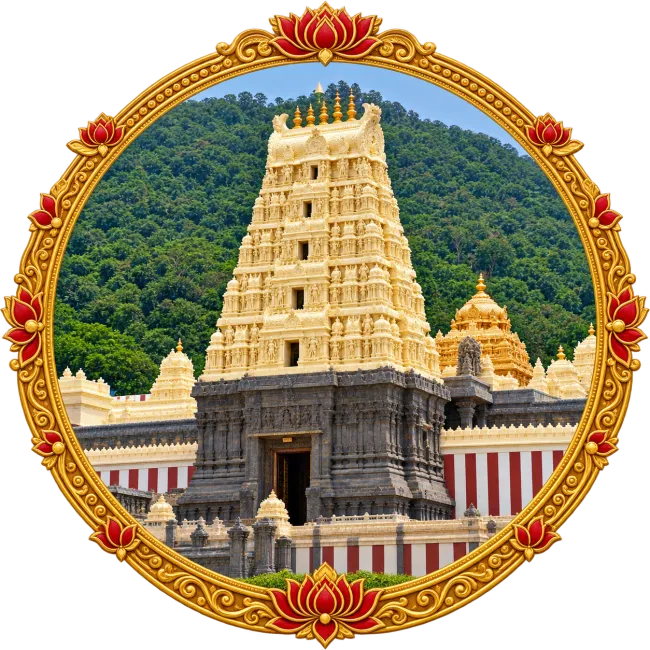
Varaha Lakshmi Narasimha Temple, Simhachalam
Varaha Lakshmi Narasimha Temple at Simhachalam in Visakhapatnam, Andhra Pradesh, is one of the most revered Vaishnavite temples in South India. The temple is dedicated to Lord Vishnu in a unique combined form of Varaha, the boar incarnation, and Narasimha, the man-lion incarnation. The presiding deity is worshipped as Sri Varaha Lakshmi Narasimha Swamy.
Located on the forested Simhachalam Hill, the temple is known for its ancient history, Kalinga-style architecture, detailed stone carvings and distinctive sandalwood-paste worship. Throughout most of the year, the main deity remains completely covered with sandalwood paste. Devotees can see the original form only once a year during the famous Chandanotsavam festival.
About Varaha Lakshmi Narasimha Temple
Varaha Lakshmi Narasimha Temple, also known as Simhachalam Temple, is located on Simhadri Hill in Visakhapatnam. The Sanskrit word “Simha” means lion, while “Achala” means an immovable hill. Simhachalam can therefore be interpreted as the Hill of the Lion.
Lord Vishnu is worshipped here in a combined form that brings together Varaha and Narasimha. The deity displays features traditionally associated with both incarnations. Goddess Lakshmi is worshipped alongside the Lord, giving the deity the complete name Sri Varaha Lakshmi Narasimha Swamy.
The temple is regarded as one of the most important Narasimha temples in Andhra Pradesh. It is also one of the 32 Narasimha Kshetras traditionally associated with the worship of Lord Narasimha.
The main deity is covered with sandalwood paste to calm the intense energy of Narasimha. With the thick sandalwood covering, the deity appears like a Shiva Lingam. On Akshaya Tritiya, the covering is removed and devotees receive Nija Roopa Darshan of the original form.
When and Who Built Simhachalam Temple?
The spiritual history of Simhachalam Temple is associated with the ancient story of Prahlada and Lord Narasimha. The earliest surviving inscriptions in the complex date from the eleventh century.
An inscription connected with the Chola ruler Kulottunga Chola I indicates that the shrine was established as an important religious centre by the late eleventh century. The temple was later expanded under the Eastern Ganga rulers of Kalinga.
King Narasimhadeva I of the Eastern Ganga dynasty made major architectural contributions during the thirteenth century. The central shrine, stone halls and many features of the present complex reflect the Kalinga and Eastern Ganga styles.
Later rulers of the Gajapati and Vijayanagara dynasties supported the temple. Vijayanagara emperor Krishnadevaraya visited Simhachalam in 1516 and made valuable offerings after his military victories. Inscriptions recording his visit and donations remain an important part of the temple’s history.
The present structure, therefore, represents contributions made by the Cholas, Eastern Gangas, Gajapatis and Vijayanagara rulers.
Legend of Prahlada and Narasimha
According to Hindu mythology, the demon king Hiranyakashipu obtained a boon that he could not be killed by a human or animal, indoors or outdoors, during the day or night, on the earth or in the sky, and by any weapon.
Believing himself invincible, Hiranyakashipu demanded that everyone worship him. His son Prahlada, however, remained a devoted follower of Lord Vishnu.
Hiranyakashipu subjected Prahlada to numerous punishments, but Lord Vishnu protected him each time. Finally, the demon king challenged Prahlada and struck a pillar, asking whether Vishnu was present within it.
Lord Vishnu emerged from the pillar as Narasimha—a form that was neither fully human nor fully animal. At twilight, which was neither day nor night, Narasimha placed Hiranyakashipu on his lap at the threshold and destroyed him with his claws.
After the demon’s death, Prahlada requested Narasimha to appear in a peaceful form combined with Varaha. The Lord manifested as Varaha Narasimha, and Prahlada is believed to have established the deity at Simhachalam.
Legend of Pururava and Urvashi
Another important temple legend involves King Pururava and the celestial maiden Urvashi. During their journey through the region, they rested near Simhachalam Hill.
Lord Vishnu appeared in Pururava’s dream and revealed that a divine image was buried beneath the earth. The king found the deity and restored its worship.
According to the divine instructions, the idol was to remain covered with sandalwood paste throughout the year. The covering would be removed only once annually so devotees could see the Lord’s original form.
This tradition continues today. The deity remains covered with sandalwood paste, except during Chandanotsavam on Akshaya Tritiya.
Unique Form of the Deity
The principal deity of Simhachalam Temple is different from conventional representations of Narasimha. The sacred image combines features of three divine forms:
- The head represents Varaha
- The torso has a human form
- The tail represents Narasimha’s leonine nature
The deity is shown in a standing posture, accompanied by Goddess Lakshmi. Because the original image is covered with sandalwood paste throughout most of the year, visitors usually see a smooth, rounded form resembling a Shiva Lingam.
The combination of Varaha and Narasimha represents both protection and the destruction of evil. Varaha rescued the earth from the cosmic waters, while Narasimha protected Prahlada and defeated Hiranyakashipu.
Religious Significance
Simhachalam Temple is especially important for devotees seeking protection from fear, enemies, illness and negative influences. Lord Narasimha is believed to respond quickly to sincere prayers and protect those who approach him with devotion.
People visit the temple to pray for:
- Protection from danger and negative energy
- Courage and mental strength
- Recovery from illness
- Relief from debts and financial difficulties
- Success in education and employment
- Family peace and prosperity
- A suitable marriage
- Blessings for children
- Victory over legal or professional difficulties
- Spiritual discipline and devotion
The temple also attracts devotees who perform special rituals for planetary difficulties and family welfare.
Main Deities and Shrines
Sri Varaha Lakshmi Narasimha Swamy
The principal deity is Lord Vishnu in the combined form of Varaha and Narasimha. The idol remains covered with sandalwood paste except during Nija Roopa Darshan.
Goddess Lakshmi
Goddess Lakshmi is worshipped as the divine consort of Varaha Narasimha. Devotees seek her blessings for prosperity, family welfare and abundance.
Other important shrines and sacred figures within the complex include:
- Lord Ganesha
- Sri Tripurantaka
- Lord Vishnu’s processional deities
- Goddess Andal
- Sri Ramanujacharya
- Alwar saints
- Hanuman
- Garuda
- Bhairava
- Kshetrapalaka deities
The temple follows Vaishnavite traditions and contains several sculptures and inscriptions connected with different historical periods.
Architecture of Simhachalam Temple
Simhachalam Temple presents a beautiful combination of Kalinga, Chola and Vijayanagara architectural traditions. Its hilltop location, stone structures and sculpted halls make it one of Andhra Pradesh’s most impressive heritage temples.
Sanctum and Vimana
The sanctum has a square plan and is crowned by a beautifully designed tower. The stone walls are decorated with floral patterns, divine figures and mythological scenes.
The main deity is installed within the sanctum, where sandalwood paste, flowers, silk garments and ornaments are offered during worship.
Natya Mandapam
The Natya Mandapam contains intricately carved pillars depicting dancers, musicians, animals, deities and scenes from Hindu mythology. The artistic details demonstrate the craftsmanship of the Eastern Ganga and Vijayanagara periods.
Kalyana Mandapam
The Kalyana Mandapam is used for ceremonial worship and the divine wedding festival. Its stone pillars contain elaborate designs and sculptural representations.
Temple Pillars and Sculptures
The temple is known for its beautifully carved pillars. Some display lions, elephants, horses, celestial beings and mythological creatures. The complex also contains numerous inscriptions recording donations and royal visits.
Kappa Stambham
Kappa Stambham is a sacred pillar within the temple complex. Devotees embrace or touch the pillar while praying for children, family welfare and the fulfilment of wishes.
Varaha Lakshmi Narasimha Temple Timings
The regular darshan and worship schedule is:
Darshan is paused during Rajabhogam, Madhyahna Puja and selected evening rituals. Timings can be reorganised during Chandanotsavam, Narasimha Jayanti, Kalyanotsavam and other important festivals.
Morning Puja and Harathi
The temple opens at 4:00 AM for Suprabhata Seva. Sacred hymns are recited to awaken the deity, followed by morning Aradhana, decoration and internal rituals.
Public darshan begins at 7:00 AM after the completion of the principal morning ceremonies. Morning Harathi is offered when darshan begins.
The best morning darshan time is from 7:00 AM to 10:30 AM. Visitors who wish to avoid long queues should arrive on a weekday before 8:00 AM.
At 11:30 AM, public darshan is suspended for Rajabhogam and Madhyahna Puja. Food offerings are presented to the deity, and the sanctum remains unavailable for general darshan until 12:30 PM.
Evening Puja and Harathi
Afternoon darshan continues from 12:30 PM to 2:30 PM. The temple then observes a ritual break from 2:30 PM to 3:30 PM.
Evening darshan begins at 3:30 PM. The best evening period is from 4:30 PM to 6:30 PM.
Evening Harathi and Deepa Aradhana are performed at 7:00 PM. General darshan remains suspended until 7:30 PM while the ritual is completed. The final darshan session continues from 7:30 PM to 8:30 PM.
Ekanta Seva is performed at 8:30 PM, after which the temple closes.
Chandanotsavam and Nija Roopa Darshan
Chandanotsavam is the most famous annual festival at Simhachalam Temple. It is celebrated on Akshaya Tritiya.
On this day, the sandalwood covering is removed from the main deity, allowing devotees to see the original form of Varaha Lakshmi Narasimha Swamy. This special appearance is known as Nija Roopa Darshan.
The original idol remains visible only for a limited period. After the special rituals, fresh layers of sandalwood paste are applied to the deity.
A very large number of devotees visit during Chandanotsavam. Special queues, traffic arrangements and darshan schedules are implemented for the occasion.
Major Festivals
Narasimha Jayanti
Narasimha Jayanti celebrates the appearance of Lord Vishnu as Narasimha. Special Abhishekam, Homam, Archana and processions are organised.
Kalyanotsavam
The divine wedding of Varaha Narasimha and Goddess Lakshmi is celebrated with traditional rituals. Married couples attend for harmony and prosperity, while unmarried devotees pray for a suitable marriage.
Chandanotsavam
Celebrated on Akshaya Tritiya, Chandanotsavam provides the annual Nija Roopa Darshan of the deity.
Vaikuntha Ekadashi
Special darshan and Vaishnavite rituals are arranged on Vaikuntha Ekadashi. Devotees observe fasting and chant the names of Lord Vishnu.
Rathotsavam
During Rathotsavam, the processional deities are taken through the temple streets in a decorated chariot.
Other celebrations include Krishna Janmashtami, Rama Navami, Deepavali, Ugadi, Holi and festivals dedicated to the Alwar saints.
Sevas and Offerings
Devotees can participate in various temple sevas, including:
- Suprabhata Seva
- Sahasranama Archana
- Ashtottara Archana
- Special Darshan
- Nitya Kalyanotsavam
- Garuda Seva
- Swarna Pushparchana
- Laksha Tulasi Puja
- Sudarshana Narasimha Homam
- Vahana Puja
- Chandanam offering
- Annadanam donation
Tulasi leaves, flowers, coconuts, fruits, silk garments and sandalwood are important offerings. Tickets for sevas should be purchased only from authorised counters.
Prasadam and Annadanam
Laddu and pulihora are commonly available as prasadam. Devotees may also receive tulasi leaves, sandalwood paste and other blessed items after worship.
The temple provides annadanam at designated locations. Pilgrims should follow the announced meal timings and maintain cleanliness in the dining areas.
Sandalwood prasadam is considered especially sacred because of its association with the main deity.
Dress Code and Entry Rules
Visitors should wear clean and modest clothing. Traditional Indian attire is recommended, particularly for special sevas.
Men may wear a dhoti, kurta-pyjama or full-length trousers with a shirt. Women may wear a saree, salwar kameez, half-saree or another modest outfit.
Footwear must be removed before entering the temple. Mobile phones, cameras and large bags may be restricted within the inner complex. Photography and videography are prohibited near the sanctum.
Tobacco, alcohol, leather articles and non-vegetarian food must not be carried inside the temple.
Entry Fee and Visit Duration
General darshan is available without an entry fee. Special darshan, Nitya Kalyanotsavam, Archana, Homam and other sevas require separate tickets.
A regular visit requires 1½ to 2 hours. Visitors attending a special seva should keep 2½ to 3 hours available.
During Chandanotsavam, Narasimha Jayanti, weekends and public holidays, waiting times can be significantly longer.
Best Time to Visit
October to March is the most comfortable time to visit Simhachalam. The weather is suitable for temple darshan and exploring Visakhapatnam.
For a peaceful visit, arrive between 7:00 AM and 9:00 AM on a weekday. Evening darshan between 4:30 PM and 6:30 PM is also convenient.
Chandanotsavam provides the rare opportunity to see the original deity, but visitors should be prepared for exceptionally large crowds.
How to Reach Simhachalam Temple
By Air
Visakhapatnam International Airport is the nearest airport. Taxis, buses and app-based cabs are available from the airport to Simhachalam.
By Train
Simhachalam Railway Station is the closest local station. Visakhapatnam Junction is the nearest major railway station and has connections with Hyderabad, Vijayawada, Chennai, Bhubaneswar, Kolkata and other cities.
By Road
Simhachalam is well connected with central Visakhapatnam by city buses, taxis and auto-rickshaws. Vehicles can travel up the hill using the designated road. Devotees may also climb the traditional steps.
Nearby Places to Visit
Visitors may also explore:
- Simhachalam Hill viewpoints
- Varaha Pushkarini
- Gangadhara Waterfall
- Kailasagiri
- Ramakrishna Beach
- INS Kursura Submarine Museum
- Sri Kanaka Mahalakshmi Temple
- Ross Hill Church
- Yarada Beach
- Thotlakonda Buddhist Complex
- Borra Caves
- Araku Valley
Visitor Guidelines
Check the darshan intervals before joining the queue because public darshan is suspended during Rajabhogam and selected temple rituals.
Arrive before the reporting time for Kalyanotsavam, Homam or another booked seva. Keep the ticket and identification safely until the ritual is completed.
Senior citizens and families with children should choose weekday mornings. During Chandanotsavam, follow the special queue, transport and security arrangements announced by the temple administration.
Deposit footwear, mobile phones and large bags only at authorised counters. Do not depend on unauthorised guides or agents for darshan and seva tickets.
Conclusion
Varaha Lakshmi Narasimha Temple at Simhachalam is a powerful centre of Vaishnavite worship and an architectural treasure of Andhra Pradesh. Its unique combined deity of Varaha and Narasimha, ancient legends, sandalwood-covered idol and annual Nija Roopa Darshan make it different from other Narasimha temples.
The temple’s historic Kalinga architecture, peaceful hilltop environment and traditional rituals attract devotees from across India. A visit to Simhachalam offers an opportunity to seek courage, protection, prosperity and the compassionate blessings of Sri Varaha Lakshmi Narasimha Swamy.