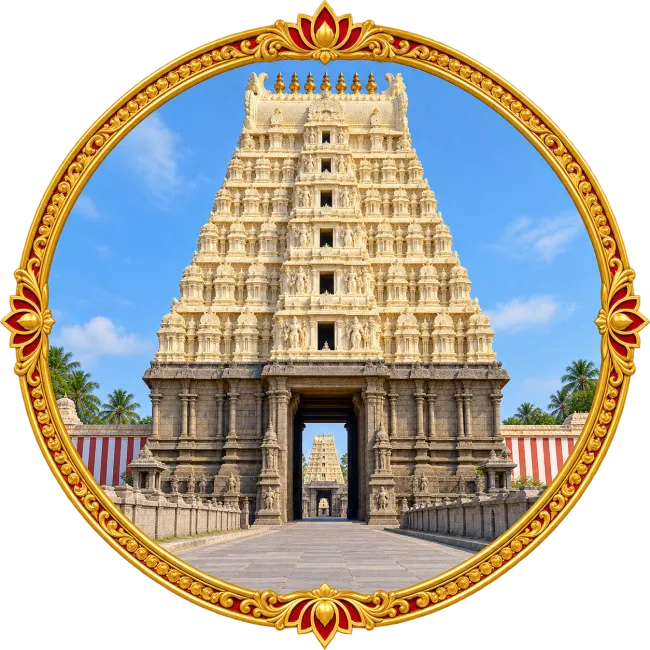
Varadharaja Perumal Temple, Kanchipuram
Visit Varadharaja Perumal Temple in Kanchipuram, one of South India’s most revered Vishnu temples and an important Divya Desam. Located on the sacred Hastigiri Hill, the temple is dedicated to Lord Vishnu as Varadharaja Perumal—the king who grants blessings and fulfils the righteous wishes of devotees.
The temple is famous for its Chola and Vijayanagara architecture, magnificent stone Mandapams, Garuda Seva, golden and silver lizard images and the sacred Athi Varadar deity brought out for public worship once every 40 years.
About Varadharaja Perumal Temple
Varadharaja Perumal Temple is located in Vishnu Kanchi, the Vaishnava section of Kanchipuram, Tamil Nadu. It is also known as:
- Sri Varadharaja Perumal Temple
- Devarajaswamy Temple
- Hastigiri Temple
- Perarulalan Temple
The presiding deity is Lord Vishnu, worshipped as Varadharaja Perumal or Perarulalan. Goddess Lakshmi is worshipped separately as Perundevi Thayar.
The name Varadharaja means:
- Varada means the giver of boons.
- Raja means king.
Varadharaja therefore means “the king who grants blessings.”
The temple is one of the 108 Divya Desams praised by the Alvar saints and one of the principal Vishnu temples of the Sri Vaishnava tradition.
History of Varadharaja Perumal Temple
The temple’s religious traditions are ancient, but much of the present stone structure developed during the Chola period.
Major construction is associated with the Chola rulers during the 11th century. Rajendra Chola and later Chola kings contributed shrines, enclosures, land and funds for daily worship.
The temple was subsequently expanded by:
- Later Cholas
- Pandya rulers
- Vijayanagara kings
- Nayaka chiefs
The Vijayanagara rulers made some of the most significant architectural contributions. They constructed large Mandapams, carved pillars, festival halls and elaborate corridors.
Kings Achyuta Deva Raya and other Vijayanagara rulers supported festivals and temple administration.
Inscriptions in Tamil and Telugu record donations, land grants, lamps, jewellery and arrangements for daily rituals.
The temple became an important centre of Sri Vaishnava learning and remains closely associated with philosophers such as Sri Ramanujacharya and Vedanta Desika.
Varadharaja Perumal Temple as a Divya Desam
Varadharaja Perumal Temple is one of the 108 Divya Desams celebrated in the Nalayira Divya Prabandham.
Several Alvar saints praised the deity, including:
- Bhoothathalvar
- Peyalvar
- Tirumangai Alvar
- Nammalvar
Within Sri Vaishnava tradition, Kanchipuram is called Perumal Koil, meaning the supreme temple of Lord Vishnu.
The three most important Sri Vaishnava centres are traditionally identified as:
- Koil – Srirangam
- Tirumalai – Tirumala
- Perumal Koil – Kanchipuram
Legend of Lord Brahma’s Yajna
According to temple mythology, Lord Brahma wished to perform an Ashwamedha Yajna at Kanchipuram.
Goddess Saraswati became displeased because Brahma began the ceremony without her. She took the form of the rapidly flowing Vegavati River and attempted to stop the Yajna.
Lord Vishnu protected the sacred ceremony and allowed Brahma to complete it successfully.
At the conclusion of the Yajna, Lord Vishnu appeared from the sacrificial fire in a radiant form. Brahma worshipped him as Varadharaja—the Lord who grants blessings.
The principal deity is therefore associated with divine fire, protection and the successful completion of sacred duty.
Legend of Hastigiri Hill
The main shrine stands upon a small hill known as Hastigiri.
The name is formed from:
- Hasti, meaning elephant
- Giri, meaning hill
According to tradition, Lord Indra’s divine elephant Airavata worshipped Lord Vishnu at this location. Airavata took the form of a hill so that it could permanently support the Lord.
The sanctum of Varadharaja Perumal stands upon this elephant-shaped sacred hill.
Religious Significance of Varadharaja Perumal Temple
Devotees worship Varadharaja Perumal for wisdom, prosperity and fulfilment of righteous wishes.
People visit the temple for:
- Success in education
- Career and business growth
- Family peace and prosperity
- Blessings for marriage
- Health and well-being of children
- Recovery from illness
- Protection from obstacles
- Relief from planetary difficulties
- Safe travel
- Spiritual progress
- Devotion to Lord Vishnu
- Fulfilment of sincere wishes
Perundevi Thayar is specially worshipped for marriage, children, compassion and financial stability.
Main Deity of Varadharaja Perumal Temple
The principal deity is Lord Varadharaja Perumal in a majestic standing posture.
The deity holds the traditional symbols of Lord Vishnu:
- Sudarshana Chakra
- Panchajanya Shankha
- Kaumodaki Gada
- Padma
The Utsava deity is worshipped as Perarulalan, meaning the Lord of abundant compassion.
The deity is decorated with silk garments, flower garlands, Tulsi, gold ornaments and traditional crowns.
Perundevi Thayar Shrine
Goddess Lakshmi is worshipped as Perundevi Thayar in a separate shrine.
Devotees generally receive her blessings before or after worshipping Varadharaja Perumal.
Women commonly perform special Archana for:
- Marriage
- Safe pregnancy
- Children
- Family harmony
- Financial prosperity
- Health
- Relief from household difficulties
Athi Varadar
Athi Varadar is one of the temple’s most sacred and remarkable traditions.
The deity is carved from the wood of an Athi or sacred fig tree. It is preserved inside a silver-lined chamber beneath the water of Anantha Saras, the temple tank.
Once every 40 years, the deity is brought out and displayed for public worship for 48 days.
During the 48-day period:
- The deity is worshipped in a reclining posture for 24 days.
- The deity is worshipped in a standing posture for 24 days.
The most recent Athi Varadar festival was held in 2019. According to the 40-year tradition, the next public appearance is expected in 2059.
The festival attracts millions of devotees from across the world.
Golden and Silver Lizards
The temple contains famous golden and silver lizard images installed upon the ceiling of a corridor.
According to legend, two disciples of Sage Gautama accidentally allowed a lizard to fall into water prepared for their teacher’s Puja.
Sage Gautama cursed them to become lizards. After they performed penance and received divine grace, they were freed from the curse.
Indra is believed to have installed golden and silver representations of the lizards at the temple.
Devotees touch the lizard images and pray for:
- Freedom from sins
- Relief from skin diseases
- Protection from harmful creatures
- Removal of past mistakes
- Good health
Access to the lizard shrine may require a separate ticket.
Architecture of Varadharaja Perumal Temple
Varadharaja Perumal Temple is an extensive Dravidian complex developed by several South Indian dynasties.
Important architectural features include:
- Tall entrance Gopurams
- Multiple Prakarams
- Hastigiri Hill
- Hundred-Pillared Hall
- Carved stone chains
- Horse and warrior sculptures
- Anantha Saras temple tank
- Perundevi Thayar shrine
- Ancient inscriptions
- Festival Mandapams
- Long stone corridors
- Sculptures depicting Hindu mythology
The Vijayanagara-period pillars are admired for their detailed horses, warriors, Yalis and mythological scenes.
Hundred-Pillared Hall
The Hundred-Pillared Hall is one of the temple’s architectural highlights.
Its pillars contain carvings of:
- Horsemen
- Warriors
- Yalis
- Dance figures
- Deities
- Scenes from Hindu scriptures
Stone chains carved from single blocks demonstrate the skill of Vijayanagara sculptors.
Visitors should not touch or damage the sculptures.
Anantha Saras Temple Tank
The sacred temple tank is known as Anantha Saras. The Athi Varadar deity remains preserved beneath its water.
The tank is also used for important temple festivals and ceremonial worship.
Devotees should not enter the tank or throw offerings into the water without authorization.
Varadharaja Perumal Temple Timings
Festival schedules may differ during Brahmotsavam, Vaikunta Ekadashi and Garuda Seva.
Morning Puja and Deepa Aradhana
The temple opens at 6:00 AM with Vishwaroopa Darshan.
Morning Puja and Deepa Aradhana begin at 6:30 AM. Lord Varadharaja is worshipped with:
- Tulsi leaves
- Flowers
- Sandalwood paste
- Incense
- Lamps
- Fruits
- Naivedyam
- Silk garments
- Vedic chanting
- Divya Prabandham recitation
Kalasanthi Puja is performed at 8:00 AM.
The period between 6:30 AM and 8:30 AM is ideal for peaceful darshan.
Special Archana and Sevas
Special Archana and Sevas are generally conducted between 8:30 AM and 11:00 AM.
Important Sevas may include:
- Sahasranama Archana
- Tulsi Archana
- Thirumanjanam
- Perundevi Thayar Archana
- Sudarshana worship
- Vastra Seva
- Flower garland Seva
- Ghee-lamp offering
- Annadanam
- Festival Ubhayam
Bookings should be made through official counters.
Uchikala Puja
Uchikala Puja is performed at 11:30 AM. Flowers, incense, lamps and Naivedyam are presented before the deity.
The morning session closes at 12:30 PM.
Devotees should enter before 11:45 AM to complete morning darshan.
Evening Puja and Deepa Aradhana
The temple reopens at 3:30 PM.
Sayaraksha Puja and Deepa Aradhana are performed at 6:00 PM. The deity is worshipped with lamps, incense and evening Naivedyam.
Ardha Jama Puja, the final worship of the day, is conducted at 8:00 PM. The temple closes at 8:30 PM.
Major Festivals Celebrated
Vaikasi Brahmotsavam
Vaikasi Brahmotsavam is the temple’s grandest annual festival.
The celebration includes:
- Flag hoisting
- Vahana processions
- Garuda Seva
- Hanumantha Vahana
- Sesha Vahana
- Temple chariot
- Special Alankarams
- Vedic chanting
- Distribution of Prasadam
Garuda Seva
Garuda Seva attracts thousands of devotees. Lord Varadharaja is taken through Kanchipuram upon the Garuda Vahana.
Vaikunta Ekadashi
The Paramapada Vasal is opened, symbolizing entry into Vaikuntha.
Panguni Uthiram
The divine relationship of Lord Vishnu and Goddess Lakshmi is celebrated.
Theppotsavam
The Utsava deity is taken upon a decorated float in the temple tank.
Krishna Jayanti
Lord Krishna’s birth is celebrated with special Puja and devotional programmes.
Rama Navami
Lord Rama’s birth is celebrated through recitation and special worship.
Adhyayana Utsavam
The Nalayira Divya Prabandham is recited during this important Sri Vaishnava festival.
Kanchipuram Idli Prasadam
Varadharaja Perumal Temple is associated with the traditional Kanchipuram Idli.
This temple-style Idli is prepared using ingredients such as:
- Rice
- Urad Dal
- Pepper
- Cumin
- Ginger
- Ghee
- Curry leaves
The preparation is seasoned and steamed in a traditional manner. It is offered to Lord Varadharaja before being distributed as Prasadam.
Availability depends on the temple’s daily programme and designated counters.
Other Offerings and Prasadam
Common offerings include:
- Tulsi garlands
- Flowers
- Fruits
- Coconut
- Butter
- Sugar candy
- Silk garments
- Ghee lamps
- Monetary donations
- Annadanam sponsorship
Temple Prasadam may include:
- Kanchipuram Idli
- Puliyodarai
- Sakkarai Pongal
- Curd rice
- Sundal
- Laddu
- Fruits
Dress Code and Entry Rules
Devotees should wear clean, modest and traditional clothing.
Recommended clothing includes:
- Dhoti, Veshti or full-length trousers for men
- Saree, half-saree, Salwar Kameez or modest clothing for women
- Traditional attire for children
Shorts, sleeveless outfits and revealing clothing should be avoided.
Photography and videography are restricted in inner areas. Mobile phones should remain silent.
Entry into the innermost worship areas follows traditional Hindu temple rules.
Entry Fee and Visit Duration
General darshan is free. Paid special-darshan, lizard-shrine access and Seva tickets may be available.
A regular visit requires two to three hours. Visitors exploring all the Mandapams, Thayar shrine, lizard images and temple tank should keep three to four hours.
During Garuda Seva and Vaikunta Ekadashi, darshan may require several hours.
Visitor Guidelines
- Remove footwear at the designated stand.
- Wear traditional and modest clothing.
- Check Puja timings before joining the queue.
- Follow separate queues for the main deity and lizard shrine.
- Do not enter or pollute Anantha Saras.
- Follow photography restrictions.
- Keep mobile phones silent.
- Use official counters for Sevas and donations.
- Do not purchase access from unauthorized agents.
- Avoid touching ancient sculptures.
- Maintain silence near the sanctum.
- Keep children and elderly devotees under supervision.
- Carry drinking water during hot weather.
- Follow instructions from priests and security personnel.
Best Time to Visit
November to February is the best period for visiting Kanchipuram because the weather remains pleasant.
For peaceful darshan, visit between 6:30 AM and 8:30 AM on a regular weekday.
Evening visitors should arrive between 5:00 PM and 5:30 PM to attend Sayaraksha Puja.
Vaikasi Brahmotsavam and Garuda Seva offer a grand devotional experience but attract large crowds.
How to Reach Varadharaja Perumal Temple
By Air
Chennai International Airport is the nearest major airport, approximately 70–75 kilometres from Kanchipuram.
By Train
Kanchipuram Railway Station is located close to the temple. Trains connect Kanchipuram with Chennai, Chengalpattu, Arakkonam and nearby towns.
By Bus
Regular government and private buses connect Kanchipuram with Chennai, Tirupati, Vellore, Bengaluru and other cities.
By Road
Taxis, auto-rickshaws and private vehicles are available throughout Kanchipuram. Parking may be restricted during major festivals.
Nearby Places to Visit
- Kamakshi Amman Temple
- Ekambareswarar Temple
- Kailasanathar Temple
- Vaikunta Perumal Temple
- Ulagalanda Perumal Temple
- Kumarakottam Murugan Temple
- Kanchi Kamakoti Peetham
- Kachapeshwarar Temple
- Chitragupta Temple
- Pandava Thoothar Perumal Temple
- Kanchipuram Silk Markets
- Vilakkoli Perumal Temple
Conclusion
Varadharaja Perumal Temple is one of South India’s most important Vishnu temples and a celebrated Divya Desam. Its Chola foundations, Vijayanagara architecture and sacred Hastigiri Hill preserve centuries of Sri Vaishnava history.
The Athi Varadar tradition, golden and silver lizards, Garuda Seva and Kanchipuram Idli Prasadam make the temple spiritually and culturally distinctive.
Worshipping Lord Varadharaja is believed to provide wisdom, prosperity and fulfilment of righteous wishes. A visit to the temple offers devotees a profound experience of Kanchipuram’s ancient Vaishnava heritage.