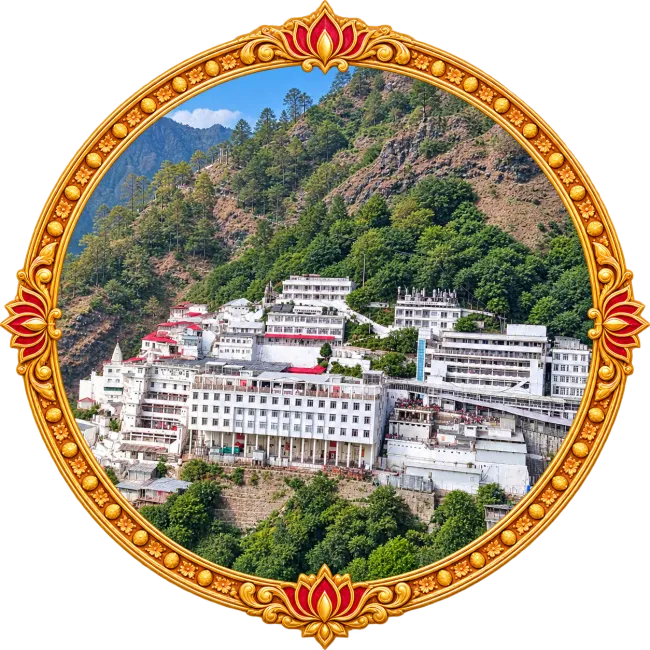
Vaishno Devi Temple, Jammu & Kashmir
Vaishno Devi Temple is one of India’s most revered Hindu pilgrimage sites. Situated in the Trikuta Hills near Katra in the Reasi district of Jammu and Kashmir, the sacred shrine is dedicated to Mata Vaishno Devi, a manifestation of the Divine Mother. Millions of devotees undertake the challenging hill journey every year while chanting “Jai Mata Di.”
Unlike conventional temples, the principal objects of worship here are three natural rock formations known as the Holy Pindies. They represent Maha Kali, Maha Lakshmi and Maha Saraswati—the divine energies associated with power, prosperity and wisdom. The pilgrimage begins from Katra and concludes at the Holy Cave, commonly called Bhawan.
About Vaishno Devi Temple
Vaishno Devi Temple is situated at an altitude of 5,200 feet above sea level. The shrine lies inside a mountain cave in the Trikuta Hills, 12–13 kilometres from the base town of Katra, depending on the route followed.
The sacred cave contains three naturally formed Pindies:
Maha Kali: Represents strength, courage and protection.
Maha Lakshmi: Represents prosperity, well-being and abundance.
Maha Saraswati: Represents wisdom, knowledge and spiritual awareness.
These three forms are collectively worshipped as Mata Vaishno Devi. There is no conventional sculpted idol inside the sanctum. The natural Pindies are continuously washed by sacred water flowing through the cave.
The shrine is managed by the Shri Mata Vaishno Devi Shrine Board, which was constituted in 1986. It manages pilgrimage registration, accommodation, sanitation, security, medical facilities, food services and other arrangements along the route.
History of Vaishno Devi Temple
The exact date of the shrine’s establishment is not recorded because the Holy Cave is an ancient natural formation rather than a temple constructed during a particular historical period. Local tradition connects the discovery of the cave with Pandit Shridhar, a devotee who lived in the region several centuries ago.
Mata Vaishnavi appeared to Pandit Shridhar in the form of a young girl and instructed him to arrange a community feast. Although Shridhar was poor and lacked sufficient resources, he obeyed her instructions. The feast was miraculously completed, and everyone who attended received food.
After the event, the divine girl disappeared. Pandit Shridhar began searching for her and eventually received a vision in which the Goddess showed him the path to the Holy Cave. He reached the cave and discovered the three sacred Pindies. Thereafter, he devoted his life to the worship of Mata Vaishno Devi.
The shrine gradually became an important pilgrimage centre. Its modern management and facilities expanded considerably after the formation of the Shri Mata Vaishno Devi Shrine Board.
Legend of Mata Vaishno Devi
Mata Vaishnavi was created from the combined spiritual energies of Maha Kali, Maha Lakshmi and Maha Saraswati. She was born to uphold righteousness and guide humanity towards devotion and spiritual discipline.
While performing penance, Mata Vaishnavi attracted the attention of Bhairon Nath, a tantric ascetic. Bhairon Nath followed her despite repeated warnings. The Goddess travelled through the Trikuta Hills and stopped at several places that later became important pilgrimage points.
At Banganga, she released a stream of water by shooting an arrow into the ground. At Charan Paduka, she paused and looked back to see whether Bhairon Nath was still following her. She then meditated inside the cave at Adhkuwari for nine months. The narrow cave is known as Garbh Joon because it symbolically resembles a mother’s womb.
Mata Vaishnavi eventually reached the Holy Cave. When Bhairon Nath continued to pursue her, she assumed the form of Maha Kali and severed his head. His head fell on a nearby hill, where the Bhairon Temple now stands.
Before his death, Bhairon Nath realised the Goddess’s divine identity and sought forgiveness. Mata Vaishno Devi forgave him and granted him a boon that the pilgrimage would be considered complete only after devotees visited Bhairon Temple following darshan at Bhawan.
Religious Significance
Vaishno Devi is regarded as a powerful manifestation of Shakti, the supreme feminine energy. Devotees visit the shrine to pray for protection, health, prosperity, family welfare and spiritual progress.
The journey itself is considered an act of devotion. Pilgrims walk through the hills while reciting prayers and chanting the name of the Goddess. Physical effort, discipline and faith are regarded as essential parts of the pilgrimage.
The three Pindies also represent the harmony of three essential divine powers:
Important Places on the Vaishno Devi Yatra
Banganga
Banganga is the first major sacred point on the route. Mata Vaishnavi created the stream to quench the thirst of Hanuman and wash her hair. Many pilgrims wash their hands and face here before continuing the journey.
Charan Paduka
Charan Paduka is associated with the footprints of Mata Vaishno Devi. It is believed that the Goddess stopped here and looked back towards Bhairon Nath.
Adhkuwari
Adhkuwari lies halfway between Katra and Bhawan. Its main attraction is the Garbh Joon cave, where Mata Vaishnavi is believed to have meditated for nine months. Entry into the narrow cave is regulated through a separate queue or token system.
Sanjichhat
Sanjichhat is one of the highest points on the route and offers wide views of the surrounding mountains. The helipad used for helicopter services is situated here.
Bhawan
Bhawan is the main shrine complex housing the Holy Cave and the three Pindies. Accommodation, cloakrooms, bathing facilities, food outlets, medical assistance and security services are available in the area.
Bhairon Nath Temple
The Bhairon Nath Temple is situated at a higher elevation above Bhawan. Devotees visit it after receiving darshan at the Holy Cave. The Bhawan–Bhairon ropeway normally operates from 9:00 AM to 5:00 PM, subject to weather, maintenance and operational conditions.
Vaishno Devi Temple Timings
The pilgrimage route and general darshan system operate throughout the day and night. Darshan is temporarily paused during the morning and evening Aarti.
Aarti schedules can be adjusted by the Shrine Board according to season, sunrise, sunset, pilgrimage volume and administrative requirements. Devotees should verify the operational schedule while registering for the Yatra.
Morning Puja and Aarti
The morning Aarti is performed in front of the Holy Cave before regular darshan resumes. The ritual includes the ceremonial worship of Mata Vaishno Devi, the chanting of sacred mantras, devotional hymns and the offering of lamps.
During this period, ordinary movement through the sanctum is temporarily stopped. Participation in the special Attka Aarti is controlled and requires an advance booking or authorised invitation. The shrine officially conducts Attka Aarti twice daily—once in the morning and once in the evening.
Evening Puja and Aarti
The evening Aarti is another important daily ceremony. Priests perform the traditional worship with lamps, flowers, incense and devotional recitations. The peaceful mountain atmosphere makes the evening ritual especially memorable.
General darshan is temporarily restricted while the Aarti takes place. The queue resumes after the ceremony and security clearance.
Yatra Registration and RFID Card
Registration is compulsory for every pilgrim. Devotees must obtain an individual RFID Yatra Access Card before beginning the journey. Registration can be completed online or at an authorised Yatra Registration Counter in Katra.
The RFID card must be presented at the Banganga check post. A pilgrim who receives the card in Katra must cross the first check post within the stipulated period printed or communicated during registration. Those without a valid card are not permitted to continue towards the shrine. Registration itself is free.
Darshan Process at Bhawan
After reaching Bhawan, pilgrims should follow the current queue and group-number procedure. Before entering the main darshan area, devotees must deposit prohibited belongings in the cloakrooms.
Leather items, mobile phones, cameras, large bags and electronic equipment are generally not permitted inside the Holy Cave. Coconuts must be deposited at the designated counter, where a token is issued.
Darshan inside the sanctum moves continuously, and pilgrims are expected to avoid stopping or obstructing the line. Devotees should concentrate on the three Holy Pindies and follow the directions of shrine employees and security personnel.
Offerings and Prasad
Traditional offerings include:
Coconut
Red chunri
Flowers
Dry fruits
Panchmeva
Sindoor
Mata’s sacred thread
Monetary donations
Only permitted offerings should be carried towards the sanctum. Coconut offerings are deposited at the designated counter rather than taken directly into the cave.
Official prasad packets can be obtained from Shrine Board counters. Donations should be placed in authorised donation boxes or submitted at official counters against a receipt.
Major Festivals
Chaitra Navratri
Chaitra Navratri is celebrated with elaborate decoration, devotional music, special worship and religious programmes. The number of pilgrims increases considerably during this period.
Sharadiya Navratri
Sharadiya Navratri is one of the grandest celebrations at the shrine. The entire Bhawan complex is decorated with flowers and lights, and the nine forms of Goddess Durga are worshipped over nine days.
Diwali
The Holy Cave and the surrounding complex are decorated with lamps and lights during Diwali. Special prayers are offered for peace, prosperity and spiritual illumination.
New Year
A very large number of devotees visit during the final days of December and the beginning of January. Advance registration, accommodation and travel planning are essential during this period.
Dress Code and Visitor Rules
The shrine does not prescribe a rigid ceremonial dress code, but pilgrims should wear modest and comfortable clothing. Warm layers are advisable because temperatures at Bhawan can be significantly lower than in Katra.
Important rules include:
Carry a valid RFID Yatra Access Card.
Cooperate during all security checks.
Do not carry alcohol, tobacco, cigarettes or non-vegetarian food.
Avoid carrying expensive jewellery and excessive cash.
Use only authorised cloakrooms and service counters.
Do not take photographs in prohibited areas.
Keep the route and hills clean.
Do not use restricted or closed paths.
Wear suitable walking shoes.
People with heart, respiratory, blood-pressure or mobility problems should consult a doctor before undertaking the climb.
Entry Fee and Darshan Duration
There is no general entry fee for receiving darshan at the shrine. Yatra registration is also free. Charges apply only to optional facilities such as accommodation, helicopter travel, battery vehicles, ropeway services, special Puja and reserved Aarti participation.
The total time required depends on the chosen mode of travel and crowd conditions. Pilgrims walking from Katra may require 5–8 hours to reach Bhawan. The return journey usually takes 4–6 hours. During Navratri, weekends and holidays, queues may significantly increase the total pilgrimage duration.
Best Time to Visit
March to June and September to November provide relatively comfortable conditions for the journey. The Navratri periods offer a highly devotional atmosphere but also attract heavy crowds.
July and August bring monsoon rain, which may make portions of the route slippery. December to February can be very cold, with the possibility of rain, fog or snowfall at higher elevations.
For a comparatively peaceful experience, pilgrims may choose regular weekdays outside major festivals and public holidays.
How to Reach Vaishno Devi Temple
By Air
Jammu Airport is the nearest major airport. It is 50 kilometres from Katra. Taxis and buses are available from Jammu to Katra.
By Train
Shri Mata Vaishno Devi Katra Railway Station is the nearest railway station. It is connected with several major Indian cities. Jammu Tawi Railway Station is another important option, 45–50 kilometres from Katra.
By Road
Katra is connected by road with Jammu, Udhampur, Delhi and other cities. Government buses, private coaches and taxis operate on these routes.
From Katra to Bhawan
Pilgrims can reach Bhawan through:
Walking
Pony service
Palki service
Battery vehicle service on designated sections
Helicopter service between Katra and Sanjichhat
Service availability depends on weather, operational conditions and official regulations.
Accommodation and Facilities
Accommodation is available at Jammu, Katra, Adhkuwari, Sanjichhat and Bhawan. Options include Shrine Board rooms, dormitories, guest houses and private hotels in Katra.
Facilities along the route include:
Drinking-water points
Toilets and bathing areas
Medical centres
Resting shelters
Bhojanalayas and refreshment outlets
Free cloakrooms
Blankets at designated locations
Security posts
Accommodation counters
Free langar at selected locations
Advance accommodation booking is recommended during Navratri, summer holidays, weekends and year-end periods.
Nearby Places to Visit
Bhairon Nath Temple: The traditional concluding point of the pilgrimage.
Adhkuwari Cave: Associated with Mata Vaishnavi’s nine-month meditation.
Banganga: A sacred stream connected with the Goddess’s journey.
Charan Paduka: Believed to preserve the footprints of Mata Vaishno Devi.
Sanjichhat: A scenic point near the helipad.
Shiv Khori: A sacred cave shrine dedicated to Lord Shiva.
Patnitop: A mountain destination known for forests and panoramic scenery.
Raghunath Temple, Jammu: A prominent temple complex dedicated to Lord Rama and other Hindu deities.
Visitor Guidelines
Begin the journey only after obtaining the RFID Yatra Access Card. Carry a valid identity document, essential medicines, a water bottle and season-appropriate clothing. Travel light and use registered ponies, porters and palkis only.
Senior citizens, children and people with medical conditions should plan sufficient rest. Avoid shortcuts, unsafe slopes and routes closed by the authorities. Weather conditions can change quickly in the mountains, so follow all Shrine Board and security announcements.
Conclusion
Vaishno Devi Temple is a sacred destination where faith, natural beauty and spiritual discipline come together. The three Holy Pindies of Maha Kali, Maha Lakshmi and Maha Saraswati represent strength, prosperity and wisdom. From Banganga and Adhkuwari to the Holy Cave and Bhairon Temple, every stage of the pilgrimage carries religious meaning.
The demanding climb through the Trikuta Hills is regarded not merely as physical travel but as a journey of surrender and devotion. With proper registration, suitable clothing, health preparation and respect for shrine regulations, pilgrims can experience a safe and deeply meaningful Vaishno Devi Yatra.