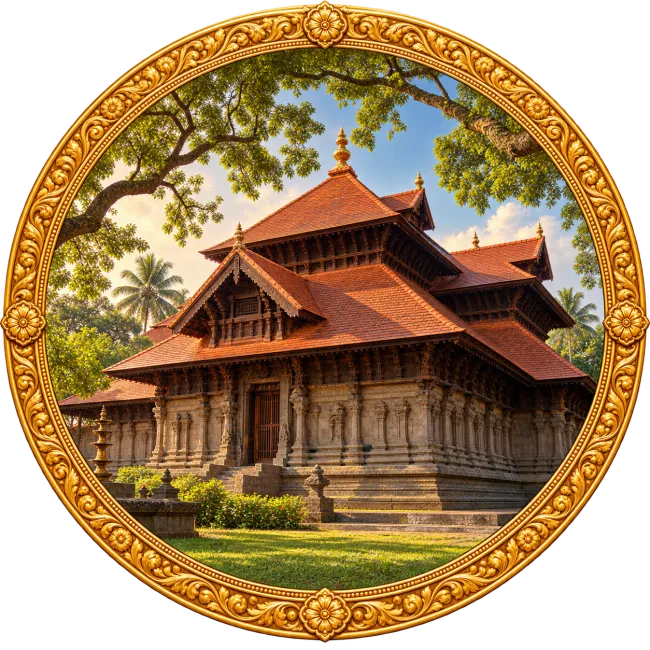
Vadakkunnathan Temple, Thrissur
Vadakkunnathan Temple in Thrissur, Kerala, is one of the state’s oldest and most revered Shiva temples. Situated on a small hill in the centre of Thrissur city, the temple is surrounded by the circular Thekkinkadu Maidanam and enclosed within massive stone walls.
The temple is renowned for its ancient Kerala architecture, traditional murals, wooden Koothambalam and unique Shiva Lingam covered by generations of sacred ghee offerings. It also forms the spiritual centre of Thrissur Pooram, one of Kerala’s grandest temple festivals.
About Vadakkunnathan Temple
Vadakkunnathan Temple is dedicated principally to Lord Shiva, worshipped here as Vadakkunnathan. The name means the Lord of the North.
The temple complex also contains prominent shrines dedicated to Lord Shankaranarayana and Lord Rama. The presence of these deities represents the harmony of Shaivite and Vaishnavite traditions.
Vadakkunnathan Temple stands within a large walled complex covering several acres. Four monumental gateways face the cardinal directions.
The temple’s sacred landscape includes:
The Vadakkunnathan Shiva shrine
Shankaranarayana shrine
Lord Rama shrine
Goddess Parvati shrine
Koothambalam
Traditional murals
Ancient gateways
Thekkinkadu Maidanam
Sacred trees and subsidiary shrines
Only Hindus are permitted inside the main temple complex under its traditionally followed entry rules.
When and Who Built Vadakkunnathan Temple?
According to temple tradition, Vadakkunnathan Temple was established by Sage Parashurama, the sixth incarnation of Lord Vishnu.
Parashurama is believed to have reclaimed Kerala from the sea and consecrated several Shiva, Vishnu and Bhagavathy temples across the region. Vadakkunnathan is traditionally regarded as the first Shiva temple he established in Kerala.
The present architectural complex developed through the support of Chera rulers, the Perumpadappu Swaroopam, the Zamorin and local rulers of the Thrissur region.
The legendary architect Perumthachan is associated with important construction work at the temple. Successive generations of artisans added wooden halls, gateways, murals and ritual spaces.
The temple’s current structures primarily reflect Kerala’s medieval architectural tradition. Careful conservation has helped preserve its woodwork, murals and sacred character.
Legend of Parashurama
After reclaiming Kerala from the sea, Parashurama wished to establish Lord Shiva in the newly created land.
He travelled to Mount Kailash and requested Shiva to accompany him. Lord Shiva agreed and arrived in Kerala with Goddess Parvati and other divine beings.
According to tradition, Shiva first rested beneath a large banyan tree at the present temple site. The place came to be known as Sri Moola Sthana.
Parashurama later installed Lord Shiva within a formal sanctum. The deity became known as Vadakkunnathan because of his sacred position and association with the northern direction.
The Sri Moola Sthana remains an important place within the temple complex.
Meaning of Vadakkunnathan
In Malayalam:
Vadakku means north.
Nathan means Lord.
Vadakkunnathan therefore means the Lord of the North.
The name may refer to the orientation of the deity, the location of the shrine within the complex or Shiva’s connection with Mount Kailash in the north.
The Ghee-Covered Shiva Lingam
The most distinctive feature of Vadakkunnathan Temple is its Shiva Lingam, which is almost completely covered by layers of sacred ghee.
Ghee has been offered during Abhishekam for generations. Over time, the accumulated offering has formed a large mound that is traditionally compared with the snow-covered Mount Kailash.
The original Lingam is no longer directly visible. Sacred ornaments and symbols placed upon the ghee mound represent Lord Shiva.
According to temple tradition, the ghee does not melt despite Kerala’s warm climate and the presence of lamps inside the sanctum. It is also believed to remain free from unpleasant odour and insects.
A small portion of the consecrated ghee may be distributed as prasadam. Devotees regard it as sacred and traditionally associate it with healing blessings.
Religious Significance
Vadakkunnathan is worshipped as a compassionate and powerful form of Lord Shiva. The temple’s three principal shrines also represent the harmony of Shiva, Vishnu and Rama worship.
Devotees visit to pray for:
Good health and recovery from illness
Long life
Peace and stability
Marriage and marital harmony
Blessings for children
Family prosperity
Relief from fear and anxiety
Success in education and employment
Protection from negative influences
Forgiveness for past mistakes
Spiritual wisdom
Liberation from worldly attachments
Mondays, Pradosham, Maha Shivaratri and the Malayalam month of Karkidakam are considered important for worship.
Main Deities and Shrines
Lord Vadakkunnathan
Lord Shiva is worshipped in the principal shrine. The Lingam is covered by the accumulated sacred ghee offered during daily rituals.
Lord Shankaranarayana
Shankaranarayana represents the combined form of Shiva and Vishnu. One half represents Shankara, while the other represents Narayana.
The deity symbolises unity between Shaivite and Vaishnavite traditions.
Lord Rama
Lord Rama has a separate principal shrine within the complex. Devotees pray for righteousness, courage and family welfare.
Goddess Parvati
Goddess Parvati is worshipped behind the Shiva shrine. She represents compassion, marriage, fertility and divine energy.
Other sacred figures and shrines include:
Lord Ganesha
Lord Krishna
Dharma Shasta
Lord Vettakkorumakan
Nandi
Adi Shankaracharya
Sacred serpent deities
Sri Moola Sthana
Traditional Darshan Order
Vadakkunnathan Temple follows a specific traditional worship sequence. Devotees should observe the route prescribed by temple staff.
The customary sequence includes prayers at selected points representing:
Sri Moola Sthana
Lord Krishna
Lord Vadakkunnathan
Goddess Parvati
Lord Shankaranarayana
Lord Rama
Lord Ganesha
Other guardian deities
Some worship points are connected with distant temples and sacred directions. Devotees offer prayers while facing those directions.
Because the sequence can be difficult for first-time visitors, they should follow the signs or ask authorised temple personnel.
Architecture of Vadakkunnathan Temple
Vadakkunnathan Temple is an outstanding example of Kerala temple architecture.
Four Gopurams
The temple has four entrance towers facing north, south, east and west. These gateways have sloping tiled roofs and intricate wooden construction.
Sreekovils
The principal shrines have circular and square forms typical of Kerala architecture. Sloping roofs protect the structures from heavy monsoon rainfall.
Copper plates, wooden beams, stone foundations and traditional decorative elements are used throughout the complex.
Chuttambalam
Covered pathways surround the principal shrines and provide space for circumambulation, lamps and ritual activities.
Koothambalam
The temple contains a magnificent Koothambalam, a traditional theatre used for sacred performing arts such as Koodiyattam and Chakyar Koothu.
Its wooden pillars, sloping roof and carefully planned performance space demonstrate Kerala’s ancient theatre architecture.
Murals
The temple contains valuable murals depicting episodes from the Mahabharata, Ramayana and Shiva traditions.
These paintings were created using natural pigments and traditional techniques. Visitors must not touch or photograph restricted murals.
Vadakkunnathan Temple Timings
The regular daily schedule is:
Timings may be reorganised during Maha Shivaratri, Thrissur Pooram, Aanayoottu and important festival occasions.
Morning Puja and Deepa Aradhana
The temple opens at 4:00 AM with Palliyunarthal and Nirmalya Darshan.
The previous day’s decorations are removed, and the first rituals of the day begin. Morning Abhishekam is performed from 4:30 AM to 5:30 AM.
Usha Puja takes place at 6:00 AM, followed by morning Deepa Aradhana at 6:30 AM.
Pantheeradi Puja is performed at 8:00 AM. The best morning darshan period is from 5:30 AM to 8:30 AM.
Ucha Puja
Ucha Puja is performed at 9:30 AM. It includes Archana, Naivedyam and worship with sacred lamps.
Madhyahna Deepa Aradhana is offered at 10:00 AM. The morning darshan session ends at 10:30 AM.
Visitors wishing to attend Ucha Puja should enter the temple before 9:00 AM.
Evening Puja and Deepa Aradhana
The temple reopens at 5:00 PM. Evening Deepa Aradhana is performed at 6:30 PM.
The best evening darshan period is from 5:00 PM to 7:00 PM. Traditional lamps illuminate the courtyard and sanctum areas during this period.
Athazha Puja is conducted at 7:30 PM, followed by night Deepa Aradhana at 8:00 PM.
The temple closes at 8:30 PM.
Thrissur Pooram
Thrissur Pooram is one of Kerala’s grandest temple festivals. It takes place at Thekkinkadu Maidanam surrounding Vadakkunnathan Temple.
The festival was organised in its present form under Sakthan Thampuran, the ruler of Cochin, during the late eighteenth century.
The principal participating groups are associated with:
Paramekkavu Bhagavathy Temple
Thiruvambady Krishna Temple
Important features include:
Decorated elephants
Kudamattam, the ceremonial exchange of colourful parasols
Panchavadyam
Melam
Processions
Fireworks
Traditional percussion ensembles
Lord Vadakkunnathan is regarded as the divine host and witness of the celebration. The temple itself maintains its traditional dignity while the Pooram events take place in the surrounding grounds.
Maha Shivaratri
Maha Shivaratri is observed with special Shiva worship, fasting, chanting and cultural programmes.
Devotees offer prayers throughout the evening and participate in religious activities connected with Lord Shiva.
The temple’s ghee-covered Lingam gives Maha Shivaratri worship a distinctive spiritual character.
Aanayoottu
Aanayoottu is a traditional ceremony in which elephants are ceremonially fed and blessed.
Special food prepared according to prescribed guidelines is offered to the elephants. The ritual reflects the association of elephants with Kerala temple traditions.
Visitors must remain behind safety barriers and follow instructions from mahouts, temple staff and authorities.
Major Festivals
Other important festivals include:
Pradosham
Thiruvathira
Karkidaka month rituals
Ramayana month observances
Ashtami Rohini
Ganesh Chaturthi
Navaratri
Deepavali
Vishu
The temple does not hold a conventional annual procession for Vadakkunnathan comparable to the Ulsavam of many Kerala temples.
Sevas and Offerings
Important Sevas include:
Ghee Abhishekam
Dhara
Rudrabhishekam
Ganapati Homam
Mrityunjaya Homam
Uma Maheshwara Puja
Sahasranama Archana
Koovala Mala offering
Deepa Seva
Annadanam donation
Special Naivedyam
Bilva leaves, ghee, flowers, coconuts and sacred lamps are common offerings to Lord Shiva.
Seva tickets should be purchased only through authorised counters.
Prasadam
Common prasadam includes:
Sacred ghee
Bhasma
Sandalwood paste
Flowers
Payasam
Other blessed offerings
The sacred ghee is handled according to temple rules and may be distributed in limited quantities.
Devotees should collect prasadam only from authorised counters.
Dress Code and Entry Rules
Vadakkunnathan Temple follows a strict traditional dress code.
Men must wear a mundu or dhoti. Shirts, T-shirts, vests and other upper garments must be removed before entering the inner temple complex.
Women may wear:
Saree
Set mundu
Salwar kameez or churidar
Long traditional skirt with blouse
Visitors should confirm the currently displayed dress instructions before joining the queue.
Only Hindus are permitted inside the main temple complex under the established entry rules.
Footwear, mobile phones, cameras and electronic devices are restricted. Photography and videography are prohibited inside the temple.
Entry Fee and Visit Duration
General darshan is available without an entry fee. Separate charges apply to Abhishekam, Archana, Homam and other Sevas.
A regular visit requires 1½ to 2 hours. Visitors interested in completing the full traditional worship sequence and observing the architecture should keep 2½ hours available.
Waiting time is longer on Mondays, Pradosham, Maha Shivaratri and Pooram days.
Best Time to Visit
October to February is the most comfortable period for visiting Thrissur.
For peaceful darshan, visit between 5:30 AM and 8:00 AM on a weekday. Evening darshan from 5:00 PM to 7:00 PM provides an opportunity to attend Deepa Aradhana.
Thrissur Pooram offers the grandest cultural experience, but visitors should be prepared for immense crowds, heat, noise and traffic restrictions.
How to Reach Vadakkunnathan Temple
By Air
Cochin International Airport is the nearest major airport. Taxis and buses are available from the airport to Thrissur.
By Train
Thrissur Railway Station is the nearest railway station. It has extensive connections with Kochi, Thiruvananthapuram, Kozhikode, Bengaluru, Chennai and other cities.
Auto-rickshaws, buses and taxis are available from the station.
By Road
Thrissur is well connected with Kochi, Palakkad, Kozhikode, Guruvayur and other Kerala destinations.
The temple is located in the centre of the city. Vehicles must use designated parking areas near Thekkinkadu Maidanam.
Nearby Places to Visit
Visitors may also explore:
Paramekkavu Bhagavathy Temple
Thiruvambady Krishna Temple
Our Lady of Dolours Basilica
Kerala Kalamandalam
Shakthan Thampuran Palace
Archaeological Museum
Thrissur Zoo and State Museum
Poonkunnam Shiva Temple
Guruvayur Sri Krishna Temple
Punnathur Kotta
Athirappilly Waterfalls
Vazhachal Waterfalls
Visitor Guidelines
Confirm the strict dress requirements before entering. Changing facilities should be used where available.
Deposit footwear, phones, cameras and bags only at authorised counters. Preserve the token carefully.
Follow the traditional darshan order displayed within the temple. Do not touch murals, wooden carvings or ritual objects.
During Thrissur Pooram, use public transport, remain behind elephant safety barriers and follow police instructions.
Maintain silence inside the sacred enclosure and avoid rushing between shrines.
Conclusion
Vadakkunnathan Temple is an outstanding centre of Shiva worship and Kerala’s architectural heritage. Its Parashurama tradition, ghee-covered Shiva Lingam, Shankaranarayana and Rama shrines, historic murals and Koothambalam give it a unique spiritual identity.
The temple also serves as the sacred heart of Thrissur Pooram, where Kerala’s devotional music, elephants, processions and community traditions come together.
A visit to Vadakkunnathan Temple offers devotees an opportunity to seek health, peace and spiritual wisdom while experiencing one of Kerala’s oldest living temple traditions.