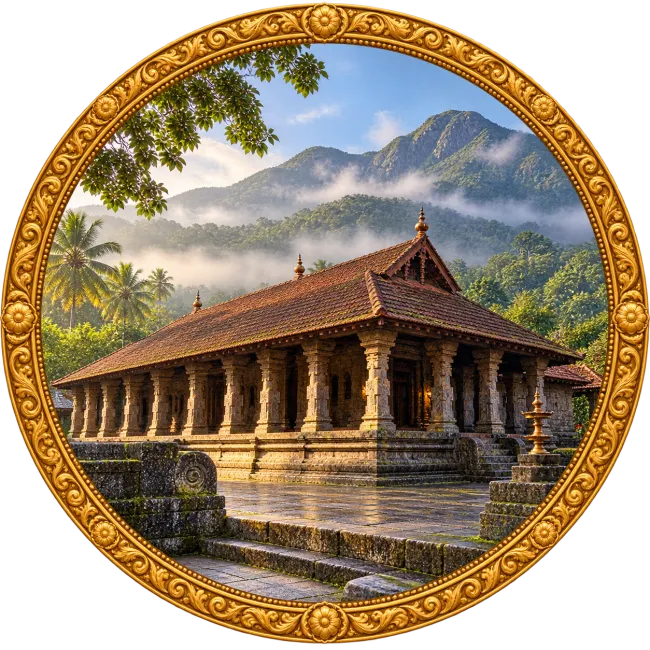
Thirunelli Temple, Wayanad
Thirunelli Temple in Wayanad, Kerala, is an ancient Vishnu temple situated amid the forested Brahmagiri Hills. Surrounded by mountains and dense greenery, the temple is revered for its peaceful atmosphere, traditional Kerala architecture and sacred connection with Lord Brahma, Lord Vishnu and Sage Parashurama.
The nearby Papanasini stream is one of the most important places in Kerala for performing ancestral rites. Devotees believe that ritual bathing and prayers at Papanasini help purify past actions and bring peace to departed family members.
About Thirunelli Temple
Thirunelli Temple, also known as Thirunelli Maha Vishnu Temple, is located in the Brahmagiri region of Wayanad district. Lord Vishnu is worshipped as the principal deity.
The temple is often called the “Kashi of the South” because of its importance for ancestral rituals, purification ceremonies and prayers for departed souls.
Another traditional name is Sahyamalaka Kshetram:
- Sahya refers to the Western Ghats.
- Amalaka means Indian gooseberry or Amla.
- Kshetram means sacred place.
The name Thirunelli is also connected with the gooseberry tree. In Malayalam, “Nelli” means Indian gooseberry.
The temple is surrounded by the Brahmagiri, Karimala and Narinirangimala hills, creating a naturally sacred setting.
When and Who Built Thirunelli Temple?
Thirunelli is an ancient pilgrimage centre whose spiritual origin is associated with Lord Brahma.
The shrine’s earliest construction date is preserved through sacred tradition rather than a single royal record. Historical evidence indicates that the temple was established as an important place of worship many centuries ago.
Regional rulers of Kerala and neighbouring Kodagu supported the temple. Different dynasties, local chieftains and royal families contributed land, ritual arrangements and structural improvements.
The stone sanctum, pillared halls and remarkable aqueduct reflect different stages of construction and renovation.
The temple’s architecture shows connections with both Kerala and neighbouring Karnataka. Its relatively simple stone design allows it to blend naturally with the surrounding mountain landscape.
Legend of Lord Brahma
According to mythology, Lord Brahma was travelling across the world on his celestial swan when he noticed an exceptionally beautiful valley within the Brahmagiri Hills.
He descended and discovered a sacred image of Lord Vishnu beneath an Amla tree. Recognising the divine nature of the location, Brahma installed and worshipped the deity.
He named the place Sahyamalaka Kshetram—the sacred Amla region of the Sahya Mountains.
According to tradition, Brahma continues to worship Lord Vishnu at Thirunelli during the early hours before the temple opens to ordinary devotees.
The story gives the shrine exceptional importance because one member of the Trimurti is believed to have consecrated another.
Legend of Sage Parashurama
Sage Parashurama is closely associated with Papanasini and the ancestral rituals performed near Thirunelli.
According to tradition, Parashurama came to the Brahmagiri region after carrying out his divine mission. He performed prayers and purification rites at Papanasini.
He is believed to have recognised the sacred stream as an ideal place for offering prayers to ancestors.
Devotees continue to perform Bali Tharpanam, Pithru Karma and other ancestral ceremonies following traditions associated with Parashurama.
Religious Significance
Thirunelli Temple is especially important for Lord Vishnu worship and ancestral ceremonies.
Devotees visit to pray for:
- Peace for departed ancestors
- Relief from ancestral obligations
- Purification from past actions
- Family welfare
- Good health
- Marriage and marital harmony
- Blessings for children
- Mental peace
- Protection during journeys
- Prosperity and stability
- Spiritual wisdom
- Liberation from the cycle of birth and death
Amavasya, Karkidaka Vavu, new-moon days and important Vishnu festivals attract large numbers of pilgrims.
Main Deity and Other Shrines
Lord Maha Vishnu
Lord Vishnu is worshipped as the principal deity. The image represents preservation, protection and divine grace.
The deity is decorated with Tulasi garlands, flowers, silk garments and sacred ornaments.
Lord Ganesha
Lord Ganesha is worshipped before beginning important rituals. Devotees seek his blessings for the removal of obstacles.
Nagadevatas
Serpent deities are worshipped as protectors of land, family and natural water sources.
Other sacred figures and locations include:
- Garuda
- Lord Shiva-related sacred traditions
- Parashurama
- Panchatheertham
- Papanasini
- Gunnika Cave
- Sacred footprints associated with Lord Vishnu
Papanasini
Papanasini is a sacred mountain stream located near the temple. The name means “destroyer of sins.”
The stream originates in the Brahmagiri Hills and flows through a rocky forested area.
Pilgrims bathe or wash at Papanasini before performing ancestral rituals. Water from the stream is also used for sacred ceremonies.
Visitors should exercise caution because rocks can become slippery, particularly during the monsoon. Elderly pilgrims and children should receive assistance.
Soap, shampoo, plastic and chemical products should not be used in the sacred water.
Ancestral Rites at Thirunelli
Thirunelli is one of Kerala’s principal places for performing Bali Tharpanam and Pithru Karma.
These ceremonies are performed to honour deceased parents, grandparents and other ancestors.
A typical process may include:
- Registration with an authorised priest
- Sankalpa in the family’s name
- Preparation of ritual offerings
- Prayers and mantras
- Bali Tharpanam
- Visit to Papanasini
- Darshan of Lord Vishnu
- Final blessings
The exact procedure depends on family tradition and priestly guidance.
Devotees should use authorised priests and counters. They should bring the required names and family details for the ceremony.
Panchatheertham
Panchatheertham is a sacred water tank near the temple. The name refers to five sacred waters traditionally believed to meet at this location.
A stone within the tank is associated with the footprint of Lord Vishnu.
Pilgrims offer prayers at Panchatheertham while completing the sacred circuit of Thirunelli.
Water levels may change according to the season. Visitors should follow local safety instructions and avoid entering restricted sections.
Gunnika Cave
Gunnika Cave is a small cave shrine associated with Lord Shiva. It is situated in the forested region near Papanasini.
The cave represents the unity of Vishnu and Shiva worship at Thirunelli.
Access may involve walking over rocks and uneven forest terrain. Visitors should attempt the route only in suitable weather and during daylight.
Architecture of Thirunelli Temple
Thirunelli Temple combines Kerala architectural principles with extensive stone construction.
Main Sanctum
The sanctum houses Lord Vishnu and is built on a strong stone base. Traditional lamps illuminate the deity during worship.
Stone Pillars
The temple contains stone corridors and pillars with restrained carvings. The design complements the surrounding mountain landscape.
Open Courtyard
A spacious courtyard surrounds the main shrine. The open design allows views of the Brahmagiri Hills.
Stone Aqueduct
The temple’s most remarkable engineering feature is its stone aqueduct.
Water from a natural mountain source is carried towards the temple through a long channel constructed from stone blocks.
The aqueduct supplies water used for temple rituals. Its careful slope and durable construction demonstrate advanced traditional engineering.
Thirunelli Temple Timings
The regular daily schedule is:
Timings may be reorganised on Karkidaka Vavu, Amavasya, festival dates and exceptionally crowded ancestral-ritual days.
Morning Puja and Deepa Aradhana
The temple opens at 5:30 AM with Nirmalya Darshan. Devotees see the Lord with the previous night’s floral decorations.
Morning Abhishekam is performed at 6:00 AM. Usha Puja follows at 6:30 AM, and Deepa Aradhana is offered at 7:00 AM.
The best morning darshan period is from 6:00 AM to 9:00 AM.
Pilgrims performing ancestral rites should report early because the ceremonies, Papanasini visit and temple darshan require additional time.
Ucha Puja
Ucha Puja is performed at 11:30 AM. The ceremony includes Archana, Tulasi offerings, Naivedyam and sacred lamps.
Madhyahna Deepa Aradhana follows at 11:45 AM. The morning session ends at 12:00 PM.
Devotees should complete the Papanasini rites and return to the temple before Ucha Puja whenever instructed by the priest.
Evening Puja and Deepa Aradhana
The temple reopens at 5:30 PM. Evening Deepa Aradhana is performed at 6:30 PM.
The best evening darshan period is from 5:30 PM to 7:00 PM.
Athazha Puja, the final worship of the day, is conducted at 7:30 PM. The temple closes at 8:00 PM.
Evening visitors should begin their return journey carefully because roads pass through forested areas.
Karkidaka Vavu
Karkidaka Vavu is one of the most important days for ancestral worship at Thirunelli.
Thousands of devotees perform Vavu Bali for departed family members. Special counters, ritual areas and crowd arrangements are introduced.
Pilgrims should:
- Reach before sunrise
- Carry necessary family details
- Follow the assigned priest or group
- Use designated bathing points
- Avoid deep or fast-flowing water
- Follow traffic and parking restrictions
- Keep ritual areas clean
Accommodation and transport should be booked in advance.
Major Festivals
Vishu
Vishukkani Darshan and special worship are organised for the Malayalam New Year.
Sri Krishna Jayanti
Lord Vishnu is worshipped through Krishna-related Alankaram, Puja and devotional activities.
Thiruvonam
Special offerings and prayers are made during Kerala’s Onam celebrations.
Karkidaka Vavu
The principal ancestral observance attracts pilgrims from across Kerala and Karnataka.
Puthari Festival
Puthari is connected with the new harvest. Agricultural produce is ceremonially offered to the deity.
Other observances include Ekadashi, Amavasya, Mandala season and important Vishnu festival dates.
Sevas and Offerings
Important temple Sevas include:
- Bali Tharpanam
- Pithru Puja
- Thilahomam
- Archana
- Sahasranama Archana
- Palpayasam
- Neypayasam
- Tulasi Mala offering
- Chuttuvilakku
- Ganapati Homam
- Deepa Seva
- Annadanam donation
- Festival sponsorship
Ancestral ceremonies should be arranged through authorised priests and temple counters.
Prasadam
Common prasadam includes:
- Tulasi
- Flowers
- Sacred sandalwood paste
- Payasam
- Appam
- Blessed ritual items
Prasadam should be collected from designated counters. Materials used in ancestral rituals must be handled according to the priest’s instructions.
Dress Code and Entry Rules
Visitors should wear clean and modest traditional clothing.
Men may wear a mundu or dhoti. Shirts and upper garments may need to be removed before entering designated inner areas.
Women may wear:
- Saree
- Set mundu
- Salwar kameez or churidar
- Long traditional skirt with blouse
Footwear must be removed before entering. Mobile phones, cameras and large bags may be restricted near the sanctum.
Photography is prohibited in designated worship areas.
Alcohol, tobacco, leather articles and non-vegetarian food must not be carried inside.
Entry Fee and Visit Duration
General darshan is available without an entry fee. Separate charges apply to Bali Tharpanam, Thilahomam, Archana and other Sevas.
A regular visit requires 1 to 1½ hours. Devotees performing ancestral ceremonies should keep 3 to 4 hours available.
During Karkidaka Vavu and Amavasya, the complete visit may require most of the morning because of heavy crowds.
Best Time to Visit
October to February is the most comfortable period for visiting Thirunelli. The weather is suitable for temple darshan and walking to Papanasini.
For peaceful darshan, visit between 6:00 AM and 9:00 AM on a weekday.
The monsoon makes the Brahmagiri forests exceptionally beautiful, but heavy rain can make roads, rocks and pathways slippery.
Visitors should avoid walking through forest areas after sunset.
How to Reach Thirunelli Temple
By Air
Kannur International Airport is the nearest airport. Calicut International Airport is another major option.
Taxis and buses are available for the onward journey to Wayanad.
By Train
Thalassery and Kozhikode railway stations are convenient railheads. Mysuru Railway Station may also be used by travellers arriving through Karnataka.
Road transport is required for the final journey to Thirunelli.
By Road
Thirunelli is connected with Mananthavady, Kalpetta, Kannur, Mysuru and nearby Wayanad destinations.
The temple is approximately 30 kilometres from Mananthavady. Government buses, taxis and private vehicles are available.
The road passes through forest areas, where travel restrictions and wildlife crossings may apply.
Nearby Places to Visit
Visitors may also explore:
- Papanasini
- Panchatheertham
- Gunnika Cave
- Brahmagiri Hills
- Thrissilery Mahadeva Temple
- Tholpetty Wildlife Sanctuary
- Kuruva Island
- Valliyoorkavu Temple
- Mananthavady
- Pazhassi Raja Tomb
- Pakshipathalam
- Banasura Sagar Dam
- Nagarhole National Park
Thrissilery Mahadeva Temple
Thrissilery Mahadeva Temple is closely connected with ancestral rituals performed at Thirunelli.
According to local tradition, pilgrims may visit Lord Shiva at Thrissilery as part of the complete ritual circuit.
Those planning both temples should begin early and arrange transport in advance.
Visitor Guidelines
Register ancestral ceremonies only through authorised counters and priests. Carry the names and family details required for Sankalpa.
Wear comfortable clothing suitable for both temple worship and walking over rocky terrain.
Use railings and designated pathways near Papanasini. Rocks can be slippery even outside the monsoon season.
Do not enter restricted forest routes or travel alone after dark. Wildlife is present in the surrounding Brahmagiri region.
Carry necessary medicines, drinking water and rain protection, but avoid plastic waste.
Conclusion
Thirunelli Temple is one of Kerala’s most sacred Vishnu temples and a major centre for ancestral worship. Its Lord Brahma legend, Papanasini stream, Panchatheertham, stone aqueduct and Brahmagiri setting give it an exceptional spiritual identity.
The temple represents purification, remembrance and the eternal relationship between families and their ancestors. A visit to Thirunelli offers devotees an opportunity to seek Lord Vishnu’s blessings, honour departed loved ones and experience the peace of Kerala’s sacred mountain forests.