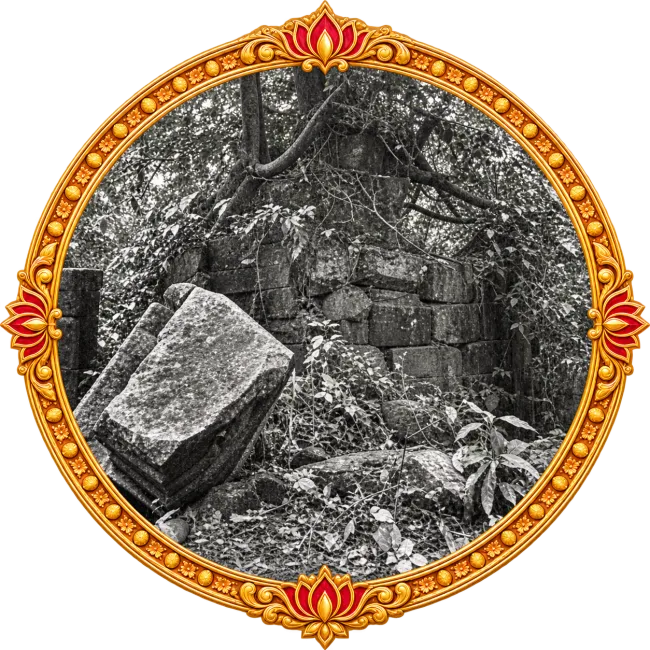
Tamreswari Temple Ruins, Tinsukia
Tamreswari Temple Ruins are the remains of an important medieval Shakti shrine located near Sadiya in the Tinsukia district of Assam. The temple was associated with the Chutia kingdom and was dedicated to a powerful tribal Goddess commonly identified as Kesai Khaiti or Kechai Khaiti.
The shrine was popularly called Tamreswari because its roof was believed to have been covered with copper plates. The Assamese word Tam refers to copper. Natural disasters, river erosion and the 1950 Assam–Tibet earthquake severely damaged the structure, leaving only archaeological traces and fragments.
Tamreswari is no longer an active temple. Regular Puja, Aarti, Bhog and festival worship are not conducted at the ruins.
About Tamreswari Temple Ruins
The ruins are situated in the historic Sadiya region of upper Assam, close to the river systems and foothills of the eastern Himalayas. Sadiya was once an important political and cultural centre of the Chutia kingdom.
The temple was dedicated to the tutelary Goddess of the Chutia rulers. She was worshipped as Kesai Khaiti, a fierce manifestation of the Divine Mother associated with protection, warfare, fertility and the power of nature.
After the Ahoms took control of Sadiya, the shrine continued to retain religious importance. The priests and rituals connected with the Goddess were treated as part of the region’s inherited sacred tradition.
Today, the site is valued primarily for its archaeological, historical and cultural significance.
When Was Tamreswari Temple Built and Who Built It?
Tamreswari Temple is associated with the Chutia rulers who governed parts of upper Assam before the Ahom expansion into the region.
An inscription connected with the shrine records construction or renovation work during the 15th century. The temple’s development is particularly associated with Chutia king Lakshminarayan, whose rule belongs to this period.
The shrine may have existed in an earlier form before the recorded construction. The Chutia kings expanded the sacred site, supported its priests and established regular worship of the royal Goddess.
After the Ahoms annexed the Chutia territories in the 16th century, the shrine came under their administration. The Ahom authorities continued to recognise the importance of the temple and its traditional priesthood.
Goddess Kesai Khaiti
Kesai Khaiti was the principal Goddess worshipped at Tamreswari. Her name is also written as Kechai Khaiti, Kesaikhati and Kachai Khaiti.
She was regarded as a fierce mother Goddess who protected the kingdom and its people. Her worship combined indigenous religious traditions with elements later associated with Shaktism and Tantric practice.
The Goddess represented:
Protection of the kingdom
Power over destructive forces
Fertility and agricultural prosperity
Victory in conflict
Natural and spiritual energy
The fierce aspect of motherhood
Over time, she came to be identified with forms such as Kali, Durga and Tamreswari.
Origin of the Name Tamreswari
The temple was known for its copper-covered roof. The term Tamreswari can be understood as “the Goddess of the copper-roofed temple.”
Copper was a valuable material and using it for the roof reflected royal patronage and the temple’s importance. Historical descriptions refer to copper plates and metalwork associated with the shrine.
No complete copper roof survives today. Natural disasters, neglect, river activity and the removal or loss of materials contributed to its disappearance.
Religious Practices and Historical Traditions
Tamreswari was a major centre of royal and community worship. Ceremonies were conducted for protection, agricultural prosperity and the welfare of the kingdom.
Historical accounts associate the shrine with animal sacrifice and, during earlier periods, with human sacrifice. These practices belonged to a historic ritual environment and ceased long ago.
The site must not be presented as a place where such ceremonies continue. It is an archaeological ruin without organised daily worship.
Modern visitors should approach the subject as part of the complex religious history of medieval northeastern India.
Architecture of Tamreswari Temple
Historical descriptions and surviving remains indicate that the temple was built using stone masonry and metal fittings.
Its architectural characteristics included:
Stone walls
Carefully fitted masonry blocks
Iron clamps or fasteners
Copper roof plates
Raised sacred enclosure
Inner sanctum
Carved architectural fragments
Boundary structures
The use of stone and metal distinguished Tamreswari from many brick temples of Assam. Its design may have combined indigenous building traditions with broader Indian temple forms.
Most of the standing structure has disappeared. Surviving blocks and fragments provide only a partial understanding of the original layout.
Destruction of the Temple
The temple suffered from repeated environmental damage because the Sadiya region is affected by powerful rivers, floods and seismic activity.
The 1950 Assam–Tibet earthquake was one of the strongest earthquakes recorded in the region. It caused widespread landslides, changes in river channels and extensive destruction in upper Assam.
The earthquake and subsequent flooding severely damaged what remained of Tamreswari Temple. River erosion and sediment deposition further altered the landscape.
As a result, visitors should not expect to find a complete temple building. The site consists of scattered or partially exposed archaeological remains.
Archaeological and Historical Significance
Tamreswari is important for understanding:
The history of the Chutia kingdom
Indigenous Goddess traditions
The development of Shaktism in upper Assam
Medieval royal patronage
Stone construction techniques
Use of metal roofing in temples
Ahom administration of earlier sacred sites
Earthquake and river damage to archaeological heritage
The ruins also demonstrate how natural forces can transform or erase important monuments over time.
Tamreswari Temple Ruins Visiting Hours
The ruins do not operate like an active temple and do not have Puja or Aarti schedules. Visits should be made only during daylight.
Access conditions can change because of weather, river levels, road conditions and conservation activity. Visitors should obtain local guidance before travelling to the ruins.
Why Puja and Aarti Are Not Conducted
The original sanctum, roof and principal sacred structure no longer survive in a condition suitable for regular worship.
The site is treated as a historical and archaeological location. Lighting oil lamps, applying sindoor, pouring water or conducting fire rituals against the surviving stones could cause permanent damage.
Visitors should not create an independent shrine among the ruins or move archaeological fragments for ritual purposes.
Entry Fee and Visit Duration
There is generally no standard temple entry fee because this is not an operating pilgrimage complex. Local access arrangements may apply depending on the route and administrative conditions.
Visitors should reserve one to two hours for the site. Additional time is required for travel from Tinsukia or other towns.
A local guide can help identify historical remains that may otherwise appear to be ordinary stone fragments.
Best Time to Visit
November to March is the most suitable period for visiting the Sadiya region. The weather is comparatively dry, and road conditions are generally more convenient.
The monsoon should be avoided because:
Rivers can rise rapidly.
Roads may become muddy or damaged.
Flooding can restrict access.
Vegetation may cover the ruins.
Snakes and insects become more active.
Exposed archaeological surfaces become slippery.
Visitors should complete the trip during daylight and avoid isolated areas after sunset.
How to Reach Tamreswari Temple Ruins
By Air
Dibrugarh Airport at Mohanbari is the nearest major airport. Visitors can continue towards Tinsukia and Sadiya by road.
By Train
New Tinsukia Junction is the nearest major railway station with broad regional connectivity.
By Road
Visitors can travel from Tinsukia towards Sadiya by taxi or private vehicle. The final approach may require local directions because the ruins are not developed like a conventional tourist complex.
Distances can vary according to the access route, bridge crossings and road conditions.
Facilities Near the Ruins
Facilities at the archaeological site are limited. Visitors should carry:
Drinking water
Light food
Sun protection
Insect repellent
Essential medicines
Fully charged phone
Suitable walking shoes
Identification documents
Accommodation, restaurants, fuel and medical facilities are more readily available in Chapakhowa, Tinsukia and other larger settlements.
Visitor and Conservation Guidelines
The ruins are fragile and irreplaceable. Visitors should follow these rules:
Do not climb on stone remains.
Do not move archaeological fragments.
Do not scratch names into stones.
Do not light lamps or fires.
Do not apply oil, paint or sindoor.
Do not pour water or milk over the ruins.
Do not remove copper, stone or pottery fragments.
Avoid digging or disturbing the soil.
Do not litter.
Follow local administrative instructions.
Seek permission before professional photography or research.
Respect nearby communities and private land.
Any newly discovered object should be left in place and reported to the appropriate local authority.
Nearby Places to Visit
Sadiya: A historic region associated with the Chutia kingdom.
Chapakhowa: The main town and transport centre of the Sadiya area.
Bhismaknagar Fort: Archaeological remains associated with an early kingdom in Arunachal Pradesh.
Dibru-Saikhowa National Park: Known for wetlands, forests and wildlife.
Tilinga Mandir: A Shiva shrine famous for thousands of bells.
Parashuram Kund: A major pilgrimage site in Arunachal Pradesh.
Dehing Patkai National Park: A rainforest region of upper Assam.
Digboi: Known for oil-industry heritage and historic sites.
Conclusion
Tamreswari Temple Ruins preserve the memory of a major Shakti shrine associated with the Chutia kingdom and Goddess Kesai Khaiti. The temple was distinguished by its stone construction and copper-covered roof, while its rituals reflected the indigenous and Shakta traditions of medieval upper Assam.
Earthquakes, flooding and river erosion destroyed most of the monument, and regular Puja and Aarti are no longer conducted. Today, the site should be approached as a fragile archaeological landscape requiring respectful exploration and careful conservation.