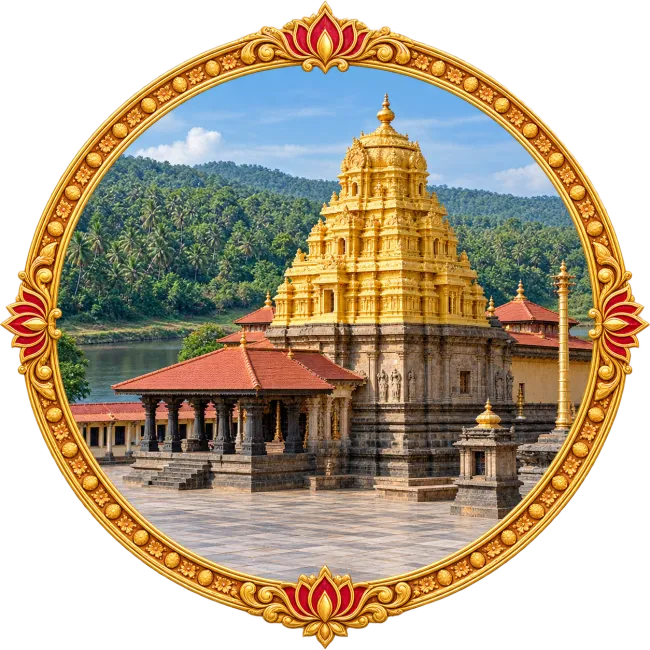
Sringeri Sharadamba Temple, Sringeri
Sringeri Sharadamba Temple in Karnataka is one of India’s most revered centres of learning and Goddess worship. Situated on the banks of the Tunga River amid the Western Ghats, the temple is dedicated to Goddess Sharadamba, a divine manifestation of Saraswati—the Goddess of knowledge, wisdom, music and speech.
The temple forms the spiritual heart of the Sringeri Sharada Peetham, established by Adi Shankaracharya. Students, scholars, artists and families visit Sringeri to seek the Goddess’s blessings, perform Vidyarambham and experience the peaceful atmosphere of the ancient monastic centre.
About Sringeri Sharadamba Temple
Sringeri Sharadamba Temple is located in Sringeri in Chikkamagaluru district, Karnataka. The principal deity is Goddess Sharadamba, represented in a seated posture and richly decorated with gold ornaments, silk garments and flowers.
The temple is part of the Sringeri Sharada Peetham, one of the four principal Amnaya Peethams traditionally established by Adi Shankaracharya.
Sringeri is regarded as the southern centre of Advaita Vedanta. The Matha preserves Vedic education, Sanskrit learning, philosophical studies and traditional worship.
Important sacred places within the complex include:
Sri Sharadamba Temple
Sri Vidyashankara Temple
Sri Torana Ganapati Temple
Adi Shankaracharya shrine
Shrines and Brindavanas of former Jagadgurus
Tunga River ghats
Sri Malahanikareshwara Temple
Narasimha Vana
The calm river, surrounding hills and traditional architecture make Sringeri suitable for meditation, study and devotional worship.
When and Who Built Sharadamba Temple?
Sringeri Sharada Peetham was established by Adi Shankaracharya during the eighth century. He selected Sringeri as an important centre for Advaita Vedanta and Vedic learning.
Adi Shankaracharya consecrated a Sri Chakra and installed an image of Goddess Sharada. The original deity is traditionally described as a sandalwood image.
During the fourteenth century, Sri Vidyaranya, one of the most influential pontiffs of Sringeri, strengthened the institution and supported the development of the temple complex. The present golden image of Goddess Sharadamba is associated with the tradition developed under his guidance.
The Vijayanagara rulers became major patrons of Sringeri. They provided land, grants, ornaments and protection to the Matha and its temples.
The older Sharadamba shrine was reconstructed in a grand South Indian style during the early twentieth century. Successive Jagadgurus supervised the renovation while preserving the Sri Chakra and ancient worship traditions.
The present temple therefore combines an eighth-century spiritual foundation with later Vijayanagara support and twentieth-century architectural reconstruction.
Legend of the Cobra and the Frog
According to tradition, Adi Shankaracharya reached the banks of the Tunga River while searching for a suitable place to establish a centre of learning.
He witnessed an extraordinary sight. A cobra had spread its hood over a pregnant frog, protecting it from the intense heat of the sun.
A snake and frog are natural enemies, but at this sacred location the cobra showed compassion and protected the vulnerable creature.
Shankaracharya understood that the land possessed such powerful spiritual harmony that natural hostility had been overcome. He selected Sringeri as the location for the first of his principal monastic institutions.
The cobra-and-frog legend symbolises compassion, coexistence and the transforming power of knowledge.
Meaning of the Name Sringeri
The name Sringeri is connected with Sage Rishyasringa, a respected figure in the Ramayana and other Hindu traditions.
The nearby hill is traditionally called Rishyasringa Giri. Over time, the name developed into Sringeri.
Sage Rishyasringa was known for his purity, penance and ability to bring rain to a drought-affected kingdom. The region’s association with the sage adds to its spiritual significance.
Adi Shankaracharya and Sharada Peetham
Adi Shankaracharya was one of India’s greatest philosophers and spiritual teachers. He systematised Advaita Vedanta, which teaches the essential unity of the individual self and the supreme reality.
He established monastic centres in different parts of India to preserve Vedic knowledge and provide spiritual guidance.
Sringeri Sharada Peetham became the southern centre and was associated with the Yajurveda. Shankaracharya appointed Sri Sureshwaracharya as its first pontiff.
Successive Jagadgurus have continued the tradition through:
- Vedic education
- Scriptural teaching
- Religious guidance
- Temple worship
- Social service
- Preservation of Sanskrit
- Support for scholars
- Cultural and educational institutions
Goddess Sharadamba
Goddess Sharadamba is a form of Saraswati, the divine source of knowledge, speech, music and artistic ability.
The Goddess is shown seated on a throne. She holds sacred objects representing knowledge, wisdom and divine authority.
Her image is decorated differently during festivals and special occasions. Gold ornaments, silk sarees, flowers and a ceremonial crown are used during Alankaram.
Students place books, notebooks and writing materials before the Goddess. Musicians and artists offer prayers for creativity, discipline and excellence.
Religious Significance
Sharadamba Temple is especially important for students, teachers, researchers, writers, musicians and spiritual seekers.
Devotees visit the temple to pray for:
- Success in education and examinations
- Knowledge and wisdom
- Clear speech and communication
- Musical and artistic ability
- Mental concentration
- Good memory
- Spiritual understanding
- Career growth
- Marriage and family welfare
- Blessings for children
- Peace and discipline
- Freedom from ignorance
Parents bring young children to Sringeri for Vidyarambham, marking the formal beginning of education.
Main Deities and Shrines
Goddess Sharadamba
Goddess Sharadamba is the principal deity. Daily Puja, Archana, Alankaram, Naivedyam and Mahamangalarathi are offered to her.
Sri Vidyashankara
The Vidyashankara Temple is dedicated to Sri Vidyatirtha, a respected Jagadguru of Sringeri. The shrine combines Hoysala, Chalukya and Vijayanagara architectural elements.
Sri Torana Ganapati
Lord Ganesha is worshipped as Torana Ganapati. Devotees seek his blessings before beginning education, a journey or an important undertaking.
Adi Shankaracharya
A shrine honours Adi Shankaracharya, the founder of the Sharada Peetham.
Other sacred places include:
- Sri Janardana Temple
- Sri Subrahmanya Temple
- Sri Kodandaramaswamy Temple
- Sri Hanuman shrine
- Shrines of previous Jagadgurus
- Sri Malahanikareshwara Temple
- Sri Kere Anjaneya Temple
- Shakti Ganapati
Architecture of Sharadamba Temple
The present Sharadamba Temple follows the South Indian Dravidian architectural style. Its decorated entrance, pillared halls, stone walls and gold-adorned sanctum create a magnificent appearance.
Main Sanctum
The sanctum houses the golden image of Goddess Sharadamba and the sacred Sri Chakra associated with Adi Shankaracharya.
Traditional lamps illuminate the interior. The Goddess is decorated with flowers, silk garments and ornaments according to the daily ritual calendar.
Mahamandapa
The spacious hall before the sanctum accommodates devotees during Puja and Mahamangalarathi. Its pillars and ceiling contain traditional decorative designs.
Entrance Gopura
The temple entrance displays sculptures and symbolic elements connected with Saraswati, Shakti and Advaita traditions.
Tunga River Setting
The temple complex is located beside the Tunga River. Stone ghats provide access to the water, while the surrounding greenery creates a peaceful atmosphere.
Vidyashankara Temple
Sri Vidyashankara Temple is one of the most architecturally remarkable structures in Sringeri. It was constructed during the fourteenth century in honour of Sri Vidyatirtha.
The temple combines:
- Hoysala-style carvings
- Dravidian structural design
- Vijayanagara architectural elements
- Astronomical planning
- Sculptures of deities and animals
Zodiac Pillars
The temple contains twelve pillars associated with the twelve zodiac signs. They are positioned so that sunlight falls on specific pillars during the corresponding solar months.
This arrangement demonstrates the astronomical and architectural knowledge of the temple builders.
The exterior walls contain sculptures of Shiva, Vishnu, Durga, Ganesha and other deities.
Sringeri Sharadamba Temple Timings
The regular daily schedule is:
Darshan and ritual timings may be reorganised during Navaratri, Vijayadashami, special Jagadguru programmes and major festivals.
Morning Puja and Mahamangalarathi
The temple opens at 6:00 AM with Suprabhata prayers and the ceremonial opening of the sanctum.
Morning Abhishekam is performed from 6:30 AM to 7:30 AM. The Goddess is then decorated with silk garments, flowers and ornaments.
Alankaram and Puja continue from 7:30 AM to 8:30 AM. Morning Mahamangalarathi is offered at 8:30 AM.
The best morning darshan period is from 6:30 AM to 10:00 AM. Families planning Vidyarambham should register at the authorised counter and arrive before their allotted time.
Madhyahna Puja
Madhyahna Puja is performed at 12:00 PM. It includes Archana, sacred hymns, Naivedyam and the offering of lamps.
Madhyahna Mahamangalarathi takes place at 12:30 PM. Devotees wishing to attend should enter the main hall before the ritual begins.
The morning session continues until 2:00 PM, after which the temple closes for the afternoon break.
Evening Puja and Deepa Aradhana
The temple reopens at 4:00 PM. Evening Puja and Deepa Aradhana are performed at 6:30 PM.
The best evening darshan period is from 4:30 PM to 7:00 PM. Night Mahamangalarathi is offered at 8:00 PM.
Chandramoulishwara Puja is traditionally conducted at the Matha at 8:30 PM according to the Jagadguru’s programme and monastic schedule.
The Sharadamba Temple closes at 9:00 PM.
Vidyarambham Ceremony
Vidyarambham marks a child’s formal beginning of education. It is one of the most popular ceremonies performed at Sringeri.
During the ritual, the child is guided to write sacred letters in a plate of rice. The ceremony symbolises the beginning of reading, writing and spiritual learning.
Books, pencils, notebooks and educational materials may also be placed before Goddess Sharadamba for blessings.
Vidyarambham can be performed throughout the year, but Vijayadashami is considered especially auspicious.
Families should:
- Register at the authorised counter
- Arrive before the reporting time
- Dress the child in clean traditional clothing
- Carry the prescribed materials
- Follow the priest’s instructions
- Avoid rushing the ceremony
Major Festivals
Navaratri
Navaratri is the most important festival celebrated at Sharadamba Temple. The Goddess appears in different Alankarams during the nine nights.
Special Puja, Vedic chanting, music, cultural programmes and processions are organised.
Vijayadashami
Vijayadashami is the principal day for Vidyarambham. Thousands of students and families seek the blessings of Goddess Sharadamba.
Shankara Jayanti
The birth anniversary of Adi Shankaracharya is celebrated with special Puja, processions, discourses and recitation of his works.
Guru Purnima
Devotees honour the Guru tradition and seek the blessings of the Jagadguru.
Vardhanti Celebrations
Special ceremonies are organised on important occasions connected with the Jagadgurus and the Sharada Peetham.
Other festivals include Deepavali, Ugadi, Sri Rama Navami, Krishna Janmashtami and Maha Shivaratri.
Sevas and Offerings
Important temple Sevas include:
- Kumkumarchana
- Sahasranama Archana
- Panchamrita Abhishekam
- Vidyarambham
- Saraswati Puja
- Deepa Seva
- Suvarna Pushpa Archana
- Chandika Homam
- Annadanam donation
- Vahana Puja
- Festival sponsorship
Devotees may offer flowers, coconuts, fruits, kumkum, turmeric, sarees, books and writing materials.
All Seva tickets should be obtained from authorised counters.
Prasadam and Annadanam
Sacred kumkum, flowers and other blessed items may be distributed after worship.
The Sringeri Matha provides free vegetarian meals to pilgrims according to the daily schedule. Meals are served in organised dining halls.
Devotees should sit in the designated rows, follow the volunteers’ instructions and avoid food wastage.
Donations towards Annadanam should be made only through authorised counters.
Tunga River
The Tunga River flows beside the temple complex and plays an important role in Sringeri’s spiritual identity.
The river contains large fish that are traditionally protected and fed by devotees. Visitors should use only approved food items and avoid throwing plastic or packaged products into the water.
Bathing should be limited to designated ghats. River currents can become strong during the monsoon.
The bridge across the river connects the main temple complex with Narasimha Vana and other Matha facilities.
Dress Code and Temple Rules
Visitors should wear clean and modest clothing. Traditional Indian attire is recommended.
Men may wear a dhoti, kurta-pyjama or full-length trousers with a shirt. Women may wear a saree, salwar kameez or another modest outfit.
Traditional dress is especially appropriate for Vidyarambham, Chandika Homam and ceremonies involving the Jagadguru.
Footwear must be removed before entry. Mobile phones, cameras and large bags may be restricted near the sanctum. Photography is prohibited in designated worship areas.
Alcohol, tobacco, leather articles and non-vegetarian food must not be carried inside.
Entry Fee and Visit Duration
General darshan is available without an entry fee. Separate charges apply to Vidyarambham, Archana, Homam and other Sevas.
A regular visit requires 2 to 3 hours. Visitors exploring Sharadamba Temple, Vidyashankara Temple, Tunga River and other shrines should keep half a day available.
Waiting times are longer during Navaratri, Vijayadashami, weekends and special Jagadguru programmes.
Best Time to Visit
October to March is the most comfortable period for visiting Sringeri. The weather is suitable for temple darshan and exploring the Matha.
For peaceful darshan, visit between 6:30 AM and 9:00 AM on a weekday. Evening darshan between 4:30 PM and 7:00 PM provides an opportunity to attend Deepa Aradhana.
The monsoon makes Sringeri exceptionally green, but heavy rain can affect roads and river access.
How to Reach Sringeri Sharadamba Temple
By Air
Mangaluru International Airport is the nearest major airport. Taxis and buses are available from Mangaluru to Sringeri.
By Train
Udupi Railway Station is a convenient railhead. Shivamogga and Mangaluru railway stations are other options depending on the traveller’s route.
Buses and taxis connect these cities with Sringeri.
By Road
Sringeri is connected with Udupi, Mangaluru, Chikkamagaluru, Shivamogga, Bengaluru and Kollur.
Government and private buses operate regularly. The roads pass through scenic sections of the Western Ghats.
Nearby Places to Visit
Visitors may also explore:
- Sri Vidyashankara Temple
- Tunga River ghats
- Narasimha Vana
- Malahanikareshwara Temple
- Kere Anjaneya Temple
- Kigga Rishyasringa Temple
- Hariharapura
- Horanadu Annapoorneshwari Temple
- Agumbe
- Kundadri Hill
- Kavaledurga Fort
- Udupi Krishna Temple
- Kollur Mookambika Temple
Visitor Guidelines
Register early for Vidyarambham, especially during Vijayadashami. Keep the receipt and follow the reporting time.
Maintain silence near the Sharadamba sanctum and during the Jagadguru’s Puja. Do not block queues or ceremonial pathways.
Feed the fish in the Tunga River only with permitted food. Do not throw plastic, coins or packaged items into the water.
Carry rain protection during the monsoon. Roads through the Western Ghats may experience fog and heavy rainfall.
Deposit footwear and restricted belongings only at authorised counters. Follow all instructions issued by the Matha and temple staff.
Conclusion
Sringeri Sharadamba Temple is a sacred centre of knowledge, devotion and Advaita Vedanta. Established by Adi Shankaracharya, it has preserved Vedic learning, spiritual discipline and Goddess worship for centuries.
The golden Sharadamba deity, Vidyashankara Temple, Tunga River and peaceful Western Ghats setting create an inspiring environment for students, scholars and devotees. A visit to Sringeri offers an opportunity to seek wisdom, concentration, artistic ability and the compassionate blessings of Goddess Sharadamba.