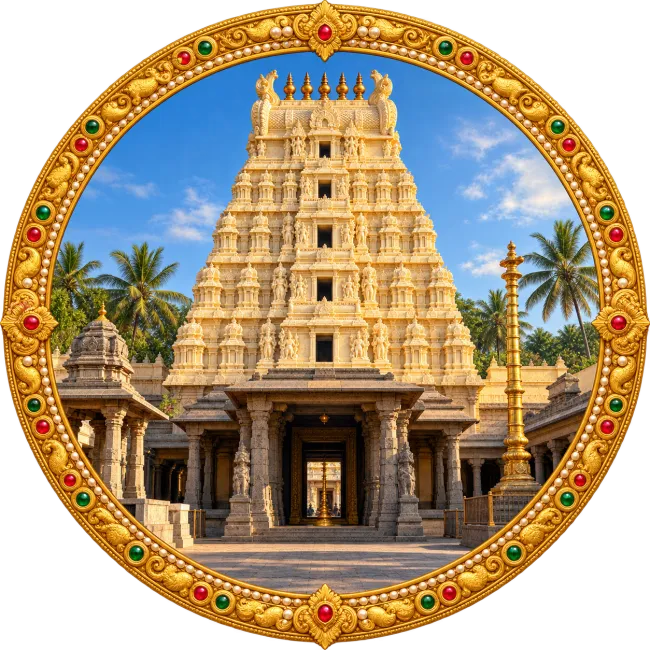
Sri Ranganathaswamy Temple, Srirangapatna
Sri Ranganathaswamy Temple in Srirangapatna, Karnataka, is one of South India’s most revered temples dedicated to Lord Vishnu. The Lord is worshipped here as Sri Ranganatha, reclining peacefully on the serpent king Adishesha.
Situated on an island formed by the Kaveri River, the temple is known as Adi Ranga, the first and principal Ranganatha shrine along the river’s sacred course. Its ancient Ganga-period foundation, Hoysala sculptures, Vijayanagara additions and association with the Wodeyars and Tipu Sultan make it an important religious and historical destination.
About Sri Ranganathaswamy Temple
Sri Ranganathaswamy Temple is located inside the historic Srirangapatna Fort in Mandya district. The temple is dedicated to Lord Vishnu in his reclining form.
The principal deity rests on Adishesha, whose multiple serpent hoods form a protective canopy above the Lord. Goddess Lakshmi is traditionally represented near his feet, while other divine figures surround him.
The town derives its name from the temple:
- Sri Ranga refers to Lord Ranganatha.
- Pattana means town or city.
Srirangapatna therefore means the town of Sri Ranganatha.
The temple follows Sri Vaishnavite traditions. Devotees worship Lord Ranganatha for peace, prosperity, family welfare and liberation.
When and Who Built Ranganathaswamy Temple?
Sri Ranganathaswamy Temple was originally constructed in 984 CE during the Western Ganga period.
An inscription credits Tirumalaiah, a local chief and administrator under the Ganga rulers, with building the original shrine.
During the twelfth century, Hoysala king Vishnuvardhana supported the temple and granted surrounding villages for its maintenance. Hoysala rulers and officials contributed sculptures, halls and provisions for regular worship.
The temple was later expanded under the Vijayanagara Empire. The entrance gopura, pillared halls and several architectural details reflect the Vijayanagara style.
The Mysuru Wodeyar rulers provided further patronage, including ornaments, land grants and support for festivals. Hyder Ali and Tipu Sultan also protected and supported the shrine while ruling from Srirangapatna.
The present temple therefore combines elements developed under the Gangas, Hoysalas, Vijayanagara rulers and Mysuru Wodeyars.
Legend of Lord Ranganatha
According to Vaishnavite tradition, Lord Vishnu manifested in the reclining form of Ranganatha to bless devotees and represent the peaceful state of the universe.
The Lord rests on Adishesha upon the cosmic ocean. This posture symbolises the period between two cycles of creation.
From Vishnu arises the power of creation, while his restful appearance represents divine control, protection and eternal peace.
At Srirangapatna, Lord Ranganatha is believed to bless devotees through the sacred waters of the Kaveri River, which surrounds the island.
Legend of the Kaveri River
The Kaveri is worshipped as a divine river and mother goddess. According to tradition, she desired Lord Vishnu to reside permanently on her islands.
Pleased by her devotion, Vishnu manifested as Ranganatha at important locations along the river.
Srirangapatna is regarded as Adi Ranga, the first major Ranganatha Kshetra. Shivanasamudra is known as Madhya Ranga, while Srirangam in Tamil Nadu is called Antya Ranga.
Pilgrims traditionally seek darshan at these sacred Ranganatha temples to receive the combined blessings of Lord Vishnu and Mother Kaveri.
Adi Ranga Significance
The title Adi Ranga distinguishes Srirangapatna from other Ranganatha temples situated along the Kaveri.
The principal sacred sequence includes:
Adi Ranga: Srirangapatna
Madhya Ranga: Shivanasamudra
Antya Ranga: Srirangam
A pilgrimage to these temples is considered highly auspicious. Each shrine presents Lord Vishnu in the reclining Ranganatha form.
Srirangapatna’s position upstream makes it the first major Ranganatha Kshetra encountered along the sacred river.
Religious Significance
Lord Ranganatha represents peace, protection and the preservation of the universe. His reclining posture reassures devotees that divine order continues even when the world appears uncertain.
People visit the temple to pray for:
Family peace and prosperity
Good health and long life
Marriage and marital harmony
Blessings for children
Success in education and employment
Financial stability
Relief from mental stress
Protection during journeys
Spiritual wisdom
Devotion to Lord Vishnu
Freedom from past karmas
Liberation from the cycle of birth and death
Ekadashi, Saturdays, Vaikuntha Ekadashi and important Vishnu festivals are considered especially auspicious.
Main Deity and Other Shrines
Sri Ranganathaswamy
Lord Vishnu is shown reclining on Adishesha. The image is large and occupies the principal sanctum.
The Lord is decorated with silk garments, Tulasi garlands, flowers and traditional ornaments.
Goddess Ranganayaki
Goddess Lakshmi is worshipped as Ranganayaki. Devotees pray to her for prosperity, marriage and family welfare.
Other deities and sacred figures include:
Lord Krishna
Lord Narasimha
Lord Venkateswara
Lord Rama
Hanuman
Garuda
Sri Ramanujacharya
Alwar saints
Sudarshana
Vishvaksena
Various forms of Lord Vishnu
The presence of Ramanujacharya and the Alwars reflects the temple’s connection with Sri Vaishnavism.
Architecture of Ranganathaswamy Temple
The temple combines Ganga, Hoysala, Vijayanagara and Dravidian architectural elements.
Entrance Gopura
The temple is entered through a tall gopura decorated with sculptures of deities and mythological figures.
The base is constructed from stone, while the upper levels contain traditional brick and plaster work.
Main Sanctum
The sanctum contains the reclining image of Ranganatha. Its interior is comparatively dark and illuminated by oil lamps.
Adishesha’s hoods rise above the Lord’s head, while Goddess Lakshmi and other divine figures appear nearby.
Navaranga Mandapa
The hall before the sanctum contains carved pillars reflecting Hoysala and Vijayanagara artistic traditions.
Images of Vishnu’s incarnations, divine attendants and decorative designs appear throughout the temple.
Garuda Stambha
A sacred pillar associated with Garuda stands in the temple complex. Garuda is Lord Vishnu’s divine vehicle and an important figure in Vaishnavite worship.
Enclosure Walls
Strong outer walls surround the temple. Their design reflects both sacred architecture and the protected character of Srirangapatna’s fortified settlement.
Sri Ranganathaswamy Temple Timings
The regular daily schedule is:
Timings may be extended or reorganised during Vaikuntha Ekadashi, Brahmotsavam and other major festivals.
Morning Puja and Deepa Aradhana
The temple opens at 7:30 AM with Suprabhata and the ceremonial opening of the sanctum.
Morning Puja and Deepa Aradhana are performed at 8:00 AM. The deity is worshipped with Tulasi, flowers, incense and sacred lamps.
Abhishekam and Alankaram rituals are conducted from 8:30 AM to 10:00 AM according to the temple schedule.
The best morning darshan period is from 8:00 AM to 10:30 AM. Weekday mornings generally offer a quieter experience.
Madhyahna Puja
Madhyahna Puja and Naivedyam are performed at 12:00 PM. Food is ceremonially offered to Lord Ranganatha, accompanied by traditional chants and sacred lamps.
Access to the sanctum may be paused during Naivedyam. The morning darshan session ends at 1:00 PM.
Visitors arriving close to midday should join the darshan queue before 12:15 PM.
Evening Puja and Deepa Aradhana
The temple reopens at 4:00 PM. Evening Puja and Deepa Aradhana are performed at 6:30 PM.
The best evening darshan period is from 4:30 PM to 6:30 PM. The temple receives soft natural light during this period, creating a peaceful atmosphere.
Night Mahamangalarathi is performed at 7:30 PM, followed by Ekanta Seva at 7:45 PM. The temple closes at 8:00 PM.
Major Festivals
Vaikuntha Ekadashi
Vaikuntha Ekadashi is one of the temple’s most important festivals. Devotees observe fasting, recite Vishnu Sahasranama and attend special darshan.
A ceremonial gateway associated with Vaikuntha may be opened according to temple tradition.
Brahmotsavam
The annual Brahmotsavam includes Vahana Sevas, processions, special Puja and cultural programmes.
Ratha Saptami
The processional deity is carried on ceremonial vehicles. The festival celebrates divine energy and the movement of the sun.
Jyesthabhisheka
Special Abhishekam and ceremonial worship are performed during Jyesthabhisheka.
Sri Rama Navami
Lord Rama is worshipped through special Puja, Ramayana recitation and devotional music.
Krishna Janmashtami
The birth of Lord Krishna is celebrated with special decoration, Puja and devotional singing.
Other festivals include Ugadi, Narasimha Jayanti, Deepavali and festivals associated with the Alwar saints.
Sevas and Offerings
Important temple Sevas may include:
Abhishekam
Sahasranama Archana
Ashtottara Archana
Tulasi Archana
Special Deepa Aradhana
Kalyanotsavam
Vahana Puja
Annadanam donation
Festival sponsorship
Tulasi leaves, flowers, coconuts, fruits and silk garments are common offerings to Lord Ranganatha.
Seva tickets and Puja materials should be obtained only through authorised counters.
Prasadam
Tulasi, flowers and blessed items may be distributed after worship. Food prasadam may also be available according to the daily temple arrangement.
Devotees should accept prasadam respectfully and avoid wasting food. Packaging must be placed in designated bins.
Dress Code and Temple Rules
Visitors should wear clean and modest clothing. Traditional Indian attire is recommended.
Men may wear a dhoti, kurta-pyjama or full-length trousers with a shirt. Women may wear a saree, salwar kameez or another modest outfit.
Specific inner areas or Sevas may require traditional clothing.
Footwear must be removed before entering. Mobile phones, cameras and large bags may be restricted near the sanctum. Photography and videography are prohibited inside designated worship areas.
Alcohol, tobacco, leather articles and non-vegetarian food must not be carried inside.
Entry Fee and Visit Duration
General darshan is available without an entry fee. Separate charges may apply to special darshan, Abhishekam, Archana and other Sevas.
A regular visit requires 1 to 1½ hours. Visitors who want to explore the architecture and all subsidiary shrines should keep 2 hours available.
A combined visit to the temple and Srirangapatna’s historical monuments requires half a day or a full day.
Best Time to Visit
October to February is the most comfortable period for visiting Srirangapatna. The weather is suitable for temple darshan and heritage sightseeing.
For peaceful darshan, visit between 8:00 AM and 10:00 AM on a weekday. Evening darshan from 4:30 PM to 6:30 PM is also convenient.
Vaikuntha Ekadashi provides a grand spiritual experience but attracts very large crowds.
How to Reach Sri Ranganathaswamy Temple
By Air
Mysuru Airport is the nearest airport. Kempegowda International Airport in Bengaluru offers broader domestic and international connectivity.
By Train
Srirangapatna Railway Station is the nearest station. Mysuru Junction is the closest major railway station and has connections with Bengaluru, Chennai and other cities.
Auto-rickshaws, buses and taxis are available from both stations.
By Road
Srirangapatna is located on the highway between Bengaluru and Mysuru. It is approximately 18 kilometres from Mysuru.
Government buses, private buses, taxis and local vehicles operate regularly. The temple lies within the historic fort area.
Nearby Places to Visit
Visitors may also explore:
Srirangapatna Fort
Tipu Sultan’s Summer Palace, Daria Daulat Bagh
Gumbaz
Colonel Bailey’s Dungeon
Sri Nimishambha Temple
Sangam
Karighatta Temple
Ranganathittu Bird Sanctuary
Garrison Cemetery
Wellesley Bridge
Mysore Palace
Chamundeshwari Temple
Srirangapatna Fort
The temple is situated within the historic Srirangapatna Fort. The area served as the capital of Hyder Ali and Tipu Sultan.
Visitors can see fort walls, gateways, dungeons, mosques and structures connected with the Anglo-Mysore Wars.
The temple predates the rule of Hyder Ali and Tipu Sultan by several centuries and remained an important place of worship during their reigns.
Sangam
Sangam is the meeting point of branches of the Kaveri River near Srirangapatna. It is considered sacred and is used for bathing and ancestral ceremonies.
Visitors should use designated ghats and follow all safety instructions, especially during the monsoon when currents become stronger.
Visitor Guidelines
Visit during the morning if you plan to combine the temple with Srirangapatna’s other monuments.
Purchase Puja and Seva tickets only from authorised counters. Keep receipts until the ritual is completed.
Maintain silence near the reclining deity and avoid blocking the darshan area. The sanctum has limited viewing space, so visitors should move according to the queue.
Wear clean, modest clothing and deposit footwear only at designated locations.
Follow traffic and parking instructions inside the fort area, particularly on weekends and festival days.
Conclusion
Sri Ranganathaswamy Temple at Srirangapatna is an important centre of Vaishnavite worship and one of Karnataka’s oldest surviving temples. Constructed in 984 CE and expanded under the Hoysalas, Vijayanagara rulers and Mysuru Wodeyars, it preserves over a thousand years of religious and architectural history.
Its reclining Ranganatha deity, Adi Ranga status, sacred Kaveri setting and location within Srirangapatna Fort make it a unique pilgrimage destination. A visit offers devotees an opportunity to seek peace, prosperity and the protective blessings of Lord Vishnu.