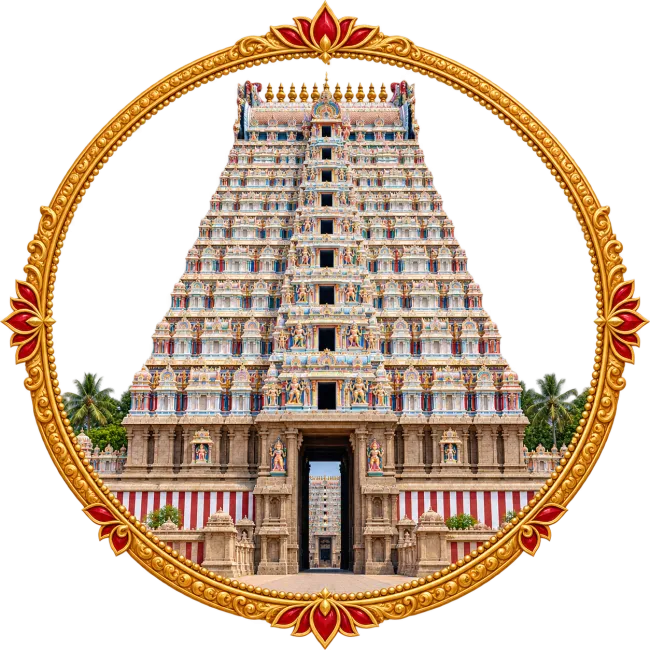
Sri Ranganathaswamy Temple, Srirangam
Visit Sri Ranganathaswamy Temple in Srirangam, one of the most sacred temples dedicated to Lord Vishnu and the foremost among the 108 Divya Desams. Located on an island formed by the Kaveri and Kollidam rivers near Tiruchirappalli, the temple is worshipped as Bhuloka Vaikuntham—the earthly abode of Lord Vishnu.
The temple is famous for its enormous complex, seven concentric Prakarams, 21 Gopurams, towering Rajagopuram and the reclining form of Lord Ranganatha. It is also one of the most important centres of the Sri Vaishnava tradition and is closely associated with Sri Ramanujacharya.
About Sri Ranganathaswamy Temple
Sri Ranganathaswamy Temple is situated in Srirangam, Tiruchirappalli district of Tamil Nadu. The temple is dedicated to Lord Vishnu in his reclining form as Sri Ranganatha.
Lord Ranganatha rests upon Adishesha, the divine serpent, with his head facing west and feet towards the east. His face is turned south in the direction of Sri Lanka, symbolically blessing his devotee Vibhishana.
Goddess Lakshmi is worshipped separately as Sri Ranganayaki Thayar.
The temple is referred to simply as Koil, meaning “The Temple,” within the Sri Vaishnava tradition. Similarly, Tirumala is called Tirumalai and Kanchipuram is called Perumal Koil.
History of Sri Ranganathaswamy Temple
The religious history of Srirangam extends back to ancient Tamil literature. References to Lord Ranganatha and Srirangam appear in early works, including the Tamil epic Silappadikaram.
According to temple tradition, an early shrine was constructed by a Chola ruler named Dharmavarma. The temple was later affected by flooding from the Kaveri River and became covered by earth and vegetation.
A later Chola king, traditionally identified as Killi Valavan, rediscovered the sacred shrine and restored it.
The temple was expanded over several centuries by different South Indian dynasties, including:
- Cholas
- Pandyas
- Hoysalas
- Vijayanagara rulers
- Madurai Nayaks
These rulers constructed Gopurams, Mandapams, enclosures, shrines and water facilities. They also donated land, jewellery and funds for festivals and daily worship.
During the 14th century, the temple faced military invasions and periods of disruption. The Utsava deity, Namperumal, was moved to different locations for protection. The deity was eventually brought back, and regular worship was restored.
Later Vijayanagara rulers and Nayaka chiefs contributed extensively to the temple’s reconstruction.
Completion of the Rajagopuram
The enormous southern Rajagopuram remained incomplete for several centuries. Its construction was resumed during the 20th century with the support of religious leaders and devotees.
The Rajagopuram was completed and consecrated in 1987. Rising approximately 73 metres, it is one of the tallest temple towers in Asia.
The tower contains multiple storeys decorated with colourful sculptures of deities, saints and mythological figures.
Srirangam as a Divya Desam
Sri Ranganathaswamy Temple is considered the foremost of the 108 Divya Desams praised by the Alvar saints.
Eleven Alvars composed hymns in praise of Lord Ranganatha, making Srirangam one of the most celebrated temples in the Nalayira Divya Prabandham.
The temple is also regarded as the first of the eight self-manifested Vishnu shrines known as Swayam Vyakta Kshetras.
Lord Ranganatha is treated as a living king. His daily rituals, processions, food offerings, clothing and ceremonial arrangements follow the traditions of royal service.
Legend of Lord Ranganatha and Vibhishana
According to temple mythology, the sacred image of Lord Ranganatha originally appeared from the cosmic ocean and was worshipped by Lord Brahma.
The deity was later given to King Ikshvaku and became the family deity of the Solar Dynasty. Lord Rama inherited the image and worshipped it in Ayodhya.
After defeating Ravana, Lord Rama presented the Ranganatha deity to Vibhishana, who was returning to Sri Lanka.
Vibhishana was instructed not to place the deity upon the ground during his journey. When he reached the Kaveri River, he wanted to perform his evening prayers.
Lord Ganesha appeared in the form of a young boy and offered to hold the deity. After calling Vibhishana three times, Ganesha placed the image on the ground.
When Vibhishana returned, he could not lift the deity. Lord Ranganatha explained that he wished to remain at Srirangam but would face south to bless Vibhishana and Sri Lanka.
Religious Significance of the Temple
Srirangam represents Vaikuntha on earth. Devotees believe that worshipping Lord Ranganatha provides peace, spiritual wisdom and liberation from the cycle of birth and death.
People visit the temple for:
- Family peace and prosperity
- Blessings for marriage
- Health and well-being of children
- Recovery from illness
- Success in education and employment
- Growth in business
- Protection from difficulties
- Relief from planetary problems
- Spiritual progress
- Devotion to Lord Vishnu
- Freedom from fear
- Blessings for liberation
Devotees also worship Ranganayaki Thayar for compassion, prosperity and family harmony.
Main Deity of Sri Ranganathaswamy Temple
The principal deity is Sri Ranganatha, a reclining manifestation of Lord Vishnu.
Lord Ranganatha rests on Adishesha beneath the serpent’s protective hoods. Lord Brahma is shown emerging from a lotus connected with Vishnu’s navel.
The reclining posture represents Yoga Nidra, the state of divine awareness in which Lord Vishnu maintains and protects the universe.
The Utsava deity is known as Namperumal, meaning “Our Lord.” Namperumal participates in processions and festivals throughout the year.
Ranganayaki Thayar Shrine
Goddess Lakshmi is worshipped as Sri Ranganayaki Thayar. Her shrine holds exceptional importance and follows an independent worship schedule.
According to temple tradition, Lord Ranganatha visits Ranganayaki Thayar during the Panguni Uthiram festival. Thayar does not leave her own shrine for outside processions.
Devotees seek her blessings for:
- Marriage
- Family prosperity
- Children
- Compassion
- Financial stability
- Peaceful relationships
Sri Ramanuja Shrine
Srirangam is closely associated with Sri Ramanujacharya, the great philosopher and exponent of Vishishtadvaita.
Ramanuja lived at Srirangam and organized temple worship, administration and Sri Vaishnava practices.
A sacred shrine contains the preserved form of Sri Ramanuja in a seated posture. Devotees worship him as Udayavar.
The shrine is an important pilgrimage destination for students of Vedanta and followers of the Sri Vaishnava tradition.
Architecture of Sri Ranganathaswamy Temple
The temple is one of the world’s largest functioning Hindu temple complexes. It covers approximately 156 acres.
Important architectural features include:
- Seven concentric Prakarams
- Twenty-one Gopurams
- Seventy-three-metre Rajagopuram
- Sacred golden Vimana
- Thousand-Pillared Hall
- Garuda Mandapam
- Sesha Mandapam
- Horse sculptures
- Ancient inscriptions
- Temple tanks
- Granaries and kitchens
- Residential streets within outer enclosures
The seven enclosures are often interpreted as representing the seven spiritual levels through which a devotee progresses towards the Supreme Being.
Sri Ranganathaswamy Temple Timings
The temple remains open from 6:00 AM to 9:00 PM, but public darshan pauses during scheduled Puja periods.
Darshan remains paused during the three principal Puja periods. Festival schedules may differ.
Vishwaroopa Seva
Vishwaroopa Seva is conducted from 6:00 AM to 7:15 AM. It is the first worship of Lord Ranganatha for the day.
The Lord is awakened with:
- Sacred music
- Vedic chanting
- Cow and elephant presentation
- Lamps
- Traditional instruments
- Recitation of devotional hymns
Separate tickets may be issued for Vishwaroopa Seva. Devotees should reach the temple before 5:45 AM.
Morning Puja and Alankaram
Morning Puja and Alankaram are performed from 7:15 AM to 9:00 AM. Public darshan pauses during this period.
The deity receives:
- Ritual purification
- Fresh garments
- Flower garlands
- Tulsi
- Sandalwood
- Jewellery
- Naivedyam
- Deepa Aradhana
General morning darshan begins at 9:00 AM.
Midday Puja and Naivedyam
Midday Puja is performed from 12:00 PM to 1:15 PM. Darshan remains paused while Naivedyam and other rituals are conducted.
Afternoon darshan begins at 1:15 PM and continues until 6:00 PM.
Evening Puja and Deepa Aradhana
Evening Puja is conducted from 6:00 PM to 6:45 PM. Public darshan pauses during the ceremony.
Lamps, incense, flowers and Naivedyam are presented before Lord Ranganatha. Evening darshan resumes at 6:45 PM and continues until 9:00 PM.
Major Festivals Celebrated
Vaikunta Ekadashi
Vaikunta Ekadashi is the largest festival at Srirangam. The celebration extends for 21 days and includes:
- Pagal Pathu
- Ra Pathu
- Opening of Paramapada Vasal
- Recitation of Divya Prabandham
- Namperumal processions
- Special Alankarams
Thousands of devotees wait overnight for entry through the Paramapada Vasal, symbolizing the gateway to Vaikuntha.
Panguni Uthiram
Panguni Uthiram celebrates the divine union of Lord Ranganatha and Ranganayaki Thayar.
Chithirai Ther
Namperumal is taken through Srirangam in a massive temple chariot pulled by devotees.
Theppotsavam
The Float Festival features the Utsava deity travelling upon a decorated float in the temple tank.
Jyeshta Abhishekam
Special Abhishekam and protective ceremonies are performed for the deity.
Krishna Jayanti
Lord Krishna’s birth is celebrated with special worship and processions.
Kaisika Ekadashi
The story of Nambaduvan and the importance of devotion are commemorated.
Sevas and Offerings
Important Sevas may include:
- Vishwaroopa Seva
- Archana
- Sahasranama Archana
- Thirumanjanam
- Tulsi offering
- Flower garlands
- Ghee lamps
- Vastra Seva
- Annadanam
- Ubhayam for festivals
- Temple chariot sponsorship
Seva bookings should be made only through official temple counters.
Prasadam
Temple Prasadam may include:
- Puliyodarai
- Sakkarai Pongal
- Curd rice
- Pongal
- Appam
- Laddu
- Vadai
- Dosai
Srirangam’s temple kitchen follows traditional preparation methods. Prasadam availability depends on the day and festival programme.
Dress Code and Entry Rules
Devotees should wear clean, modest and traditional clothing.
Recommended clothing includes:
- Dhoti, Veshti or full-length trousers for men
- Saree, half-saree, Salwar Kameez or other modest clothing for women
- Traditional clothing for children
Shorts, sleeveless outfits and revealing clothing should be avoided.
Photography and videography are restricted in inner areas. Mobile phones, cameras and large bags may need to be deposited at designated counters.
Entry into the innermost sanctum area is governed by traditional temple rules.
Entry Fee and Visit Duration
General darshan is free. Paid Sevas and special-darshan options may be available.
A regular visit requires two to three hours because of the size of the complex. Visitors wishing to see the major shrines, Ramanuja shrine and architectural halls should keep four to five hours.
During Vaikunta Ekadashi and Brahmotsavam, darshan may require considerably longer.
Visitor Guidelines
- Check Puja breaks before joining the queue.
- Remove footwear at the designated stand.
- Wear traditional and modest clothing.
- Follow photography restrictions.
- Keep mobile phones silent.
- Do not touch sculptures or inscriptions.
- Use official counters for Sevas and donations.
- Do not purchase access from unauthorized agents.
- Maintain silence near the sanctum.
- Accept Prasadam respectfully.
- Keep the temple and tank clean.
- Carry drinking water during hot weather.
- Keep children and elderly devotees under supervision.
- Follow instructions from priests and security personnel.
Best Time to Visit
November to February is the best period for visiting Srirangam because the weather remains pleasant.
For a quieter visit, choose a regular weekday between 9:00 AM and 11:00 AM.
Evening darshan from 6:45 PM to 8:00 PM provides a peaceful experience after Deepa Aradhana.
Vaikunta Ekadashi offers the grandest devotional experience but attracts extremely large crowds.
How to Reach Sri Ranganathaswamy Temple
By Air
Tiruchirappalli International Airport is the nearest airport, approximately 15 kilometres from Srirangam.
By Train
Srirangam Railway Station is located close to the temple.
Tiruchirappalli Junction is approximately 12 kilometres away and is connected with Chennai, Madurai, Coimbatore, Bengaluru and other major cities.
By Bus
Frequent city buses operate between Tiruchirappalli, Srirangam and nearby towns.
By Road
Taxis, auto-rickshaws and private vehicles are available throughout Tiruchirappalli.
Vehicle access is restricted within certain streets near the temple, particularly during festivals.
Nearby Places to Visit
- Jambukeswarar Temple
- Uthamar Kovil
- Rockfort Ucchi Pillayar Temple
- Thayumanaswamy Temple
- Samayapuram Mariamman Temple
- Vekkali Amman Temple
- Gunaseelam Prasanna Venkatachalapathy Temple
- Kallanai Dam
- Kaveri River Ghats
- Tiruchirappalli Rockfort
- Butterfly Park
- Vayalur Murugan Temple
Conclusion
Sri Ranganathaswamy Temple is the spiritual heart of the Sri Vaishnava tradition and the foremost among the 108 Divya Desams. Its ancient history, enormous architecture, seven Prakarams and magnificent reclining deity make it one of India’s most significant Vishnu temples.
The temple’s association with Vibhishana, the Alvar saints and Sri Ramanujacharya gives it exceptional religious importance.
A visit to Srirangam offers devotees the blessings of Lord Ranganatha and an opportunity to experience centuries of South Indian architecture, philosophy, ritual and devotion.