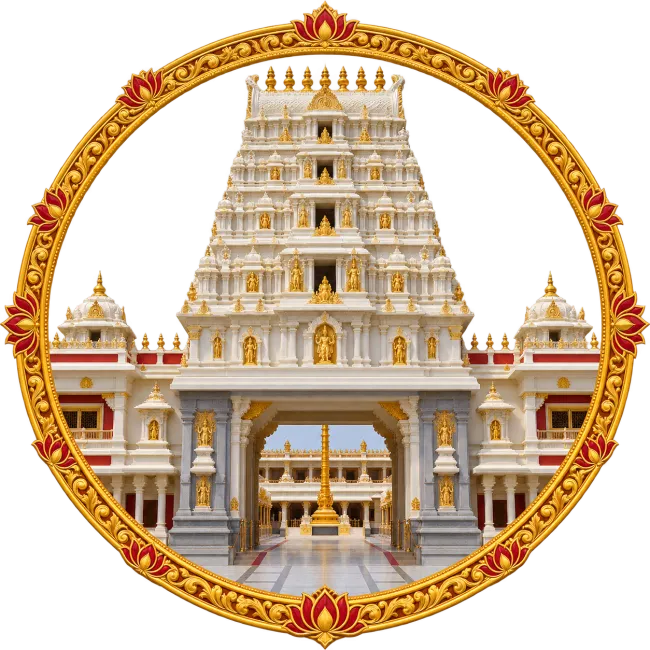
Sri Raghavendra Swamy Temple, Mantralayam
Sri Raghavendra Swamy Temple in Mantralayam, Andhra Pradesh, is one of India’s most revered spiritual centres dedicated to Guru Raghavendra Swamy. Situated on the banks of the Tungabhadra River, the temple contains the sacred Jeeva Brindavana where the saint entered deep meditation in 1671.
Also known as Mantralayam Raghavendra Swamy Matha, the shrine attracts devotees from Andhra Pradesh, Karnataka, Telangana, Tamil Nadu and Maharashtra. People visit the temple to seek the Guru’s blessings for education, health, marriage, children, employment and relief from difficult circumstances.
About Sri Raghavendra Swamy Temple
Sri Raghavendra Swamy Temple is centred on the Jeeva Brindavana of Sri Raghavendra Tirtha, a distinguished saint and philosopher of the Dvaita Vedanta tradition established by Sri Madhvacharya.
Unlike a conventional temple containing only an idol, Mantralayam is primarily a sacred Matha and Brindavana shrine. Devotees believe that Guru Raghavendra remains spiritually present within the Brindavana and continues to bless those who approach him with faith.
The complex also preserves the traditional worship of Sri Moola Rama, an ancient deity worshipped by successive pontiffs of the Madhva tradition. Daily Vedic rituals, Mahapuja, Rathotsava, devotional chanting and Annadanam form an important part of life at Mantralayam.
Devotees respectfully address the saint as Rayaru or Guru Raghavendra. The chant “Om Sri Raghavendraya Namaha” is recited throughout the pilgrimage centre.
Who Was Sri Raghavendra Swamy?
Sri Raghavendra Swamy was born in 1595 at Bhuvanagiri in present-day Tamil Nadu. His childhood name was Venkatanatha. His parents were Thimmanna Bhatta and Gopikamba.
Venkatanatha displayed exceptional intelligence and devotion from an early age. He became highly learned in the Vedas, Sanskrit grammar, music, logic and Dvaita philosophy.
He married Saraswati Bai and lived as a householder for a period. Despite his scholarship, the family experienced severe financial difficulties. Venkatanatha continued teaching students and following a disciplined spiritual life.
He later accepted Sannyasa under Sri Sudheendra Tirtha and received the monastic name Sri Raghavendra Tirtha. He became the head of the Matha and travelled extensively, teaching Dvaita Vedanta, participating in philosophical discussions and helping devotees.
Guru Raghavendra wrote several important works explaining the teachings of Madhvacharya, Jayatirtha and Vyasaraja. He became known for his scholarship, compassion and miraculous assistance to devotees.
When Was the Mantralayam Temple Established?
The sacred centre at Mantralayam was established in 1671 when Sri Raghavendra Swamy entered Jeeva Samadhi within the Brindavana.
The land was part of the Adoni region, which was governed by Nawab Siddi Masud Khan. According to tradition, the Nawab granted the village of Manchala to Guru Raghavendra after witnessing his spiritual power.
Guru Raghavendra selected the site because it was considered sacred from the time of Prahlada. The Guru instructed his disciples to construct the Brindavana using consecrated stones.
On the appointed day in 1671, Guru Raghavendra entered the Brindavana while reciting sacred prayers and holding his rosary. His disciples placed the prescribed stone slabs over the structure after receiving his signal.
The original Brindavana became the spiritual centre of the present Matha. Additional shrines, halls, queue complexes, accommodation buildings and pilgrim facilities were developed during later centuries.
Why Is It Called Mantralayam?
The earlier name of the village was Manchala. It was associated with Goddess Manchalamma, the local guardian deity.
After Guru Raghavendra established his sacred presence here, the location gradually became known as Mantralayam. The name reflects the spiritual power of mantras, meditation and the Guru’s divine presence.
Devotees traditionally visit Manchalamma Temple before entering the Raghavendra Swamy Matha. According to local tradition, Guru Raghavendra received the Goddess’s permission before selecting the land for his Brindavana.
Jeeva Brindavana of Guru Raghavendra
A Jeeva Brindavana is a sacred structure associated with a realised saint who enters deep spiritual meditation while still alive. Devotees believe that the saint continues to guide and bless followers through the Brindavana.
Guru Raghavendra did not undergo an ordinary burial. He consciously entered meditation and instructed his disciples to construct the Brindavana over him.
The Brindavana is decorated with flowers, silk cloth and sacred ornaments. Abhishekam is performed to the Brindavana according to the traditions of the Matha.
Devotees stand before it, offer prayers and recite the Guru Stotra. Circumambulating the Brindavana is considered highly auspicious.
Connection with Prahlada
According to Madhva tradition, Sri Raghavendra Swamy is associated with Prahlada, the devoted follower of Lord Narasimha.
Mantralayam is believed to be the location where Prahlada performed a sacred Yajna in an earlier age. Guru Raghavendra selected the site because of its spiritual connection with Prahlada and Lord Narasimha.
The Guru is traditionally described as part of a spiritual lineage involving Prahlada, Bahlika Raja and Vyasaraja before his incarnation as Raghavendra Tirtha.
This association gives Mantralayam special importance among devotees of Lord Vishnu, Narasimha and the Madhva tradition.
Religious Significance
Devotees believe that Guru Raghavendra responds to sincere prayer and helps people overcome difficulties. He is especially revered by students, teachers, families and those experiencing professional or financial challenges.
People visit Mantralayam to pray for:
- Success in education and examinations
- Employment and professional growth
- Relief from financial difficulties
- Good health and recovery from illness
- Marriage and marital harmony
- Blessings for children
- Peace within the family
- Relief from fear and anxiety
- Protection from negative influences
- Spiritual wisdom and devotion
- Strength during difficult periods
- Fulfilment of sincere wishes
Thursday is considered especially auspicious for Guru worship. The temple receives larger crowds on Thursdays, weekends and festival days.
Main Sacred Places Within the Complex
Sri Raghavendra Swamy Brindavana
The Jeeva Brindavana is the principal sacred place. Devotees offer prayers, flowers and Seva before the Brindavana.
Sri Moola Rama Shrine
Moola Rama is the principal deity traditionally worshipped by the pontiffs of the Matha. Daily Mahapuja is performed according to Madhva traditions.
Sri Vadeendra Tirtha Brindavana
The Brindavana of Sri Vadeendra Tirtha, an important saint of the lineage, is situated near the main Brindavana.
Sri Sudharmeendra Tirtha and Other Pontiffs
The temple complex contains Brindavanas and memorials associated with other respected pontiffs of the Matha.
Manchalamma Temple
The shrine of Goddess Manchalamma is located near the Matha. Devotees traditionally visit this temple before taking darshan of Guru Raghavendra.
Architecture of Mantralayam Temple
The temple complex combines traditional South Indian Matha architecture with facilities required for large numbers of pilgrims.
The main entrance leads towards spacious queue halls and the Brindavana area. The sacred Brindavana is protected by a decorated enclosure and surrounded by areas used for worship and circumambulation.
The complex contains:
- The main Brindavana shrine
- Moola Rama worship area
- Brindavanas of other pontiffs
- Vedic study and ritual spaces
- Annadanam halls
- Seva counters
- Accommodation buildings
- Prasadam counters
- Meditation and devotional areas
The architecture is simple compared with highly sculpted Dravidian temples because the spiritual focus remains on the Guru’s Brindavana and the traditional activities of the Matha.
Sri Raghavendra Swamy Temple Timings
The regular daily schedule is:
Timings may be reorganised during Aradhana Mahotsava, Thursdays, public holidays and other major celebrations.
Morning Puja and Mahamangalarathi
The temple opens at 6:00 AM with Suprabhata prayers and the ceremonial opening of the Brindavana area.
Nirmalya Visarjana and other morning rituals are performed from 6:30 AM. Abhishekam and Alankaram are conducted from 7:30 AM to 8:30 AM.
Morning Mahamangalarathi is performed at 8:30 AM. Devotees gather before the Brindavana while lamps are offered and devotional hymns are recited.
The best morning darshan period is from 7:00 AM to 10:00 AM. Visitors who want to attend Mahamangalarathi should join the queue before 8:00 AM.
Moola Rama Mahapuja
Moola Rama Mahapuja is one of the most important daily rituals at Mantralayam. It is performed from 10:00 AM to 12:00 PM according to the traditions of the Madhva Matha.
The sacred Moola Rama deity is worshipped with Abhishekam, Tulasi, flowers, Naivedyam and Vedic chanting. The serving pontiff or designated priests conduct the ceremony.
Devotees should maintain silence and observe the ritual respectfully. The ceremony reflects the unbroken tradition of Rama worship followed by Guru Raghavendra and earlier pontiffs.
Evening Rathotsava and Mahamangalarathi
The temple reopens at 4:00 PM after the afternoon break. Evening darshan continues until 9:00 PM.
Rathotsava and related evening Seva are performed at 7:00 PM. The processional representation of Guru Raghavendra is carried ceremonially while devotees chant hymns and the Guru’s name.
Evening Mahamangalarathi is performed at 8:00 PM. The best evening darshan period is from 4:30 PM to 7:30 PM.
Final darshan continues after the Harathi, and the temple closes at 9:00 PM.
Important Sevas
Devotees can participate in several Sevas, including:
- Panchamrita Abhishekam
- Kanakabhishekam
- Pushparchana
- Hastodaka Seva
- Sarva Seva
- Rathotsava Seva
- Tulabhara Seva
- Annadanam Seva
- Nanda Deepa Seva
- Go Seva
- Vastra Seva
- Special Mahamangalarathi
- Parimala Prasada Seva
Seva availability and participation rules depend on the daily Matha schedule. Tickets should be purchased only from authorised counters.
Offerings should not be placed directly on the Brindavana unless permitted by the priests.
Major Festivals
Sri Raghavendra Swamy Aradhana
The annual Aradhana Mahotsava commemorates the day Guru Raghavendra entered the Brindavana. It is the largest festival celebrated at Mantralayam.
The celebration includes Vedic chanting, special Abhishekam, Moola Rama Puja, Rathotsava, cultural programmes and Annadanam. Thousands of devotees attend the festival.
Raghavendra Jayanti
The birth anniversary of Guru Raghavendra is observed with special worship, devotional chanting and religious discourses.
Madhva Navami
Madhva Navami honours Sri Madhvacharya, the founder of Dvaita Vedanta. Special prayers and philosophical discourses are organised.
Narasimha Jayanti
The festival celebrates Lord Narasimha and the devotion of Prahlada. It has special importance because of Guru Raghavendra’s traditional association with Prahlada.
Rama Navami
Sri Rama Navami is celebrated with special worship of Moola Rama, devotional music and recitation of the Ramayana.
Other important occasions include Vaikuntha Ekadashi, Hanuman Jayanti, Krishna Janmashtami and Deepavali.
Tungabhadra River and Sacred Bath
The Tungabhadra River flows beside Mantralayam. Pilgrims traditionally take a bath in the river before visiting the temple.
Visitors should use designated bathing ghats and follow all safety instructions. Entering deep or fast-moving water should be avoided, particularly during the monsoon and periods of high river flow.
Those unable to bathe in the river may wash their hands and feet before entering the temple.
Prasadam and Annadanam
Mantralayam is well known for its Annadanam service. Free meals are served to devotees in the designated dining hall, generally from 12:00 PM to 2:00 PM.
Food is prepared according to the traditional practices of the Matha. Devotees should sit in the assigned rows, accept the meal respectfully and avoid wasting food.
Parimala Prasada, sacred Mantrakshata and other blessed items may be distributed after Seva or obtained from authorised counters.
Dress Code and Temple Rules
Traditional and modest clothing is recommended. Men may wear a dhoti, kurta-pyjama or full-length trousers with a shirt. Women may wear a saree, salwar kameez or another modest Indian outfit.
Specific Sevas may require stricter traditional dress. Men participating in designated rituals may be required to wear a dhoti and remove their shirt according to Matha customs.
Footwear must be removed before entry. Photography and videography are prohibited near the Brindavana and worship areas. Mobile phones should remain silent and may need to be deposited at an authorised counter.
Alcohol, tobacco, leather articles and non-vegetarian food must not be carried inside.
Entry Fee and Visit Duration
General darshan is available without an entry fee. Charges apply to Abhishekam, Rathotsava, special Sevas and sponsored worship.
A regular visit requires 1½ to 2 hours. Devotees attending Moola Rama Mahapuja, Annadanam or a special Seva should keep 3 to 4 hours available.
Waiting time is longer on Thursdays, weekends and during the annual Aradhana festival.
Best Time to Visit
October to February is the most comfortable period for visiting Mantralayam. Summers are extremely hot, particularly during the afternoon.
For peaceful darshan, arrive between 7:00 AM and 9:00 AM on a weekday. Evening darshan from 4:30 PM to 7:30 PM is suitable for attending Rathotsava.
Thursday is spiritually significant but usually more crowded. The Aradhana festival offers the grandest experience, but accommodation should be booked well in advance.
How to Reach Mantralayam
By Air
Rajiv Gandhi International Airport in Hyderabad is the nearest major airport with extensive connectivity. Ballari and Kurnool airports may also be considered depending on available services.
By Train
Mantralayam Road Railway Station is the nearest railway station. It is situated approximately 16 kilometres from the temple town.
Trains connecting Hyderabad, Bengaluru, Chennai, Mumbai and other cities stop at Mantralayam Road. Buses, taxis and shared vehicles are available outside the station.
By Road
Mantralayam is connected by road with Kurnool, Adoni, Raichur, Hyderabad, Bengaluru and Ballari. Government and private buses operate from major regional cities.
The temple is close to the Karnataka border, making it easily accessible from Raichur.
Nearby Places to Visit
Visitors may also explore:
- Manchalamma Temple
- Tungabhadra River and bathing ghats
- Panchamukhi Anjaneya Temple
- Bichale Appanacharya Temple
- Chikka Mantralaya
- Venkateswara Swamy Temple
- Madhavaram
- Adoni Fort
- Raichur
- Urukunda Eranna Swamy Temple
Panchamukhi Anjaneya Temple
Panchamukhi is an important pilgrimage site near Mantralayam. According to tradition, Guru Raghavendra performed penance here and received the divine vision of Panchamukhi Hanuman.
The deity represents Hanuman with five faces—Hanuman, Narasimha, Garuda, Varaha and Hayagriva. Many pilgrims include Panchamukhi in their Mantralayam journey.
The road may pass through rural areas, so visitors should arrange reliable transport and complete the visit during daylight.
Visitor Guidelines
Visit Manchalamma Temple before entering the Raghavendra Swamy Matha, following the traditional pilgrimage order.
Arrive early if you wish to attend morning Mahamangalarathi or Moola Rama Mahapuja. Keep Seva tickets and identification safely until the ritual is complete.
Maintain silence near the Brindavana. Do not touch the sacred structure, cross barriers or place offerings in unauthorised areas.
Book accommodation in advance for Thursdays, weekends and the Aradhana festival. Summer visitors should carry sufficient drinking water and avoid unnecessary outdoor travel during the afternoon.
Conclusion
Sri Raghavendra Swamy Temple at Mantralayam is a powerful centre of devotion, learning and spiritual comfort. The sacred Jeeva Brindavana, Moola Rama worship, Tungabhadra River and centuries-old traditions create a deeply peaceful atmosphere.
Guru Raghavendra’s life represents knowledge, compassion, discipline and complete devotion to God. Devotees believe that he remains spiritually present at Mantralayam and continues to guide those who pray with sincerity. A pilgrimage to Mantralayam offers faith, courage and strength to face life’s challenges.