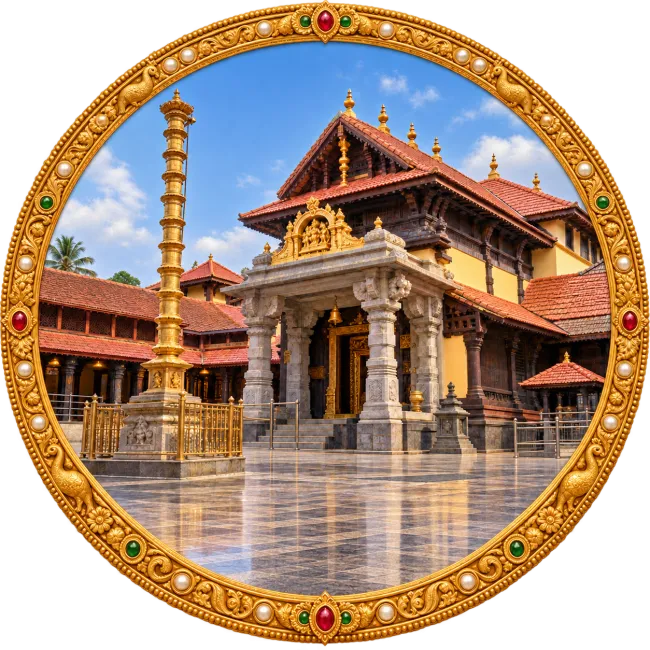
Sri Krishna Temple, Udupi
Sri Krishna Temple in Udupi, Karnataka, is one of India’s most revered temples dedicated to Lord Krishna. The deity is worshipped here in the charming form of Balakrishna, holding a churning rod and rope. Established by the great philosopher Sri Madhvacharya during the thirteenth century, the temple became an important centre of Dvaita Vedanta and Krishna devotion.
Unlike most Hindu temples, devotees traditionally view Lord Krishna through a silver-plated window with nine openings known as Navagraha Kindi. The temple is also famous for Kanakana Kindi, associated with the devotee-saint Kanakadasa. Its distinctive worship traditions, Ashta Mathas, Paryaya system, devotional music and community meals make Udupi one of Karnataka’s most important pilgrimage destinations.
About Sri Krishna Temple, Udupi
Sri Krishna Temple, commonly known as Udupi Sri Krishna Matha, is situated in the centre of Udupi city. The main deity is Lord Krishna in his childhood form.
The idol portrays Krishna holding a churning rod in one hand and a rope in the other. This form is connected with the childhood activities of Krishna in Gokul, particularly his love for butter.
The deity faces west, which is unusual because many Hindu temple deities face east. According to tradition, the idol originally faced east but later turned west to bless the devotee Kanakadasa.
The temple follows the Dvaita philosophy and worship traditions established by Sri Madhvacharya. Its administration rotates among eight monasteries called the Ashta Mathas under the Paryaya system.
The temple complex includes the Krishna shrine, Madhva Sarovara, Ashta Mathas, Kanakana Kindi, dining halls and several smaller shrines.
When and Who Built Udupi Krishna Temple?
Udupi Krishna Temple was established during the thirteenth century by Sri Madhvacharya, the founder of the Dvaita Vedanta school of philosophy. The establishment of the temple is generally associated with the period between 1238 and 1317, during Madhvacharya’s life.
According to tradition, Madhvacharya recovered the sacred image of Krishna from a large block of Gopichandana carried aboard a ship travelling near the Malpe coast.
After discovering the idol, he brought it to Udupi, installed it and established regular worship. He appointed eight disciples to manage the temple through eight monastic institutions.
The temple was expanded and renovated by successive pontiffs, regional rulers and devotees. Its present complex developed gradually while preserving the central worship traditions established by Madhvacharya.
Legend of the Krishna Idol
Sri Madhvacharya was meditating near the shore. He signalled the ship and helped guide it safely to land. The ship’s captain offered Madhvacharya a valuable reward, but the saint asked only for a block of Gopichandana.
When the block was opened, an image of Balakrishna was discovered inside. The idol is believed to have been worshipped by Rukmini, the principal queen of Lord Krishna.
Madhvacharya carried the image to Udupi and installed it in the present temple. He composed devotional hymns and established a detailed system of daily worship.
Legend of Kanakadasa
Kanakadasa was a distinguished poet, musician and devotee of Lord Krishna. He travelled to Udupi to receive darshan but was denied entry because of the social restrictions practised during that period.
Kanakadasa stood outside the western wall and prayed to Krishna with complete devotion. According to tradition, the idol turned from east to west, and an opening appeared in the wall so the devotee could receive darshan.
This opening became known as Kanakana Kindi, meaning Kanaka’s window. The incident represents the belief that sincere devotion is more important than social identity or external status.
Today, devotees visit Kanakana Kindi before or after entering the main temple. Lord Krishna continues to face west in the direction associated with Kanakadasa.
Religious Significance
Udupi Krishna Temple is one of the leading centres of Krishna worship and Dvaita Vedanta. Sri Madhvacharya taught that the individual soul and the Supreme Being are distinct and that liberation is attained through knowledge, devotion and divine grace.
Devotees visit the temple to pray for:
Spiritual knowledge and devotion
Success in education
Good health and long life
Marriage and family happiness
Blessings for children
Protection from difficulties
Peace and prosperity
Relief from fear and anxiety
Professional growth
Discipline and clarity of mind
Worshipping Balakrishna is considered especially beneficial for children and students. Parents bring children to the temple for health, intelligence and good character.
Main Deity of Udupi Krishna Temple
Lord Krishna is worshipped as a young child holding a churning rod and rope. The image is decorated with different ornaments, garments and flowers throughout the day.
The Alankaram changes according to festivals, sacred occasions and the imagination of the worshipping pontiff. Krishna may be decorated in forms connected with different incarnations and divine stories.
Devotees view the Lord through the Navagraha Kindi. The nine openings are traditionally associated with the nine planets and the nine forms of devotion.
The sanctum has a deeply devotional atmosphere created by lamps, chanting, bells and traditional musical instruments.
Ashta Mathas of Udupi
Sri Madhvacharya established eight monasteries and appointed eight disciples to manage Krishna’s worship. These institutions are known as the Ashta Mathas:
Palimaru Matha
Adamaru Matha
Krishnapura Matha
Puttige Matha
Shirur Matha
Sodhe Matha
Kaniyooru Matha
Pejavara Matha
Each Matha receives responsibility for temple administration and Krishna worship for a fixed two-year term.
These monasteries preserve Madhvacharya’s philosophy, Vedic education, traditional worship and religious literature.
Paryaya Tradition
Paryaya is the ceremonial transfer of temple administration from one Ashta Matha to another. It takes place once every two years.
The incoming pontiff assumes responsibility for:
Daily worship of Lord Krishna
Temple administration
Religious festivals
Annadanam
Vedic education
Maintenance of temple traditions
The Paryaya procession is one of Udupi’s grandest celebrations. The incoming Swamiji enters the city in a ceremonial procession accompanied by decorated vehicles, music, cultural performances and thousands of devotees.
Architecture of Udupi Krishna Temple
Udupi Krishna Temple differs from the towering Dravidian temples of Tamil Nadu. Its architecture reflects the coastal Karnataka style, with sloping tiled roofs, wooden structures, stone courtyards and functional monastic buildings.
Main Sanctum
The sanctum houses the Balakrishna idol. Devotees view the deity through the silver-covered Navagraha Kindi instead of entering directly in front of the image.
The doorway and window are decorated with traditional designs, lamps and silverwork.
Kanakana Kindi
Kanakana Kindi is situated on the western side of the temple. It commemorates Krishna’s blessing to Kanakadasa and represents the equality of sincere devotees before God.
Madhva Sarovara
Madhva Sarovara is the sacred temple tank within the complex. It is named after Sri Madhvacharya and is used during important rituals and festivals.
The Mandapa situated within the tank contributes to the temple’s distinctive appearance. Bathing access is controlled according to temple rules.
Chandrasala Hall
The hall facing the sanctum allows devotees to stand in orderly rows and view Krishna through the Navagraha Kindi. Traditional lamps illuminate the area during morning and evening worship.
Ashta Mathas
The eight monasteries are situated around the main Krishna Matha. Their buildings contain shrines, worship areas, living quarters and spaces for religious education.
Sri Krishna Temple Udupi Timings
The regular temple schedule is:
Darshan may pause briefly during Naivedya, Alankaram and selected private rituals. Timings can be reorganised during Paryaya, Krishna Janmashtami and other major festivals.
Morning Puja and Deepa Aradhana
The temple opens at 4:30 AM with Nirmalya Visarjana. The flowers and decorations from the previous day are ceremonially removed before the new day’s worship begins.
Ushakala Puja is performed at 6:00 AM, followed by Akshaya Patra Puja and Gopuja at 6:15 AM. Cows hold a special place in Krishna worship and receive ceremonial offerings.
Morning Deepa Aradhana is conducted at 6:30 AM. Panchamrita Abhisheka follows at 7:30 AM, during which the designated sacred image is worshipped with milk, curd, ghee, honey and sugar.
Alankara Puja is performed at 8:30 AM. Lord Krishna is dressed in silk garments, flowers and ornaments. The best morning darshan period is from 6:30 AM to 9:30 AM.
Madhyahna Puja
Avasara Puja is performed at 10:30 AM. Mahapuja and Madhyahna Naivedya take place from 11:00 AM to 12:00 PM.
A detailed food offering is presented to Lord Krishna. The Naivedya later becomes part of the sacred prasadam and community meal traditions.
Darshan may be paused while the offering is made. Visitors should follow directions given by temple personnel.
Evening Puja and Deepa Aradhana
Evening worship begins at 5:00 PM. Chamara Seva and evening Deepa Aradhana are performed at 7:00 PM.
Ratri Puja takes place at 7:30 PM, followed by Rangapuja and Utsava at 8:00 PM. During the Utsava, the processional deity is ceremonially worshipped with lamps, music and chanting.
Thottilu Puja is performed at 8:30 PM. Lord Krishna is worshipped as a divine child and symbolically placed in a cradle.
Ekanta Seva is conducted at 8:45 PM, and the temple closes at 9:30 PM.
Major Festivals
Sri Krishna Janmashtami
Krishna Janmashtami is the most important festival celebrated at Udupi Krishna Temple. Special Puja, Abhisheka, devotional singing and cultural programmes are organised.
Vittal Pindi
Vittal Pindi is held after Janmashtami and includes a colourful procession. Participants break pots suspended above the streets, recalling Krishna’s childhood love for butter.
Paryaya Festival
Paryaya marks the transfer of temple administration between two Ashta Mathas. The festival takes place every two years and includes a ceremonial procession, religious meetings and cultural activities.
Makara Sankranti
Special worship and processions are organised during Makara Sankranti. The temple and surrounding streets are decorated for the celebration.
Madhva Navami
Madhva Navami commemorates Sri Madhvacharya. Religious discourses, special Puja and recitation of philosophical texts take place.
Other festivals include Rama Navami, Narasimha Jayanti, Deepavali, Hanuman Jayanti and Vaikuntha Ekadashi.
Sevas and Offerings
Devotees may participate in or sponsor different forms of worship, including:
Panchamrita Abhisheka
Sahasranama Archana
Alankara Seva
Gopuja
Deepa Seva
Utsava Seva
Thottilu Seva
Annadanam
Kanakabhisheka
Tulasi Archana
Festival sponsorship
Tulasi leaves, flowers, butter, fruits and traditional garments are common offerings to Lord Krishna.
Sevas should be booked only through authorised temple counters. The availability of a particular Seva depends on the temple calendar and Paryaya administration.
Prasadam and Anna Brahma Tradition
Udupi is widely known for its tradition of feeding devotees. Lord Krishna is worshipped as Anna Brahma, the divine source of food.
Free or organised community meals are served in the temple dining halls according to the daily schedule. The meal is strictly vegetarian and is prepared according to temple customs.
Devotees should sit in the designated rows, accept the food respectfully and avoid wasting it. Commercial Udupi cuisine developed separately, but its vegetarian character is deeply influenced by the region’s temple culture.
Dress Code and Temple Rules
Visitors should wear clean and modest clothing. Traditional Indian attire is recommended.
Men may wear a dhoti, kurta-pyjama or full-length trousers with a shirt. Women may wear a saree, salwar kameez or another modest outfit.
Specific worship areas may follow traditional customs regarding upper garments for men. Devotees should follow instructions displayed at the entrance.
Footwear must be removed before entering the temple complex. Photography and videography are restricted near the sanctum, Navagraha Kindi and worship areas.
Alcohol, tobacco, leather articles and non-vegetarian food must not be carried inside.
Entry Fee and Visit Duration
General darshan is available without an entry fee. Charges may apply to special Sevas, sponsored worship and other religious services.
A regular visit requires 1½ to 2 hours. Devotees who wish to attend several Pujas, visit the Ashta Mathas and take temple prasadam should keep 3 to 4 hours available.
Waiting times are longer during Janmashtami, Paryaya, weekends and public holidays.
Best Time to Visit
October to February is the most comfortable period for visiting Udupi. The coastal weather is comparatively pleasant during these months.
For peaceful darshan, visit between 6:30 AM and 9:00 AM on a weekday. Evening darshan from 5:30 PM to 7:30 PM allows visitors to attend Deepa Aradhana.
The monsoon creates beautiful greenery across coastal Karnataka, but heavy rain may affect travel plans. Janmashtami and Paryaya offer grand celebrations but attract large crowds.
How to Reach Udupi Krishna Temple
By Air
Mangaluru International Airport is the nearest airport. Taxis and buses are available from the airport to Udupi.
By Train
Udupi Railway Station is the nearest railway station. It lies on the Konkan Railway route and has connections with Mangaluru, Bengaluru, Mumbai, Goa, Kerala and other destinations.
Auto-rickshaws, taxis and local buses are available from the station to the temple.
By Road
Udupi is well connected with Mangaluru, Bengaluru, Kundapura, Murudeshwar and other Karnataka destinations.
Government and private buses operate regularly. The temple is located in the centre of Udupi city and can be reached by auto-rickshaw, taxi or local bus.
Nearby Places to Visit
Visitors may also explore:
Chandramouleshwara Temple
Anantheshwara Temple
Kanakana Kindi
Madhva Sarovara
Ashta Mathas
Malpe Beach
St. Mary’s Islands
Sri Mookambika Temple, Kollur
Kaup Beach and Lighthouse
Hasta Shilpa Heritage Village
Pajaka Kshetra
Manipal End Point
Visitor Guidelines
Visit Chandramouleshwara and Anantheshwara temples before Krishna Matha if following the traditional Udupi pilgrimage order.
Maintain silence while standing before Navagraha Kindi. Allow other devotees sufficient space and avoid extending darshan unnecessarily during crowded hours.
Deposit footwear and restricted belongings only at authorised counters. Follow the dining-hall rules when receiving prasadam.
Visit Kanakana Kindi to understand the temple’s association with Kanakadasa. During Paryaya or Janmashtami, book accommodation and transport in advance.
Conclusion
Sri Krishna Temple in Udupi is a major centre of devotion, philosophy and community service. Established by Sri Madhvacharya during the thirteenth century, it preserves an unbroken tradition of Dvaita Vedanta and Balakrishna worship.
The distinctive Krishna idol, Kanakana Kindi, Ashta Mathas, Paryaya system, elaborate daily Pujas and Anna Brahma tradition give the temple a unique identity. A visit to Udupi Krishna Temple offers devotees an opportunity to seek wisdom, humility, prosperity and the loving blessings of Lord Balakrishna.