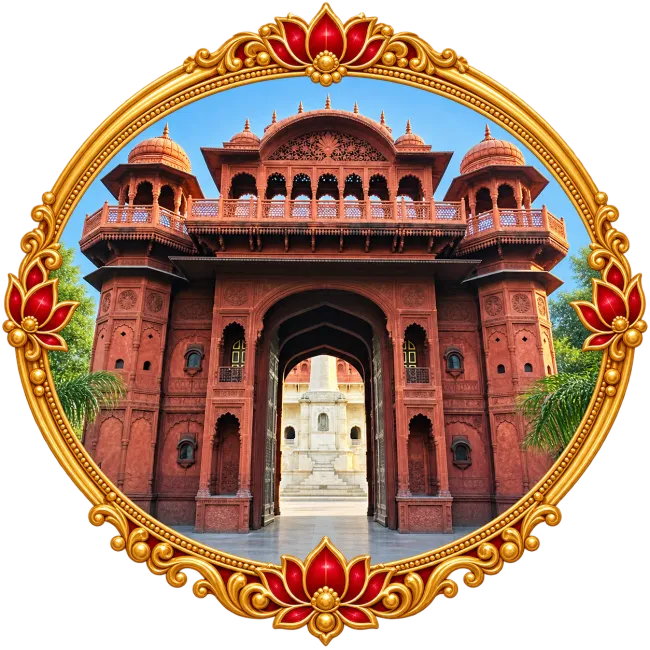
Soniji Ki Nasiyan Jain Temple, Ajmer
Visit Soniji Ki Nasiyan Jain Temple in Ajmer, a magnificent Digambar Jain temple famous for its red sandstone architecture and extraordinary Swarna Nagari, or City of Gold. Officially known as Shri Digambar Jain Siddhkoot Chaityalaya, the temple is dedicated to Lord Rishabhanatha, also called Lord Adinath, the first Jain Tirthankara.
About Soniji Ki Nasiyan Jain Temple
Soniji Ki Nasiyan is a historic Jain temple situated on Prithviraj Marg in Ajmer, Rajasthan. The temple is one of Ajmer’s most important architectural, religious and cultural landmarks.
The complex is divided into two principal sections:
- Siddhkoot Chaityalaya—the active worship area dedicated to Lord Adinath
- Swarna Nagari—a museum hall containing gold-plated wooden representations of Jain cosmology and the life of Lord Adinath
Constructed mainly from red sandstone, the building is also known as the Red Temple or Lal Mandir. Its popular name, Soniji Ki Nasiyan, comes from the Soni family that commissioned and developed the temple.
The temple belongs to the Digambar tradition of Jainism and presents the teachings, life events and spiritual journey of Lord Rishabhanatha through worship, paintings, wooden models and intricate gold work.
Other Names of Soniji Ki Nasiyan
The temple is known by several names:
- Soniji Ki Nasiyan
- Soni Ji Ki Nasiya
- Ajmer Jain Temple
- Shri Digambar Jain Siddhkoot Chaityalaya
- Nasiyan Jain Temple
- Red Temple
- Lal Mandir
- Sone Ka Mandir
Siddhkoot Chaityalaya is the formal name of the worship area, while Swarna Nagari refers specifically to the golden museum section.
History of Soniji Ki Nasiyan
The history of Soniji Ki Nasiyan began during the second half of the 19th century. Its foundation was laid on 10 October 1864 by Rai Bahadur Seth Moolchand Soni, a wealthy Jain merchant and religious patron of Ajmer.
Construction and religious arrangements were carried out under the guidance of Pandit Sadasukhdas Ji of Jaipur, a respected Jain scholar.
The white marble idol of Lord Rishabhanatha was installed in the sanctum on 26 May 1865. This ceremony formally established the temple as an active Digambar Jain place of worship.
Development continued after the consecration of the principal shrine. A large museum hall was subsequently created to present important events from the life of Lord Adinath and the Jain understanding of the universe.
The Swarna Nagari section was developed between 1870 and 1895. Thousands of individually crafted wooden components, figures, palaces, elephants, chariots and celestial structures were prepared and later covered with gold leaf.
After Swarna Nagari was completed in 1895, the complex became famous as Sone Ka Mandir and Soniji Ki Nasiyan.
Who Built Soniji Ki Nasiyan and When?
Soniji Ki Nasiyan was commissioned by Rai Bahadur Seth Moolchand Soni, with later contributions and development associated with Nemichand Soni and the Soni family.
The temple and museum represent several decades of craftsmanship rather than a single phase of construction.
Religious Significance
Soniji Ki Nasiyan is dedicated to Lord Rishabhanatha, the first of Jainism’s 24 Tirthankaras. He is also known as Lord Adinath, meaning the first spiritual teacher.
According to Jain tradition, Lord Adinath taught humanity important social and practical skills before renouncing worldly life and following the path of spiritual liberation.
He represents:
- Non-violence
- Renunciation
- Self-discipline
- Detachment from material possessions
- Right faith
- Right knowledge
- Right conduct
- Liberation from the cycle of birth and death
Devotees visit the temple to meditate, perform abhishek, recite Jain prayers and seek guidance for living a peaceful and ethical life.
The temple also teaches visitors that material splendour, represented by the golden city, remains temporary compared with the eternal value of spiritual knowledge.
Architecture of Soniji Ki Nasiyan
Soniji Ki Nasiyan is one of Ajmer’s finest examples of late-19th-century Jain architecture. Its design combines red sandstone construction, white marble deities, decorated pillars, arches, jharokhas and gold-plated artistic models.
Red Sandstone Gateway
The main entrance is built from red sandstone brought from Karauli. Its rich colour gave the temple the popular name Red Temple.
The entrance has high pointed arches and elaborate jharokhas inspired by traditional Rajasthani architecture.
Marble Staircase
A marble staircase leads from the entrance towards the main temple. Images and representations of Jain Tirthankaras decorate the approach.
Main Prayer Hall
The main prayer hall contains beautifully designed pillars, painted surfaces, stained-glass elements and religious decorations.
The hall is reserved primarily for worship and should not be treated as part of the museum attraction.
Main Sanctum
The sanctum houses a large white marble idol of Lord Rishabhanatha. The deity is shown in a meditative posture, representing tranquillity, detachment and spiritual enlightenment.
Daily abhishek of the deity is traditionally performed with clean water.
Upper Museum Hall
The museum section is located within a large double-storey hall behind the principal worship area. Visitors view the golden models from galleries and designated observation points.
Swarna Nagari—The City of Gold
Swarna Nagari is the most famous part of Soniji Ki Nasiyan. It contains large gold-plated wooden models depicting Jain cosmology and important events in the life of Lord Adinath.
The construction took approximately 25 years, from 1870 to 1895. Thousands of wooden pieces were separately carved, decorated and assembled to create a complex three-dimensional religious display.
The golden models depict:
- Ancient Ayodhya
- Royal palaces
- Mount Sumeru
- Celestial vehicles
- Elephants and chariots
- Deities and heavenly beings
- Lord Adinath’s royal life
- His renunciation
- His attainment of omniscience
- Samavasarana, the divine preaching assembly
- His final liberation
The display is traditionally stated to contain extensive gold work and is regarded as one of India’s most elaborate artistic presentations of Jain narratives.
Panch Kalyanaka Depictions
Swarna Nagari presents the five principal auspicious events in the life of a Tirthankara, collectively known as Panch Kalyanaka.
Garbha Kalyanaka
Garbha Kalyanaka represents the conception of the future Tirthankara. Jain tradition describes auspicious dreams and divine celebrations connected with this event.
Janma Kalyanaka
Janma Kalyanaka celebrates the birth of the Tirthankara. The golden displays include royal processions, celestial beings and ceremonial bathing.
Diksha or Tapa Kalyanaka
This event represents the renunciation of royal life and worldly possessions. Lord Adinath abandoned material comforts to pursue spiritual liberation.
Keval Gyan Kalyanaka
Keval Gyan Kalyanaka commemorates the attainment of infinite and complete knowledge.
Moksha Kalyanaka
Moksha Kalyanaka represents final liberation from the cycle of birth and death. It is the highest spiritual goal in Jainism.
Soniji Ki Nasiyan Temple Timings
The worship area and Swarna Nagari Museum follow different schedules.
Main Temple and Worship Schedule
Swarna Nagari Museum Timings
The museum is generally open throughout the week and on public holidays. Religious ceremonies follow Jain customs and may be adjusted during festivals according to the day’s sunrise and sunset.
Best Time for Darshan
For worship and a peaceful temple experience, visit between 6:30 AM and 9:00 AM. Morning visitors can observe or participate in the abhishek and puja according to temple rules.
Visitors primarily interested in Swarna Nagari should arrive between 9:00 AM and 11:30 AM. This provides sufficient time to observe the displays without rushing.
October to March is the most comfortable season for visiting Ajmer. Weekday mornings are generally quieter than weekends and public holidays.
Daily Puja and Aarti
Daily worship at Siddhkoot Chaityalaya follows Digambar Jain traditions. The rituals include:
- Cleaning of the sanctum
- Jal Abhishek
- Prakshal
- Application of sandalwood
- Ashtaprakari Puja
- Recitation of the Navkar Mantra
- Morning Aarti
- Meditation and Swadhyaya
- Evening Aarti
The Navkar Mantra offers respect to enlightened souls, liberated beings, spiritual teachers and Jain monks. It does not seek material rewards but encourages spiritual purification.
Devotees wishing to participate directly in abhishek may need to wear clean, unstitched or prescribed ritual clothing.
Major Festivals Celebrated
Mahavir Jayanti
Mahavir Jayanti celebrates the birth of Lord Mahavira, the 24th Jain Tirthankara. Special puja, processions and religious discourses are organised.
Rishabhdev Janma Kalyanaka
The birth anniversary of Lord Adinath is particularly important because he is the principal deity of the temple.
Akshaya Tritiya
Akshaya Tritiya commemorates Lord Adinath receiving sugarcane juice after a prolonged period of fasting.
Paryushan Parva
Paryushan is devoted to fasting, repentance, spiritual study and forgiveness.
Das Lakshan Parva
Digambar Jains observe ten spiritual virtues, including forgiveness, humility, truth, purity and non-attachment.
Diwali
Jains celebrate Diwali as the occasion when Lord Mahavira attained nirvana. Lamps symbolise spiritual knowledge overcoming ignorance.
Entry Fee and Visit Duration
Entry to the main worship temple is generally free. A nominal ticket is required for the Swarna Nagari Museum.
Museum ticket charges may be revised by the temple trust, so the rate displayed at the official counter applies on the date of the visit.
Offerings and Jain Temple Customs
Devotees may use prescribed materials for worship, including:
- Clean water
- Rice
- Sandalwood paste
- Saffron
- Incense
- Lamps
- Flowers according to temple rules
- Donations
- Jain religious literature
Jain Tirthankaras are worshipped as liberated spiritual teachers. Edible food is not offered before the deity in the same manner as prasad in many Hindu temples.
Visitors should not carry food, leather products or items conflicting with Jain principles into the worship area.
How to Reach Soniji Ki Nasiyan
The temple is situated on Prithviraj Marg near Ajmer’s central area.
By Air
Kishangarh Airport is approximately 30 kilometres from the temple. Taxis are available from the airport.
Jaipur International Airport is approximately 135 kilometres away and offers wider flight connectivity.
By Train
Ajmer Junction is approximately 1.5–2 kilometres from Soniji Ki Nasiyan. Auto-rickshaws, e-rickshaws and taxis are available outside the station.
By Bus
Ajmer Central Bus Stand is approximately 2–3 kilometres away. Local buses, auto-rickshaws and taxis are available.
By Road
Ajmer is connected with Jaipur, Delhi, Jodhpur, Udaipur and Kota through major highways. Visitors arriving by private car should use an authorised parking area because traffic can be congested near the old city.
Nearby Places to Visit
Ajmer Sharif Dargah
Ajmer Sharif is one of India’s most prominent Sufi pilgrimage destinations and is dedicated to Khwaja Moinuddin Chishti.
Akbari Fort and Museum
This historic fort houses a museum containing sculptures, weapons, inscriptions and artefacts associated with Rajasthan’s history.
Adhai Din Ka Jhonpra
Adhai Din Ka Jhonpra is known for its elaborate arches, carved pillars and layered architectural history.
Ana Sagar Lake
Ana Sagar is a historic artificial lake surrounded by gardens and marble pavilions.
Nareli Jain Temple
Nareli Jain Temple is a modern Digambar Jain pilgrimage complex featuring a monumental Adinath idol and 24 hilltop Jinalayas.
Taragarh Fort
Taragarh Fort stands above Ajmer and offers panoramic views of the city.
Pushkar
Pushkar is approximately 15 kilometres from Ajmer and is famous for Pushkar Lake, Brahma Temple, Savitri Mata Temple and Rangji Temple.
Visitor Guidelines
- Wear clean and modest clothing.
- Remove footwear before entering both temple and museum areas.
- Do not carry leather products inside.
- Maintain silence in the main worship hall.
- Follow restrictions on photography and videography.
- Do not touch the golden models or display cases.
- Purchase museum tickets only from the authorised counter.
- Do not touch the deity without permission.
- Follow prescribed clothing rules for abhishek.
- Use authorised counters for donations.
- Keep food outside the worship area.
- Supervise children inside the museum.
- Do not lean against railings or glass displays.
- Allow sufficient time before the museum closes.
Conclusion
Soniji Ki Nasiyan is one of Ajmer’s most remarkable religious and architectural landmarks. Founded by Rai Bahadur Seth Moolchand Soni, its foundation was laid on 10 October 1864, and the idol of Lord Rishabhanatha was installed on 26 May 1865.
The adjoining Swarna Nagari, constructed between 1870 and 1895, presents the life of Lord Adinath and Jain cosmology through extraordinary gold-plated wooden models. Its palaces, elephants, celestial vehicles, Mount Sumeru and Panch Kalyanaka scenes create an unforgettable visual experience.
Beyond its golden splendour, the temple communicates the Jain principles of non-violence, self-control, truth, detachment and spiritual liberation. A visit allows devotees to worship Lord Adinath while giving travellers an opportunity to explore one of Rajasthan’s finest examples of Jain religious art.