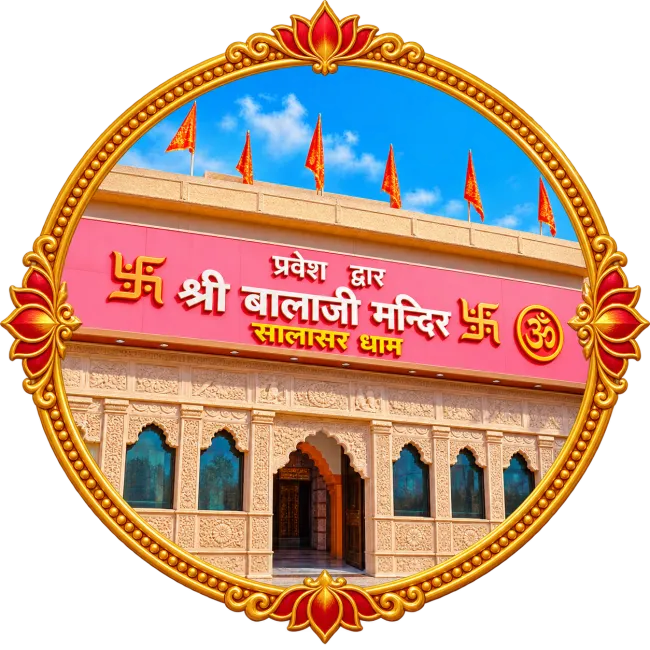
Salasar Balaji Temple, Rajasthan
Visit Salasar Balaji Temple in Rajasthan, one of India’s most revered temples dedicated to Lord Hanuman. Located in Salasar town of Churu district, the temple is famous for its unique bearded and moustached idol of Hanuman Ji, the devotion of Mohandas Ji Maharaj, wish-fulfilling coconut tradition, continuous Ram Naam chanting and grand fairs organised during Chaitra Purnima and Ashwin Purnima.
About Salasar Balaji Temple
Salasar Balaji Temple, also known as Salasar Dham, is situated near Sujangarh in Rajasthan’s Churu district. The temple is dedicated to Lord Hanuman, who is respectfully called Balaji in Rajasthan.
The deity at Salasar is different from most traditional images of Hanuman Ji. The idol has a round face, large eyes, a beard and a moustache. Devotees consider this form Swayambhu because the sacred image was discovered naturally from the ground rather than being specially carved for installation.
Salasar Balaji is recognised as a Siddhpeeth—a sacred place where devotees believe sincere prayers and religious vows are fulfilled.
The temple forms part of a popular Rajasthan pilgrimage circuit that includes:
- Khatu Shyam Ji Temple
- Jeen Mata Temple
- Rani Sati Temple
- Shakambhari Mata Temple
- Salasar Balaji Temple
Tuesdays, Saturdays, Purnima and Hanuman Jayanti attract particularly large numbers of devotees.
History of Salasar Balaji Temple
The history of Salasar Balaji begins in Asota village in Rajasthan. On Shravan Shukla Navami, Vikram Samvat 1811, corresponding to 1754–1755 CE, a farmer was ploughing his field when the plough struck a hard object.
When the ground was excavated, a stone image of Lord Hanuman was discovered. The farmer cleaned the idol and offered it the bajra churma that he had brought for his meal.
On the same night, the Thakur of Asota received a divine message instructing him to send the idol to Salasar. At the same time, the great Hanuman devotee Mohandas Ji Maharaj, who lived in Salasar, received a dream informing him that Balaji’s sacred image had appeared in Asota and should be brought to Salasar.
When messages were exchanged, both sides realised that the dreams carried the same divine instruction. The idol was therefore placed on a bullock cart and carried towards Salasar.
According to tradition, the bullocks stopped at the location where the present temple stands. The event was accepted as Balaji’s wish, and the deity was installed there.
Who Built Salasar Balaji Temple and When?
The sacred idol appeared at Asota village during Shravan Shukla Navami in 1754–1755 CE. Mohandas Ji Maharaj played the principal role in bringing the deity to Salasar and establishing regular worship.
Craftsmen Noor Mohammad and Dau were involved in the original construction and installation work. The initial shrine was developed during the years following the deity’s appearance and was later expanded by devotees, local patrons and the priestly family.
The present marble complex is the result of subsequent renovations and expansion. It developed gradually from a small shrine into a large pilgrimage centre.
Mohandas Ji Maharaj
Mohandas Ji Maharaj was a great devotee of Lord Hanuman and is central to the history of Salasar Dham. His devotion is believed to have led to the appearance and installation of Balaji’s sacred idol.
Mohandas Ji lived a life of prayer, meditation and service. He established regular worship at Salasar and appointed his nephew Udayram Ji to continue the temple’s priestly responsibilities.
Before entering Jeevit Samadhi, Mohandas Ji prayed that Udayram and his descendants be blessed to continue serving Balaji while living as householders.
The descendants of this priestly tradition have continued the temple worship across generations.
Why Does Salasar Balaji Have a Beard and Moustache?
The idol at Salasar depicts Hanuman Ji with a beard and moustache, making it one of the most distinctive Hanuman images in India.
According to temple tradition, Balaji appeared before Mohandas Ji Maharaj in a dream in this mature form. The sacred image was therefore decorated and worshipped with a beard and moustache.
This appearance represents strength, wisdom, courage and the protective form of Lord Hanuman. Devotees also see it as a reminder that the divine may manifest in forms different from commonly accepted representations.
Religious Significance
Salasar Balaji is worshipped as a powerful protector and fulfiller of wishes. Devotees believe that sincere prayer at the temple provides courage, strength and relief from difficult circumstances.
Worshippers pray for:
- Protection from fear and negative influences
- Relief from physical and mental difficulties
- Success in employment and business
- Resolution of family problems
- Marriage and children
- Health and recovery
- Strength to overcome obstacles
- Freedom from harmful habits
- Fulfilment of religious vows
- Devotion to Lord Rama and Hanuman
Many devotees return after their wish is fulfilled to offer coconut, churma, laddus, sindoor, chola or a ceremonial flag.
Architecture of Salasar Balaji Temple
The temple began as a small shrine but has developed into an elaborate marble structure with decorative silver and gold work.
White Marble Exterior
The principal structure is covered with white marble. Its bright surface, decorative arches and traditional motifs give the temple a distinctive appearance.
Main Sanctum
The central sanctum houses the sacred idol of Salasar Balaji. The deity is decorated with flowers, ornaments, ceremonial garments and a crown.
Sindoor and other traditional materials associated with Hanuman worship form part of the daily decoration.
Silver and Gold Decoration
The sanctum, Sabha Mandap and circumambulatory path contain mosaic work, floral designs and gold- and silver-coloured decorative details.
Sabha Mandap
The assembly hall accommodates devotees during aarti, bhajans and religious ceremonies. Temple bells and collective chanting create a powerful devotional atmosphere.
Circumambulation Path
A designated pathway allows devotees to perform parikrama around the sanctum while chanting Balaji’s name.
Salasar Balaji Temple Timings
The official regular darshan time is from 6:00 AM to 9:00 PM. Morning rituals begin before general darshan, and the summer Shayan Aarti is performed at 10:00 PM.
Winter Aarti Timings
Summer Aarti Timings
The programme may be extended during Chaitra Purnima, Ashwin Purnima, Hanuman Jayanti and other major celebrations.
Best Time for Darshan
For peaceful darshan, visit between 6:00 AM and 8:00 AM on a weekday. Tuesdays and Saturdays have special religious importance and are generally more crowded.
Devotees wishing to attend Mangala Aarti should reach before 5:30 AM in winter or before 5:00 AM in summer.
October to March is the most comfortable season for visiting Salasar. The weather is cooler and suitable for combining the temple with Khatu Shyam, Jeen Mata or Rani Sati Temple.
Visitors seeking shorter queues should avoid:
- Tuesday
- Saturday
- Purnima
- Hanuman Jayanti
- Chaitra Purnima Fair
- Ashwin Purnima Fair
- Public holidays
Daily Puja and Aarti
Daily worship includes several ceremonies conducted according to the established temple tradition.
Mangala Aarti
Mangala Aarti is the first principal ceremony of the day. It welcomes Balaji and marks the beginning of daily worship.
Mohandas Ji Aarti
Special aarti is performed in honour of Mohandas Ji Maharaj, whose devotion is central to the establishment of Salasar Dham.
Morning aarti at the samadhi is performed after Balaji’s morning ceremony, while the evening Mohandas Ji worship is completed before Balaji’s Sandhya Aarti.
Rajbhog Aarti
A midday offering is made to the deity. Special Rajbhog Mahaprasad Aarti is performed on Tuesdays.
Dhoop Gwal Aarti
This early-evening ceremony includes incense offerings and prayers before the main Sandhya Aarti.
Sandhya Aarti
The evening ceremony is performed with lamps, bells and collective devotional singing.
Bal Bhog Stuti
An evening food offering and prayer are presented to Balaji after Sandhya Aarti.
Shayan Aarti
Shayan Aarti is the final worship ceremony and marks the completion of the day’s rituals.
Coconut-Tying Tradition
One of the most famous traditions at Salasar Balaji is tying a coconut wrapped in red cloth to a sacred Khejri tree.
Devotees pray for a particular wish and tie the coconut as a symbol of faith. When the wish is fulfilled, they return to thank Balaji and complete their religious vow.
Temple workers periodically remove the coconuts. They are not casually burned or discarded; they are respectfully buried at a designated site.
Visitors should tie coconuts only in permitted areas and follow instructions issued by the temple administration.
Churma Prasad
Churma holds special importance at Salasar because the farmer who discovered the idol first offered his own bajra churma to Balaji.
Since then, churma has remained one of the temple’s traditional offerings. Devotees may offer:
- Bajra churma
- Wheat churma
- Boondi laddus
- Besan laddus
- Peda
- Coconut
- Fruits
- Mishri
Offerings should be purchased from authorised counters or trusted shops and deposited only at designated locations.
Mohandas Ji Ki Dhuni
Mohandas Ji Ki Dhuni is situated near the Balaji Temple. It marks the place where Mohandas Ji performed meditation and maintained a sacred fire.
The Akhand Dhuni is believed to have continued since his time. Devotees receive its sacred ash, known as vibhuti, with reverence.
The ash is regarded as a symbol of Balaji’s protection and Mohandas Ji’s blessings. It should be accepted respectfully and not treated as an ordinary souvenir.
Mohan Mandir and Samadhi Sthal
Mohan Mandir contains the samadhi sites associated with Mohandas Ji Maharaj and his sister Kanhi Dadi. Their footprints are also revered by devotees.
The temple’s morning and evening ritual sequence includes worship at this samadhi complex.
Visitors should maintain silence and avoid crowding the small prayer space.
Akhand Ram Naam and Hari Kirtan
Continuous chanting of Lord Rama’s name is an important tradition at Salasar Dham. Lord Hanuman is regarded as the greatest devotee of Lord Rama, making Ram Naam inseparable from Balaji worship.
Akhand Hari Kirtan and Ramayana recitation have been organised in the temple precinct for extended periods. Devotees may sit peacefully and participate in the chanting.
Major Fairs and Festivals
Chaitra Purnima Fair
Chaitra Purnima is one of the two largest annual fairs at Salasar. The celebration is closely associated with Hanuman Jayanti.
Large numbers of devotees visit for darshan, aarti, Bhandara and devotional singing.
Ashwin Purnima Fair
The second major fair is organised during Ashwin Purnima, also known as Sharad Purnima.
Special crowd-control arrangements, transport services and extended darshan hours may be introduced.
Hanuman Jayanti
Hanuman Jayanti is celebrated with special Shringar, puja, Sundarkand recitation, Ramayana chanting and Bhandaras.
Ram Navami
Since Hanuman Ji is the supreme devotee of Lord Rama, Ram Navami is celebrated with devotional recitations and kirtan.
Tuesdays and Saturdays
Every Tuesday and Saturday is considered important for Hanuman worship. Special offerings and larger gatherings are common on these days.
Entry Fee and Visit Duration
General entry and darshan at Salasar Balaji Temple are free.
Waiting time may increase significantly during major fairs and public holidays.
How to Reach Salasar Balaji Temple
By Air
Jaipur International Airport is the nearest major airport, approximately 170–185 kilometres from Salasar. Taxis and buses are available from Jaipur.
By Train
Sujangarh Railway Station is one of the nearest convenient stations, approximately 27 kilometres from the temple.
Other nearby stations include:
Buses and taxis are available from these stations.
By Bus
Regular buses connect Salasar with:
- Jaipur
- Sikar
- Sujangarh
- Churu
- Ratangarh
- Delhi
- Rewari
- Bikaner
- Jhunjhunu
Additional services operate during major fairs.
By Road
Salasar is accessible by private car, taxi and bus. The temple is situated in the centre of Salasar town, and designated parking areas are available outside the busiest streets.
Nearby Places to Visit
Anjani Mata Temple
Anjani Mata Temple is dedicated to the mother of Lord Hanuman and is located approximately 2 kilometres from Salasar Dham.
Mohan Mandir
Mohan Mandir contains the samadhi and sacred footprints connected with Mohandas Ji and Kanhi Dadi.
Khatu Shyam Ji Temple
Khatu Shyam Ji Temple is approximately 55–60 kilometres from Salasar and can be included in the same pilgrimage.
Jeen Mata Temple
Jeen Mata is an important Shakti shrine in Sikar district and is commonly visited with Khatu Shyam and Salasar Balaji.
Rani Sati Temple
Rani Sati Temple in Jhunjhunu is known for its large marble complex and religious importance.
Sujangarh
Sujangarh is the nearest major town and railway connection for many pilgrims visiting Salasar.
Visitor Guidelines
- Check the current temple schedule before travelling.
- Wear clean and modest clothing.
- Remove footwear at the designated counter.
- Use only the authorised queue route.
- Do not push during aarti.
- Tie coconuts only at permitted locations.
- Purchase offerings from authorised or trusted shops.
- Keep children and senior citizens close in crowds.
- Use official donation counters.
- Follow photography and mobile-phone restrictions.
- Do not carry unnecessary luggage.
- Book accommodation early during major fairs.
- Keep the temple and town clean.
- Respect the Akhand Dhuni and samadhi areas.
- Follow police traffic instructions during festivals.
Conclusion
Salasar Balaji Temple is one of Rajasthan’s most powerful centres of Hanuman worship. Its sacred idol appeared in Asota village during 1754–1755 CE and was brought to Salasar through divine instructions received by Mohandas Ji Maharaj and the Thakur of Asota.
The distinctive bearded and moustached form of Balaji, the devotion of Mohandas Ji, Akhand Dhuni, coconut-tying tradition, churma offering and multiple daily aartis give Salasar Dham a unique religious identity.
Whether devotees visit for Mangala Aarti, offer a coconut for a heartfelt wish, receive vibhuti from Mohandas Ji’s Dhuni or attend the grand Chaitra and Ashwin Purnima fairs, Salasar Balaji Temple provides an experience centred on faith, courage, service and devotion to Lord Rama.