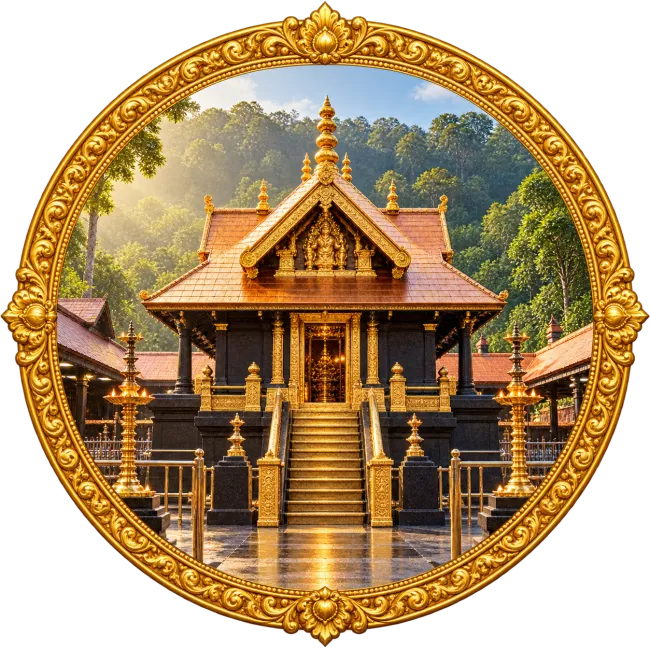
Sabarimala Ayyappa Temple, Pathanamthitta
Sabarimala Ayyappa Temple in Kerala is one of India’s most revered pilgrimage destinations. Situated amid the dense forests and hills of the Periyar Tiger Reserve in Pathanamthitta district, the temple is dedicated to Lord Ayyappa, also known as Dharma Shasta, Manikandan and Hariharaputra.
The pilgrimage is known for its discipline, simplicity and equality. Devotees traditionally observe a 41-day Vratham, wear black or dark blue clothing, carry an Irumudi Kettu and climb the sacred Pathinettam Padi—the eighteen golden steps leading towards the sanctum. The chant “Swamiye Saranam Ayyappa” accompanies pilgrims throughout the journey.
About Sabarimala Ayyappa Temple
Sabarimala Temple is located on a hill at an elevation of approximately 1,260 metres above sea level. It is surrounded by forested mountains traditionally called Poongavanam, the sacred garden of Lord Ayyappa.
The main deity is Lord Ayyappa, shown in a yogic posture with a band around his knees. This form represents discipline, meditation, self-control and the balance between spiritual knowledge and worldly responsibility.
Unlike temples that remain open throughout the year, Sabarimala follows a seasonal worship calendar. The temple opens primarily during:
- Mandala Puja season
- Makaravilakku season
- The first days of each Malayalam month
- Vishu
- Special festival and ceremonial dates
The Mandala–Makaravilakku pilgrimage season, extending from November to January, attracts the largest number of devotees.
When and Who Built Sabarimala Temple?
The spiritual origin of Sabarimala is associated with Lord Ayyappa and the Pandalam royal family. According to tradition, the original deity was consecrated by Sage Parashurama after Lord Ayyappa completed his divine mission.
The shrine developed as an important forest pilgrimage centre under the protection of the Pandalam rulers and local communities.
The earlier temple structure was damaged by a major fire in 1950. The sanctum and deity were subsequently restored, and the reconstructed image was consecrated in 1951.
Additional facilities, pathways, protective structures and pilgrim services were developed during later decades. Despite these changes, the temple continues to follow ancient Tantric and ritual traditions.
Birth of Lord Ayyappa
Lord Ayyappa is traditionally described as Hariharaputra—the son of Hari and Hara.
Hari refers to Lord Vishnu, while Hara refers to Lord Shiva. According to mythology, Vishnu assumed the form of Mohini, and the divine union of Shiva and Mohini resulted in the birth of Ayyappa.
This origin gives Ayyappa a special position connecting Shaivite and Vaishnavite traditions. He represents unity, Dharma, self-control and protection.
Legend of King Rajasekhara and Manikandan
King Rajasekhara of Pandalam was a devoted ruler who had no children. One day, while travelling near the Pamba River, he discovered an infant wearing a bell around his neck.
The king brought the child to the palace and named him Manikandan—“Mani” meaning bell and “Kandan” referring to the neck.
Manikandan grew into an intelligent, courageous and spiritually gifted prince. Although the king wanted him to become heir, members of the royal court developed a plan to remove him.
The queen pretended to be seriously ill, and the royal physician claimed that only the milk of a tigress could cure her. Manikandan volunteered to enter the forest and obtain it.
Defeat of Mahishi
Manikandan’s journey into the forest was part of his divine purpose. A powerful demoness named Mahishi had received a boon that she could be defeated only by a son of Shiva and Vishnu.
Manikandan confronted Mahishi and destroyed her, freeing the gods and sages from her oppression.
After completing his mission, he returned to Pandalam riding a tigress, accompanied by other tigers. The king and queen recognised his divine nature and asked for forgiveness.
Manikandan instructed the king to construct a temple at the place where his arrow landed. The arrow indicated Sabarimala, where the temple was established.
Lord Ayyappa then entered the sacred shrine in a yogic form and became the eternal protector of devotees.
Malikappurathamma Legend
Malikappurathamma is closely associated with the Sabarimala tradition. According to one account, after Mahishi was liberated from her demonic form, she requested Lord Ayyappa to marry her.
Ayyappa, committed to eternal celibacy, promised that he would marry her when no new pilgrim came to Sabarimala.
Malikappurathamma waits at her nearby shrine, while new pilgrims continue to arrive every year. First-time pilgrims are known as Kanni Swamis.
Devotees traditionally visit Malikappurathamma after completing darshan of Lord Ayyappa.
Religious Significance
Sabarimala pilgrimage emphasises equality, discipline and surrender. Pilgrims address one another as “Swami,” recognising the divine presence within every person.
The pilgrimage teaches:
- Control over the senses
- Simplicity in food and clothing
- Equality beyond social status
- Compassion towards all beings
- Devotion and self-discipline
- Physical and mental endurance
- Surrender to Dharma
- Respect for nature
Devotees visit Sabarimala to pray for courage, health, protection, family welfare, relief from difficulties and spiritual transformation.
Forty-One-Day Vratham
Pilgrims traditionally observe a 41-day period of discipline before visiting Sabarimala. The Vratham begins after wearing a sacred Mala under the guidance of a Guru Swami or at a temple.
During the Vratham, devotees generally follow these practices:
- Wake up early and bathe daily
- Perform morning and evening prayers
- Visit an Ayyappa temple whenever possible
- Follow a strict vegetarian diet
- Avoid alcohol, tobacco and intoxicants
- Practise celibacy
- Speak truthfully and control anger
- Avoid unnecessary luxury
- Walk barefoot whenever practical and safe
- Wear black, dark blue or saffron clothing
- Chant “Swamiye Saranam Ayyappa”
- Treat everyone respectfully
The purpose of the Vratham is to purify the body and mind before the pilgrimage.
Irumudi Kettu
Irumudi Kettu is the sacred twin-compartment bundle carried on a pilgrim’s head.
The front section contains offerings for Lord Ayyappa, including a coconut filled with ghee. The rear section contains provisions required for the pilgrim’s journey.
The Irumudi is prepared during a ritual led by a Guru Swami. Pilgrims carrying a properly prepared Irumudi may climb the sacred eighteen steps.
Those without an Irumudi use the alternative entrance prescribed by temple authorities.
Neyyabhishekam
Neyyabhishekam is one of the most important offerings at Sabarimala.
Before beginning the pilgrimage, a coconut is emptied and filled with pure ghee. The opening is sealed, and the coconut is placed in the Irumudi.
At Sabarimala, the coconut is opened and the ghee is offered for Abhishekam to Lord Ayyappa. The empty coconut represents the human body, while the ghee symbolises the purified soul.
The coconut shell is later offered in the sacred fire at the designated place.
Pathinettam Padi – Eighteen Sacred Steps
Pathinettam Padi consists of eighteen sacred steps leading towards the sanctum. The steps are covered with gold and are treated with exceptional reverence.
Different interpretations connect the steps with:
- The five senses
- The eight passions
- The three qualities of nature
- Knowledge and ignorance
- The eighteen weapons of Lord Ayyappa
- The eighteen chapters of the Bhagavad Gita
Pilgrims carrying Irumudi climb the steps while chanting Ayyappa’s name.
Visitors must follow queue instructions and should not stop for photographs or extended prayers on the steps.
Main Deity and Sacred Shrines
Lord Ayyappa
The main deity is Lord Ayyappa in a seated yogic posture. His knees are bound by a Yogapatta, representing meditation and control over the senses.
Malikappurathamma
The nearby shrine of Malikappurathamma is visited after Ayyappa darshan. She is worshipped as a powerful form of the Goddess.
Lord Ganesha
Kannimoola Ganapati is worshipped before devotees proceed towards the principal sanctum.
Other sacred places include:
- Nagaraja shrine
- Kochu Kadutha Swami
- Valiya Kadutha Swami
- Vavar-related sacred tradition
- Bhasma Kulam
- Homakundam
- Pathinettam Padi
Sabarimala Temple Timings
Sabarimala is not open every day of the year. The following schedule applies during the principal Mandala–Makaravilakku pilgrimage season:
On monthly opening days and special occasions outside the main pilgrimage season, opening hours may follow a shorter schedule announced for that specific period.
Morning Puja and Neyyabhishekam
The temple opens at 3:00 AM with Nirmalya Darshan. The previous day’s decorations are removed, and devotees receive the first darshan of the day.
Ganapati Homam and Neyyabhishekam begin at 3:30 AM. Ghee brought by pilgrims in their Irumudi is offered to Lord Ayyappa.
Usha Puja is performed at 7:30 AM. The best morning darshan period is from 4:00 AM to 8:00 AM.
Kalabhabhishekam and other special Pujas are conducted according to the day’s ritual schedule. Ucha Puja is performed at 12:30 PM, and the morning session ends at 1:00 PM.
Evening Puja and Deepa Aradhana
The temple reopens at 3:00 PM. Evening Deepa Aradhana is performed at 6:30 PM.
Pushpabhishekam takes place from 7:00 PM to 9:30 PM. Different varieties of flowers are ceremonially offered to Lord Ayyappa.
Athazha Puja, the final major worship, is performed at 10:30 PM. The day concludes with Harivarasanam at 10:50 PM.
Harivarasanam is a devotional lullaby offered to Lord Ayyappa before the sanctum closes. The temple closes at 11:00 PM.
Major Festivals
Mandala Puja
The Mandala season begins during the Malayalam month of Vrischikam. Devotees complete the 41-day Vratham and visit Sabarimala during this period.
Makaravilakku
Makaravilakku is celebrated in January and is one of the largest annual events at Sabarimala.
The Thiruvabharanam, sacred ornaments connected with the Pandalam royal family, is carried ceremonially to the temple.
Makara Jyothi
Devotees witness the celestial light associated with Makara Sankranti from designated viewing areas.
Crowds are extremely large, and pilgrims must follow official safety and crowd-control arrangements.
Vishu
The temple opens for Vishu, the Kerala New Year observance. Vishukkani darshan and special worship are organised.
Monthly Puja
The temple opens during the beginning of each Malayalam month for several days. Special Pujas and darshan are conducted according to the announced calendar.
Temple Anniversary
The consecration anniversary is observed through special Abhishekam, Homam and ceremonial worship.
Sevas and Offerings
Important Sabarimala offerings include:
- Neyyabhishekam
- Ganapati Homam
- Usha Puja
- Ucha Puja
- Pushpabhishekam
- Kalabhabhishekam
- Laksharchana
- Sahasrakalasam
- Ashtabhishekam
- Padi Puja
- Udayasthamana Puja
- Annadanam donation
Sevas should be booked only through the authorised system or official counters. Pilgrims should preserve all booking confirmations and identification documents.
Prasadam
The most famous Sabarimala prasadam includes:
- Aravana Payasam
- Appam
- Abhisheka ghee
- Sacred ash
- Turmeric and other blessed items
Prasadam must be collected from authorised counters. Pilgrims should avoid purchasing items from unauthorised sellers.
Aravana and Appam should be carried carefully and stored according to the instructions printed on the containers.
Vavar Tradition and Erumeli
Vavar is traditionally described as a close companion of Lord Ayyappa. The Vavar mosque at Erumeli forms part of the wider Sabarimala pilgrimage tradition.
Many pilgrims following the traditional forest route visit Erumeli, worship at the Dharma Shasta Temple and respectfully visit the Vavar mosque.
The tradition symbolises friendship, religious harmony and shared devotion.
Pamba and the Trek to Sannidhanam
Pamba is the principal base point for the final journey to Sabarimala. Pilgrims reach Pamba by authorised bus or vehicle and continue towards Sannidhanam on foot.
The route includes steep sections and can become crowded. Pilgrims should:
- Carry limited luggage
- Wear safe walking footwear when required
- Drink sufficient water
- Rest at designated locations
- Follow one-way crowd routes
- Avoid shortcuts
- Keep medical information accessible
- Assist children and senior citizens
Bathing in the Pamba River should be done only at permitted locations and when conditions are safe.
Dress Code and Entry Rules
Pilgrims traditionally wear black, dark blue or saffron clothing. Simple attire reflects discipline and freedom from luxury.
Footwear rules vary across the pilgrimage route, but footwear must be removed before entering the sacred temple zone.
Every visitor must follow the current entry eligibility, virtual-queue, identification and security instructions issued for the pilgrimage period.
Mobile phones, cameras and large bags may be restricted within the inner temple area. Photography and videography are prohibited near the sanctum and sacred steps.
Alcohol, tobacco, meat, leather articles and intoxicants must not be carried into the pilgrimage area.
Entry Fee and Visit Duration
General darshan does not require a temple entry fee. Virtual-queue registration, transport, accommodation, prasadam and selected Sevas may involve separate bookings or charges.
The journey from Pamba to Sannidhanam can take 3 to 5 hours depending on fitness and crowd conditions. Waiting time for darshan varies significantly during peak pilgrimage dates.
Pilgrims should keep at least one complete day available after reaching Pamba.
Best Time to Visit
The Mandala season from November to December is the principal pilgrimage period. January is important for Makaravilakku but attracts exceptionally large crowds.
Monthly opening days outside the main season can provide a less crowded experience, subject to the announced calendar.
Pilgrims should avoid travelling without confirming that the temple is open. Weather, forest regulations and crowd-control arrangements can affect access.
How to Reach Sabarimala
By Air
Thiruvananthapuram International Airport and Cochin International Airport are the principal airports used by Sabarimala pilgrims.
Road transport is available from both airports to Pathanamthitta, Chengannur, Nilakkal and Pamba.
By Train
Chengannur Railway Station is one of the most convenient railheads. Kottayam and Thiruvalla are other major stations.
Special buses operate during the pilgrimage season from railway stations and transport hubs.
By Road
Pilgrims generally travel through Pathanamthitta, Erumeli or other designated routes to Nilakkal.
Private vehicles may be restricted beyond Nilakkal. Pilgrims use authorised transport services from Nilakkal to Pamba and then continue on foot.
Nearby Sacred Places
Pilgrims may also visit:
- Pamba Ganapati Temple
- Malikappurathamma Temple
- Vavar Mosque, Erumeli
- Dharma Shasta Temple, Erumeli
- Pandalam Valiyakoikkal Temple
- Achankovil Sastha Temple
- Aryankavu Sastha Temple
- Kulathupuzha Sastha Temple
- Nilakkal Mahadeva Temple
- Perunthenaruvi Waterfalls
Health and Safety Guidelines
The pilgrimage requires considerable physical effort. People with heart conditions, breathing difficulties, uncontrolled blood pressure or severe mobility problems should seek medical advice before travelling.
Carry prescribed medicines and a copy of medical information. Use medical aid centres if any discomfort occurs.
Do not push within queues or on the eighteen steps. Follow police, forest, health and temple instructions.
Avoid entering restricted forest zones. Do not feed wild animals or leave plastic waste in the forest.
Drink purified water and consume food only from authorised or hygienic facilities.
Visitor Guidelines
Complete the required virtual-queue and travel registrations before beginning the journey. Carry the accepted identification document.
Check the temple opening calendar, weather and transport arrangements before departure.
Prepare physically by walking regularly before the pilgrimage. The route from Pamba includes steep climbs.
Carry the Irumudi correctly under the guidance of a Guru Swami. Do not place it on the ground.
Keep the forest, river and temple clean. Use only designated waste collection points.
Maintain discipline, avoid arguments and address fellow pilgrims respectfully as Swami.
Conclusion
Sabarimala Ayyappa Temple is a pilgrimage of discipline, equality and complete surrender. The journey requires physical effort, mental control and devotion rather than ordinary sightseeing.
Lord Ayyappa’s story, the 41-day Vratham, Irumudi, Neyyabhishekam and sacred eighteen steps create a unique spiritual tradition. A sincere pilgrimage to Sabarimala teaches simplicity, courage, compassion and the principle expressed through the eternal chant: Swamiye Saranam Ayyappa.