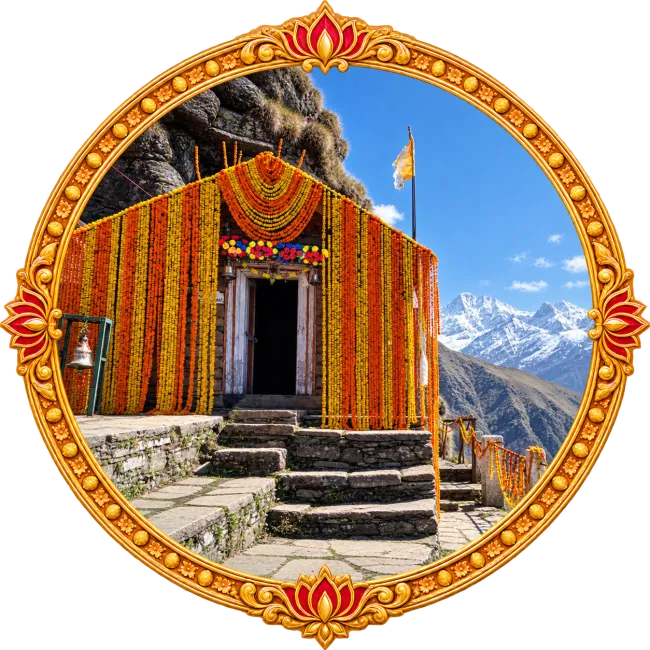
Rudranath Temple, Chamoli, Uttarakhand
Rudranath Temple is a remote and sacred Shiva shrine situated in the Garhwal Himalayas of Chamoli district, Uttarakhand. It is one of the Panch Kedar temples and is surrounded by alpine meadows, dense forests, natural rock formations and snow-covered mountain peaks.
At Rudranath, the face of Lord Shiva is worshipped in a naturally formed rock. The demanding trek and isolated Himalayan landscape make the pilgrimage an experience of faith, endurance and spiritual discipline.
About Rudranath Temple
Rudranath Temple is situated at an elevation of approximately 3,600 metres. The shrine lies inside a natural rock formation surrounded by high-altitude meadows.
The name Rudranath means “Lord of the Fierce Form.” Rudra represents the powerful aspect of Shiva who destroys ignorance, fear and ego.
The naturally formed rock face inside the temple is worshipped as Neelkanth Mahadev. Unlike conventional Shiva temples, the principal sacred form is not a cylindrical Lingam.
The temple remains open only during the warmer months. During winter, the ceremonial image is taken to Gopinath Temple in Gopeshwar.
When Was Rudranath Temple Built and Who Built It?
According to Hindu tradition, Rudranath Temple was established by the Pandavas after the Mahabharata war.
The shrine developed around the natural rock formation where the face of Lord Shiva appeared. The pilgrimage tradition was later revived and organised under Adi Shankaracharya during the 8th century CE.
Regional rulers, priests and local communities maintained the route and stone shrine over subsequent centuries. The structure has remained simple because its spiritual importance centres on the natural manifestation of Shiva.
Panch Kedar Legend
After the Mahabharata war, the Pandavas wanted Lord Shiva to forgive them for the destruction caused during the conflict.
Shiva avoided them and took the form of a bull. Bhima recognised the bull and tried to catch it, but Shiva disappeared into the earth. His body parts appeared at five places:
The Pandavas built shrines at these locations. Rudranath became the sacred place where Shiva’s face is worshipped.
Natural Face of Lord Shiva
The principal deity appears as a natural rock formation resembling a face. Devotees worship it as the calm but powerful expression of Rudra.
The face symbolises:
Divine awareness
Destruction of ego
Courage during hardship
Protection from fear
Truth and spiritual insight
Liberation from karmic burdens
The sanctum’s cave-like setting creates a meditative atmosphere.
Religious Significance
Devotees visit Rudranath to pray for:
Forgiveness for past actions
Spiritual courage
Protection from danger
Health and recovery
Family welfare
Relief from fear and grief
Peace for departed ancestors
Mental discipline
Fulfilment of wishes
Liberation
Ancestral rituals are also performed in the sacred region surrounding the temple.
Architecture of Rudranath Temple
Rudranath is a compact stone shrine built around the natural rock manifestation.
Its principal features include:
Natural stone sanctum
Rock face of Lord Shiva
Stone walls
Sloping roof
Small Mandapa
Entrance platform
Bells
Nearby sacred Kunds
Alpine meadow setting
The shrine’s simple architecture reflects the extreme climate and remote location.
Sacred Kunds and Vaitarani
Several sacred water bodies are associated with Rudranath:
Surya Kund
Chandra Kund
Tara Kund
Mana Kund
A stream known as Vaitarani or Rudraganga flows through the region. Devotees perform Tarpan and prayers for ancestors near designated sacred areas.
Pilgrims should avoid entering fast-flowing water and must not use soap or throw offerings into the Kunds.
Rudranath Temple Opening Season
The temple generally opens during May after the snow clears. It closes during October or November before heavy snowfall.
The opening and closing dates are declared annually according to Hindu calendrical traditions and local weather.
After closure, the ceremonial image is taken to Gopinath Temple in Gopeshwar, where winter worship continues.
Rudranath Temple Timings
The following schedule applies during the regular pilgrimage season:
Weather, fog, snowfall and special ceremonies can affect the schedule.
Morning Puja and Aarti
Morning worship begins with purification of the sanctum and Mangal Puja. The natural Shiva form receives ceremonial offerings.
The rituals include:
Water Abhishekam
Milk and curd
Bilva leaves
Flowers
Sandalwood
Sacred ash
Shiva mantra chanting
Incense and lamps
Naivedya
Morning Aarti
Offerings should be made according to the instructions of the priests.
Bhog and Evening Aarti
Bhog is offered at noon. Fruits, sweets and simple Satvik food form part of the offering.
Evening Puja begins at 5:30 PM, followed by Aarti at 6:00 PM. Pilgrims attending evening worship should stay in authorised accommodation near the shrine because trekking after dark is unsafe.
Major Festivals
Opening-Day Ceremony
The ceremonial image arrives from Gopeshwar, and special Puja is performed before general darshan begins.
Closing-Day Ceremony
Special worship takes place before the deity starts its winter journey to Gopinath Temple.
Shravan Month
Special Shiva Puja and Rudrabhishek are performed during Shravan.
Mahashivratri
Winter worship associated with Rudranath is conducted at Gopinath Temple in Gopeshwar.
Local Nanda Devi Festivals
Regional communities honour Goddess Nanda Devi through traditional processions and worship.
Puja and Religious Services
Available services may include:
General Shiva Puja
Jalabhishek
Rudrabhishek
Panch Kedar Puja
Mahamrityunjaya Mantra Path
Ancestral prayers
Tarpan
Health and protection Puja
Family welfare prayers
Thanksgiving worship
Puja arrangements should be made through authorised priests.
Offerings and Prasad
Traditional offerings include:
Water
Milk
Bilva leaves
Flowers
Sandalwood
Sacred ash
Fruits
Dry fruits
Sweets
Monetary donations
Pilgrims should carry only small quantities of offerings and bring all plastic waste back from the mountain.
Dress Code and Temple Rules
There is no formal ceremonial dress code, but proper trekking and cold-weather clothing are essential.
Visitors should carry:
Thermal layers
Waterproof jacket
Woollen cap
Gloves
Trekking shoes
Walking stick
Water
Essential medicines
Rain cover
Torch
Important rules include:
Remove footwear before entering.
Do not photograph restricted areas.
Avoid trekking alone.
Do not trek after dark.
Do not litter.
Keep sacred Kunds clean.
Avoid alcohol and tobacco.
Follow local weather instructions.
Respect shepherd settlements and grazing land.
Entry Fee and Darshan Duration
General darshan is free. Charges apply only to optional Pujas and ritual materials.
Darshan normally requires 20–45 minutes. The complete pilgrimage requires several days because of the long trek and remote location.
Visitors should not attempt the route without adequate fitness and weather preparation.
Trek Routes to Rudranath
Several trekking routes lead to the shrine.
Sagar Village Route
The most commonly used route begins at Sagar village near Gopeshwar. It passes through forests and high-altitude meadows, including Panar Bugyal.
The trek covers approximately 20 kilometres and includes steep ascents.
Mandal–Anusuya Devi Route
This longer route passes through Mandal and Anusuya Devi Temple before continuing towards Rudranath.
Urgam Valley Route
Experienced trekkers can approach through Urgam Valley and high mountain sections. This route requires local guidance and suitable weather.
A registered guide is strongly recommended.
Best Time to Visit
May to June and September to October are the best periods.
May and June offer green landscapes, while September and October provide clearer mountain views. Temperatures become very low after sunset.
The monsoon brings heavy rain, fog, leeches and slippery trails. Winter access is closed because of snow.
How to Reach Rudranath Temple
By Air
Jolly Grant Airport near Dehradun is the nearest major airport.
By Train
Rishikesh, Yog Nagari Rishikesh and Haridwar are the nearest convenient railway stations.
By Road
Travellers can reach Gopeshwar and then continue to Sagar village, the main trekking base.
Accommodation and Facilities
Homestays and basic guest houses are available at Sagar and Gopeshwar. Seasonal shelters and simple accommodation may be available at Panar and near Rudranath.
Facilities on the trail are limited. Pilgrims should carry food, water purification supplies, cash, medicines and weather protection.
Nearby Places to Visit
Gopinath Temple, Gopeshwar
Anusuya Devi Temple
Atri Muni Ashram
Panar Bugyal
Urgam Valley
Kalpeshwar Temple
Joshimath
Auli
Badrinath Temple
Nanda Devi region
Conclusion
Rudranath Temple is a remote Panch Kedar shrine where the natural face of Lord Shiva is worshipped. Its origin is associated with the Pandavas, while its pilgrimage tradition is connected with Adi Shankaracharya.
The long trek, sacred Kunds and isolated Himalayan landscape make Rudranath a journey of devotion and endurance. Proper fitness, local guidance and respect for mountain conditions are essential for a safe and meaningful pilgrimage.