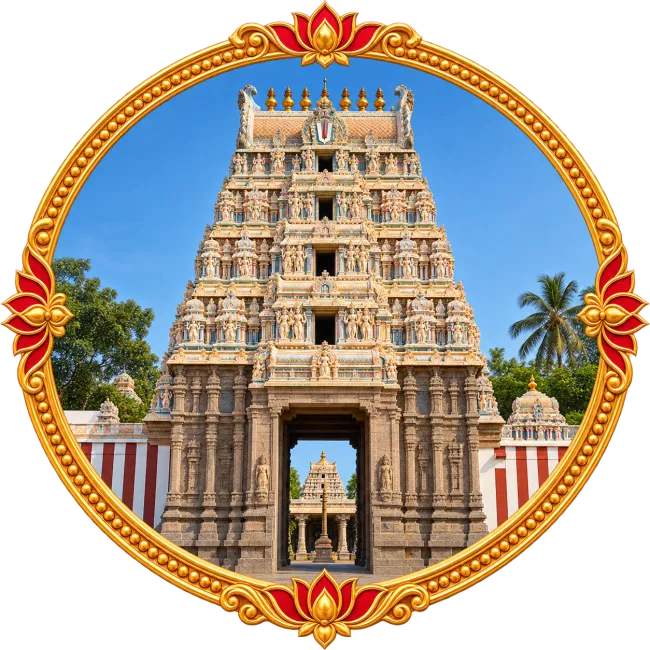
Parthasarathy Temple, Chennai
Visit Parthasarathy Temple in Triplicane, Chennai, one of South India’s oldest and most revered temples dedicated to Lord Vishnu. The temple is famous for the unique form of Lord Krishna as Parthasarathy—the charioteer of Arjuna during the Mahabharata war.
Built by the Pallavas during the 8th century and later expanded by the Cholas and Vijayanagara rulers, the temple is one of the 108 Divya Desams praised by the Alvar saints. Its towering Gopuram, ancient inscriptions, multiple Vishnu shrines and traditional Vaishnava rituals make it an important pilgrimage destination in Tamil Nadu.
About Parthasarathy Temple
Parthasarathy Temple is located in Triplicane, one of Chennai’s oldest neighbourhoods. The temple is dedicated to Lord Krishna in his role as the charioteer and spiritual guide of Arjuna.
The name Parthasarathy is formed from:
- Partha, another name for Arjuna
- Sarathy, meaning charioteer
Parthasarathy therefore means the “Charioteer of Arjuna.”
The principal deity is worshipped as Sri Venkatakrishna or Parthasarathy. The temple also contains major shrines dedicated to Lord Narasimha, Lord Rama, Lord Ranganatha and Gajendra Varadaraja.
Because five important forms of Lord Vishnu are worshipped within the same complex, the temple holds exceptional importance in the Sri Vaishnava tradition.
History of Parthasarathy Temple
Parthasarathy Temple is one of Chennai’s oldest surviving temples. Its original structure was constructed by the Pallavas during the 8th century and is traditionally associated with Pallava King Narasimhavarman.
Inscriptions connected with Pallava King Dantivarman provide evidence of royal donations and temple development during the early medieval period.
The temple was later expanded and renovated by:
- Chola rulers
- Pandya rulers
- Vijayanagara kings
- Nayaka chiefs
- Local Vaishnava communities
The Cholas contributed land, lamps and funds for daily worship. During the Vijayanagara period, additional Mandapams, corridors and festival arrangements were developed.
The temple contains inscriptions in Tamil and Telugu recording donations, land grants, festivals and administrative arrangements.
Despite Chennai’s transformation into a modern metropolitan city, Parthasarathy Temple continues to preserve traditional Sri Vaishnava worship practices.
Parthasarathy Temple as a Divya Desam
Parthasarathy Temple is one of the 108 Divya Desams—sacred temples of Lord Vishnu praised by the Alvar saints.
The temple is mentioned in the devotional hymns of:
- Peyalvar
- Tirumalisai Alvar
- Tirumangai Alvar
These hymns form part of the Nalayira Divya Prabandham, the collection of 4,000 Tamil Vaishnava verses.
The ancient name of the region was Brindaranya, meaning the forest of Tulsi plants. Lord Vishnu is believed to have appeared here to bless sages and devotees.
Mythology of Lord Parthasarathy
According to the Mahabharata, Lord Krishna promised that he would not use a weapon during the Kurukshetra war. Arjuna selected Krishna as his charioteer, while the Kauravas received Krishna’s army.
As Arjuna’s charioteer, Krishna guided the horses, protected Arjuna and provided spiritual wisdom. When Arjuna became emotionally confused before the battle, Krishna revealed the teachings of the Bhagavad Gita.
The temple’s deity represents Krishna in this charioteer form. Unlike the youthful form commonly worshipped in Krishna temples, Parthasarathy has a prominent moustache representing his mature warrior appearance.
Marks on the deity’s face are traditionally interpreted as scars caused by arrows during the Mahabharata war. These features make the image of Parthasarathy unique.
Legend of King Sumati
According to temple tradition, King Sumati was a devoted worshipper of Lord Venkateswara of Tirumala.
The king wished to see Lord Vishnu in the form of Krishna as Arjuna’s charioteer. Lord Vishnu instructed him to visit Brindaranya, the area now known as Triplicane.
At Brindaranya, the Lord appeared before King Sumati as Parthasarathy. The sacred image was then established for public worship.
This legend explains why the principal deity is also known as Venkatakrishna.
Religious Significance of Parthasarathy Temple
The temple represents Lord Krishna as a divine guide who helps devotees understand Dharma and overcome confusion.
People visit Parthasarathy Temple for:
- Clarity during difficult decisions
- Success in education
- Career and business growth
- Family peace and prosperity
- Blessings for marriage
- Health and well-being of children
- Protection from enemies
- Courage during challenging situations
- Relief from planetary difficulties
- Devotion to Lord Krishna
- Spiritual wisdom
- Fulfilment of sincere wishes
Recitation of the Bhagavad Gita and Vishnu Sahasranama is considered especially beneficial at the temple.
Main Deity of Parthasarathy Temple
The principal deity is Sri Venkatakrishna, worshipped as Lord Parthasarathy.
The deity stands with Goddess Rukmini and is accompanied by members of Krishna’s family:
- Lord Balarama
- Satyaki
- Pradyumna
- Aniruddha
This complete family group is a distinctive feature of the temple.
Lord Parthasarathy has a moustache and visible marks traditionally associated with the Mahabharata war. The deity holds the Panchajanya conch, representing the divine sound that awakens spiritual knowledge.
Other Important Shrines
Sri Thelliya Singar
Lord Narasimha is worshipped as Thelliya Singar, meaning the bright or radiant lion.
Devotees pray here for courage, protection and relief from fear.
Sri Ranganatha
Lord Vishnu is worshipped in a reclining form upon Adishesha. The shrine represents divine rest and cosmic preservation.
Sri Rama
Lord Rama is worshipped with Goddess Sita, Lakshmana, Bharata, Shatrughna and Lord Hanuman.
Gajendra Varadaraja
This form represents Lord Vishnu rescuing the elephant king Gajendra from a crocodile.
Andal
Goddess Andal, the celebrated Tamil Vaishnava saint, has a separate shrine within the complex.
Vedavalli Thayar
Goddess Lakshmi is worshipped as Vedavalli Thayar. Devotees seek her blessings for prosperity, marriage and family harmony.
Architecture of Parthasarathy Temple
Parthasarathy Temple is built in the traditional Dravidian architectural style.
Important features include:
- Tall entrance Gopuram
- Multiple Prakarams
- Carved stone pillars
- Spacious Mandapams
- Separate shrines for Vishnu’s different forms
- Ancient Tamil and Telugu inscriptions
- Sculptures of deities and Alvar saints
- Temple kitchen
- Vahana Mandapam
- Flagstaff
- Sacred temple tank
The eastern entrance is decorated with colourful sculptures depicting forms of Lord Vishnu and scenes from Hindu scriptures.
Kairavini Pushkarani
The temple’s sacred tank is known as Kairavini Pushkarani. The name is associated with water lilies believed to have once grown in the tank.
The Pushkarani is connected with five sacred Tirthas:
- Indra Tirtha
- Soma Tirtha
- Agni Tirtha
- Meena Tirtha
- Vishnu Tirtha
Ceremonial events and the annual Float Festival are conducted at the tank.
Devotees should not enter the water unless permission is granted during an authorized religious ceremony.
Parthasarathy Temple Timings
Festival schedules may differ during Brahmotsavam, Vaikunta Ekadashi, Krishna Janmashtami and other major occasions.
Morning Puja and Deepa Aradhana
The temple opens with Vishwaroopa Darshan at 5:30 AM. This is the first darshan of Lord Parthasarathy for the day.
Morning Puja and Deepa Aradhana are performed at 6:00 AM. Priests offer lamps, incense, flowers and sacred food while reciting Vedic and Tamil Vaishnava hymns.
Kalasanthi Puja is performed at 8:00 AM. The deity is worshipped with:
- Tulsi leaves
- Flowers and garlands
- Sandalwood paste
- Incense
- Sacred lamps
- Fruits
- Naivedyam
- Silk garments
The period between 6:30 AM and 8:30 AM is ideal for peaceful darshan.
Uchikala Puja
Uchikala Puja is the principal midday worship performed at 11:30 AM.
Special Naivedyam is offered to the deity, followed by Deepa Aradhana. The morning session closes at 12:00 PM.
Devotees wishing to attend Uchikala Puja should enter the temple before 11:15 AM.
Evening Puja and Deepa Aradhana
The temple reopens at 4:00 PM.
Sayaraksha Puja and evening Deepa Aradhana are performed at 6:00 PM. Lamps are presented before Lord Parthasarathy while Vedic mantras and Divya Prabandham hymns are recited.
Ardha Jama Puja, the final worship of the day, is performed at 8:30 PM. The temple closes at 9:00 PM.
Abhishekam and Special Sevas
Special Sevas may include:
- Thirumanjanam
- Sahasranama Archana
- Tulsi Archana
- Sri Suktam recitation
- Vishnu Sahasranama recitation
- Thayar Archana
- Sudarshana worship
- Utsava deity Seva
- Vahana Seva during festivals
Thirumanjanam refers to the ceremonial bathing of the Utsava deity with water, milk, curd, honey, sandalwood and other sacred substances.
Seva schedules may depend on the weekday, festival calendar and prior booking.
Major Festivals Celebrated
Brahmotsavam
The annual Brahmotsavam is one of the temple’s grandest festivals. The Utsava deity is taken through Triplicane on different Vahanas.
Important processions include:
- Garuda Vahana
- Hanumantha Vahana
- Sesha Vahana
- Surya Prabha
- Chandra Prabha
- Temple chariot procession
Vaikunta Ekadashi
A special gateway representing Vaikunta is opened for devotees. Large crowds begin forming before sunrise.
Krishna Janmashtami
Lord Krishna’s birth is celebrated with special decoration, Abhishekam, Bhajans and devotional recitation.
Theppotsavam
The Float Festival is conducted at Kairavini Pushkarani. The decorated Utsava deity is taken upon a ceremonial float.
Narasimha Brahmotsavam
A separate Brahmotsavam is conducted for Sri Thelliya Singar.
Rama Navami
Lord Rama’s birth is celebrated with special Puja, recitation and processions.
Gajendra Moksha
The divine rescue of Gajendra is commemorated through special worship.
Panguni Uthiram
The divine relationship between Lord Vishnu and Goddess Lakshmi is celebrated.
Offerings and Prasadam
Common offerings include:
- Tulsi garlands
- Flowers
- Fruits
- Coconut
- Butter
- Sugar candy
- Silk garments
- Ghee lamps
- Monetary donations
- Sponsorship of Annadanam
Temple Prasadam may include:
- Puliyodarai
- Sweet Pongal
- Curd rice
- Laddu
- Sundal
- Other vegetarian preparations
Prasadam availability depends on the day and temple programme.
Dress Code and Entry Rules
Devotees should wear clean and modest clothing.
Recommended clothing includes:
- Dhoti or traditional trousers for men
- Saree, Salwar Kameez or other modest clothing for women
- Traditional clothing for children
Visitors should avoid shorts, sleeveless clothing and revealing outfits.
Photography may be restricted inside the temple, particularly near the sanctums. Mobile phones should remain silent.
Only Hindus may be permitted inside selected inner worship areas according to temple traditions.
Entry Fee and Visit Duration
Regular darshan is free. Paid special-darshan or Seva tickets may be available depending on the temple schedule.
A normal visit requires one to two hours. During Vaikunta Ekadashi, Brahmotsavam and Krishna Janmashtami, darshan may require several hours.
Visitors wishing to see all the major shrines should keep at least two hours.
Visitor Guidelines
- Remove footwear before entering the temple.
- Wear modest and traditional clothing.
- Follow separate darshan queues where provided.
- Do not carry leather items near restricted areas.
- Keep mobile phones silent.
- Follow photography restrictions.
- Do not touch the deities or ritual objects.
- Use official counters for Seva bookings and donations.
- Do not purchase darshan access from unauthorized agents.
- Maintain silence during Puja.
- Accept Prasadam respectfully.
- Keep the temple and tank clean.
- Follow instructions from priests and security personnel.
- Keep children and elderly devotees under supervision.
Best Time to Visit
November to February is the best period for visiting Chennai because the weather remains relatively pleasant.
For peaceful darshan, visit between 6:30 AM and 8:30 AM on a regular weekday.
Evening visitors should arrive between 5:00 PM and 5:30 PM to attend Sayaraksha Puja at 6:00 PM.
Vaikunta Ekadashi and Brahmotsavam provide a grand devotional experience but attract very large crowds.
How to Reach Parthasarathy Temple
By Air
Chennai International Airport is the nearest airport, located approximately 18 kilometres from the temple. Taxis, metro services and app-based cabs are available.
By Train
Chennai Central Railway Station is approximately 5 kilometres away.
Chepauk MRTS Station and Thiruvallikeni MRTS Station provide convenient local rail access.
By Metro
Government Estate Metro Station is one of the nearest metro stations. Visitors can continue by auto-rickshaw or taxi.
By Bus
Chennai city buses regularly operate through Triplicane, Chepauk and nearby areas.
By Road
Taxis, auto-rickshaws and app-based cabs can reach the temple through Triplicane High Road.
Parking near the temple may be limited during festivals.
Nearby Places to Visit
- Marina Beach
- Vivekananda House
- Kapaleeshwarar Temple
- San Thome Basilica
- Sri Ramakrishna Math
- Government Museum
- Fort St. George
- Kalikambal Temple
- Ashtalakshmi Temple
- Mylapore
- Chennai Lighthouse
- Triplicane Big Mosque
Conclusion
Parthasarathy Temple is one of Chennai’s oldest and most spiritually important Vishnu temples. Built by the Pallavas and expanded by later South Indian dynasties, the temple preserves centuries of Vaishnava worship, architecture and Tamil devotional heritage.
The unique moustached form of Lord Krishna, marks associated with the Mahabharata war and the presence of five major Vishnu manifestations distinguish the temple from other Divya Desams.
A visit to Parthasarathy Temple offers devotees the blessings of Lord Krishna as a divine guide who provides courage, wisdom and clarity during life’s most difficult decisions.