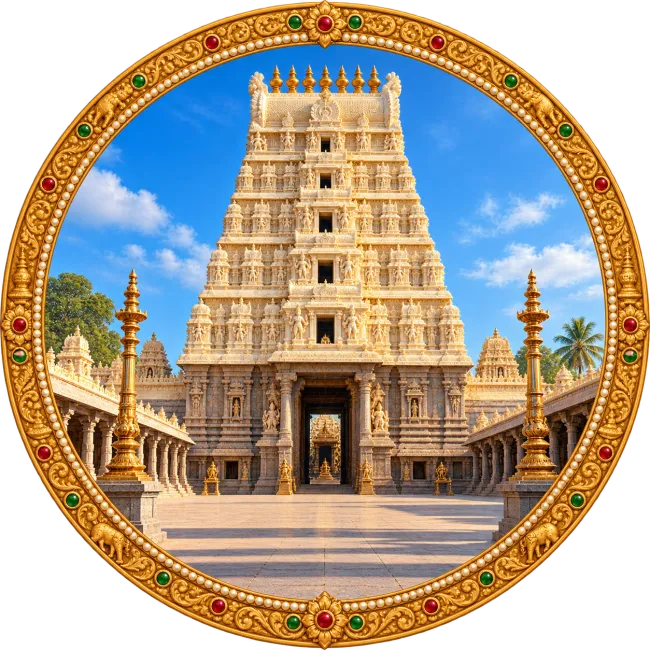
Nanjundeshwara Temple, Nanjangud
Nanjundeshwara Temple in Nanjangud, Karnataka, is one of the state’s largest and most revered temples dedicated to Lord Shiva. The deity is worshipped as Sri Nanjundeshwara or Srikanteshwara—the form of Shiva who consumed the deadly Halahala poison to protect the universe.
Located on the banks of the Kapila River near Mysuru, the temple is often called Dakshina Kashi, meaning the Kashi of South India. Its ancient history, towering gopura, sacred bathing ghats, annual chariot festivals and legends connected with Lord Shiva attract thousands of devotees.
About Nanjundeshwara Temple
Nanjundeshwara Temple, officially known as Sri Srikanteshwara Swamy Temple, is situated in Nanjangud in Mysuru district.
The principal deity is Lord Shiva in the form of a Shiva Lingam. He is worshipped under two closely connected names:
Nanjundeshwara: The Lord who consumed poison
Srikanteshwara: The Lord with the sacred or radiant throat
The town’s name, Nanjangud, is derived from Nanjunda. In Kannada, “Nanju” means poison, while “Unda” refers to one who consumed it.
The temple complex contains numerous shrines dedicated to Ganesha, Parvati, Subramanya, Vishnu and other deities. It also has an enormous entrance tower, spacious corridors, ceremonial halls and a traditional wooden temple chariot.
When and Who Built Nanjundeshwara Temple?
The earliest portions of Nanjundeshwara Temple are associated with the Western Ganga dynasty, which ruled parts of Karnataka between the fourth and tenth centuries.
The original shrine was expanded under the Chola rulers during the eleventh and twelfth centuries. Chola influence can be observed in the temple’s stone construction and Shaivite traditions.
The Hoysalas and Vijayanagara rulers subsequently contributed to the temple’s development. They supported festivals, added architectural elements and provided grants for worship.
The Wodeyar kings of Mysuru became major patrons of Nanjundeshwara Temple. They commissioned renovations, sculptures, ritual objects, processional vehicles and the grand entrance gopura.
Queen Devajammanni, members of the Mysuru royal family and other patrons contributed to the expansion of the temple complex.
The present structure therefore reflects the work of the Gangas, Cholas, Hoysalas, Vijayanagara rulers and Mysuru Wodeyars across many centuries.
Legend of Halahala Poison
According to Hindu mythology, the gods and demons churned the cosmic ocean to obtain Amrita, the nectar of immortality.
Before the nectar appeared, a deadly poison called Halahala emerged from the ocean. Its fumes threatened all living beings and the entire universe.
The gods approached Lord Shiva and requested his help. To protect creation, Shiva consumed the poison. Goddess Parvati held his throat to prevent it from spreading through his body.
The poison remained in Shiva’s throat, turning it blue. He became known as Neelkantha, Srikanteshwara and Nanjundeshwara.
The deity at Nanjangud represents this compassionate form of Shiva who accepted suffering to save the universe.
Legend of Parashurama
Nanjangud is also associated with Parashurama, the warrior incarnation of Lord Vishnu.
According to tradition, Parashurama came to the banks of the Kapila River while seeking relief from the consequences of his actions. He selected a peaceful location for meditation and began clearing the ground.
During the process, he accidentally struck a Shiva Lingam hidden beneath the earth. Blood emerged from the sacred image, and Parashurama realised his mistake.
He immediately performed penance and requested Lord Shiva’s forgiveness. Shiva appeared before him, accepted his devotion and instructed him to establish worship at the site.
A shrine associated with Parashurama is situated within the temple complex, preserving this legend.
Tipu Sultan and Nanjundeshwara
A popular historical tradition connects Tipu Sultan of Mysuru with Nanjundeshwara Temple.
According to the account, one of Tipu Sultan’s favourite elephants became seriously ill. Different treatments failed to improve its condition.
The elephant was brought before Lord Nanjundeshwara, and prayers were offered for its recovery. When the animal regained its health, Tipu Sultan respectfully referred to the deity as Hakim Nanjunda, meaning Nanjunda the divine physician.
Tipu is traditionally believed to have presented valuable ornaments to the temple in gratitude. This story reflects the temple’s reputation as a place of healing and its importance across communities.
Why Is Nanjangud Called Dakshina Kashi?
Nanjangud is called Dakshina Kashi because it is one of southern India’s most important Shiva pilgrimage centres.
The temple’s location beside the Kapila River is compared with the sacred relationship between Kashi Vishwanath and the Ganga. Pilgrims bathe at the designated ghats before worshipping Lord Nanjundeshwara.
The presence of numerous shrines and sacred water bodies strengthens this comparison. Devotees believe that worship at Nanjangud helps reduce past karmas and brings peace to departed ancestors.
Religious Significance
Lord Nanjundeshwara is especially worshipped for good health and recovery from illness. His association with consuming poison gives him the role of a divine healer.
Devotees visit the temple to pray for:
Recovery from illness
Protection from poison and harmful influences
Good health and long life
Mental peace
Family harmony
Marriage and marital happiness
Blessings for children
Relief from fear and anxiety
Professional success
Spiritual wisdom
Forgiveness for past actions
Peace for departed ancestors
Mondays, Pradosham, Maha Shivaratri and the month of Shravan are considered especially auspicious.
Main Deity and Other Shrines
Sri Nanjundeshwara
The principal deity is Lord Shiva as a sacred Lingam. Daily Abhishekam, Archana, Naivedyam and Deepa Aradhana are performed.
Goddess Parvati
Goddess Parvati is worshipped as the divine mother and consort of Nanjundeshwara. Devotees pray to her for marriage, children and family welfare.
Lord Ganesha
The temple contains several representations of Ganesha. One important image is traditionally associated with the Hoysala or Vijayanagara period.
Other deities and sacred figures include:
Lord Subramanya
Lord Vishnu
Goddess Chandikeshwari
Lord Surya
Parashurama
Veerabhadra
Chandikeswara
Navagrahas
Nandi
Various forms of Shiva
The large number of shrines makes the complex an important centre of both Shaivite and wider Hindu worship.
Architecture of Nanjundeshwara Temple
Nanjundeshwara Temple is a large Dravidian-style complex built primarily from stone. Its architecture reflects contributions made over several historical periods.
Main Gopura
The entrance is marked by a massive multi-tiered gopura decorated with colourful sculptures.
Images of Shiva, Parvati, Ganesha, Subramanya, divine guardians and mythological figures cover the tower. The gopura is one of Nanjangud’s most recognisable landmarks.
Main Sanctum
The sanctum contains the Nanjundeshwara Shiva Lingam. Traditional oil lamps, flowers, bilva leaves and sacred ornaments are used during worship.
The compact, dark interior creates a deeply devotional atmosphere. Access is regulated according to temple customs.
Nandi Mandapa
A large Nandi faces the Shiva sanctum. Devotees offer prayers to Nandi before receiving darshan of Lord Nanjundeshwara.
Pillared Halls
The temple contains spacious mandapams supported by carved stone pillars. Images of deities, animals and mythological scenes appear throughout these halls.
Temple Chariots
Nanjundeshwara Temple possesses large traditional wooden chariots used during Rathotsava. The chariots are decorated with cloth, flowers and sacred symbols before carrying the processional deities through the town.
Nanjundeshwara Temple Timings
The regular daily schedule is:
The schedule may be reorganised during Maha Shivaratri, Dodda Jathre, Chikka Jathre, Shravan Mondays and Pradosham.
Morning Puja and Deepa Aradhana
The temple opens at 6:00 AM with Suprabhata prayers and the ceremonial opening of the sanctum.
Morning Abhishekam is performed from 6:30 AM to 8:00 AM. The Lingam is worshipped using sacred water and other permitted offerings.
Morning Puja and Deepa Aradhana are conducted at 8:00 AM. Devotees offer flowers, bilva leaves, coconuts and prayers.
The best morning darshan period is from 6:30 AM to 9:30 AM. Visitors who wish to attend Abhishekam should arrive before 6:30 AM.
Madhyahna Mahapuja
Madhyahna Mahapuja is performed at 11:30 AM. The ritual includes Archana, sacred lamps, Vedic chanting and offerings to Lord Nanjundeshwara.
Naivedyam is presented at 12:00 PM. Access to the inner sanctum may be paused briefly while the food offering is made.
The morning session ends at 1:00 PM. Visitors should join the queue before 12:15 PM to complete darshan before closure.
Evening Puja and Deepa Aradhana
The temple reopens at 4:00 PM. Pradosha Puja is performed at 6:00 PM, followed by evening Deepa Aradhana at 6:30 PM.
The best evening darshan period is from 4:30 PM to 6:30 PM.
Night Mahamangalarathi is offered at 8:00 PM. Final darshan continues until the temple closes at 8:30 PM.
Kapila River and Sacred Bath
The Kapila River, also called Kabini, flows beside Nanjangud. Pilgrims traditionally bathe or wash their hands and feet at the designated ghats before entering the temple.
The river is used for religious ceremonies, including ancestral rites and festival rituals.
Visitors should follow safety instructions because water levels and currents can change during the monsoon. Soap and chemical products should not be used in the sacred bathing areas.
Major Festivals
Dodda Jathre
Dodda Jathre, meaning the Great Festival, is the largest annual celebration at Nanjundeshwara Temple.
Several decorated chariots carry the processional deities through Nanjangud. Thousands of devotees gather to pull the chariots and receive blessings.
Chikka Jathre
Chikka Jathre, meaning the Small Festival, is another important chariot celebration. It includes special Puja, processions and cultural activities.
Maha Shivaratri
Maha Shivaratri is celebrated with Abhishekam, Rudra chanting, fasting and night-long worship.
Girija Kalyana
The divine wedding of Shiva and Parvati is celebrated through traditional ceremonies. Married couples pray for harmony, while unmarried devotees seek blessings for a suitable partner.
Shravan Mondays
Special Abhishekam and Archana are performed on Mondays during Shravan.
Other important observances include Pradosham, Kartika Deepotsava, Ugadi and Makara Sankranti.
Sevas and Offerings
Important temple Sevas include:
Abhishekam
Rudrabhishekam
Panchamrita Abhishekam
Bilvarchana
Sahasranama Archana
Special Mahapuja
Deepa Seva
Vahana Puja
Girija Kalyana Seva
Annadanam donation
Festival sponsorship
Flowers, bilva leaves, coconuts, fruits, sacred ash and lamps are common offerings.
Seva tickets and worship materials should be obtained only through authorised counters.
Prasadam and Annadanam
Sacred ash, kumkum and other blessed items are distributed after worship. Food prasadam may be available through designated counters or Annadanam services.
Devotees should accept prasadam respectfully and avoid wasting food. Packaging must be disposed of in designated bins.
Dress Code and Temple Rules
Visitors should wear clean and modest clothing. Traditional Indian attire is recommended.
Men may wear a dhoti, kurta-pyjama or full-length trousers with a shirt. Women may wear a saree, salwar kameez or another modest outfit.
Men entering selected inner areas may be required to remove shirts or upper garments according to temple customs.
Footwear must be removed before entry. Mobile phones, cameras and large bags may be restricted. Photography and videography are prohibited near the sanctum.
Alcohol, tobacco, leather articles and non-vegetarian food must not be carried inside.
Entry Fee and Visit Duration
General darshan is available without an entry fee. Separate charges apply to Abhishekam, Archana and other special Sevas.
A complete visit requires 1½ to 2 hours. Visitors exploring all subsidiary shrines and the Kapila River ghats should keep 2½ hours available.
Waiting times are longer on Mondays, Pradosham, weekends and festival days.
Best Time to Visit
October to February is the most comfortable period for visiting Nanjangud. The weather is suitable for darshan and nearby sightseeing.
For peaceful darshan, visit between 6:30 AM and 9:00 AM on a weekday. Evening darshan from 4:30 PM to 6:30 PM allows visitors to attend Pradosha Puja and Deepa Aradhana.
Dodda Jathre and Maha Shivaratri provide a grand devotional experience but attract very large crowds.
How to Reach Nanjundeshwara Temple
By Air
Mysuru Airport is the nearest airport. Kempegowda International Airport in Bengaluru provides wider domestic and international connectivity.
Taxis and buses are available from Mysuru and Bengaluru.
By Train
Nanjangud Town Railway Station is the nearest station. It has regional connections with Mysuru and nearby destinations.
Mysuru Junction is the nearest major railway station and offers extensive connectivity.
By Road
Nanjangud is approximately 25 kilometres from Mysuru and is well connected by highway.
Government buses, private buses, taxis and local vehicles operate regularly between Mysuru and Nanjangud.
Nearby Places to Visit
Visitors may also explore:
Kapila River ghats
Sri Raghavendra Swamy Matha
Parashurama Temple
Srikanteshwara subsidiary shrines
Mysore Palace
Chamundeshwari Temple
Sri Nandi Temple
Srirangapatna
Ranganathittu Bird Sanctuary
Himavad Gopalaswamy Betta
Bandipur National Park
Talakadu
Visitor Guidelines
Take a bath or wash your hands and feet before entering. Wear clean, dry clothing rather than wet garments from the river.
Purchase Abhishekam and Archana tickets only from authorised counters. Keep the receipt until the ritual is completed.
Visit on a weekday morning for a peaceful experience. During Dodda Jathre, follow traffic restrictions and crowd-control instructions.
Do not enter deep sections of the Kapila River. Parents should supervise children near the ghats and temple chariots.
Maintain silence near the sanctum and allow other devotees sufficient space for darshan.
Conclusion
Nanjundeshwara Temple is one of Karnataka’s most important centres of Shiva worship. Its association with the Halahala poison, Parashurama and the healing of Tipu Sultan’s elephant gives it a rich spiritual identity.
The ancient Ganga foundation, contributions of the Cholas and Vijayanagara rulers, and patronage of the Mysuru Wodeyars created a magnificent temple complex. A visit to Nanjangud offers devotees an opportunity to seek health, forgiveness, protection and the compassionate blessings of Lord Nanjundeshwara.