Murudeshwar Temple
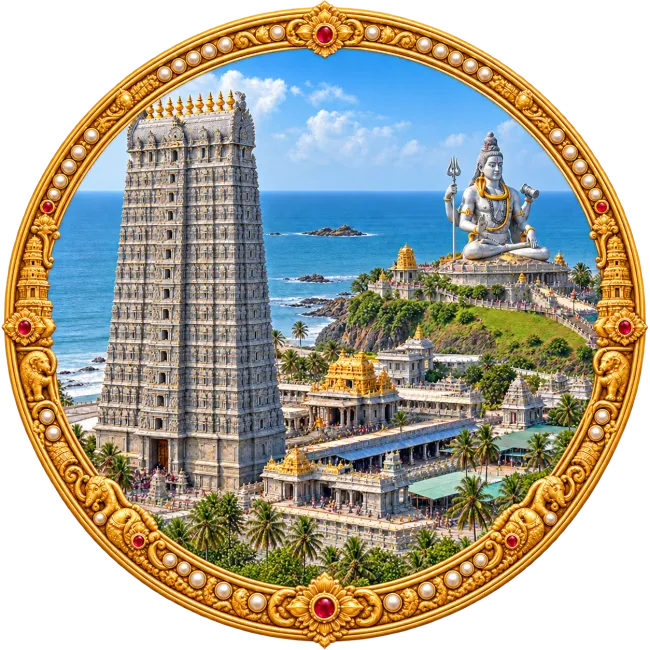
Murudeshwar Temple in Karnataka is one of India’s most striking coastal temples dedicated to Lord Shiva. Situated on Kanduka Hill and surrounded by the Arabian Sea on three sides, the temple is famous for its towering Raja Gopura and enormous statue of Lord Shiva.
The main deity is worshipped as Sri Mridesa Linga, a form connected with the sacred Atma Linga of Lord Shiva. Murudeshwar combines mythology, ancient worship, modern architecture and beautiful coastal scenery, making it a major pilgrimage and tourist destination in Uttara Kannada district.
About Murudeshwar Temple
Murudeshwar Temple is dedicated to Lord Shiva and is located in the coastal town of Murudeshwar, Karnataka. The temple is built on Kanduka Hill, which extends into the Arabian Sea.
The main Shiva Lingam is known as Sri Mridesa Linga or Murudeshwara. It is connected with the legend of Ravana and the Atma Linga, which also forms the sacred history of the nearby Mahabaleshwar Temple at Gokarna.
The temple complex is especially recognised for:
The sacred Mridesa Linga
The 123-foot statue of Lord Shiva
The twenty-storey Raja Gopura
Sculptures depicting episodes from Hindu mythology
Panoramic views of the Arabian Sea
Kanduka Hill and Murudeshwar Beach
Its connection with the Atma Linga legend
Devotees visit the temple to seek Lord Shiva’s blessings for health, courage, family welfare, prosperity and freedom from negative influences.
When and Who Built Murudeshwar Temple?
The original Murudeshwar shrine is an ancient centre of Shiva worship associated with the Atma Linga tradition. Its sacred history predates the modern structures visible today.
The temple was renovated at different times by local rulers, devotees and religious patrons. The principal sanctum preserves the traditional form and importance of the original shrine.
The present-day Murudeshwar complex was extensively developed by businessman and philanthropist R. N. Shetty and his family. They supported the construction of the monumental Shiva statue, Raja Gopura, mythological sculpture park, pathways and other facilities.
The enormous Shiva statue was created by a team of sculptors led by Kashinath. The modern development transformed Murudeshwar into a prominent religious and coastal tourism destination while preserving the worship of the ancient Mridesa Linga.
Legend of Ravana and the Atma Linga
According to Hindu mythology, Ravana, the king of Lanka, was a great devotee of Lord Shiva. He performed severe penance to obtain the Atma Linga, a divine Lingam containing Shiva’s immense spiritual power.
Pleased with Ravana’s devotion, Lord Shiva gave him the Atma Linga but imposed an important condition: it must not be placed on the ground before reaching Lanka. If it touched the earth, it would become permanently fixed at that location.
The gods feared that Ravana would become invincible after installing the Atma Linga in Lanka. They requested Lord Ganesha to prevent him from completing his journey.
As Ravana approached Gokarna, Lord Vishnu created the appearance of sunset. Ravana needed to perform his evening prayers, so he asked a young boy—Lord Ganesha in disguise—to hold the Atma Linga.
Ganesha agreed but said he would call Ravana three times if the Lingam became too heavy. If Ravana did not return, he would place it on the ground.
Ganesha called Ravana three times and then placed the Atma Linga at Gokarna. When Ravana returned, he tried to pull it out of the ground but was unable to move it.
How Murudeshwar Received Its Name
In anger, Ravana attempted to destroy the outer covering of the Atma Linga. Parts of its covering were thrown in different directions and landed at several locations along the Karnataka coast.
One portion fell at the present location of Murudeshwar. This sacred fragment came to be worshipped as Mridesa Linga.
The original name is traditionally associated with Mrideshwara. Over time, it developed into the present name Murudeshwar.
Other sacred places connected with different portions of the Atma Linga covering include:
Gokarna
Dhareshwara
Gunavanteshwara
Sajjeshwara
Shejjeshwara
Together, these coastal Shiva shrines form an important pilgrimage circuit.
Religious Significance
Murudeshwar Temple is considered a powerful place for Shiva worship. The temple’s association with the Atma Linga gives it special importance among devotees.
People visit the temple to pray for:
Good health and long life
Protection from danger
Relief from fear and anxiety
Family peace and prosperity
Marriage and marital harmony
Blessings for children
Professional success
Relief from negative influences
Spiritual wisdom
Freedom from past mistakes
Courage during difficult situations
Blessings before beginning a journey
Mondays, Pradosham, Maha Shivaratri and the month of Shravan are considered especially auspicious for visiting the temple.
Main Deity and Other Shrines
Sri Mridesa Linga
The principal deity is Lord Shiva as Sri Mridesa Linga. The sacred Lingam is installed within the main sanctum and worshipped through Abhishekam, Archana and Deepa Aradhana.
The sanctum retains a traditional and peaceful atmosphere despite the monumental modern structures surrounding it.
Goddess Parvati
Goddess Parvati is worshipped as the divine consort of Lord Shiva. Devotees pray to her for family harmony, marriage and protection.
Other deities and sacred figures represented within the temple complex include:
Lord Ganesha
Lord Subrahmanya
Nandi
Lord Hanuman
Goddess Durga
Navagrahas
Ravana
Lord Krishna and Arjuna
Surya and other divine figures
The complex contains numerous sculptural representations of mythological scenes rather than separate sanctums for every figure.
Architecture of Murudeshwar Temple
Murudeshwar Temple combines a traditional Shiva shrine with grand modern architecture. Its location on a coastal hill gives it a distinctive appearance.
Main Sanctum
The main sanctum contains the sacred Mridesa Linga. It is comparatively modest in scale and follows the traditional design of a South Indian Shiva temple.
Devotees enter through the main complex, offer prayers to Nandi and proceed towards the sanctum for darshan.
Raja Gopura
The temple’s monumental Raja Gopura rises above the entrance and consists of twenty storeys. Its surface is decorated with sculptures of Hindu deities, guardians and mythological characters.
An elevator carries visitors to an upper viewing level. From there, they can see the Shiva statue, Arabian Sea, Murudeshwar Beach, fishing boats and surrounding landscape.
The elevator may have a separate ticket, while entry to the main temple remains free.
Lord Shiva Statue
The enormous seated statue of Lord Shiva is the most recognisable landmark of Murudeshwar. Measuring approximately 123 feet in height, it is among the tallest Shiva statues in India.
The statue is positioned so that sunlight falls directly upon it. The metallic finish causes the image to shine against the blue sea and sky.
Lord Shiva is shown seated in meditation, holding divine symbols and facing the surrounding landscape.
Mythological Sculpture Park
The area near the Shiva statue contains large sculptures depicting the Atma Linga story. Important scenes include Ravana performing penance, Lord Shiva granting the Atma Linga and Ganesha placing it on the ground.
These visual representations help visitors understand the mythology connected with Murudeshwar and Gokarna.
Kanduka Hill
The temple is constructed on Kanduka Hill, surrounded by the Arabian Sea on three sides. The elevated position provides excellent views and creates a peaceful setting for worship.
Murudeshwar Temple Timings
The regular darshan and Puja schedule is:
The schedule may change on Maha Shivaratri, Pradosham, Shravan Mondays and other major festival days.
Morning Puja and Deepa Aradhana
The temple opens at 6:00 AM with Suprabhata prayers and the ceremonial opening of the sanctum.
Morning Abhishekam is performed from 6:30 AM to 7:30 AM. The Shiva Lingam is worshipped using sacred water and other permitted offerings according to temple tradition.
Morning Puja and Deepa Aradhana are conducted at 7:30 AM. Devotees offer flowers, bilva leaves, coconuts and prayers.
The best morning darshan period is from 7:00 AM to 10:00 AM. The weather is comparatively pleasant, and visitors have sufficient time to explore the Raja Gopura and Shiva statue.
Madhyahna Puja
Madhyahna Puja and Naivedyam are performed at 12:15 PM. Food is ceremonially offered to Lord Shiva, followed by sacred lamps and prayers.
Access to the sanctum may be paused during the Naivedyam ritual. The morning session ends at 1:00 PM.
Visitors arriving close to midday should enter the darshan line before 12:00 PM.
Evening Puja and Deepa Aradhana
The temple reopens at 3:00 PM. Evening Abhishekam is performed at 6:00 PM, followed by Puja and Deepa Aradhana at 7:15 PM.
The best evening darshan period is from 4:30 PM to 6:30 PM. This period also provides beautiful views of the sea and Shiva statue before sunset.
Final darshan continues after the evening Puja, and the temple closes at 8:15 PM.
Major Festivals
Maha Shivaratri
Maha Shivaratri is the most important festival celebrated at Murudeshwar Temple. Special Abhishekams, Rudra chanting, night worship and cultural programmes are organised.
Large numbers of devotees observe fasting and offer bilva leaves to Lord Shiva.
Kartika Masam
Devotees light sacred lamps and perform special worship during Kartika month. Mondays and Pradosham days attract large crowds.
Shravan Mondays
Every Monday during the month of Shravan is dedicated to special Shiva worship. Abhishekam and Archana are performed throughout the day.
Pradosham
Pradosham is observed during the twilight period on the thirteenth lunar day. Devotees worship Shiva and Nandi for relief from difficulties and past karmas.
Ganesha Chaturthi
Lord Ganesha is worshipped with special rituals because of his important role in the Atma Linga legend.
Other festivals include Deepavali, Ugadi, Makara Sankranti and Navaratri.
Sevas and Offerings
Available temple Sevas may include:
Abhishekam
Rudrabhishekam
Panchamrita Abhishekam
Archana
Bilvarchana
Deepa Seva
Special Puja
Vahana Puja
Annadanam donation
Festival sponsorship
Bilva leaves, flowers, coconuts, fruits, incense and sacred lamps are common offerings to Lord Shiva.
Seva tickets and Puja materials should be obtained from authorised counters. Devotees should not hand money to unauthorised guides or intermediaries.
Prasadam
Sacred ash, kumkum and other blessed items may be distributed after darshan. Food prasadam may be available at designated counters according to the daily schedule.
Devotees should accept prasadam respectfully and use designated bins for packaging. Littering is especially harmful because the temple is close to the sea.
Dress Code and Entry Rules
Visitors should wear clean and modest clothing. Men may wear a dhoti, kurta-pyjama or full-length trousers with a shirt. Women may wear a saree, salwar kameez or another modest outfit.
Beachwear, wet clothing and excessively short garments should not be worn inside the temple. Visitors coming from the beach should change into clean, dry clothes before darshan.
Footwear must be removed before entering. Photography may be permitted in exterior areas but is restricted near the sanctum.
Alcohol, tobacco, leather articles and non-vegetarian food must not be carried inside.
Entry Fee and Visit Duration
General temple entry and darshan are available without an entry fee. A separate charge may apply for using the Raja Gopura elevator and selected services.
A complete visit requires 2 to 3 hours. This includes temple darshan, the Shiva statue, Raja Gopura viewpoint and mythological sculpture park.
Visitors planning to spend time at Murudeshwar Beach should reserve at least half a day.
Best Time to Visit
October to February is the most comfortable period for visiting Murudeshwar. The weather is suitable for temple darshan, coastal sightseeing and outdoor activities.
For peaceful darshan, arrive between 7:00 AM and 9:00 AM on a weekday. Evening visits between 4:30 PM and 6:30 PM offer cooler weather and beautiful sunset views.
The monsoon creates dramatic coastal scenery, but heavy rain and rough sea conditions may affect outdoor activities.
How to Reach Murudeshwar Temple
By Air
Mangaluru International Airport is the nearest major airport. Taxis, buses and trains are available from Mangaluru to Murudeshwar.
By Train
Murudeshwar Railway Station is the nearest station and lies on the Konkan Railway route. It has connections with Mangaluru, Udupi, Karwar, Goa, Mumbai and several other destinations.
Auto-rickshaws and taxis are available outside the station.
By Road
Murudeshwar is situated near the coastal highway connecting Mangaluru, Udupi, Kundapura, Honnavar, Gokarna and Karwar.
Government and private buses operate regularly. The temple is easily accessible by car, taxi or local transport.
Nearby Places to Visit
Visitors may also explore:
Murudeshwar Beach
Netrani Island
Bhatkal
Gokarna Mahabaleshwar Temple
Idagunji Ganapati Temple
Apsarakonda Falls
Eco Beach, Honnavar
Sharavathi Kandla Mangrove Boardwalk
Maravanthe Beach
Kollur Mookambika Temple
Jog Falls
Mirjan Fort
Netrani Island
Netrani Island is situated off the Murudeshwar coast and is popular for scuba diving and boat activities.
Visitors should use only authorised operators and follow all safety instructions. Water activities depend on weather, sea conditions and official permissions.
Temple visitors should complete worship before participating in beach or adventure activities, particularly if they intend to enter the sanctum in clean traditional clothing.
Visitor Guidelines
Visit the main sanctum before exploring the statue and Raja Gopura. Morning hours provide cooler weather and shorter darshan queues.
Maintain caution near hill edges, stairways and sea-facing viewpoints. Children should remain under adult supervision.
Follow elevator capacity rules inside the Raja Gopura. Visitors who are uncomfortable with heights should avoid the upper viewing level.
Do not wear wet beach clothes inside the temple. Deposit footwear and restricted belongings only at authorised counters.
Avoid swimming during rough sea conditions and obey all warning signs placed along the beach.
Conclusion
Murudeshwar Temple is a remarkable combination of ancient Shiva worship, mythology, modern architecture and coastal beauty. Its connection with the Atma Linga, sacred Mridesa Lingam, enormous Shiva statue and towering Raja Gopura make it one of Karnataka’s most distinctive pilgrimage destinations.
Surrounded by the Arabian Sea, the temple offers devotees an opportunity to experience prayer, history and nature in one place. A visit to Murudeshwar inspires devotion to Lord Shiva while providing unforgettable views of Karnataka’s beautiful coastline.