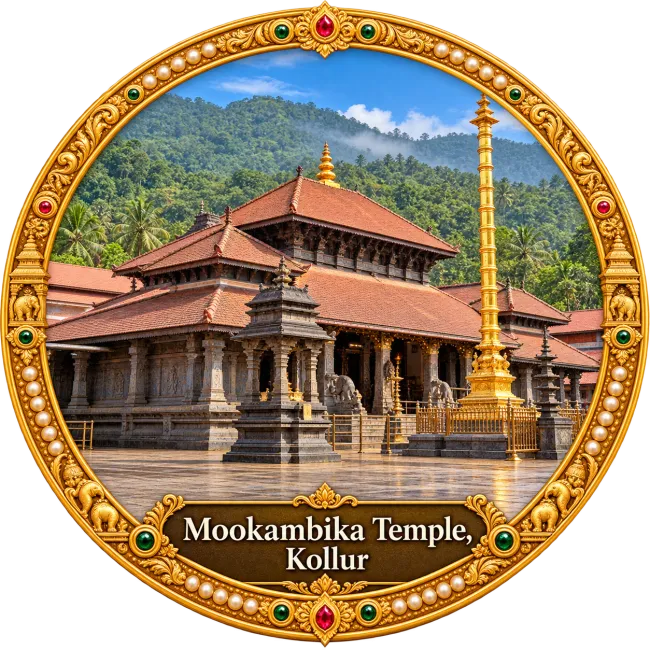
Mookambika Temple, Kollur
Mookambika Temple in Kollur, Karnataka, is one of South India’s most revered Shakti temples. Located near the banks of the Souparnika River and surrounded by the green hills of the Western Ghats, the temple is dedicated to Goddess Mookambika, a unified manifestation of Mahakali, Mahalakshmi and Mahasaraswati.
The temple is especially significant for students, musicians, artists and spiritual seekers. Families visit Kollur to perform Vidyarambham, a ceremony that marks a child’s formal introduction to education. The temple’s Swayambhu Jyotirlinga, connection with Adi Shankaracharya and association with the defeat of Mookasura give it exceptional religious importance.
About Mookambika Temple
Sri Mookambika Temple is situated in Kollur village in Udupi district, Karnataka. The principal deity, Goddess Mookambika, represents the combined powers of Mahakali, Mahalakshmi and Mahasaraswati.
A Swayambhu Jyotirlinga is worshipped within the sanctum. A golden line divides the Lingam into two unequal portions. The larger portion is associated with Shakti, while the other represents Shiva and the divine masculine principle.
A Panchaloha idol of Goddess Mookambika is installed behind the Jyotirlinga. According to temple tradition, this idol was consecrated by Adi Shankaracharya after he experienced the divine presence of the Goddess.
Kollur is situated at the base of the Kodachadri Hills, where Adi Shankaracharya is believed to have performed meditation. The forests, hills and Souparnika River contribute to the temple’s peaceful spiritual environment.
When and Who Built Mookambika Temple?
The sacred site and Swayambhu Jyotirlinga are believed to be ancient. The organised worship of Goddess Mookambika is closely associated with Adi Shankaracharya, who lived during the early medieval period.
According to tradition, Adi Shankaracharya installed the Panchaloha idol and Sri Chakra within the sanctum. He also established a systematic form of worship combining Shakti and Advaita traditions.
The present temple complex developed through the contributions of different South Indian rulers. The Keladi Nayakas, Vijayanagara rulers and local royal families supported the temple, donated land and contributed ornaments, structures and religious services.
Rulers from the coastal Karnataka and Kerala regions also maintained close devotional ties with Mookambika Temple. The sanctum, halls, enclosure walls and supporting buildings were repaired and expanded during successive periods.
Therefore, the temple’s sacred origin is ancient, while its present architectural form developed over several centuries.
Legend of Kola Maharishi
According to tradition, a sage named Kola Maharishi performed severe penance in the forests of Kollur. He worshipped the Swayambhu Jyotirlinga and prayed for the divine mother to manifest permanently at the location.
Pleased with his devotion, Goddess Shakti appeared and agreed to reside at the sacred site. The location came to be associated with the sage, and the name Kollur is traditionally linked with Kola Maharishi.
A shrine dedicated to Kola Maharishi is situated within the temple complex. Devotees honour him as the sage whose penance established Kollur as a major Shakti Kshetra.
Legend of Mookasura
A powerful demon named Kaumasura performed severe penance and sought a boon that would make him invincible. The gods feared that he would misuse the boon and requested Goddess Saraswati to intervene.
The Goddess made the demon unable to speak before he could state his desired boon. Because he became mute, he came to be known as Mookasura. The word “Mooka” means mute.
Mookasura later troubled sages and disturbed their spiritual practices. In response to their prayers, the divine mother appeared in a powerful form and defeated him.
Before his death, Mookasura recognised the Goddess and requested that the sacred place be connected with his name. The Goddess accepted his final prayer and became known as Mookambika—the divine mother who defeated Mookasura.
The legend represents the destruction of ignorance, arrogance and the misuse of power.
Adi Shankaracharya and Goddess Mookambika
Adi Shankaracharya is central to the temple’s spiritual tradition. He is believed to have meditated at Kodachadri and received a divine vision of Goddess Mookambika.
According to one tradition, Shankaracharya requested the Goddess to accompany him to Kerala. She agreed on the condition that he should walk ahead without looking back. He heard the sound of her anklets as she followed him.
At a particular point, the sound stopped. Shankaracharya turned to check whether she was still following, thereby breaking the condition. The Goddess then chose to remain at Kollur.
Shankaracharya installed the Panchaloha image and consecrated a Sri Chakra to focus the Goddess’s divine energy. He is also believed to have composed devotional verses in her honour.
A seat known as the Shankara Peetha is associated with his meditation and worship within the temple tradition.
Swayambhu Jyotirlinga
The Swayambhu Jyotirlinga is the most sacred element of Mookambika Temple. It is believed to have manifested naturally rather than being carved or installed by human hands.
A golden line divides the Lingam. One portion represents the divine feminine energies of Mahakali, Mahalakshmi and Mahasaraswati. The other portion represents Brahma, Vishnu and Shiva.
The Lingam therefore symbolises the unity of:
Shiva and Shakti
Knowledge and power
Creation, preservation and transformation
Masculine and feminine divine energies
Different forms of Hindu worship
The Panchaloha idol of Mookambika is positioned behind the Jyotirlinga, allowing devotees to worship both the formless and visible manifestations of the Goddess.
Religious Significance
Mookambika is worshipped as the Goddess of knowledge, speech, music, prosperity and protection. The temple is especially important for children beginning education and artists seeking excellence.
Devotees visit the temple to pray for:
Success in education and examinations
Improvement in speech and communication
Knowledge and wisdom
Musical and artistic ability
Good health and protection
Marriage and family happiness
Blessings for children
Relief from fear and anxiety
Professional growth
Financial prosperity
Spiritual discipline
Freedom from ignorance
The Goddess is believed to fulfil sincere wishes and guide devotees towards wisdom and righteous living.
Main Deity and Other Shrines
Goddess Mookambika
The Panchaloha image of Goddess Mookambika is shown in a seated posture. She holds divine symbols and is richly decorated with flowers, silk garments and ornaments.
Swayambhu Jyotirlinga
The naturally manifested Lingam is installed in front of the Goddess. Daily Abhishekam and worship are performed according to the established temple tradition.
Other important shrines and sacred figures include:
Lord Ganesha
Lord Subrahmanya
Lord Veerabhadra
Lord Hanuman
Goddess Saraswati
Goddess Mahalakshmi
Goddess Mahakali
Kola Maharishi
Nagadevata
Navagrahas
Shankara Peetha
Devotees should complete darshan of the principal deity before visiting the subsidiary shrines.
Architecture of Mookambika Temple
The temple reflects a combination of Kerala and coastal Karnataka architectural styles. Its tiled roofs, wooden details, stone sanctum and enclosed courtyards are suitable for the region’s heavy rainfall.
Main Sanctum
The sanctum houses the Swayambhu Jyotirlinga and the Panchaloha image of Goddess Mookambika. The interior is illuminated by traditional lamps and decorated with flowers and gold ornaments.
Access to the innermost area is controlled according to temple customs. Devotees receive darshan from the designated viewing space.
Deepa Stambha
A tall Deepa Stambha stands within the complex. Numerous lamps are lit on important festival days, creating a beautiful devotional atmosphere.
Shankara Peetha
Shankara Peetha commemorates Adi Shankaracharya’s connection with the temple. Devotees and spiritual seekers offer prayers at this sacred place.
Saraswati Mandapa
Saraswati Mandapa is used for Vidyarambham, musical performances, recitations and ceremonies connected with education.
Golden Crest and Temple Roof
The sanctum and adjoining structures display traditional metalwork, wooden craftsmanship and tiled roofing. The architecture is elegant and devotional rather than highly monumental.
Mookambika Temple Timings
The regular daily schedule is:
The schedule may be reorganised during Navaratri, annual Rathotsava, Saraswati Puja and other major festivals.
Morning Puja and Mangalarathi
The temple opens at 5:00 AM with Nirmalya Darshan. During this period, devotees see the Goddess before the previous day’s floral decorations are completely removed.
Dantadhavana Mangalarathi is performed at 5:30 AM. Udayakala Puja takes place at 6:30 AM, followed by the morning Mangalarathi at 7:30 AM.
Bali and Nivedana are performed at 8:00 AM. Food is ceremonially offered to the deity, and ritual offerings are made to the guardian deities.
The best morning darshan period is from 6:30 AM to 10:30 AM. Devotees planning Vidyarambham should arrive early and register at the authorised counter.
Madhyahna Puja and Mahamangalarathi
Madhyahna Puja is performed at 11:30 AM. Mahamangalarathi follows at 12:00 PM, when sacred lamps are offered before the Goddess.
Madhyahna Bali is conducted at 12:30 PM. The morning session ends at 1:30 PM.
Visitors who wish to attend the complete midday ritual should enter the temple before 11:15 AM.
Evening Puja and Mangalarathi
The temple reopens at 3:00 PM. Pradosha Puja is performed at 6:00 PM, followed by evening Mangalarathi at 6:30 PM.
Evening Nivedana takes place at 7:00 PM, and Deepa Aradhana is performed at 7:30 PM.
Bali Utsava begins at 8:00 PM. Saraswati Mandapa Puja is performed at 8:30 PM, making this period especially meaningful for students, musicians and artists.
Kashaya Mangalarathi, the final worship of the day, is performed at 9:00 PM. The temple closes after this ritual.
Vidyarambham Ceremony
Vidyarambham is one of the most important ceremonies performed at Mookambika Temple. It marks a child’s formal introduction to letters, knowledge and education.
During the ceremony, the child writes sacred letters in rice under the guidance of a priest, parent or teacher. The phrase “Om Hari Sri Ganapataye Namaha” is commonly used to begin the learning process.
Children are also guided to write letters on their tongue using a golden ring or another prescribed ritual object. This symbolises the blessing of Goddess Saraswati for knowledge and clear speech.
Vidyarambham is performed throughout the year, but Vijayadashami is considered the most auspicious day. Thousands of families visit Kollur on this occasion.
Major Festivals
Navaratri
Navaratri is the largest annual celebration at Mookambika Temple. The Goddess is worshipped in different forms through special Puja, Alankaram, music and cultural programmes.
The final days associated with Saraswati Puja, Ayudha Puja and Vijayadashami are especially important.
Vijayadashami
Vijayadashami is the principal day for Vidyarambham. Children begin their education with the blessings of Goddess Mookambika.
Annual Rathotsava
During Rathotsava, the processional deity is taken through Kollur in a decorated temple chariot. Devotees gather to pull the sacred chariot and receive blessings.
Saraswati Puja
Books, musical instruments and educational materials are placed before the Goddess for blessings. Students and artists participate in large numbers.
Maha Shivaratri
The Swayambhu Jyotirlinga receives special Abhishekam and worship during Maha Shivaratri, emphasising the temple’s Shiva–Shakti unity.
Other festivals include Deepavali, Ugadi, Krishna Janmashtami and full-moon observances.
Sevas and Offerings
Important temple Sevas include:
Nirmalya Darshan
Udayakala Puja
Sahasranama Archana
Kumkumarchana
Chandika Homam
Panchamrita Abhishekam
Mahamangalarathi
Deepa Seva
Vidyarambham
Saraswati Puja
Annadanam donation
Vahana Puja
Festival sponsorship
Devotees may offer flowers, coconuts, fruits, turmeric, kumkum, sarees and sacred lamps.
Students and musicians often offer books, notebooks, pens or musical instruments for ceremonial blessings.
Prasadam and Annadanam
Kashaya is a distinctive sacred offering associated with Mookambika Temple. It is a herbal preparation distributed after the final Mangalarathi.
Other prasadam may include laddu, appam, rice preparations, kumkum and sacred items blessed during worship.
The temple provides Annadanam to pilgrims according to the daily meal schedule. Devotees should sit in designated rows, accept the food respectfully and avoid wastage.
Souparnika River
The Souparnika River flows near Kollur and is considered sacred. According to tradition, Suparna, another name for Garuda, performed penance on its banks.
The river is believed to receive medicinal qualities from the herbs and plants growing in the Kodachadri forests.
Pilgrims may visit the designated bathing ghats before entering the temple. Visitors should follow safety instructions and avoid deep water during heavy rainfall.
Dress Code and Temple Rules
Devotees should wear clean, modest and traditional clothing. Men may wear a dhoti, kurta-pyjama or full-length trousers with a shirt. Women may wear a saree, salwar kameez or another modest outfit.
Traditional dress may be required for selected Sevas. Visitors should follow the instructions displayed at the temple.
Footwear must be removed before entering. Mobile phones, cameras and large bags may be restricted within the inner complex. Photography is prohibited near the sanctum.
Alcohol, tobacco, leather articles and non-vegetarian food must not be carried inside.
Entry Fee and Visit Duration
General darshan is available without an entry fee. Separate charges apply to special darshan, Vidyarambham, Abhishekam, Chandika Homam and other Sevas.
A regular visit requires 1½ to 2 hours. Devotees participating in Vidyarambham or special Puja should keep 2½ to 3 hours available.
Waiting time is longer on Fridays, weekends, Navaratri and Vijayadashami.
Best Time to Visit
October to March is the most comfortable period for visiting Kollur. The weather is suitable for temple worship and exploring the Western Ghats.
For peaceful darshan, visit between 6:30 AM and 9:00 AM on a weekday. Evening darshan between 5:00 PM and 7:30 PM provides an opportunity to attend Pradosha Puja and Deepa Aradhana.
The monsoon brings heavy rainfall to Kollur. The surrounding forests become exceptionally green, but visitors should be prepared for wet roads and travel delays.
How to Reach Mookambika Temple
By Air
Mangaluru International Airport is the nearest major airport. Taxis and buses are available from Mangaluru to Kollur.
By Train
Byndoor Mookambika Road Railway Station is the nearest railway station. Kundapura and Udupi are other convenient stations with wider connectivity.
Buses and taxis are available from the railway stations to Kollur.
By Road
Kollur is well connected with Udupi, Kundapura, Mangaluru, Murudeshwar, Byndoor, Shivamogga and Bengaluru.
Government and private buses operate regularly. The roads pass through scenic forested areas of the Western Ghats.
Nearby Places to Visit
Visitors may also explore:
Souparnika River
Kodachadri Hills
Sarvajna Peetha
Arasinagundi Waterfalls
Hidlumane Falls
Maranakatte Brahmalingeshwara Temple
Ottinene Viewpoint
Byndoor Beach
Sri Krishna Temple, Udupi
Murudeshwar Temple
Anegudde Vinayaka Temple
Visitor Guidelines
Arrive early for Vidyarambham, particularly during Vijayadashami. Register only at authorised temple counters and preserve the receipt until the ceremony is complete.
Senior citizens and families with children should prefer weekday mornings. Rain protection is essential during the monsoon.
Deposit footwear, mobile phones and large bags at authorised counters. Avoid using unauthorised agents for darshan or Seva arrangements.
If visiting Kodachadri, hire an authorised local vehicle or guide. Forest routes should be completed during daylight and only in suitable weather.
Conclusion
Mookambika Temple in Kollur is a powerful centre of knowledge, Shakti worship and spiritual harmony. Its Swayambhu Jyotirlinga, Panchaloha deity, association with Adi Shankaracharya and beautiful Western Ghats setting give it a unique identity.
The Goddess is worshipped as Mahakali, Mahalakshmi and Mahasaraswati, representing power, prosperity and wisdom. A visit to Mookambika Temple offers devotees an opportunity to seek knowledge, artistic excellence, family welfare and the compassionate blessings of the divine mother.