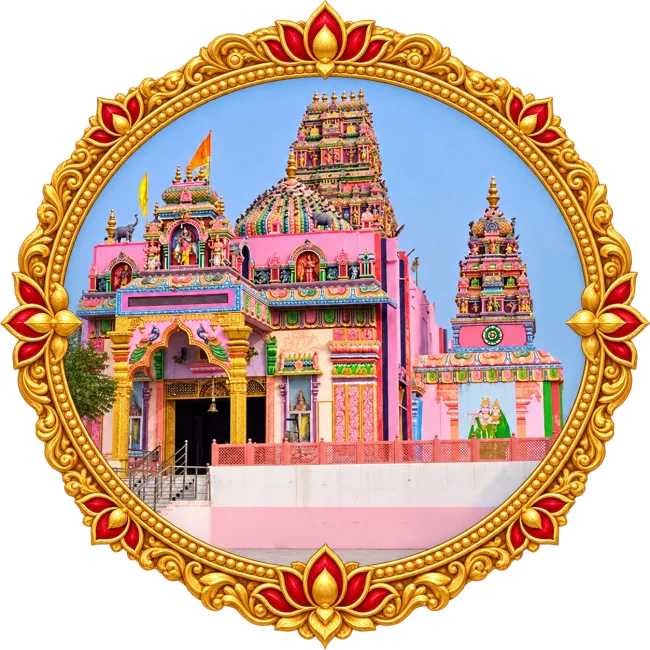
Mehandipur Balaji Temple
Visit Mehandipur Balaji Temple in Rajasthan, one of the most revered temples dedicated to Lord Hanuman in his Balaji form. Situated between two hills in Ghata Mehandipur, the temple is known for its powerful spiritual atmosphere, ancient religious traditions and the worship of Shri Balaji Maharaj, Pretraj Sarkar and Bhairav Baba. Thousands of devotees visit the temple to pray for protection, courage, relief from difficulties and freedom from negative influences.
About Mehandipur Balaji Temple
Mehandipur Balaji Temple is situated in Ghata Mehandipur village of Sikrai tehsil in Rajasthan’s Dausa district. The temple stands close to the boundary of Dausa and Gangapur districts and is surrounded by the rocky landscape of the Aravalli region.
The temple is dedicated to Lord Hanuman, worshipped here in his child form as Shri Balaji Maharaj. In many parts of Rajasthan, the name Balaji is used for Lord Hanuman. The shrine should not be confused with Tirupati Balaji Temple in Andhra Pradesh, which is dedicated to Lord Venkateswara.
Along with Shri Balaji Maharaj, devotees worship Pretraj Sarkar and Bhairav Baba in the temple complex. These three sacred forms are connected with the temple’s distinctive prayer tradition. Balaji Maharaj is worshipped as the remover of suffering, Pretraj Sarkar represents divine justice, and Bhairav Baba is regarded as a guardian deity.
Devotees believe that sincere prayer at the temple provides protection from fear, negative thoughts, unexplained difficulties and spiritual disturbances. The temple is particularly crowded on Tuesdays and Saturdays because both days are traditionally considered auspicious for worshipping Lord Hanuman.
History of Mehandipur Balaji Temple
The history of Mehandipur Balaji Temple is connected with the self-manifested form of Shri Balaji Maharaj. According to temple tradition, this region was once covered with dense forest and surrounded by rocky hills. Very few people lived in the area, and wild animals were commonly found here.
It is believed that the sacred form of Balaji Maharaj appeared naturally between two hills several centuries ago. The divine form was not carved or installed by a human being. For this reason, devotees regard it as a Swayambhu or self-manifested form of Lord Hanuman.
According to the temple’s traditional account, an ancestor of the present mahant family, known as Gosai Ji Maharaj, experienced a divine dream. In the dream, he saw thousands of lamps, heard the sounds of horses and elephants and witnessed a large celestial procession approaching the sacred forms of Balaji Maharaj, Bhairav Baba and Pretraj Sarkar.
Gosai Ji later saw the three sacred forms and a large temple in another vision. He was instructed to begin regular worship and take responsibility for serving Balaji Maharaj. After receiving these visions repeatedly, he went to the location shown in his dream and found the sacred site between the hills.
The local villagers arranged bhog and worship at the site. Gosai Ji Maharaj then began regular seva, puja and offerings. The tradition of worship was subsequently continued by his descendants. The mahant family has reportedly maintained this service tradition for approximately fifteen generations.
Who Built Mehandipur Balaji Temple?
No single historical ruler or architect is identified as the original builder because the main form of Balaji Maharaj is considered self-manifested. The earliest worship at the site was started by Gosai Ji Maharaj after his divine visions.
The initial shrine was comparatively small and simple. It was gradually expanded as more devotees began visiting the sacred place. Mahant Ganesh Puri Ji Maharaj played an important role in laying the foundation for the reconstruction and modern development of the temple.
In 1965, Mahant Ganesh Puri Ji handed over the temple’s administration and management responsibilities to Mahant Kishor Puri Ji Maharaj. Further development was undertaken to provide better darshan arrangements, accommodation, pathways and public facilities for the increasing number of pilgrims.
Therefore, the temple was not constructed at one particular time by one person. It developed gradually around the self-manifested sacred form, beginning with Gosai Ji Maharaj’s worship and later expanding under successive generations of the mahant family.
Religious Significance of Mehandipur Balaji Temple
Mehandipur Balaji Temple is considered a Siddha Peeth—a place where devotees believe divine power is actively present. Lord Hanuman is worshipped as a protector who removes fear, suffering and obstacles.
The worship tradition is centred on three divine authorities:
Shri Balaji Maharaj
Shri Balaji Maharaj represents Lord Hanuman’s protective and compassionate power. Devotees pray to him for courage, health, success and relief from problems.
Pretraj Sarkar
Pretraj Sarkar is associated with divine justice. Devotees offer prayers here after worshipping Balaji Maharaj and seek resolution of spiritual or emotional difficulties.
Bhairav Baba
Bhairav Baba is worshipped as Kotwal Kaptan or the divine guardian of the temple. Offerings of urad dal are traditionally associated with his worship.
The temple is widely associated with faith-based spiritual healing. Some visitors come here seeking relief from conditions traditionally understood as negative spiritual influence. Such beliefs form part of the temple’s religious tradition. However, anyone experiencing physical or mental-health symptoms should also seek qualified medical or psychological care and should not discontinue prescribed treatment.
Architecture of Mehandipur Balaji Temple
Mehandipur Balaji Temple has developed between two rocky hills, giving it a distinctive natural setting. Unlike temples constructed entirely according to a planned architectural design, this shrine developed around the location where the sacred form is believed to have appeared naturally.
The entrance leads into narrow pathways that are often filled with devotees, sweet shops and puja-material stalls. The main temple contains separate worship areas associated with Balaji Maharaj, Bhairav Baba and Pretraj Sarkar.
The sanctum of Shri Balaji Maharaj is particularly significant because the sacred form appears as part of the natural rock. Devotees believe that a small stream of water continuously flows near the deity’s form. Sindoor and sacred oil are offered as part of Hanuman worship.
The temple interiors are functional and focused primarily on worship rather than elaborate decorative architecture. Due to the limited space and large number of visitors, devotees move through the main worship areas in organised queues.
The surrounding hills, ringing bells, continuous chanting and fragrance of incense create an intense devotional atmosphere. The temple trust has continued developing the premises, queue systems and facilities to manage the growing number of visitors.
Mehandipur Balaji Temple Timings
The temple follows a structured schedule for aarti, darshan, Rajbhog and special decoration. Visitors should note that regular darshan begins after the morning aarti.
Special Chola Shringar Schedule
On Monday, Wednesday and Friday, darshan remains closed from 4:00 PM to 6:00 PM for the special Chola Shringar of Shri Balaji Maharaj. Devotees planning an evening visit on these days should arrive after the shringar period or before 4:00 PM.
Temple timings may be modified during Hanuman Jayanti, Holi, Dussehra, special religious programmes and days of exceptionally heavy crowds.
Best Time for Darshan
The best time for a comparatively peaceful darshan is between 7:00 AM and 9:00 AM on Monday, Wednesday, Thursday, Friday or Sunday. Visitors should reach Mehandipur before the temple opens if they wish to attend the morning aarti.
Tuesday and Saturday are the busiest days because they are especially important for Lord Hanuman worship. Long queues may begin before sunrise and continue throughout the day.
The evening period after 6:40 PM is suitable for devotees wishing to attend evening aarti and then have darshan. However, visitors should remember the special Chola Shringar closure from 4:00 PM to 6:00 PM on Monday, Wednesday and Friday.
October to March is the most comfortable season for travelling to Mehandipur. Rajasthan experiences intense heat during summer, so early morning darshan is preferable between April and June.
Daily Puja and Aarti
Daily worship begins with the morning aarti from 6:00 AM to 6:40 AM. Lamps, incense, sacred hymns and devotional chanting are offered to Shri Balaji Maharaj. Regular darshan begins at 7:00 AM.
The morning darshan continues until 11:00 AM. Preparations are then made for Rajbhog, which is offered between 11:30 AM and 12:00 PM. Darshan resumes at noon.
The evening aarti is performed from 6:00 PM to 6:40 PM. The sound of bells, collective chanting and recitation of Hanuman prayers create a powerful devotional environment. Darshan continues after aarti until the temple closes at 9:00 PM.
Important prayers recited by devotees include:
- Hanuman Chalisa
- Bajrang Baan
- Sankat Mochan Hanuman Ashtak
- Hanuman Bahuk
- Shri Ram Naam
- Sundarkand
- Balaji Maharaj’s traditional aarti
Offerings at Mehandipur Balaji Temple
The offering tradition at Mehandipur differs from that of many other Hindu temples. Common ritual offerings include darkhast, arji and savamani.
Darkhast
Darkhast is a small offering made when entering the temple. It generally includes small laddus offered in separate plates. It symbolically informs the divine court of the devotee’s arrival and prayer.
Arji
Arji is a traditional offering associated with Balaji Maharaj, Pretraj Sarkar and Bhairav Baba. It may include laddus, boiled rice and urad dal. Visitors should seek guidance only from authorised temple personnel before making such offerings.
Savamani
Savamani is offered after the fulfilment of a prayer or vow. It generally consists of a larger quantity of food or sweets distributed according to temple arrangements. Advance booking may be required.
According to a widely followed temple tradition, ritual offerings should not be carried back home. Devotees either offer them at the designated place or follow the instructions provided by the temple authorities. Visitors should not leave food randomly on roads or public pathways.
Major Festivals and Celebrations
Hanuman Jayanti
Hanuman Jayanti is one of the most important festivals celebrated at the temple. Special decoration, aarti, bhog and devotional programmes are organised, and a large number of devotees visit throughout the day.
Holi
Holi has special importance at Mehandipur Balaji. Devotional programmes, special worship and festive offerings are organised during this period.
Dussehra
Dussehra symbolises the victory of righteousness over evil and is observed with special prayers. Devotees worship Balaji Maharaj for protection and courage.
Diwali
The temple is illuminated during Diwali, and special prayers are offered for prosperity, protection and spiritual well-being.
Tuesday and Saturday Worship
Although they are not annual festivals, every Tuesday and Saturday is treated as an important worship day. These are also the most crowded days of the week.
Entry Fee and Visit Duration
There is no entry fee for regular darshan at Mehandipur Balaji Temple. Devotees may voluntarily purchase puja materials or make donations through authorised counters.
A normal visit may take one to two hours on weekdays. On Tuesdays, Saturdays and major festivals, darshan can take three to six hours depending on crowd levels.
Visitors wishing to attend aarti, complete the traditional worship sequence and explore nearby temples should reserve at least three hours.
How to Reach Mehandipur Balaji Temple
By Air
Jaipur International Airport is the nearest major airport and is approximately 115 kilometres from the temple. Taxis and buses are available from Jaipur to Mehandipur.
By Train
Bandikui Junction is the nearest major railway station, situated approximately 35 kilometres from the temple. It is connected with Jaipur, Delhi, Agra and several other cities.
Local buses, shared jeeps and taxis are available from Bandikui to Mehandipur. Dausa Railway Station is another option, depending on train availability.
By Road
Mehandipur Balaji Temple is accessible from the Jaipur–Agra highway. Government buses, private buses, taxis and shared vehicles operate from major cities.
Nearby Places to Visit
Chand Baori, Abhaneri
Chand Baori is one of Rajasthan’s oldest and most impressive stepwells. It is known for thousands of symmetrical steps and remarkable ancient architecture.
Harshat Mata Temple
Situated near Chand Baori, Harshat Mata Temple is an ancient shrine dedicated to the goddess of joy and happiness.
Bhandarej
Bhandarej is known for its traditional architecture, stepwell and heritage surroundings.
Dausa
Dausa contains several historic temples, traditional markets and cultural attractions connected with Rajasthan’s heritage.
Kaila Devi Temple
Kaila Devi Temple in Karauli district is a prominent Shakti shrine that can be included in a longer religious journey.
Visitor Guidelines
- Wear modest and comfortable clothing.
- Deposit footwear at the designated place.
- Keep valuables and mobile phones secure in crowded areas.
- Follow the official queue and instructions given by temple staff.
- Do not pay unauthorised individuals for special darshan or spiritual rituals.
- Purchase offerings only after understanding the prescribed process.
- Do not record or photograph people participating in private religious rituals.
- Avoid making noise or disturbing other devotees.
- Senior citizens and families with young children should avoid Tuesdays, Saturdays and major festivals.
- Do not carry prohibited items inside the temple.
- Follow official instructions regarding prasad and ritual offerings.
- Do not block narrow lanes or temple exits.
- Seek professional medical assistance for physical or mental-health conditions.
- Book accommodation in advance during festivals and weekends.
Conclusion
Mehandipur Balaji Temple is one of Rajasthan’s most distinctive Hanuman temples. Its self-manifested sacred form, ancient mahant tradition and worship of Balaji Maharaj, Pretraj Sarkar and Bhairav Baba give the temple a unique religious identity.
The temple was not built by one ruler at a single point in history. Worship began under Gosai Ji Maharaj and was continued by his descendants, while Mahant Ganesh Puri Ji and later mahants contributed to the reconstruction, expansion and management of the present temple complex.
Whether devotees visit for morning aarti, Hanuman worship, fulfilment of a vow or spiritual peace, the temple offers an intense devotional experience. Proper planning, respect for temple customs and adherence to official instructions can help visitors complete their pilgrimage safely and peacefully.