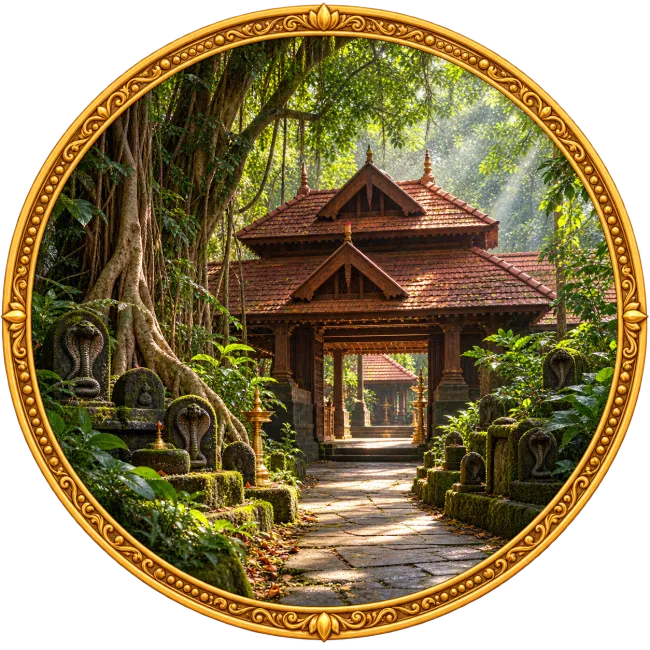
Mannarasala Nagaraja Temple, Haripad
Mannarasala Nagaraja Temple near Haripad in Kerala is one of India’s most revered centres of serpent worship. Situated within a dense sacred grove, the temple is dedicated to Nagaraja and is surrounded by thousands of stone images representing serpent deities.
The temple is especially known for its unique priestess tradition. The senior-most woman of the Mannarasala Illam serves as the principal spiritual authority and is respectfully called Valiya Amma. Devotees visit Mannarasala to pray for family welfare, children, health, prosperity and relief from difficulties traditionally associated with Naga Dosha.
About Mannarasala Nagaraja Temple
Mannarasala Nagaraja Temple is located near Haripad in Alappuzha district, Kerala. The temple is set within a sacred forest grove containing ancient trees, narrow pathways and numerous serpent images.
Nagaraja is worshipped as the king of serpents. The principal sacred presence is associated with both Vasuki and Ananta, also known as Adishesha.
Serpent deities are important in Kerala’s religious and ecological traditions. They are regarded as protectors of:
- Land
- Water sources
- Family lineage
- Fertility
- Children
- Agricultural prosperity
- Natural balance
The temple is visited by families seeking blessings for children and relief from Sarpa Dosha or Naga Dosha. Such rituals represent religious faith and should complement professional medical guidance when health or fertility treatment is needed.
When and Who Built Mannarasala Temple?
Mannarasala is an ancient sacred grove whose origin is traditionally associated with Sage Parashurama.
According to temple tradition, Parashurama consecrated serpent deities in the region after reclaiming Kerala from the sea. He appointed a Brahmin family to maintain the worship and protect the sacred grove.
The Mannarasala Illam has preserved the temple’s rituals for generations. The complex developed gradually around the forest shrine rather than through one large construction project.
Successive generations of devotees contributed serpent images, ritual vessels, lamps and facilities. The temple’s sacred character remains centred on the natural grove instead of monumental architecture.
The current structures preserve the traditional Kerala style, with tiled roofs, wooden details and pathways passing through the serpent forest.
Legend of Parashurama
According to Hindu tradition, Parashurama threw his axe into the sea and reclaimed the land that became Kerala.
The newly created land contained excessive salt and was unsuitable for habitation and cultivation. Parashurama sought a way to purify the soil and water.
He performed penance to Lord Shiva, who advised him to seek the help of serpent deities. Parashurama then worshipped Nagaraja and requested the serpents to make the land fertile.
The serpents spread their powerful energy through the soil and helped remove its harmful salinity. Kerala became fertile and suitable for human settlement.
Parashurama consecrated Nagaraja and other serpent deities at Mannarasala and appointed a Brahmin family to perform their worship.
Origin of Mannarasala Amma
According to the temple legend, a devastating forest fire once spread through the sacred grove. Many serpents were injured by the heat.
The women of the nearby Brahmin household cared for the serpents, pouring cool water over them and protecting them from the fire.
Pleased by their compassion, Nagaraja blessed the family. The wife of the head of the household later gave birth to twin children—one human child and one serpent child.
The serpent child became the spiritual protector of the family and the sacred grove. Before withdrawing into the underground chamber, he instructed his mother in the temple’s rituals.
From that time, the senior-most woman of the Mannarasala family became the principal priestess and spiritual mother of the serpent deities. She is known as Mannarasala Amma or Valiya Amma.
Valiya Amma Tradition
Mannarasala is unique because its principal religious authority is a woman.
The senior-most married woman of Mannarasala Illam assumes the role of Valiya Amma. She performs important rituals, guides devotees and preserves the instructions associated with Nagaraja.
Valiya Amma leads ceremonies connected with:
Ayilyam festival
Uruli Kamazhthal
Special Naga Puja
Family blessings
Sacred offerings
Important temple decisions
The tradition reflects the close relationship between motherhood, fertility, family continuity and serpent worship.
Devotees regard Valiya Amma as the spiritual mother of all who visit Mannarasala.
Religious Significance
Mannarasala is one of Kerala’s most important Naga Kshetras. Devotees believe that respectful worship of serpent deities protects the family and restores harmony with nature.
People visit the temple to pray for:
Blessings for children
Safe pregnancy
Family continuity
Marriage and marital harmony
Relief from Sarpa Dosha
Relief from Naga Dosha
Protection of property and land
Good health
Agricultural prosperity
Relief from recurring obstacles
Peace for ancestral lineages
Environmental harmony
Ayilyam Nakshatra is considered especially sacred for Nagaraja worship.
Main Deities and Sacred Places
Nagaraja
Nagaraja is the principal deity and is associated with both Vasuki and Ananta. Devotees offer turmeric, milk, flowers and prescribed ritual items.
Sarpayakshi
Sarpayakshi is worshipped as a powerful feminine serpent deity. She represents protection, fertility and divine energy.
Nagayakshi
Nagayakshi is another important serpent Goddess worshipped within the complex.
Nagachamundi
Nagachamundi represents the fierce protective aspect of the serpent Goddess.
Appooppan Kavu
Appooppan Kavu is associated with the serpent child who became the protector of the Mannarasala family.
Other sacred places include:
Underground chamber associated with Nagaraja
Numerous family serpent shrines
Sacred trees
Forest pathways
Ritual platforms
Shrines connected with guardian deities
Thousands of Serpent Images
The Mannarasala grove contains thousands of stone serpent images placed beneath trees and along pathways.
Many of these images were offered by devotees after the fulfilment of prayers or as part of family traditions.
The serpent stones should not be touched, moved or stepped over. Visitors must remain on designated paths and preserve the grove’s natural environment.
The large number of images creates an atmosphere unlike that of a conventional temple. The sacred forest itself functions as an important part of the shrine.
Architecture of Mannarasala Temple
Mannarasala Temple follows Kerala’s Kavu tradition rather than monumental Dravidian architecture.
Sacred Grove
The dense forest is the temple’s defining feature. Ancient trees, medicinal plants and natural vegetation create a protected habitat.
Sreekovil
The sanctum is constructed in the traditional Kerala style, with a compact inner chamber and sloping tiled roof.
Illam
The Mannarasala Illam is the traditional residence of the family responsible for the temple. Valiya Amma performs important rituals connected with the Illam and sacred grove.
Forest Pathways
Narrow paths lead devotees through clusters of serpent images and smaller shrines.
Visitors should walk quietly, avoid damaging vegetation and follow the prescribed route.
Mannarasala Nagaraja Temple Timings
The regular daily schedule is:
Timings may be extended or reorganised on Ayilyam Nakshatra, Mannarasala Ayilyam festival and other important ritual dates.
Morning Puja and Deepa Aradhana
The temple opens at 5:00 AM with Nirmalya Darshan. The previous day’s decorations are removed, and the first worship begins.
Morning Abhishekam is performed at 5:30 AM. Usha Puja follows at 6:00 AM, and Deepa Aradhana is offered at 6:30 AM.
Special Naga Puja and Archana are generally performed during the morning session. The best morning darshan period is from 6:00 AM to 9:00 AM.
Morning is the preferred time for exploring the sacred grove because the weather is cooler and the atmosphere is peaceful.
Ucha Puja
Ucha Puja is performed at 11:30 AM. Offerings, Archana and sacred lamps are presented to Nagaraja.
Madhyahna Deepa Aradhana takes place at 11:45 AM. The morning session ends at 12:00 PM.
Devotees attending a booked ritual should report well before the midday closure.
Evening Puja and Deepa Aradhana
The temple reopens at 5:30 PM. Evening Deepa Aradhana is performed at 6:30 PM.
The best evening darshan period is from 5:30 PM to 7:00 PM.
Athazha Puja, the final worship of the day, is conducted at 7:00 PM. The temple closes at 7:30 PM.
Uruli Kamazhthal
Uruli Kamazhthal is one of the most well-known rituals at Mannarasala. Married couples perform the offering while praying for a child.
An Uruli, a traditional metal vessel, is ceremonially placed upside down at the designated sacred location under temple guidance.
After the couple receives the blessing of a child, they return to the temple and place the vessel in its proper position as an expression of gratitude.
The ritual should be arranged only through authorised temple channels and performed according to instructions provided by Valiya Amma or designated priests.
Uruli Kamazhthal is a religious act of faith. Couples experiencing fertility concerns should also consult qualified medical professionals.
Noorum Palum
Noorum Palum is an important offering made to serpent deities. It traditionally uses prescribed ingredients, including rice powder, turmeric and milk.
The offering is prepared and presented according to temple customs. Devotees should not make independent offerings within the grove.
The ritual symbolises purification, cooling and respect for Nagaraja.
Pulluvan Pattu
Pulluvan Pattu is a traditional form of serpent worship involving sacred songs and musical instruments.
Members of the Pulluva community perform songs praising Nagaraja and other serpent deities. The music is believed to invoke divine blessings and create a sacred atmosphere.
Pulluvan Pattu may form part of special rituals, family observances and festival ceremonies.
Turmeric Prasadam
Turmeric is one of the most important sacred offerings at Mannarasala. It is associated with purity, healing, prosperity and fertility.
Devotees receive turmeric prasadam after worship. It should be treated respectfully and used according to the instructions given by the temple.
The turmeric should not be discarded carelessly or used for commercial purposes.
Major Festivals
Mannarasala Ayilyam
Mannarasala Ayilyam is the temple’s most important annual festival. It is observed during the Malayalam month of Thulam on the day of Ayilyam Nakshatra.
Valiya Amma ceremonially carries the sacred idols from Mannarasala Illam towards the temple. Special Puja, processions, offerings and devotional music are organised.
Thousands of devotees gather to seek the blessings of Nagaraja.
Ayilyam Nakshatra Puja
Every Ayilyam day is considered sacred for serpent worship. Special offerings and larger crowds can be expected.
Maha Shivaratri
Maha Shivaratri is observed because of the close relationship between Lord Shiva and serpent deities.
Nagara Panchami
Special Naga Puja, turmeric offerings and prayers are performed on Nagara Panchami.
Mandala Season
Additional worship is conducted during the Mandala period, attracting pilgrims travelling through Kerala.
Sevas and Offerings
Important Sevas include:
Uruli Kamazhthal
Noorum Palum
Sarpa Bali
Ashtanaga Puja
Nagaraja Abhishekam
Ayilya Puja
Pulluvan Pattu
Turmeric offering
Milk offering
Archana
Deepa Seva
Annadanam donation
Festival sponsorship
All Sevas should be booked through authorised temple counters.
Milk and other offerings should never be poured onto serpent stones without permission because uncontrolled offerings can damage the sacred grove.
Prasadam
Common prasadam includes:
Sacred turmeric
Flowers
Sandalwood paste
Payasam
Other blessed ritual items
Prasadam should be collected only from authorised counters. Devotees should follow any instructions given with the turmeric or ritual items.
Dress Code and Temple Rules
Visitors should wear clean and modest traditional clothing.
Men may wear a mundu, dhoti or other modest full-length attire. Women may wear a saree, set mundu, salwar kameez or another traditional outfit.
Footwear must be removed before entering the sacred complex. Mobile phones and cameras may be restricted near the sanctum and Illam.
Visitors must not:
Touch or move serpent stones
Step over sacred images
Enter restricted forest areas
Damage plants or trees
Pour milk without permission
Capture photographs in prohibited areas
Leave plastic waste
Disturb animals or reptiles
The sacred grove should be treated as both a place of worship and an ecologically sensitive area.
Entry Fee and Visit Duration
General darshan is available without an entry fee. Separate charges apply to Noorum Palum, Uruli Kamazhthal, Sarpa Bali and other Sevas.
A regular visit requires 1½ to 2 hours. Devotees attending a special ritual should keep 2 to 3 hours available.
Waiting times are longer on Ayilyam Nakshatra days, festival dates and weekends.
Best Time to Visit
October to February is the most comfortable period for visiting Mannarasala.
For peaceful darshan, visit between 6:00 AM and 9:00 AM on a weekday. Morning is preferable for walking through the sacred grove.
Mannarasala Ayilyam offers the most important festival experience but attracts very large crowds.
The monsoon makes the forest exceptionally green, but pathways may become slippery.
How to Reach Mannarasala Temple
By Air
Cochin International Airport and Thiruvananthapuram International Airport are the convenient airports for reaching Haripad.
Taxis, buses and trains are available from both cities.
By Train
Haripad Railway Station is the nearest railway station. It has connections with Alappuzha, Kollam, Kochi, Thiruvananthapuram and other Kerala destinations.
Auto-rickshaws and taxis are available from the station to Mannarasala.
By Road
Mannarasala is well connected with Haripad, Alappuzha, Kayamkulam, Kollam and other Kerala towns.
Government and private buses operate to Haripad. Local transport can be used for the final journey to the temple.
Nearby Places to Visit
Visitors may also explore:
Haripad Sree Subrahmanya Swamy Temple
Ambalappuzha Sri Krishna Temple
Chettikulangara Bhagavathy Temple
Krishnapuram Palace
Alappuzha Backwaters
Thakazhi Temple
Thrikkunnapuzha Beach
Kayamkulam Lake
Aranmula Parthasarathy Temple
Sree Vallabha Temple, Thiruvalla
Visitor Guidelines
Arrive early on Ayilyam days. Special rituals should be booked in advance through authorised counters.
Follow the designated pathway through the grove. Do not enter thick vegetation or disturb wildlife.
Wear simple clothing suitable for walking in a humid forest environment. Carry rain protection during the monsoon.
Parents should supervise children because serpent stones are placed throughout the grove and pathways can be narrow.
Use spiritual rituals alongside qualified medical guidance for fertility, mental health or other health-related concerns.
Conclusion
Mannarasala Nagaraja Temple is one of India’s most distinctive centres of serpent worship. Its sacred forest, thousands of Naga images, Valiya Amma priestess tradition and Parashurama legend give it an exceptional religious identity.
The temple teaches respect for nature, family lineage and the protective energy represented by Nagaraja. Rituals such as Uruli Kamazhthal, Noorum Palum and Ayilyam Puja continue traditions preserved by the Mannarasala family for generations.
A visit to Mannarasala offers devotees an opportunity to seek family welfare, children, protection and harmony with the natural world.