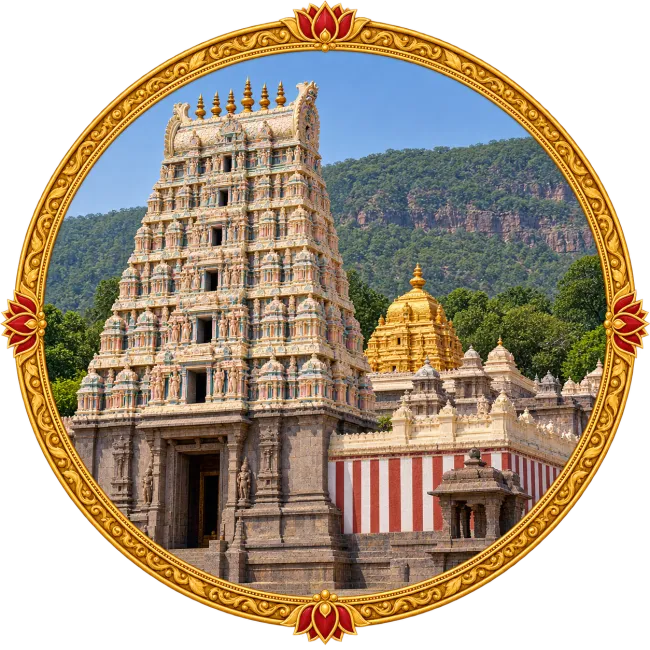
Mallikarjuna Swamy Temple, Srisailam
Mallikarjuna Swamy Temple in Srisailam, Andhra Pradesh, is one of the most sacred pilgrimage destinations in India. Dedicated to Lord Shiva as Sri Mallikarjuna Swamy and Goddess Parvati as Sri Bhramaramba Devi, the temple possesses the rare distinction of being both a Jyotirlinga and a Shakti Peetha.
Located on the Nallamala Hills beside the Krishna River, the temple is surrounded by forests, mountains and sacred water bodies. It is popularly known as Srisailam Temple and is regarded as the “Kailash of the South.” Devotees visit the temple to seek blessings for health, marriage, family welfare, spiritual progress and liberation.
About Mallikarjuna Swamy Temple
Mallikarjuna Swamy Temple, officially known as Sri Bhramaramba Mallikarjuna Swamy Varla Devasthanam, is one of the twelve Jyotirlingas dedicated to Lord Shiva. The shrine of Goddess Bhramaramba within the same complex is recognised as one of the eighteen Maha Shakti Peethas.
Lord Shiva is worshipped here as Mallikarjuna Swamy in the form of a naturally formed Shiva Lingam. Goddess Parvati is worshipped as Bhramaramba Devi, the divine mother who assumed the form of bees to defeat a powerful demon.
The temple stands on the sacred Srisailam Hill, traditionally known as Sri Parvata. The location is considered spiritually powerful because it combines Shiva worship, Shakti worship, natural beauty and ancient pilgrimage traditions.
Srisailam is also associated with the Krishna River, which flows through the region as Patalaganga. Pilgrims traditionally bathe in the river before visiting the temple.
When and Who Built Mallikarjuna Swamy Temple?
Mallikarjuna Swamy Temple is an ancient shrine that developed over many centuries under different South Indian dynasties. References to the sacred Srisailam region can be traced to ancient religious texts, inscriptions and early historical traditions.
The Satavahana rulers referred to the area as Sri Parvata and supported religious activity in the region. The Ikshvakus, Pallavas, Chalukyas, Kakatiyas and other dynasties subsequently contributed to the development and protection of the pilgrimage centre.
Major architectural expansion took place during the rule of the Reddy kings and the Vijayanagara Empire. The Reddy rulers constructed steps, pathways, temple structures and facilities for pilgrims. Prolaya Vema Reddy and other rulers of the dynasty made important contributions to Srisailam.
Harihara II of the Vijayanagara Empire supported the construction and expansion of temple halls and shrines. Later Vijayanagara rulers, including Krishnadevaraya and Achyuta Deva Raya, contributed to the temple’s architecture, religious services and administration.
The temple was also patronised by rulers and devotees from the Maratha period. Chhatrapati Shivaji Maharaj is traditionally associated with a visit to Srisailam and support for the temple’s protection and worship.
Therefore, the present temple complex represents the collective work of several dynasties rather than the construction of one ruler.
Meaning of the Name Mallikarjuna
The name Mallikarjuna combines two sacred names:
Mallika represents Goddess Parvati and also refers to jasmine flowers.
Arjuna represents Lord Shiva.
According to tradition, Goddess Parvati worshipped Lord Shiva at Srisailam with jasmine flowers. The divine couple consequently came to be worshipped together as Mallikarjuna.
The name also symbolises the inseparable union of Shiva and Shakti. Worshipping Mallikarjuna Swamy and Bhramaramba Devi together is believed to bring balance, strength and spiritual fulfilment.
Legend of Lord Kartikeya
The most famous legend of Srisailam is connected with Lord Ganesha and Lord Kartikeya, the sons of Shiva and Parvati.
According to the story, Shiva and Parvati announced that the son who travelled around the world and returned first would be married before the other. Kartikeya immediately departed on his peacock to circle the world.
Lord Ganesha understood that his parents represented the entire universe. He walked around Shiva and Parvati seven times and declared that he had completed the journey around the world. Pleased by his wisdom, they arranged his marriage.
When Kartikeya returned and learned what had happened, he felt disappointed and moved to Mount Krauncha. Shiva and Parvati followed him to comfort him. They settled at Srisailam in the forms of Mallikarjuna and Bhramaramba so they could remain close to their son.
This legend represents parental love, wisdom and the unity of the divine family.
Legend of Princess Chandravati
Another legend concerns Princess Chandravati. She left her royal life and began living near Srisailam, where she spent her time worshipping Lord Shiva.
She noticed that one of her cows regularly went to a particular place and released its milk over a natural stone formation. When the spot was examined, a self-manifested Shiva Lingam was discovered.
Chandravati began worshipping the Lingam with jasmine flowers. Lord Shiva appeared before her and blessed her devotion. Because jasmine flowers were offered to the deity, Shiva became known as Mallikarjuna.
A sculptural representation connected with Princess Chandravati and the sacred cow can be seen within the temple complex.
Legend of Bhramaramba Devi
Goddess Bhramaramba is associated with the story of a demon named Arunasura. The demon obtained a boon that he could not be killed by humans, gods or creatures with two or four legs.
Protected by the boon, Arunasura became powerful and disturbed the world. Goddess Shakti assumed the form of countless bees, which had six legs, and destroyed the demon.
The Goddess was then worshipped as Bhramaramba. The Sanskrit word “Bhramara” means bee. Devotees believe that the sacred vibration associated with bees can be experienced near the Goddess’s shrine.
Mallikarjuna Jyotirlinga
Mallikarjuna is one of the twelve Jyotirlingas, the most sacred manifestations of Lord Shiva. According to Shaivite tradition, a Jyotirlinga represents Shiva as an endless pillar of divine light.
Devotees believe that worshipping Mallikarjuna Swamy provides relief from sins, fear and suffering. It is also believed to lead a devotee towards moksha, or liberation from the cycle of birth and death.
The Shiva Lingam is comparatively small and is located within the main sanctum. On specified occasions and according to temple rules, Sparsha Darshan may allow devotees to touch the sacred Lingam. The availability of Sparsha Darshan is controlled by the temple administration and may be suspended during crowded periods.
Bhramaramba Shakti Peetha
The Bhramaramba Devi shrine is recognised as one of the eighteen Maha Shakti Peethas. According to Shakti tradition, these sacred sites emerged where parts or ornaments of Goddess Sati fell after Lord Vishnu used his Sudarshana Chakra to separate her body.
Srisailam is traditionally associated with the neck portion of Goddess Sati. Consequently, the Bhramaramba shrine is one of the most important centres of Goddess worship in South India.
Devotees offer kumkum, flowers, sarees and sacred lamps to the Goddess. Kumkumarchana is one of the most popular rituals performed at her shrine.
Religious Significance
Mallikarjuna Swamy Temple is sacred to both Shaivite and Shakta devotees. The presence of a Jyotirlinga and Shakti Peetha within the same temple complex makes Srisailam exceptionally significant.
Devotees visit the temple to pray for:
Good health and long life
Peace and prosperity
A suitable marriage
Marital happiness
Blessings for children
Protection from negative influences
Relief from family difficulties
Professional growth
Spiritual wisdom
Liberation and freedom from past karmas
Darshan of Mallikarjuna Swamy, Bhramaramba Devi and Lord Kartikeya is considered spiritually rewarding. Pilgrims also visit Patalaganga and important shrines situated throughout the Srisailam region.
Main Deities and Shrines
Sri Mallikarjuna Swamy
Lord Shiva is worshipped as Mallikarjuna Swamy in the form of a sacred Shiva Lingam. The sanctum is the spiritual centre of the temple, where Abhishekam, Archana and other Shaivite rituals are performed.
Sri Bhramaramba Devi
Goddess Parvati is worshipped as Bhramaramba Devi. Her shrine is situated within the temple complex and has equal religious importance. She is worshipped as the compassionate mother and powerful protector of devotees.
Other important shrines include:
Lord Ganesha
Lord Subrahmanya
Nandi
Lord Veerabhadra
Lord Nataraja
Sahasra Lingam
Vriddha Mallikarjuna
Pancha Pandava Lingas
Navagrahas
Annapurna Devi
Chandikeswarar
Various forms of Shiva and Shakti
Devotees should visit both the Mallikarjuna and Bhramaramba shrines to complete their pilgrimage.
Architecture of Mallikarjuna Swamy Temple
Mallikarjuna Swamy Temple is built in the traditional Dravidian architectural style. The complex contains tall gopurams, fortified walls, stone mandapams, sculpted pillars and numerous subsidiary shrines.
The temple covers a large area and is surrounded by strong enclosure walls. Sculptural panels on the outer walls depict episodes from the Ramayana, Mahabharata, Shiva Purana and regional legends.
Main Sanctum
The sanctum of Mallikarjuna Swamy is relatively compact compared with the size of the entire complex. The sacred Lingam is installed beneath an ornamented structure and surrounded by traditional lamps.
The sanctum of Bhramaramba Devi contains the richly decorated idol of the Goddess. Flowers, silk garments, gold ornaments and kumkum are used during her daily worship.
Gopurams
The temple has monumental gateway towers constructed and renovated by different rulers. These gateways contain sculptures of deities, guardians and mythological figures.
Mukha Mandapam
The spacious halls in front of the sanctums are supported by carved stone pillars. They are used for rituals, processions, devotional gatherings and festival ceremonies.
Temple Walls and Sculptures
The enclosure walls are decorated with detailed carvings portraying Shiva’s divine forms, the marriage of Shiva and Parvati, Nataraja, Ganesha, Kartikeya, sages and celestial beings.
Mallikarjuna Swamy Temple Timings
The regular temple and worship schedule is:
The schedule may be reorganised on Mondays, Pradosham, Maha Shivaratri, Ugadi, Karthika month and Brahmotsavam festival dates.
Morning Puja and Harathi
The temple opens at 4:30 AM with Suprabhata Seva. Sacred hymns are recited to awaken Lord Mallikarjuna and Goddess Bhramaramba.
Morning Harathi and Mangala Vadyam are performed from 5:00 AM to 5:30 AM. The sound of bells, drums and traditional instruments creates a powerful devotional atmosphere.
Abhishekam and other Arjitha Sevas begin at 6:00 AM. Milk, curd, honey, ghee, sacred water and other permitted substances are offered to the Shiva Lingam according to the selected seva.
The best morning darshan time is from 6:30 AM to 9:00 AM. Devotees should arrive earlier if they have booked Abhishekam or another special seva.
Evening Puja and Harathi
The evening darshan session begins at 4:30 PM. Evening Puja and Deepa Harathi are performed at 6:00 PM.
Kalyanotsavam is conducted from 6:00 PM to 7:00 PM. The ritual celebrates the divine marriage of Lord Mallikarjuna and Goddess Bhramaramba. Married couples attend the seva for harmony and family welfare, while unmarried devotees seek blessings for a suitable life partner.
Night Harathi is performed at 9:00 PM, followed by Ekanta Seva at 9:30 PM. The temple closes at 10:00 PM.
Important Sevas and Offerings
Devotees can participate in several traditional sevas, including:
Suprabhata Seva
Rudrabhishekam
Mahanyasa Purvaka Rudrabhishekam
Laghu Abhishekam
Sahasranama Archana
Bilvarchana
Kalyanotsavam
Kumkumarchana
Laksha Kumkumarchana
Chandika Homam
Ganapati Homam
Navagraha Homam
Deepa Seva
Vahana Puja
Annadanam donation
Bilva leaves, flowers, coconuts, fruits, milk and sacred lamps are common offerings to Lord Mallikarjuna. Kumkum, turmeric, flowers and sarees are offered to Bhramaramba Devi.
Seva tickets should be purchased only through the authorised temple counters or the official temple booking system.
Major Festivals
Maha Shivaratri Brahmotsavam
Maha Shivaratri is the largest festival celebrated at Srisailam. Special Abhishekams, Rudra chanting, Kalyanotsavam, processions and night-long worship are organised.
Ugadi
Ugadi is another major festival at the temple. Devotees from Andhra Pradesh, Telangana and Karnataka visit Srisailam during the celebrations.
Karthika Masam
The entire month of Karthika is considered highly auspicious for Lord Shiva. Devotees light lamps, observe fasting and participate in special Monday worship.
Navaratri
Bhramaramba Devi receives special decorations and worship during Navaratri. Kumkumarchana, homams and processions are conducted throughout the festival.
Sankranti Utsavam
Special rituals are performed during Makara Sankranti. Devotees worship the divine couple and participate in traditional temple celebrations.
Other important occasions include Pradosham, monthly Shivaratri, Shravan Mondays and the divine wedding festival.
Patalaganga
The Krishna River flowing through the Srisailam region is known as Patalaganga. Pilgrims traditionally take a sacred bath here before visiting the temple.
Patalaganga can be reached by steps or ropeway. Visitors should exercise caution near the river and follow all safety instructions, especially during the monsoon or periods of high water levels.
Prasadam and Annadanam
Laddu and pulihora are commonly available as temple prasadam. Sacred ash, kumkum and other blessed items may also be distributed after darshan or special sevas.
The temple provides annadanam to pilgrims at designated halls. Devotees may support the service by making donations at authorised counters.
Prasadam should be accepted respectfully and should not be wasted. Visitors should keep the temple complex clean and use designated waste bins.
Dress Code and Entry Rules
Devotees should wear clean and modest clothing. Traditional Indian attire is recommended, particularly for special sevas and entry near the sanctum.
Men may wear a dhoti, kurta-pyjama or full-length trousers with a shirt. Women may wear a saree, salwar kameez, half-saree or another modest outfit.
Footwear must be removed before entering the temple. Photography and videography are prohibited near the sanctums. Mobile phones, cameras and large bags may need to be deposited at authorised counters.
Alcohol, tobacco, leather articles and non-vegetarian food should not be carried inside the temple complex.
Entry Fee and Visit Duration
General darshan is available without an entry fee. Separate charges apply to special darshan, Sparsha Darshan, Abhishekam, Kalyanotsavam, Kumkumarchana and other sevas.
A normal visit requires 2 to 3 hours. Devotees attending a special seva should keep 3 to 4 hours available.
Waiting time is longer on Mondays, weekends, Karthika month, Maha Shivaratri and public holidays.
Best Time to Visit
October to March is the most comfortable period for visiting Srisailam. The weather is suitable for temple darshan, forest travel and nearby sightseeing.
For peaceful darshan, visit between 6:30 AM and 9:00 AM on an ordinary weekday. The evening period from 5:00 PM to 7:30 PM is suitable for Deepa Harathi and Kalyanotsavam.
Devotees seeking a grand spiritual experience may visit during Maha Shivaratri, but they should be prepared for heavy crowds and extended queues.
How to Reach Mallikarjuna Swamy Temple
By Air
Hyderabad’s Rajiv Gandhi International Airport is the most convenient major airport. From Hyderabad, Srisailam can be reached by taxi or bus.
By Train
Markapur Road Railway Station is one of the nearest convenient railway stations. Road transport is available from Markapur to Srisailam. Devotees may also travel through Kurnool, Nandyal or Hyderabad depending on their starting location.
By Road
Srisailam is connected by road with Hyderabad, Kurnool, Nandyal, Markapur and nearby cities. Government and private buses operate regularly.
The route passes through sections of the Nallamala forest. Travellers should check forest-road entry restrictions before beginning a late-night journey.
Nearby Places to Visit
Visitors can also explore:
Patalaganga
Srisailam Dam
Sakshi Ganapati Temple
Hatakeswaram Temple
Paladhara Panchadhara
Shikhareswara Temple
Akkamahadevi Caves
Phaladhara Panchadhara
Chenchu Lakshmi Tribal Museum
Srisailam Tiger Reserve
Ishta Kameswari Temple
Octopus Viewpoint
Visitor Guidelines
Book accommodation and special sevas in advance during Maha Shivaratri, Ugadi, Karthika month and long weekends.
Devotees attending an Abhishekam or Kalyanotsavam should arrive before the reporting time and carry valid identification when required.
Deposit footwear, phones and large bags at authorised counters. Keep all tokens and seva tickets safely until the visit is complete.
Visit both Mallikarjuna Swamy and Bhramaramba Devi shrines. Pilgrims may also take darshan of Sakshi Ganapati while entering or leaving Srisailam, as the deity is traditionally believed to record their pilgrimage.
Conclusion
Mallikarjuna Swamy Temple is one of India’s most spiritually important pilgrimage centres. Its exceptional status as both a Jyotirlinga and a Shakti Peetha represents the sacred union of Lord Shiva and Goddess Shakti.
The ancient temple architecture, legends of Kartikeya and Princess Chandravati, powerful Bhramaramba shrine, beautiful Nallamala surroundings and traditional rituals make Srisailam a deeply inspiring destination. A visit to Mallikarjuna Swamy Temple offers devotees an opportunity to seek courage, peace, prosperity and spiritual liberation.