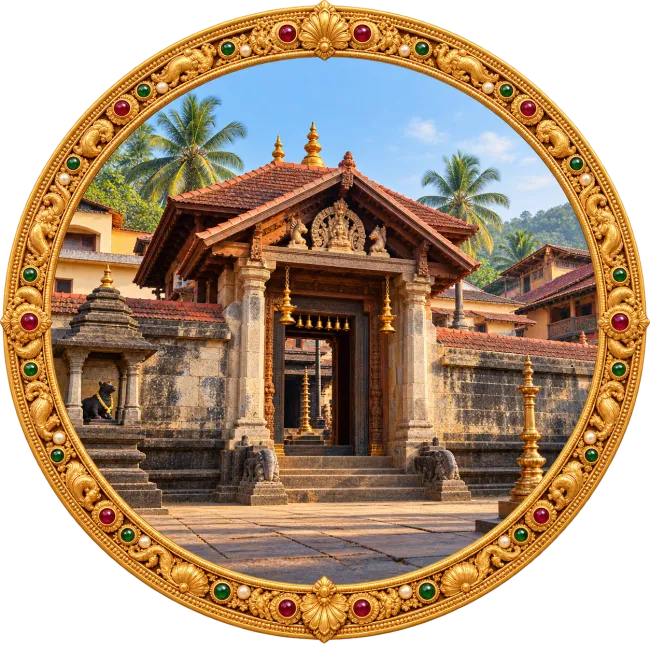
Mahabaleshwar Temple, Gokarna
Mahabaleshwar Temple in Gokarna, Karnataka, is one of South India’s most revered temples dedicated to Lord Shiva. The temple houses the sacred Atma Linga, which is traditionally believed to contain the divine power of Lord Shiva himself.
Located near the Arabian Sea in Uttara Kannada district, Gokarna is known as Dakshina Kashi, meaning the Kashi of South India. The temple’s ancient history, Atma Linga legend, traditional rituals and proximity to Kotiteertha and the sea make it an important pilgrimage destination for devotees of Lord Shiva.
About Mahabaleshwar Temple
Mahabaleshwar Temple, also known as Gokarna Mahabaleshwara Temple, is dedicated to Lord Shiva in the form of the Atma Linga.
The sacred Lingam is installed beneath the surface of the sanctum, with only its upper portion visible through an opening in the Peetha. Devotees worship it as Mahabaleshwara, meaning the Lord of immense strength.
The name refers to the extraordinary strength of the Atma Linga. According to mythology, even the powerful demon king Ravana could not remove it after Lord Ganesha placed it on the ground at Gokarna.
The temple is one of the principal sacred sites in coastal Karnataka. Pilgrims traditionally worship Mahaganapati before entering Mahabaleshwar Temple because Ganesha played the decisive role in establishing the Atma Linga at Gokarna.
When and Who Built Mahabaleshwar Temple?
The present stone temple is associated with the early Kadamba period. King Mayurasharma of the Kadamba dynasty is traditionally credited with constructing or developing the shrine during the fourth century.
The temple was supported and renovated by later dynasties that governed the coastal Karnataka region. The Chalukyas, Hoysalas and Vijayanagara rulers contributed to temples, religious institutions and pilgrimage facilities in and near Gokarna.
Regional chiefs, merchants and devotees also supported the daily worship, festivals and maintenance of the shrine.
The temple’s architectural simplicity reflects its antiquity. Unlike later temples with highly decorated gopurams, Mahabaleshwar Temple uses strong granite construction and a restrained Dravidian design.
Legend of Ravana and the Atma Linga
The most important legend of Gokarna concerns Ravana, the king of Lanka. Ravana was a great devotee of Lord Shiva and performed severe penance to obtain the Atma Linga.
The Atma Linga contained Shiva’s divine power. Ravana believed that installing it in Lanka would make his kingdom invincible.
Pleased by his penance, Lord Shiva gave the Atma Linga to Ravana but imposed a condition: the Lingam must not be placed on the ground before reaching Lanka. If it touched the earth, it would become permanently fixed at that location.
The gods became concerned that Ravana would become impossible to defeat. They requested Lord Ganesha to prevent him from carrying the Atma Linga to Lanka.
As Ravana reached the Gokarna region, Lord Vishnu created the appearance of sunset. Ravana needed to perform his evening prayers and searched for someone to hold the Lingam temporarily.
Lord Ganesha appeared before him in the form of a young Brahmin boy. Ganesha agreed to hold the Lingam but said he would call Ravana three times if it became too heavy. If Ravana failed to return, he would place it on the ground.
While Ravana performed his prayers, Ganesha called him three times and then placed the Atma Linga on the earth. When Ravana returned, he found that it had become permanently fixed.
Why Is the Deity Called Mahabaleshwara?
Ravana used all his strength to pull the Atma Linga out of the ground. Despite being exceptionally powerful, he could not move it.
The word “Maha” means great, while “Bala” means strength. Since the Lingam proved stronger than Ravana, Lord Shiva came to be worshipped here as Mahabaleshwara—the Lord of immense strength.
Ravana’s effort caused portions of the outer covering of the Atma Linga to scatter across the coastal region. These fragments are associated with other Shiva temples, including Murudeshwar, Dhareshwara, Gunavanteshwara and Sajjeshwara.
Together, these temples form a significant coastal Shiva pilgrimage circuit.
Why Is Gokarna Called Dakshina Kashi?
Gokarna is called Dakshina Kashi because it is regarded as one of the most sacred Shiva pilgrimage centres in southern India.
Like Varanasi, Gokarna is associated with liberation, ancestral rituals, sacred bathing and the worship of Lord Shiva. Pilgrims visit Kotiteertha, perform ceremonies for ancestors and seek darshan of the Atma Linga.
The natural combination of temple, sacred water tank, hills and Arabian Sea gives Gokarna exceptional spiritual importance.
Devotees believe that sincere worship at Mahabaleshwar Temple helps reduce the burden of past karmas and guides the soul towards spiritual liberation.
Meaning of the Name Gokarna
The word “Gokarna” means “cow’s ear.” According to one tradition, Lord Shiva emerged at this place from the ear of Mother Earth, who had assumed the form of a cow.
The shape of the surrounding land between the Gangavali and Aghanashini rivers is also traditionally compared to a cow’s ear.
The name reflects both the sacred mythology and geographical identity of the region.
Religious Significance
Mahabaleshwar Temple is one of Karnataka’s most important Shaivite shrines. The Atma Linga is believed to contain the concentrated spiritual presence of Lord Shiva.
Devotees visit the temple to pray for:
Good health and long life
Protection from danger
Relief from past karmas
Family peace and prosperity
Marriage and marital harmony
Blessings for children
Courage and mental strength
Relief from fear and anxiety
Professional success
Spiritual wisdom
Peace for departed ancestors
Liberation from the cycle of birth and death
Mondays, Pradosham, Maha Shivaratri, Amavasya and the month of Shravan are considered especially auspicious.
Main Deity and Other Shrines
Sri Mahabaleshwara
The principal deity is the sacred Atma Linga. It is installed within a square Peetha in the sanctum. Only the upper part can be seen and worshipped.
The Lingam is worshipped through Abhishekam, bilva leaves, flowers, sacred ash and Deepa Aradhana.
Goddess Tamra Gauri
Goddess Parvati is worshipped as Tamra Gauri. Devotees seek her blessings for marriage, family welfare and protection.
Mahaganapati
Mahaganapati Temple is situated near Mahabaleshwar Temple. Pilgrims traditionally worship Ganesha first because he established the Atma Linga at Gokarna.
The Ganesha idol is associated with the blow delivered by Ravana after discovering that the Atma Linga had been placed on the ground.
Other deities and sacred places include:
Nandi
Chandikeswara
Lord Dattatreya
Veerabhadra
Adi Gokarneshwara
Bhadrakali
Venkataramana
Various forms of Shiva and Shakti
Traditional Gokarna Pilgrimage Order
Devotees following the traditional pilgrimage sequence generally complete worship in this order:
Take a sacred bath at Kotiteertha or wash hands and feet.
Visit Mahaganapati Temple.
Worship Sri Mahabaleshwara and the Atma Linga.
Visit Goddess Tamra Gauri.
Offer prayers at Bhadrakali Temple.
Visit other sacred shrines in Gokarna.
Worshipping Mahaganapati before Mahabaleshwara is considered especially important because of the Atma Linga legend.
Architecture of Mahabaleshwar Temple
The temple follows an ancient Dravidian architectural style. Granite is the principal construction material, giving the structure a strong and dignified appearance.
Main Sanctum
The sanctum houses the Atma Linga within a stone Peetha. Its interior is compact, dark and illuminated by traditional lamps.
The sanctum’s atmosphere is intense and devotional. Access is regulated according to temple customs and the level of crowding.
Entrance and Gopura
The entrance structure is comparatively simple when viewed against the elaborate towers of later South Indian temples. Its proportions and stonework reflect the ancient character of the shrine.
Nandi Mandapa
A sacred Nandi faces the sanctum. Devotees offer prayers to Nandi before approaching Lord Mahabaleshwara.
Stone Corridors
The temple’s stone corridors and halls contain religious symbols, lamps and areas for devotees to sit or wait for worship. The restrained architecture keeps attention focused on the Atma Linga.
Mahabaleshwar Temple Timings
The regular darshan and worship schedule is:
Timings may be extended or reorganised during Maha Shivaratri, Shravan Mondays, Pradosham and other important occasions.
Morning Puja and Deepa Aradhana
The temple opens at 6:00 AM with Suprabhata prayers and the ceremonial opening of the sanctum.
Morning Abhishekam is performed from 6:30 AM to 8:00 AM. Sacred water and other permitted offerings are used according to temple tradition.
Morning Puja and Deepa Aradhana are conducted at 8:00 AM. Devotees offer bilva leaves, flowers, coconuts and prayers to Lord Mahabaleshwara.
The best morning darshan period is from 6:30 AM to 9:30 AM. Pilgrims wishing to perform Abhishekam should report early and purchase the required Seva ticket.
Madhyahna Puja
Madhyahna Puja and Naivedyam are performed at 12:00 PM. Food is ceremonially offered to Lord Shiva, followed by sacred lamps and prayers.
The morning darshan session ends at 12:30 PM. Visitors should enter the queue before noon if they want to complete darshan before the afternoon closure.
Evening Puja and Deepa Aradhana
The temple reopens at 5:00 PM. Evening Abhishekam is performed at 6:00 PM.
Evening Puja and Deepa Aradhana take place at 7:00 PM. The best evening darshan period is from 5:00 PM to 7:00 PM.
Final Harathi is offered at 7:45 PM. The temple closes at 8:00 PM after the completion of the day’s rituals.
Major Festivals
Maha Shivaratri
Maha Shivaratri is the largest festival celebrated at Mahabaleshwar Temple. Special Abhishekams, Rudra chanting, fasting and night-long worship are organised.
Rathotsava
The temple chariot festival is an important part of the Maha Shivaratri celebrations. The processional deity is carried through Gokarna in a decorated wooden chariot.
Kartika Masam
Devotees light sacred lamps and perform special Shiva worship during Kartika month. Mondays and Pradosham days attract large crowds.
Shravan Mondays
Each Monday during Shravan is considered highly auspicious. Special Abhishekam and Archana are performed throughout the month.
Tripurari Purnima
Lamps are lit in honour of Lord Shiva’s victory over the three demon cities. Devotees visit the temple and sacred water bodies.
Other festivals include Ugadi, Ganesha Chaturthi, Deepavali, Makara Sankranti and Navaratri.
Sevas and Offerings
Important temple Sevas include:
Abhishekam
Rudrabhishekam
Panchamrita Abhishekam
Bilvarchana
Sahasranama Archana
Deepa Seva
Special Harathi
Vahana Puja
Ancestral rituals
Annadanam donation
Festival sponsorship
Bilva leaves, flowers, coconuts, fruits, sacred ash and lamps are commonly offered to Lord Shiva.
Seva tickets and worship materials should be obtained only through authorised counters.
Kotiteertha
Kotiteertha is the principal sacred water tank in Gokarna. It is surrounded by temples, monasteries and traditional houses.
Pilgrims take a ritual bath in Kotiteertha before visiting Mahabaleshwar Temple. Ceremonies for ancestors are also performed near the tank.
Visitors should use the designated steps and maintain cleanliness. Soap, shampoo and other chemical products should not be used in the sacred water.
Prasadam
Sacred ash, kumkum and other blessed items are distributed after worship. Food prasadam may be available at designated counters or during Annadanam.
Devotees should accept prasadam respectfully and avoid wasting it. Packaging should be disposed of in designated bins.
Dress Code and Entry Rules
Mahabaleshwar Temple follows traditional entry customs. Devotees should wear clean and modest Indian clothing.
Men entering designated inner areas may be required to wear a dhoti and remove shirts, vests and upper garments. Women should wear a saree, salwar kameez or another modest traditional outfit.
The exact dress requirement may depend on the type of darshan or Seva. Visitors should follow the instructions displayed at the entrance.
Footwear, mobile phones, cameras and leather items may be restricted inside. Photography and videography are prohibited near the sanctum.
Visitors should enter after bathing and should not wear wet beach clothing inside the temple.
Entry Fee and Visit Duration
General darshan is available without an entry fee. Separate charges apply to Abhishekam, Archana, ancestral rituals and other Sevas.
A regular temple visit requires 1½ to 2 hours. Following the complete pilgrimage sequence, including Kotiteertha, Mahaganapati and Tamra Gauri, requires 3 to 4 hours.
Waiting times are longer during Maha Shivaratri, Mondays and public holidays.
Best Time to Visit
October to March is the most comfortable period for visiting Gokarna. The weather is suitable for temple worship, walking and visiting nearby beaches.
For peaceful darshan, arrive between 6:30 AM and 9:00 AM on a weekday. Evening visitors should reach the temple between 5:00 PM and 6:30 PM.
Maha Shivaratri provides the grandest devotional experience, but visitors should expect large crowds, road restrictions and long queues.
How to Reach Mahabaleshwar Temple
By Air
Dabolim Airport in Goa is a convenient airport for Gokarna. Hubballi Airport and Mangaluru International Airport are other options.
Taxis and buses are available from these cities to Gokarna.
By Train
Gokarna Road Railway Station is the nearest railway station. It lies on the Konkan Railway route and has connections with Mangaluru, Goa, Mumbai and other cities.
The station is outside the main town. Buses, taxis and auto-rickshaws are available for reaching the temple.
By Road
Gokarna is well connected with Kumta, Ankola, Karwar, Goa, Hubballi, Bengaluru, Udupi and Mangaluru.
Government and private buses operate regularly. The streets near the temple can become congested, so visitors may need to walk from the parking area.
Nearby Places to Visit
Visitors may also explore:
Mahaganapati Temple
Kotiteertha
Tamra Gauri Temple
Bhadrakali Temple
Maha Ganapati Temple
Gokarna Main Beach
Kudle Beach
Om Beach
Half Moon Beach
Paradise Beach
Yana Caves
Mirjan Fort
Murudeshwar Temple
Vibhooti Falls
Visitor Guidelines
Take a sacred bath or wash hands and feet before entering. Wear clean, dry and modest clothing rather than beachwear.
Visit Mahaganapati Temple before Mahabaleshwar Temple to follow the traditional pilgrimage sequence.
Check the dress requirements before joining the queue. Men may need to remove upper garments before entering designated inner areas.
Use authorised priests and counters for Abhishekam, ancestral rituals and other Sevas. Avoid unauthorised agents.
Observe safety instructions at the beaches. Sea currents can be strong, especially during the monsoon.
Conclusion
Mahabaleshwar Temple in Gokarna is one of Karnataka’s most spiritually important Shiva temples. Its sacred Atma Linga, association with Ravana and Ganesha, ancient Kadamba-period heritage and status as Dakshina Kashi give it exceptional religious importance.
The temple’s traditional rituals, Kotiteertha, Mahaganapati shrine and peaceful coastal setting create a complete pilgrimage experience. A visit to Gokarna Mahabaleshwar Temple offers devotees an opportunity to seek strength, forgiveness, spiritual wisdom and the blessings of Lord Shiva.