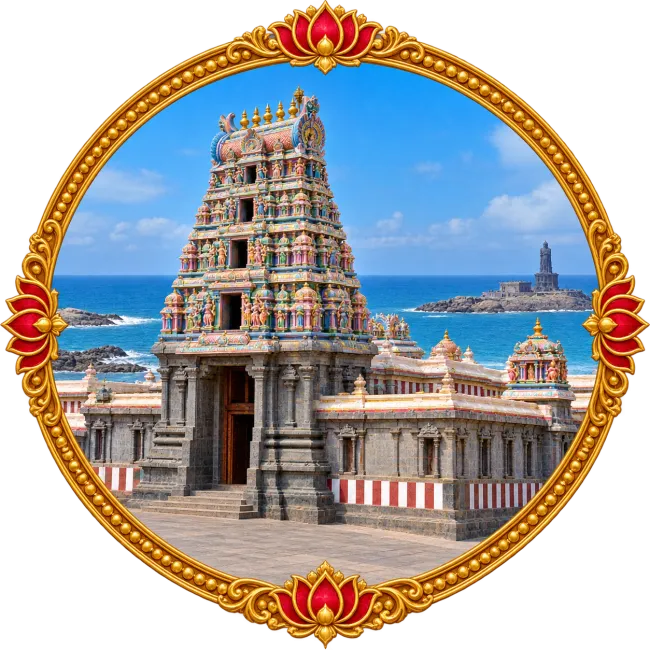
Kumari Amman Temple, Kanyakumari
Visit Kumari Amman Temple in Kanyakumari, one of India’s most sacred coastal temples dedicated to Goddess Parvati in her eternal virgin form. Also known as Bhagavathy Amman Temple, the shrine stands close to the meeting point of the Arabian Sea, the Bay of Bengal and the Indian Ocean.
The temple is famous for the powerful image of Goddess Kanya Kumari, her brilliant nose ring, ancient Shakti worship and the legend of her unfinished marriage with Lord Shiva. Devotees visit the temple to pray for marriage, courage, spiritual purity, family prosperity and protection from negative forces.
About Kumari Amman Temple
Kumari Amman Temple is situated at the southernmost tip of mainland India in Kanyakumari, Tamil Nadu. The temple faces the sea and stands close to the sacred Triveni Sangam.
The presiding deity is Goddess Kanya Kumari, the youthful and unmarried form of Goddess Parvati. She is also worshipped by the names:
Devi Kanya Kumari
Kumari Amman
Bhagavathy Amman
Bala Parvati
Kanyakumari Devi
The name Kanyakumari means “the virgin maiden.” The entire town and district derive their names from the goddess.
The temple is one of South India’s most important Shakti shrines and is traditionally included among the sacred Shakti Peethas.
History of Kumari Amman Temple
Kumari Amman Temple has an ancient religious history. References to Kanyakumari and the worship of a virgin goddess appear in early Tamil literature.
The original shrine developed under the ancient rulers of the Tamil region. The Pandyas made significant contributions to the temple’s construction and formal worship.
The temple was later expanded and maintained by:
Chera rulers
Chola kings
Pandya rulers
Kings of Venad
Travancore royal family
These rulers contributed land, jewellery, lamps, ritual objects and arrangements for daily Puja.
The temple’s location along an ancient maritime route also made it important to merchants and travellers. Sailors prayed to Goddess Kanya Kumari for protection before crossing the ocean.
Several renovations were carried out over the centuries while preserving the traditional Dravidian architectural design and ancient worship practices.
Banasura Legend of Goddess Kanya Kumari
According to Hindu mythology, a powerful demon named Banasura performed severe penance and received a boon.
The boon protected him from being killed by any married woman. He believed that this made him undefeatable and began troubling sages, gods and ordinary people.
The gods prayed to Adi Shakti for protection. The Divine Mother appeared at the southern tip of India as a young maiden named Kanya Kumari.
The goddess performed penance and prepared to marry Lord Shiva. However, the gods understood that if she married Shiva, she would no longer remain a virgin and would be unable to defeat Banasura.
Through a sequence of divine events, the marriage did not take place. Goddess Kanya Kumari remained unmarried and later destroyed Banasura, freeing the world from his cruelty.
The goddess therefore represents purity, determination, courage and the victory of divine power over evil.
Unfinished Marriage with Lord Shiva
Goddess Kanya Kumari wished to marry Lord Shiva, who was worshipped at Suchindram.
An auspicious time was selected, and Lord Shiva began travelling towards Kanyakumari for the wedding. A grand feast was prepared with rice, grains, vegetables and other foods.
The sage Narada understood that the goddess needed to remain unmarried to kill Banasura. Before the actual sunrise, he caused a rooster to crow.
Lord Shiva believed that the auspicious wedding time had passed and returned to Suchindram.
When the marriage did not take place, the goddess became disappointed but continued her penance. The prepared food was left unused and is traditionally believed to have transformed into the colourful sand and stones found along the Kanyakumari coast.
Shakti Peetha Significance
Kumari Amman Temple is revered as a sacred Shakti Peetha associated with Goddess Sati.
According to Shakti Peetha tradition, parts of Goddess Sati’s body and ornaments fell at different places when Lord Shiva carried her body across the universe.
Each place became a centre of divine feminine power. Kanyakumari is worshipped as one such sacred location where the energy of the youthful goddess remains eternally present.
The temple represents the unmarried and spiritually disciplined form of Shakti.
Religious Significance of Kumari Amman Temple
Goddess Kanya Kumari is worshipped as a source of courage, purity and spiritual determination.
Devotees visit the temple for:
Blessings for marriage
Removal of delays in marriage
Courage and confidence
Protection from negative forces
Family peace and prosperity
Health and well-being of children
Success in education and employment
Safe sea journeys
Spiritual discipline
Control over anger and desire
Removal of obstacles
Fulfilment of sincere wishes
Unmarried devotees commonly offer prayers for a suitable life partner. Students seek concentration and determination from the youthful goddess.
Main Deity of Kumari Amman Temple
The principal deity is Goddess Kanya Kumari, depicted as a young maiden performing penance.
The goddess holds a rosary, symbolizing meditation and spiritual discipline. She wears a beautiful crown, traditional garments and sacred ornaments.
One of the deity’s most famous features is her brilliant nose ring. According to tradition, the jewel shines with exceptional brightness.
The image is decorated with:
Silk garments
Flower garlands
Gold ornaments
Kumkum
Sandalwood
Traditional crown
Sacred jewellery
The goddess’s calm appearance represents purity, while her power as the destroyer of Banasura represents courage.
Legend of the Diamond Nose Ring
The nose ring of Goddess Kanya Kumari is famous for its brilliant light.
According to local tradition, the jewel’s reflection was once visible from the sea. Sailors mistook the light for a lighthouse or coastal signal and directed their ships towards it.
Some vessels reportedly struck the rocks near the shore. To prevent further accidents, the sea-facing eastern door of the temple was kept closed.
The eastern entrance is opened only on selected religious occasions. The story adds to the mystery and spiritual importance of the goddess’s nose ring.
Architecture of Kumari Amman Temple
Kumari Amman Temple is built in the traditional Dravidian style, with architectural influences from both Tamil and Kerala temple traditions.
Important features include:
Traditional entrance Gopuram
Granite walls
Enclosed Prakarams
Main sanctum of Goddess Kanya Kumari
Carved stone pillars
Temple corridors
Flagstaff
Sacred wells and water sources
Shrines dedicated to associated deities
Closed eastern sea-facing entrance
Views of the ocean from the surrounding area
The temple’s strong granite structure protects it from coastal winds and salty sea air.
Kumari Amman Temple Timings
Festival schedules may differ during Navratri, Vaikasi Festival, Kalabham and other major occasions.
Morning Abhishekam and Deepa Aradhana
The temple opens at 4:30 AM. Abhishekam begins at 5:00 AM.
The goddess may be ceremonially worshipped with:
Sacred water
Milk
Tender coconut water
Turmeric
Sandalwood
Rose water
Flowers
Kumkum
Morning Deepa Aradhana is performed at 6:00 AM, followed by Usha Puja at 7:00 AM.
The period between 6:00 AM and 8:00 AM is ideal for peaceful darshan.
Pantheeradi and Uchikala Puja
Pantheeradi Puja is performed at 10:00 AM. The name traditionally refers to the morning period when the sun has risen to a particular position.
Uchikala Puja takes place at 11:30 AM. Naivedyam, flowers, incense and lamps are offered before the goddess.
The morning session closes at 12:30 PM.
Evening Puja and Deepa Aradhana
The temple reopens at 4:00 PM.
Sayaraksha Puja and evening Deepa Aradhana are performed at 6:30 PM. The illuminated sanctum and sound of temple bells create a powerful devotional atmosphere.
Athazha Puja, the final worship of the day, is performed at 8:15 PM. The temple closes at 8:30 PM.
Abhishekam and Special Sevas
Devotees may arrange or participate in Sevas such as:
Kumkum Archana
Lalitha Sahasranama Archana
Bhagavathy Seva
Milk Abhishekam
Turmeric Abhishekam
Sandalwood offering
Flower garland Seva
Ghee-lamp offering
Saree offering
Annadanam
Special Naivedyam
Seva schedules and availability depend on the temple calendar. Bookings should be made through official counters.
Major Festivals Celebrated
Vaikasi Festival
The annual Vaikasi festival is one of the temple’s largest celebrations. It includes processions, special Alankarams and ceremonial worship.
Navratri
Navratri is celebrated for nine nights with different forms and decorations of the goddess.
Special programmes include:
Daily Alankaram
Kumkum Archana
Devi Mahatmyam recitation
Music and cultural performances
Vijayadashami worship
Kalabham Festival
During Kalabham, a special sandalwood preparation is applied to the deity. The ceremony symbolizes cooling, purification and divine grace.
Thirukarthigai
Oil lamps illuminate the temple during Thirukarthigai.
Chaitra Purnima
Large numbers of pilgrims visit the Triveni Sangam and temple during the full moon.
Aadi Amavasai
Devotees perform ancestral rituals at the seashore and then receive darshan of Kumari Amman.
Vijayadashami
Special prayers are offered for education, courage and new beginnings.
Triveni Sangam
Kanyakumari is traditionally regarded as the meeting point of:
Bay of Bengal
Arabian Sea
Indian Ocean
Pilgrims take a sacred bath at the Sangam before visiting Kumari Amman Temple.
Bathing should be done only in designated safe areas because sea currents can be strong.
Visitors should follow warnings issued by lifeguards, police and local authorities.
Offerings and Prasadam
Common offerings include:
Red flowers
Lotus flowers
Kumkum
Turmeric
Sarees
Bangles
Coconut
Fruits and sweets
Ghee lamps
Flower garlands
Sandalwood
Monetary donations
Temple Prasadam may include:
Kumkum
Turmeric
Sandalwood
Sweet Pongal
Payasam
Laddu
Fruits
Women often offer bangles and sarees while praying for marriage and family prosperity.
Dress Code and Entry Rules
Devotees should wear clean, traditional and modest clothing.
Recommended clothing includes:
Dhoti, Mundu or full-length trousers for men
Saree, half-saree, Salwar Kameez or modest traditional clothing for women
Traditional clothing for children
Men may be required to remove shirts and vests before entering selected inner areas. Visitors should follow the instructions displayed at the temple.
Photography and videography are prohibited near the sanctum. Cameras, mobile phones and bags may need to be deposited at designated counters.
Entry into the principal inner worship area follows traditional Hindu temple rules.
Entry Fee and Visit Duration
General darshan is free. Paid special-darshan and Seva tickets may be available.
A normal visit requires one to two hours. During Navratri, Vaikasi Festival and full-moon days, darshan may require additional time.
Visitors combining the temple with Triveni Sangam and nearby monuments should keep half a day.
Visitor Guidelines
Bathe only in designated safe areas.
Remove footwear before entering the temple.
Wear traditional and modest clothing.
Follow rules regarding shirts in the inner area.
Keep mobile phones silent or deposit them where required.
Follow photography restrictions.
Do not carry leather items near restricted areas.
Use official counters for Sevas and donations.
Do not purchase darshan access from unauthorized agents.
Maintain silence near the sanctum.
Keep the temple and seashore clean.
Take care of children near the sea.
Follow instructions from priests, police and security personnel.
Best Time to Visit
October to March is the best period for visiting Kanyakumari because the weather remains pleasant.
For peaceful darshan, visit between 6:00 AM and 8:00 AM.
Evening visitors should arrive between 5:00 PM and 6:00 PM to attend Sayaraksha Puja at 6:30 PM.
Navratri and Vaikasi Festival provide a grand devotional experience but attract large crowds.
How to Reach Kumari Amman Temple
By Air
Thiruvananthapuram International Airport is the nearest major airport, located approximately 90 kilometres from Kanyakumari.
By Train
Kanyakumari Railway Station is approximately 1 kilometre from the temple.
Nagercoil Junction, located approximately 20 kilometres away, has rail connections with Chennai, Madurai, Bengaluru, Thiruvananthapuram and other major cities.
By Bus
Regular government and private buses connect Kanyakumari with Nagercoil, Madurai, Tirunelveli, Rameswaram and Thiruvananthapuram.
By Road
Taxis, auto-rickshaws and private vehicles are easily available. Vehicle access is restricted near selected pedestrian areas close to the temple and seashore.
Nearby Places to Visit
Triveni Sangam
Vivekananda Rock Memorial
Thiruvalluvar Statue
Gandhi Memorial Mandapam
Suchindram Thanumalayan Temple
Kanyakumari Beach
Vattakottai Fort
Sunset View Point
Vivekananda Kendra
Padmanabhapuram Palace
Thanumalayan Temple
Our Lady of Ransom Church
Conclusion
Kumari Amman Temple is one of India’s most sacred coastal Shakti shrines. Its association with Goddess Parvati’s virgin form, the defeat of Banasura and the unfinished marriage with Lord Shiva gives the temple a distinctive spiritual identity.
The brilliant nose ring, ancient Dravidian architecture and location beside the meeting point of three seas make it an unforgettable pilgrimage destination.
Worshipping Goddess Kanya Kumari is believed to provide courage, purity and freedom from obstacles. A visit to the temple allows devotees to experience the spiritual power, natural beauty and ancient traditions of India’s southernmost sacred shore.