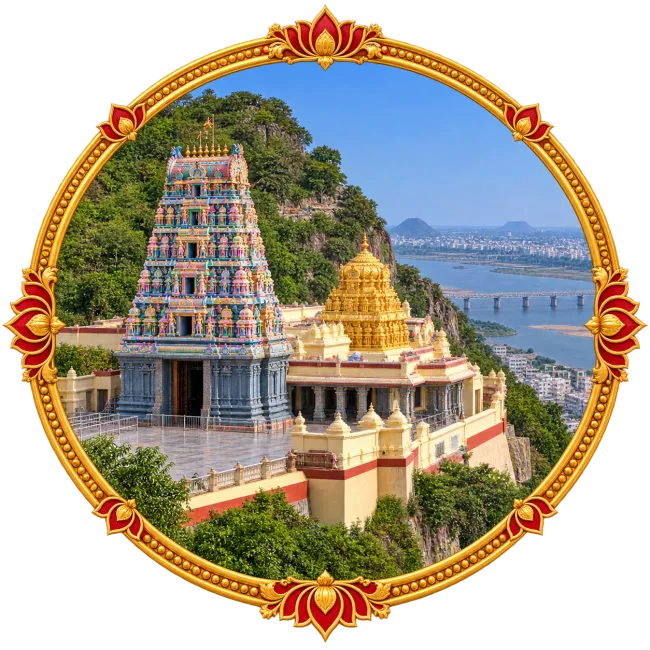
Kanaka Durga Temple, Vijayawada
Kanaka Durga Temple in Vijayawada is one of the most revered Shakti temples in Andhra Pradesh. The temple is situated on the sacred Indrakeeladri Hill, overlooking the Krishna River. Goddess Durga is worshipped here as Sri Kanaka Durga, the powerful divine mother who blesses devotees with courage, prosperity, protection and victory over difficulties.
About Kanaka Durga Temple
Kanaka Durga Temple is located on Indrakeeladri Hill in Vijayawada, beside the Krishna River. Goddess Kanaka Durga is considered the presiding deity and divine protector of Vijayawada.
The principal deity is represented in a powerful form, standing over the demon Mahishasura. The idol is decorated with ornaments, silk garments, flowers and sacred weapons. The Goddess is worshipped as the embodiment of courage, wisdom and divine energy.
Lord Shiva is worshipped in the adjoining shrine as Sri Malleswara Swamy. A unique feature of the temple is that Goddess Durga is positioned on the right side of Lord Malleswara. In most Hindu temples, the Goddess occupies the left side of her consort. Her position on the right is interpreted as a sign of the dominance of Shakti at Indrakeeladri.
Devotees visit the temple for protection from negative influences, success in education and career, family prosperity, marital harmony and relief from personal difficulties.
History of Kanaka Durga Temple
Kanaka Durga Temple is an ancient shrine whose spiritual traditions extend back through several historical periods. The temple is mentioned in regional legends and sacred traditions associated with Indrakeeladri, Goddess Durga and Lord Shiva.
The present temple complex developed over centuries under the patronage of different South Indian rulers and local administrators. Several dynasties that governed the Krishna River region contributed to the maintenance, renovation and expansion of temples in and near Vijayawada.
The worship of Lord Malleswara Swamy at Indrakeeladri is traditionally linked with Adi Shankaracharya. According to local tradition, Adi Shankaracharya visited the hill, installed the Sri Chakra and established a more peaceful form of worship for the Goddess.
The temple continued to grow as an important Shakti centre. Mandapams, pathways, queue complexes and facilities for devotees were added during later periods. Today, the temple is administered as Sri Durga Malleswara Swamy Varla Devasthanam.
Legend of Indrakeeladri Hill
According to mythology, a devotee named Keela performed intense penance to Goddess Durga. Pleased by his devotion, the Goddess appeared before him and offered to grant a boon.
Keela requested the Goddess to reside permanently within his heart. She accepted his request and instructed him to take the form of a hill. Keela then became Indrakeeladri Hill, and Goddess Durga made the hill her sacred abode.
The name “Indrakeeladri” combines references to Indra, Keela and the sacred hill. The hill is believed to contain the divine energy of the Goddess, making it an important Shakti Kshetra.
Legend of Mahishasura
Kanaka Durga is depicted as the victorious Goddess who defeated the buffalo demon Mahishasura. According to Hindu mythology, Mahishasura obtained immense power and began troubling gods, sages and human beings.
The combined divine energies of the gods gave rise to Goddess Durga. Armed with celestial weapons, she fought Mahishasura and destroyed him. The form of Kanaka Durga at Vijayawada represents this victory of righteousness over arrogance and evil.
Devotees worship the Goddess for the strength to overcome fear, injustice, enemies, emotional suffering and difficult circumstances.
Arjuna and Lord Shiva at Indrakeeladri
Indrakeeladri is also associated with Arjuna, one of the five Pandava brothers. According to tradition, Arjuna performed severe penance on the hill to please Lord Shiva and obtain the powerful Pashupatastra.
Lord Shiva appeared before Arjuna in the form of a hunter and tested his courage. After recognising Arjuna’s devotion and ability, Shiva revealed his divine form and granted him the celestial weapon.
Because Arjuna achieved victory here, the region came to be connected with the name Vijayavatika, which later developed into Vijayawada. The word “Vijaya” means victory.
Religious Significance
Kanaka Durga Temple is one of the most important Shakti worship centres in Andhra Pradesh. The Goddess is believed to grant strength, knowledge, confidence and protection to sincere devotees.
People visit the temple to pray for:
Success in education and examinations
Professional growth and business prosperity
Protection from negative influences
Peace and unity within the family
A suitable marriage
Blessings for children
Recovery from illness
Relief from fear and anxiety
Courage to overcome challenges
Spiritual wisdom and inner strength
Fridays, Tuesdays, full-moon days and the Navaratri period are considered especially auspicious for worshipping the Goddess.
The combined presence of Kanaka Durga and Malleswara Swamy also represents the unity of Shakti and Shiva. Devotees generally visit both shrines to complete their worship.
Main Deities and Shrines
Sri Kanaka Durga
Goddess Kanaka Durga is the principal deity. She is depicted in a majestic form with eight arms, holding divine weapons and standing triumphantly over Mahishasura. Her facial expression combines motherly compassion with the strength of a warrior.
Sri Malleswara Swamy
Lord Shiva is worshipped as Sri Malleswara Swamy. His shrine is an essential part of the pilgrimage. Devotees offer bilva leaves, flowers and prayers for health, peace and spiritual progress.
Other shrines and deities within the temple complex include:
Lord Ganesha
Lord Subrahmanya with Valli and Devasena
Lord Nataraja
Goddess Saraswati
Goddess Mahalakshmi
Lord Anjaneya
Navagrahas
Nandi
Various forms of Shiva and Shakti
Devotees should follow the prescribed temple route and visit the shrines without blocking the movement of other worshippers.
Architecture of Kanaka Durga Temple
The temple follows the traditional South Indian architectural style. Its hilltop position provides beautiful views of Vijayawada, the Krishna River and the surrounding landscape.
The sanctum contains the richly decorated idol of Kanaka Durga. The interior is illuminated by traditional lamps, while the walls and pillars display religious motifs and sculptural details.
The gold-coloured elements of the vimana and temple structures enhance the appearance of the sacred complex. The temple also contains mandapams used for rituals, homams, archanas and festival ceremonies.
Devotees can reach the hilltop temple by road or by the traditional steps. The road provides convenient access for buses, cars and temple transport, while many pilgrims prefer climbing the steps as an act of devotion.
Facilities such as queue halls, prasadam counters, cloakrooms, drinking-water points and annadanam halls have been developed to accommodate the large number of pilgrims.
Kanaka Durga Temple Timings
The regular darshan and worship schedule is:
The commonly followed darshan sessions are 4:00 AM to 1:00 PM and 4:00 PM to 10:00 PM. Festival-day schedules, especially during Dasara, may be extended or reorganised by the temple administration.
Morning Puja and Harathi
The temple opens at 4:00 AM with Suprabhata Seva, during which the Goddess is awakened through sacred chants and traditional music.
Khadgamala Archana is performed from 4:00 AM to 5:00 AM. This special worship invokes the various divine energies associated with the Sri Chakra and Goddess Lalita Tripurasundari. Participation may require advance booking or a separate seva ticket.
Snapanabhishekam and morning worship are conducted from 4:30 AM to 5:30 AM. The morning Harathi is offered at 5:30 AM, after which regular darshan continues.
The best morning darshan period is from 6:30 AM to 9:00 AM. Weekday mornings are generally more peaceful than Fridays, weekends and festival dates.
Evening Puja and Harathi
The evening darshan session begins at 4:00 PM. Devotees can attend Pancha Harathi and Deepa Aradhana at 6:30 PM. During the ritual, different sacred lamps are offered before the Goddess while priests recite mantras.
Pallaki Seva is conducted at 7:00 PM. The processional form of the deity is ceremonially worshipped and carried in a palanquin according to temple tradition.
The best evening darshan period is from 5:00 PM to 7:30 PM. Night Puja and final Harathi are performed at 9:00 PM, and the temple closes at 10:00 PM.
Major Festivals
Dasara and Sharad Navaratri
Dasara is the most important annual celebration at Kanaka Durga Temple. Lakhs of devotees visit Indrakeeladri during the festival. The Goddess is decorated in a different Alankaram on each day.
Her festival forms may include:
Sri Bala Tripura Sundari Devi
Sri Gayatri Devi
Sri Annapurna Devi
Sri Lalita Tripura Sundari Devi
Sri Maha Chandi Devi
Sri Saraswati Devi
Sri Durga Devi
Sri Mahishasura Mardini
Sri Rajarajeshwari Devi
The precise sequence of Alankarams is announced for each festival according to the lunar calendar and temple tradition.
Moola Nakshatram
Moola Nakshatram during Dasara is dedicated to the Saraswati form of the Goddess. Students, teachers and parents visit in large numbers to seek blessings for education and knowledge.
Bhavani Deeksha
Bhavani Deeksha is an important devotional observance associated with Kanaka Durga. Devotees wear prescribed clothing, follow spiritual discipline, perform daily worship and later complete the deeksha at the temple.
Shakambari Festival
During Shakambari Utsavam, the Goddess and temple premises are decorated with vegetables, fruits and green leaves. The decoration represents the Goddess as the provider of food, fertility and nourishment.
Varalakshmi Vratham
Varalakshmi Vratham is celebrated during the Shravan month. Married women worship the Goddess for family prosperity, health and marital happiness.
Other festivals include Ugadi, Vasantha Panchami, Maha Shivaratri at the Malleswara shrine, Karthika Deepam and various monthly observances.
Sevas and Offerings
The temple conducts several paid and general sevas, including:
Suprabhata Seva
Khadgamala Archana
Kumkumarchana
Sahasranama Archana
Laksha Kumkumarchana
Sri Chakra Navavarana Puja
Chandi Homam
Ganapati Homam
Navagraha Shanti Homam
Pallaki Seva
Vastram Seva
Special Darshan
Annadanam donation
Flowers, coconuts, fruits, turmeric, kumkum and sarees may be offered according to temple regulations. All seva tickets and offerings should be purchased through authorised counters or the approved temple booking system.
Prasadam and Annadanam
Laddu is one of the principal forms of prasadam available at Kanaka Durga Temple. Pulihora, pongal, curd rice and other food offerings may also be distributed on selected days and during festivals.
The temple operates an annadanam service for pilgrims. Devotees may contribute to this service through authorised donation counters.
Dress Code and Entry Rules
Visitors should wear clean and modest clothing. Traditional Indian attire is recommended.
Men may wear a dhoti, kurta-pyjama or full-length trousers with a shirt. Women may wear a saree, salwar kameez, half-saree or another modest outfit.
Footwear must be removed before entering the temple. Mobile phones are prohibited within the temple premises, so visitors should use the authorised deposit facilities before joining the darshan queue.
Photography and videography are not permitted near the sanctum. Tobacco, alcohol, leather articles and non-vegetarian food must not be brought inside.
Entry Fee and Visit Duration
General Dharma Darshan is available without an entry fee. Paid darshan options and special seva tickets may be offered in separate categories.
A regular visit requires 1½ to 2 hours. Visitors attending a special archana, homam or seva should keep 2½ to 3 hours available.
Waiting times can be much longer on Fridays, Tuesdays, weekends and during Dasara. During the main Navaratri celebrations, devotees should be prepared for extensive queues and traffic restrictions.
Best Time to Visit
October to March is the most comfortable period for visiting Vijayawada. The weather is more suitable for climbing the temple steps and exploring nearby attractions.
For peaceful darshan, visit between 6:30 AM and 9:00 AM on a weekday. Evening visitors should arrive between 5:00 PM and 6:00 PM to attend Pancha Harathi.
Dasara provides the grandest spiritual experience, while ordinary weekdays are better for devotees seeking a calm and less crowded visit.
How to Reach Kanaka Durga Temple
By Air
Vijayawada International Airport at Gannavaram is the nearest airport. It is approximately 21 kilometres from the temple. Taxis, app-based cabs and buses are available from the airport.
By Train
Vijayawada Junction is the nearest major railway station, situated approximately 3 kilometres from the temple. It is one of South India’s most important railway junctions and has direct connections with Hyderabad, Chennai, Visakhapatnam, Bengaluru, Tirupati and other cities.
By Road
Vijayawada is connected with Hyderabad, Guntur, Amaravati, Rajahmundry, Visakhapatnam, Tirupati and Chennai by road. The main bus station is approximately 2 kilometres from the temple.
Local buses, auto-rickshaws, taxis and temple transport services are available for reaching Indrakeeladri Hill.
Nearby Places to Visit
Visitors can also explore:
Sri Malleswara Swamy Temple
Krishna River and Durga Ghat
Prakasam Barrage
Undavalli Caves
Bhavani Island
Gandhi Hill
Akkanna Madanna Caves
Hinkar Thirtha Jain Temple
Mangalagiri Panakala Narasimha Temple
Amaravati Amareswara Temple
Visitor Guidelines
Deposit mobile phones, footwear and large bags at authorised counters. Keep the deposit token safely until the items are collected.
Devotees attending Khadgamala Archana or another special seva should arrive before the stated reporting time. Carry valid identification if required for booked services.
Senior citizens and families with children should prefer weekday mornings. Avoid carrying unnecessary luggage because of the hilltop location, security checks and crowded queue areas.
Take darshan of both Kanaka Durga and Malleswara Swamy to complete the pilgrimage. Maintain silence near the sanctums and follow instructions issued by priests, security personnel and temple volunteers.
Conclusion
Kanaka Durga Temple is a magnificent centre of Shakti worship and one of Andhra Pradesh’s most important pilgrimage destinations. Its sacred location on Indrakeeladri Hill, association with Mahishasura Mardini, connection with Arjuna and combined worship of Kanaka Durga and Malleswara Swamy give it profound religious importance.
The powerful form of the Goddess, the peaceful Krishna River, traditional sevas and vibrant Dasara celebrations create an unforgettable spiritual experience. Devotees visit Kanaka Durga Temple to seek strength, wisdom, prosperity and the courage to overcome every difficulty in life.