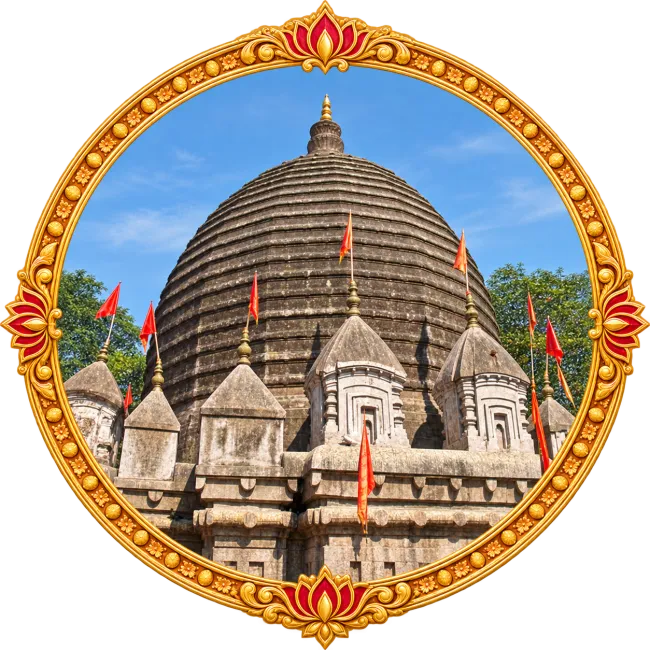
Kamakhya Temple, Guwahati
Kamakhya Temple is one of the most revered Shakti shrines and Tantric pilgrimage centres in India. Situated on Nilachal Hill in Guwahati, Assam, the temple is dedicated to Goddess Kamakhya, a manifestation of the Divine Mother associated with fertility, creative energy and feminine power.
The shrine is traditionally counted among the 51 Shakti Peethas. Unlike conventional temples, Kamakhya has no anthropomorphic idol of the presiding Goddess. The central object of worship is a natural rock formation shaped like a Yoni and continuously moistened by an underground spring.
About Kamakhya Temple
Kamakhya Temple stands on Nilachal Hill, overlooking the Brahmaputra River and Guwahati city. It is the principal shrine in a large complex containing temples dedicated to different forms of Shakti, Shiva and other Hindu deities.
Goddess Kamakhya is closely connected with desire, fertility, motherhood and the creative force responsible for sustaining life. The name is associated with Kama, meaning desire, and Akhya, meaning renowned or expressed.
The temple is important to Shakta and Tantric traditions. It is also visited by ordinary families seeking protection, marriage, children, health and prosperity.
When Was Kamakhya Temple Built and Who Built It?
The sacred site is ancient, but the earliest structure has not survived. Historical and archaeological traditions connect the earlier temple with the rulers of Kamarupa.
The temple suffered major destruction during medieval conflicts. The present main structure was rebuilt in 1565 CE by Koch king Nara Narayana and his brother, the military commander Chilarai.
Craftsmen reconstructed the shrine using the remains of the earlier temple while adding new architectural elements. The resulting style is commonly called Nilachal architecture, combining a hemispherical dome with a traditional temple base.
Later Ahom rulers supported the shrine and added temples, gateways, sculptures and ritual facilities. The existing complex therefore reflects several phases of construction.
Kamakhya Temple as a Shakti Peetha
The temple’s sacred status is associated with Goddess Sati and Lord Shiva.
King Daksha organised a grand yajna but did not invite Sati and Shiva. Sati attended the ceremony, where her father insulted Lord Shiva. Unable to tolerate the humiliation, she entered the sacrificial fire.
Lord Shiva lifted Sati’s body and began performing the destructive Tandava. To protect creation, Lord Vishnu divided her body with the Sudarshana Chakra. Its parts fell at different places, which became Shakti Peethas.
According to the Kamakhya tradition, Sati’s Yoni or womb fell on Nilachal Hill. The site consequently became associated with fertility, creation and the supreme feminine principle.
The associated Bhairava is worshipped as Umananda or Kameshwar.
Sacred Yoni and Underground Spring
The Garbhagriha lies below the main floor and is reached by descending stone steps. It is a dark, cave-like chamber with a naturally formed rock fissure.
The rock formation is worshipped as the Yoni of Goddess Kamakhya. An underground spring continuously keeps it moist. The sacred water is distributed to devotees as a blessing.
Flowers and red cloth are placed over the rock during worship. The absence of a sculpted idol distinguishes Kamakhya from most major Hindu temples.
Religious Significance
Kamakhya is worshipped as the source of life and creative energy. The temple honours natural biological processes as expressions of divine power.
Devotees pray for:
Marriage and harmonious relationships
Children and family welfare
Fertility and safe motherhood
Health and recovery
Protection from negative influences
Prosperity and professional success
Courage and emotional strength
Fulfilment of wishes
Spiritual knowledge
Tantric practitioners consider Nilachal Hill a powerful centre for mantra, meditation and the worship of the Mahavidyas.
Architecture of Kamakhya Temple
The main temple combines an underground sanctum, cruciform base and distinctive hemispherical dome. The dome is crowned by several smaller decorative spires.
The walls contain carvings of Hindu deities, celestial figures, flowers and animals. Stone sculptures from earlier construction periods have been incorporated into the existing structure.
The temple complex includes shrines dedicated to the ten Mahavidyas:
Kali
Tara
Tripurasundari
Bhuvaneshwari
Bhairavi
Chhinnamasta
Dhumavati
Bagalamukhi
Matangi
Kamalatmika
Other temples are dedicated to Kameshwar, Bhairava, Ganesha and various forms of Shiva and Shakti.
Kamakhya Temple Timings
The priests begin daily rituals before general darshan opens. The temple closes temporarily in the afternoon for Bhog and ceremonial worship.
During Ambubachi Mela, Navratri and special Tantric festivals, ordinary schedules are replaced by festival arrangements.
Morning Puja and Aarti
The temple opens for priests at 5:30 AM. The sanctum is cleaned, the sacred rock is bathed and flowers and red cloth are offered.
Morning rituals include:
Opening of the sanctum
Ceremonial bathing
Mantra chanting
Flower and red-cloth offering
Incense and lamp offering
Naivedya
Morning Aarti
General devotees are admitted from 8:00 AM after the principal morning worship has been completed.
Bhog and Evening Aarti
General darshan closes at 1:00 PM for Bhog Puja. Cooked food and other offerings are ceremonially presented to the Goddess.
The temple reopens at 2:30 PM. Evening Aarti is performed at 5:30 PM with lamps, incense and devotional hymns. Final rituals continue after public darshan ends.
Ambubachi Mela
Ambubachi Mela is the most important annual festival at Kamakhya Temple. It is held during the monsoon, usually in June.
The festival represents the annual menstruation of Goddess Kamakhya and celebrates the fertility of the earth. The temple remains closed for three days while the Goddess is believed to undergo her annual cycle.
During this period:
The sanctum remains closed.
Agricultural activities are traditionally avoided by some devotees.
Regular worship is suspended.
Pilgrims and spiritual practitioners gather on Nilachal Hill.
The temple reopens on the fourth day after purification rituals. Devotees receive special prasad known as Angodak and Angabastra. Angodak refers to sacred water, while Angabastra is a piece of red cloth associated with the Goddess.
Other Major Festivals
Durga Puja and Navratri
Navratri is celebrated with special worship, recitations and offerings. Durga Puja rituals at Kamakhya follow distinctive local and Tantric traditions.
Manasha Puja
Goddess Manasha, associated with snakes and protection, is worshipped during the monsoon season.
Kumari Puja
Young girls are worshipped as living manifestations of the Divine Mother. The ritual reflects the belief that feminine energy is present in all stages of life.
Kali Puja
Special worship is performed for Goddess Kali and the Mahavidyas during Kali Puja.
Puja and Religious Services
Devotees may participate in:
General Puja
Special Puja
Kumari Puja
Marriage-related prayers
Child-blessing Puja
Family welfare Puja
Havan
Navratri worship
Mahavidya Puja
Thanksgiving ceremony
Puja arrangements should be made through authorised temple counters. Visitors should avoid unauthorised agents offering guaranteed or immediate darshan.
Offerings and Prasad
Common offerings include:
Red flowers
Red cloth
Sindoor
Coconut
Fruits
Sweets
Incense
Clarified butter
Bangles
Shringar materials
Monetary donations
Animal sacrifice forms part of certain traditional Shakta ceremonies at Kamakhya. Devotees who do not wish to participate can make symbolic offerings such as coconut, pumpkin or sugarcane according to authorised temple practices.
Ordinary prasad includes sweets, coconut, fruits and blessed flowers.
Dress Code and Temple Rules
Visitors should wear clean and modest clothing. Traditional Indian attire is suitable but not compulsory.
Important rules include:
Remove footwear before entering.
Follow the designated queue.
Maintain caution on wet steps leading to the sanctum.
Do not touch the sacred rock unless permitted.
Follow photography restrictions.
Avoid alcohol and tobacco.
Keep the hill and temple clean.
Deposit donations only at authorised counters.
Respect Tantric and local religious traditions.
Protect personal belongings in crowded areas.
Entry Fee and Darshan Duration
General darshan is free. Paid special-entry arrangements may be available according to temple administration rules and daily capacity.
General darshan can require one to three hours on a regular day. Tuesdays, Saturdays, Navratri and public holidays are usually busier. During Ambubachi Mela, waiting time can extend for many hours.
Best Time to Visit
October to March is the most comfortable period for visiting Guwahati. The weather is pleasant and suitable for exploring Nilachal Hill.
Ambubachi Mela provides the most distinctive religious experience but attracts extremely large crowds. Devotees seeking peaceful darshan should visit on a weekday and reach the temple before 8:00 AM.
The monsoon brings heavy rain, humidity and slippery pathways.
How to Reach Kamakhya Temple
By Air
Lokpriya Gopinath Bordoloi International Airport is approximately 20 kilometres from the temple. Taxis and app-based cabs are available.
By Train
Kamakhya Junction is the nearest railway station. Guwahati Railway Station also provides extensive connections to major Indian cities.
By Road
City buses, taxis, auto-rickshaws and app-based cabs connect Nilachal Hill with different parts of Guwahati.
Vehicles reach the upper temple area through a hill road. Pilgrims can also climb the traditional steps.
Accommodation and Facilities
Hotels, guest houses and Dharamshalas are available near Nilachal Hill and throughout Guwahati.
Facilities include drinking water, toilets, shoe-storage counters, prasad shops, parking, medical assistance, security posts, food outlets and pilgrim accommodation.
Nearby Places to Visit
Bhuvaneshwari Temple: A hilltop Mahavidya shrine with panoramic views.
Umananda Temple: A Shiva temple on an island in the Brahmaputra.
Navagraha Temple: An ancient temple dedicated to the nine planetary deities.
Basistha Ashram: A sacred site associated with Sage Vashishtha.
Assam State Museum: Displays the cultural history of Assam.
Srimanta Sankardev Kalakshetra: A major cultural institution.
Brahmaputra Riverfront: Known for evening views and river cruises.
Conclusion
Kamakhya Temple is a unique Shakti Peetha where the creative power of the Divine Mother is worshipped through a natural rock formation and sacred spring. Rebuilt by King Nara Narayana and Chilarai in 1565 CE, the shrine combines ancient belief, Tantric tradition and distinctive Nilachal architecture.
The underground sanctum, Mahavidya temples and Ambubachi Mela give Kamakhya an identity unlike any other Indian shrine. Devotees visit the Goddess to seek fertility, protection, prosperity and spiritual strength.