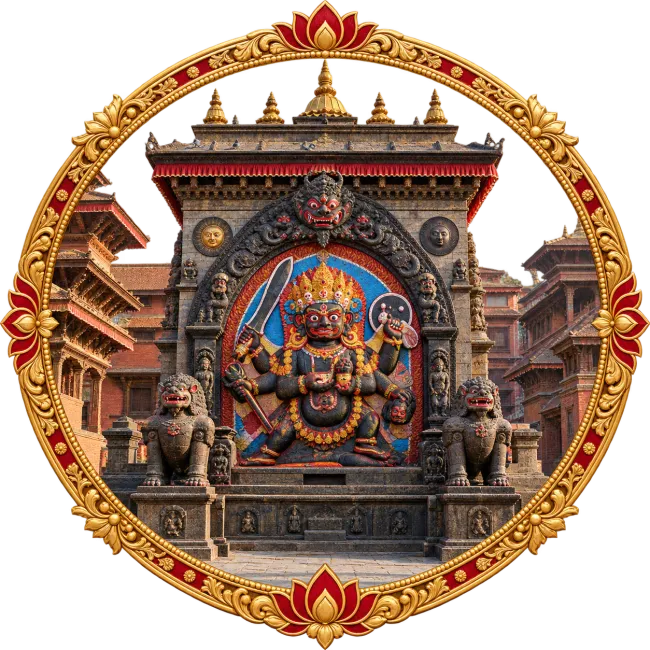
Kaal Bhairav Shrine, Kathmandu
Visit Kaal Bhairav Shrine in Kathmandu Durbar Square, one of Nepal’s most powerful and visually impressive shrines dedicated to the fierce manifestation of Lord Shiva. The shrine is famous for its enormous stone image of Kaal Bhairav, shown standing upon a defeated figure and holding divine weapons.
Installed at its present location by King Pratap Malla during the 17th century, the image became a symbol of truth, justice and royal authority. People historically took important oaths before Kaal Bhairav because it was believed that anyone speaking falsely in his presence would face divine punishment.
About Kaal Bhairav Shrine
Kaal Bhairav Shrine is situated within Kathmandu Durbar Square near Hanuman Dhoka Palace and the Jagannath Temple. Unlike a conventional enclosed temple, it is an open-air shrine centred around a large stone image.
Kaal Bhairav is a fierce manifestation of Lord Shiva and is worshipped as the guardian of time, justice, truth and sacred places.
The name Kaal Bhairav can be understood as:
- Kaal means time, death and the force that brings everything to an end.
- Bhairav means the powerful form that removes fear and destroys evil.
Kaal Bhairav represents the divine power that controls time and ensures that every action produces its proper result.
Devotees visit the shrine for courage, protection, justice and freedom from fear.
History of Kaal Bhairav Shrine
The large stone image of Kaal Bhairav is generally associated with the Licchavi period, indicating that it existed before its installation at Kathmandu Durbar Square.
According to local tradition, the image was discovered in a field outside the central city. King Pratap Malla, who ruled Kathmandu between 1641 and 1674, ordered the statue to be brought to Hanuman Dhoka and installed at its present location.
Pratap Malla was deeply interested in religion, art, poetry and Tantric traditions. He commissioned and renovated numerous monuments in Kathmandu Durbar Square.
After the image was installed, it became closely connected with the royal court and the administration of justice. Officials, soldiers and individuals involved in legal disputes were sometimes required to take an oath before Kaal Bhairav.
The shrine survived political changes and earthquakes and remains one of the most prominent religious monuments within Kathmandu Durbar Square.
Mythology of Kaal Bhairav
According to Hindu mythology, Lord Brahma once became filled with pride. He believed that his position as the creator made him superior to the other gods.
Lord Shiva appeared in a fierce form to destroy Brahma’s ego. From Shiva’s divine power emerged Kaal Bhairav, who removed Brahma’s fifth head.
Because he had cut the head of Brahma, Bhairav had to carry the skull and wander until he was freed from the consequences of the action.
This story does not simply represent punishment. It symbolizes the destruction of ego, false knowledge and misuse of authority.
Kaal Bhairav teaches that:
- No one is greater than truth.
- Pride eventually leads to downfall.
- Time controls every living being.
- Justice applies equally to rulers and ordinary people.
- Spiritual progress requires freedom from ego.
Kaal Bhairav as the Deity of Justice
Kaal Bhairav was historically treated as a divine witness in legal and royal matters.
People believed that lying before the deity could lead to illness, misfortune or death. Because of this belief, individuals were expected to speak truthfully when taking an oath at the shrine.
Royal officials used the image as a symbol of honest administration. The shrine therefore functioned as both a religious monument and a place associated with public justice.
Even today, devotees involved in court cases, property disputes or serious disagreements visit Kaal Bhairav and pray for a fair outcome.
Religious Significance of Kaal Bhairav Shrine
Kaal Bhairav is worshipped as the guardian of Kathmandu Durbar Square and the sacred royal city.
Devotees believe that his worship provides protection from fear, enemies, accidents and negative forces.
People visit the shrine for:
- Justice in court cases
- Protection from enemies
- Courage and confidence
- Freedom from fear
- Removal of negative energies
- Success in difficult work
- Protection during travel
- Relief from planetary difficulties
- Business growth
- Family protection
- Control over anger and ego
- Spiritual discipline
- Fulfilment of sincere wishes
Bhairav worship is also believed to strengthen a person’s ability to face uncomfortable truths and make disciplined decisions.
Main Image of Kaal Bhairav
The principal image is carved from a large piece of stone and is considered one of the largest stone representations of Bhairav in Nepal.
Kaal Bhairav is depicted with:
- A fierce facial expression
- Wide-open eyes
- A crown
- Multiple arms
- Divine weapons
- A garland associated with his fearsome form
- A defeated figure beneath his feet
- Traditional Tantric ornaments
The powerful appearance represents divine authority over death, ego, injustice and negative forces.
The image is decorated with:
- Red and black cloth
- Vermilion
- Flowers and garlands
- Metal ornaments
- Sacred threads
- Oil lamps
Symbolism of the Image
Every feature of Kaal Bhairav carries spiritual meaning.
Fierce Expression
The deity’s expression creates fear in those who act dishonestly but offers confidence to sincere devotees.
Divine Weapons
The weapons represent the destruction of ignorance, pride, injustice and harmful forces.
Figure Beneath His Feet
The defeated figure symbolizes the control of evil, ego and uncontrolled desires.
Garland and Ornaments
The ornaments represent the temporary nature of physical life and the power of time.
Multiple Arms
The arms symbolize Bhairav’s ability to protect devotees and control different cosmic forces simultaneously.
Architecture and Setting
Kaal Bhairav is an open-air shrine rather than a separate enclosed temple building.
Important features include:
- Monumental stone image
- Raised stone platform
- Decorative arch surrounding the deity
- Traditional prayer bells
- Oil-lamp stands
- Sacred offering areas
- Historic monuments surrounding the shrine
- Direct relationship with Hanuman Dhoka Palace
- Open public worship space
The setting allows large groups of devotees to view the complete image. The colourful decoration of the deity contrasts with the stone architecture of Kathmandu Durbar Square.
Kaal Bhairav Shrine Timings
Because Kaal Bhairav is an open-air shrine, the image does not have conventional temple doors. Regular worship follows the schedule below.
The image may remain externally visible after regular worship concludes, subject to Kathmandu Durbar Square’s security and heritage-area access arrangements.
Morning Puja and Aarti
Morning Puja begins at 5:30 AM, followed by Aarti at 6:00 AM.
The deity is worshipped with:
- Red flowers
- Vermilion
- Mustard oil
- Oil lamps
- Incense
- Rice and grains
- Fruits and sweets
- Red or black cloth
- Bhairav mantras
The period between 6:00 AM and 9:00 AM is suitable for peaceful darshan and photography of the shrine’s exterior.
Special Bhairav Puja
Special pujas are generally arranged between 6:30 AM and 11:00 AM.
Devotees may perform worship for:
- Justice in legal matters
- Protection from enemies
- Relief from fear
- Removal of negative influences
- Safe travel
- Business protection
- Family security
- Planetary difficulties
- Courage and discipline
- Fulfilment of wishes
A special Bhairav Puja may include Sankalp, mantra recitation, mustard-oil lamps, flowers, vermilion, Bhog and protective sacred threads.
Special ceremonies should be arranged through authorized priests.
Bhog and Traditional Offerings
Bhog is offered at 12:00 PM. Offerings may include fruits, sweets, rice, beaten rice and traditional Newari preparations.
Certain Bhairav traditions include ritual offerings of alcohol, eggs, fish or meat. Such offerings should only be presented according to established customs and through authorized priests.
Devotees who prefer vegetarian worship may offer:
- Coconut
- Fruits
- Sweets
- Flowers
- Incense
- Mustard-oil lamps
Traditional ritual practices are personal choices and are not compulsory for receiving darshan.
Evening Puja and Aarti
Evening Puja begins at 6:00 PM, followed by Aarti at 6:30 PM.
Oil lamps are offered before Kaal Bhairav while devotees chant prayers and ring bells. The shrine’s illuminated appearance creates a powerful atmosphere within Durbar Square.
Visitors should reach the shrine before 6:00 PM to attend the complete evening ceremony.
Indra Jatra and Kaal Bhairav
Indra Jatra is one of the most important festivals celebrated in Kathmandu Durbar Square.
During the festival, Bhairav deities are worshipped as protectors of Kathmandu. The nearby Seto Bhairav mask is opened for public viewing, and ceremonial activities take place throughout the square.
Kaal Bhairav receives:
- Special flower decorations
- Oil lamps
- Bhairav Puja
- Traditional offerings
- Newari music
- Community worship
- Visits from large numbers of devotees
The festival also includes the Kumari chariot procession, Lakhey dance and worship of Lord Indra.
Other Major Festivals
Bhairav Ashtami
Special worship is performed with mustard-oil lamps, flowers and Bhairav mantras.
Maha Shivaratri
As a fierce form of Lord Shiva, Kaal Bhairav receives special worship during Maha Shivaratri.
Dashain
Devotees worship Bhairav for courage, protection and victory over negative forces.
Kali Puja
Special lamps and Tantric prayers are offered during Kali Puja.
Tuesdays and Saturdays
Tuesday and Saturday are considered auspicious for Bhairav worship.
Ashtami
Ashtami dates are important for both Bhairav and Shakti worship.
Offerings and Prasad
Common offerings made at Kaal Bhairav Shrine include:
- Red flowers
- Black or red cloth
- Vermilion
- Mustard oil
- Oil lamps
- Black sesame seeds
- Rice and grains
- Coconut
- Fruits and sweets
- Incense sticks
- Protective sacred threads
- Monetary donations
Prasad may include fruits, sweets, flowers, vermilion and blessed threads.
Offerings should be placed only in designated areas.
Entry Fee and Visit Duration
There is no separate fee for worshipping Kaal Bhairav. However, the Kathmandu Durbar Square heritage-area ticket applies to eligible visitors.
A regular shrine visit requires 30–45 minutes. Visitors exploring the complete Durbar Square should keep two to three hours.
During Indra Jatra, Dashain and Bhairav Ashtami, additional time is required because of large crowds.
Visitor Guidelines
- Wear modest and respectful clothing.
- Maintain silence during Puja and Aarti.
- Follow the designated worship area.
- Do not touch or climb on the stone image.
- Ask permission before photographing rituals.
- Avoid using flash close to the deity.
- Keep mobile phones on silent mode.
- Use authorized priests for special pujas.
- Do not place offerings outside designated areas.
- Keep Kathmandu Durbar Square clean.
- Respect traditional Newari worship practices.
- Keep personal belongings secure.
- Avoid carrying large bags during festivals.
- Keep children and elderly visitors under supervision.
- Follow instructions from security and heritage officials.
Best Time to Visit
October to March is the best period for exploring Kathmandu Durbar Square.
For peaceful darshan, visit between 6:00 AM and 9:00 AM. Evening visitors should reach between 5:00 PM and 6:00 PM to attend Puja and Aarti.
Indra Jatra provides the most vibrant cultural experience, but the square remains extremely crowded.
How to Reach Kaal Bhairav Shrine
By Air
Tribhuvan International Airport is the nearest airport. Taxis are available for Kathmandu Durbar Square or a nearby drop-off point.
From Thamel
Kathmandu Durbar Square is approximately 1.5 kilometres from Thamel. Visitors can walk or use a taxi or cycle-rickshaw.
From Ratna Park
The shrine can be reached by walking, taxi or cycle-rickshaw from Ratna Park.
From New Road
Walk through the traditional market area towards Basantapur and Kathmandu Durbar Square.
By Local Transport
Local buses and minibuses stop near Ratna Park, New Road Gate, Shahid Gate and Sundhara.
From India
Indian visitors can reach Kathmandu by air or enter Nepal through road-border points such as Raxaul–Birgunj and Sunauli–Bhairahawa.
Indian citizens should carry a valid passport or voter identity card and confirm transportation requirements before departure.
Nearby Places to Visit
- Hanuman Dhoka Palace
- Taleju Bhawani Temple
- Kumari Ghar
- Seto Bhairav
- Jagannath Temple
- Kasthamandap
- Shiva-Parvati Temple
- Gaddi Baithak
- Indra Chowk
- Akash Bhairav Temple
- Ason Market
- Freak Street
Conclusion
Kaal Bhairav Shrine is one of Kathmandu’s most powerful symbols of truth, justice and divine protection. Its ancient stone image was installed at Kathmandu Durbar Square by King Pratap Malla during the 17th century.
The shrine’s historic use as a place of oath-taking reflects the deep belief that Kaal Bhairav punishes dishonesty and protects those who follow truth.
Worshipping Kaal Bhairav is believed to provide courage, justice and freedom from fear. A visit to the shrine offers devotees a direct experience of Kathmandu’s ancient Shaiva, Tantric and Newari traditions.