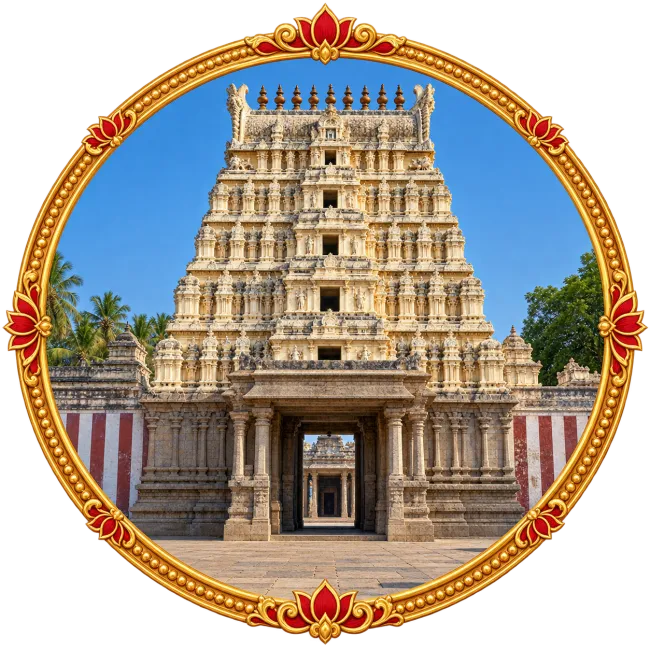
Jambukeswarar Temple, Tiruchirappalli
Visit Jambukeswarar Temple in Thiruvanaikaval, Tiruchirappalli, one of South India’s most sacred Shiva temples. Dedicated to Lord Shiva as Jambukeswarar and Goddess Parvati as Akilandeswari, the temple represents the element of water among the five Pancha Bhoota Sthalams.
The Shiva Lingam is installed above a natural underground water source, and water continuously collects around its base. The temple is also famous for its midday Puja in which a priest dressed in the form of Goddess Akilandeswari worships Lord Jambukeswarar.
About Jambukeswarar Temple
Jambukeswarar Temple is located in Thiruvanaikaval, an island region formed by the Kaveri and Kollidam rivers near Srirangam.
The presiding deities are:
- Lord Jambukeswarar, a manifestation of Shiva
- Goddess Akilandeswari, a manifestation of Parvati
The temple is one of the five Pancha Bhoota Sthalams, where Lord Shiva is worshipped as the five natural elements:
- Earth – Ekambareswarar Temple, Kanchipuram
- Water – Jambukeswarar Temple, Thiruvanaikaval
- Fire – Arunachaleswarar Temple, Tiruvannamalai
- Air – Srikalahasteeswara Temple, Srikalahasti
- Space – Nataraja Temple, Chidambaram
At Thiruvanaikaval, Shiva is worshipped as Appu Lingam, representing water.
History of Jambukeswarar Temple
The original temple is traditionally attributed to the early Chola king Kochengat Chola, who is believed to have ruled during the Sangam or early Chola period.
Kochengat Chola constructed several elevated Shiva temples known as Maadakovils. The sanctums of these temples were built above ground level so that elephants could not enter.
The temple was expanded over several centuries by:
- Imperial Cholas
- Pandyas
- Hoysalas
- Vijayanagara rulers
- Madurai Nayaks
These dynasties constructed Gopurams, Mandapams, corridors, walls and additional shrines. Inscriptions record land grants, donations, lamps and arrangements for festivals.
The temple is also praised in the Tevaram hymns of the Tamil Shaiva saints Appar, Sundarar and Thirugnana Sambandar. It is therefore classified as a Paadal Petra Sthalam.
Legend of Goddess Parvati and the Water Lingam
According to temple mythology, Goddess Parvati once playfully disturbed Lord Shiva during his meditation.
Shiva instructed her to descend to earth and perform penance. Goddess Parvati arrived at a forest containing Jambu trees near the Kaveri River.
She collected water from the river and created a Shiva Lingam beneath a Jambu tree. Because the Lingam was formed and worshipped with water, it became known as the Appu Lingam.
Goddess Parvati worshipped the Lingam and received spiritual teachings from Lord Shiva. In this tradition, Shiva acted as the Guru while Parvati became his disciple.
Because the divine couple appeared in the relationship of teacher and student, ceremonial weddings between Jambukeswarar and Akilandeswari are not conducted in the same manner as at other Shiva temples.
Elephant and Spider Legend
Another famous legend explains the name Thiruvanaikaval and the construction of the elevated temple.
A white elephant and a spider were devoted to Lord Shiva and worshipped the same Lingam.
The elephant collected water and performed Abhishekam each day. It also cleared leaves and dust from the shrine.
The spider protected the Lingam from falling leaves by creating a web above it. When the elephant saw the web, it believed the shrine had become dirty and washed it away.
The spider repeatedly rebuilt its web, while the elephant repeatedly removed it. Their disagreement eventually resulted in both losing their lives.
Lord Shiva blessed both devotees. The elephant attained liberation, while the spider was reborn as King Kochengat Chola.
Remembering his previous life, the king constructed elevated temples that elephants could not enter. Jambukeswarar Temple is traditionally regarded as one of these Maadakovils.
The name Thiruvanaikaval refers to the sacred place associated with the elephant:
- Thiru means sacred.
- Aanai means elephant.
- Kaval means forest or protected place.
Religious Significance of Jambukeswarar Temple
Jambukeswarar Temple represents water, purity, emotional balance and the continuous flow of divine grace.
Devotees visit the temple for:
- Mental peace
- Relief from emotional stress
- Family harmony
- Recovery from illness
- Blessings for marriage and children
- Success in education
- Spiritual knowledge
- Relief from water-related fears
- Protection from negative influences
- Removal of obstacles
- Devotion to Lord Shiva
- Fulfilment of sincere wishes
Worshipping Goddess Akilandeswari is believed to provide courage, wisdom and protection.
Main Deity and Underground Water
The principal Shiva Lingam is installed inside a low sanctum. A natural underground spring continuously fills the area around the base of the Lingam.
Even when water is removed, it gradually returns. This natural phenomenon symbolizes the water element and the eternal presence of divine energy.
During the rainy season, the water level may rise further. Priests conduct the rituals while carefully managing the water within the sanctum.
Devotees view the Appu Lingam from the designated area outside the inner chamber.
Goddess Akilandeswari
Goddess Parvati is worshipped as Akilandeswari, meaning the ruler of the entire universe.
The goddess was originally worshipped in an intense and powerful form. According to tradition, Adi Shankaracharya installed Sri Chakra-shaped earrings called Tatankas to transform her fierce energy into a peaceful and compassionate form.
He also established a shrine of Lord Ganesha opposite Akilandeswari. The presence of Ganesha is believed to keep the goddess calm.
Devotees seek her blessings for:
- Education and wisdom
- Marriage
- Children
- Family prosperity
- Courage
- Protection
- Relief from fear
Architecture of Jambukeswarar Temple
Jambukeswarar Temple is a massive Dravidian complex covering several acres.
Important architectural features include:
- Five concentric Prakarams
- Tall entrance Gopurams
- Elevated Shiva sanctum
- Akilandeswari shrine
- Stone-pillared Mandapams
- Sacred temple tanks
- Carved pillars and sculptures
- Ancient inscriptions
- Jambu tree
- Vibhuti Prakaram
- Thousand-pillared structures
- Shrines dedicated to Ganesha, Murugan and other deities
The five enclosures represent stages of spiritual progress from the external world towards the divine centre.
Vibhuti Prakaram
One enclosure is known as Vibhuti Prakaram or the sacred-ash enclosure.
According to tradition, Lord Shiva appeared in the form of a worker during the construction of the temple wall. Instead of paying workers with coins, he gave them sacred ash.
For sincere workers, the ash transformed into money according to the value of their labour. This miracle established the religious importance of the enclosure.
Jambukeswarar Temple Timings
Festival timings may differ during Maha Shivaratri, Panguni Brahmotsavam and Navratri.
Morning Puja and Deepa Aradhana
The temple opens at 5:30 AM. Ushathkala Puja and the first Deepa Aradhana are performed at 6:30 AM.
Lord Jambukeswarar is worshipped with:
- Sacred water
- Milk
- Bilva leaves
- Flowers
- Sandalwood paste
- Vibhuti
- Incense
- Oil and ghee lamps
- Naivedyam
Kalasanthi Puja is performed at 8:00 AM. The period between 6:30 AM and 8:00 AM is ideal for peaceful darshan.
Abhishekam and Special Puja
Special Abhishekam and Archana are generally arranged between 8:30 AM and 11:00 AM.
Abhishekam may include:
- Sacred water
- Milk
- Curd
- Honey
- Tender coconut water
- Sandalwood
- Vibhuti
- Panchamritam
Devotees may arrange Rudrabhishekam, Bilva Archana and other ceremonies through official temple counters.
Unique Uchikala Puja
Uchikala Puja at 12:00 PM is the temple’s most distinctive daily ceremony.
During this worship, a priest dresses in a saree and represents Goddess Akilandeswari. Carrying a ceremonial pot and worship materials, the priest proceeds to the Jambukeswarar shrine.
The priest then worships Lord Shiva in the manner that Goddess Parvati is believed to have performed her penance.
A cow and other ceremonial elements may be included in the procession. This ritual symbolically recreates the relationship of Parvati as the student and Shiva as the Guru.
Devotees should reach the temple before 11:30 AM to witness the ceremony.
Evening Puja and Deepa Aradhana
The temple reopens at 3:00 PM.
Sayaraksha Puja and Deepa Aradhana are performed at 5:00 PM. Irandam Kala Puja takes place at 7:00 PM.
Ardha Jama Puja, the final worship of the day, is performed at 8:00 PM. The temple closes at 8:30 PM.
Major Festivals Celebrated
Panguni Brahmotsavam
Panguni Brahmotsavam is the temple’s grandest annual festival. It extends over several days and includes processions on different Vahanas.
Pancha Prakara Festival
During this distinctive festival, Lord Shiva and Goddess Akilandeswari appear in exchanged forms. It represents the unity of Shiva and Shakti.
Maha Shivaratri
The temple remains active with special Abhishekam, Rudra chanting and night worship.
Aadi Pooram
Aadi Pooram is dedicated to Goddess Akilandeswari. Special decoration and Puja are performed.
Navratri
The goddess is decorated in different Alankarams during the nine nights of Navratri.
Aippasi Annabhishekam
The Shiva Lingam is covered with cooked rice and worshipped for prosperity and food security.
Thai Poosam
Special worship and processions are organized during Thai Poosam.
Pradosham
Pradosha Puja is performed twice every lunar month and is considered highly auspicious for Shiva worship.
Sevas and Offerings
Devotees may arrange:
- Rudrabhishekam
- Bilva Archana
- Sahasranama Archana
- Akilandeswari Kumkum Archana
- Milk Abhishekam
- Panchamrita Abhishekam
- Vastra Seva
- Ghee-lamp offering
- Annadanam
- Festival Ubhayam
All Sevas should be booked through official temple counters.
Prasadam
Temple Prasadam may include:
- Vibhuti
- Kumkum
- Puliyodarai
- Sakkarai Pongal
- Curd rice
- Sundal
- Panchamritam
- Fruits
Prasadam availability depends on the day and temple programme.
Dress Code and Entry Rules
Visitors should wear clean and modest clothing.
Recommended clothing includes:
- Dhoti, Veshti or full-length trousers for men
- Saree, half-saree, Salwar Kameez or modest traditional attire for women
- Traditional clothing for children
Shorts, sleeveless outfits and revealing clothes should be avoided.
Photography is restricted near the inner sanctums. Mobile phones should remain silent.
Entry Fee and Visit Duration
General darshan is free. Paid Sevas, Abhishekam and special-darshan tickets may be available.
A regular visit requires two to three hours. Visitors wishing to witness the unique midday Puja should arrive by 10:30 AM and remain until the ceremony is completed.
Festival darshan may require additional time.
Visitor Guidelines
- Remove footwear at the designated stand.
- Wear modest and traditional clothing.
- Check the Puja schedule before joining the queue.
- Reach before 11:30 AM for Uchikala Puja.
- Follow photography restrictions.
- Keep mobile phones silent.
- Do not enter restricted areas of the water Lingam sanctum.
- Use official counters for Sevas and donations.
- Do not purchase access from unauthorized agents.
- Avoid wasting milk or water during offerings.
- Keep the temple and tanks clean.
- Maintain silence during Vedic chanting.
- Keep children and elderly devotees under supervision.
- Follow instructions from priests and security personnel.
Best Time to Visit
November to February is the best period for visiting Tiruchirappalli because the weather remains pleasant.
For peaceful darshan, visit between 6:30 AM and 8:00 AM.
The best time to experience the temple’s distinctive tradition is before the 12:00 PM Uchikala Puja.
Evening visitors should arrive between 4:30 PM and 5:00 PM to attend Sayaraksha Puja.
How to Reach Jambukeswarar Temple
By Air
Tiruchirappalli International Airport is the nearest airport, located approximately 15 kilometres away.
By Train
Srirangam Railway Station is approximately 3 kilometres from the temple.
Tiruchirappalli Junction is approximately 11 kilometres away and is connected with Chennai, Madurai, Bengaluru, Coimbatore and other cities.
By Bus
Frequent city buses connect Thiruvanaikaval with Srirangam, Tiruchirappalli and surrounding towns.
By Road
Taxis, auto-rickshaws and private vehicles are easily available. Parking may be limited during major festivals.
Nearby Places to Visit
- Sri Ranganathaswamy Temple
- Uthamar Kovil
- Rockfort Ucchi Pillayar Temple
- Thayumanaswamy Temple
- Samayapuram Mariamman Temple
- Vekkali Amman Temple
- Kallanai Dam
- Kaveri River
- Gunaseelam Temple
- Vayalur Murugan Temple
- Tiruchirappalli Rockfort
- Butterfly Park
Conclusion
Jambukeswarar Temple is one of India’s most important Shiva temples and the sacred water shrine among the Pancha Bhoota Sthalams. Its underground spring, Appu Lingam and unique Uchikala Puja distinguish it from every other Shiva temple.
The temple’s connection with Goddess Parvati, the elephant-spider legend and King Kochengat Chola gives it exceptional religious and historical significance.
A visit to Jambukeswarar Temple offers devotees the blessings of Lord Shiva and Goddess Akilandeswari while providing a profound experience of South India’s ancient architecture, ritual and spiritual philosophy.