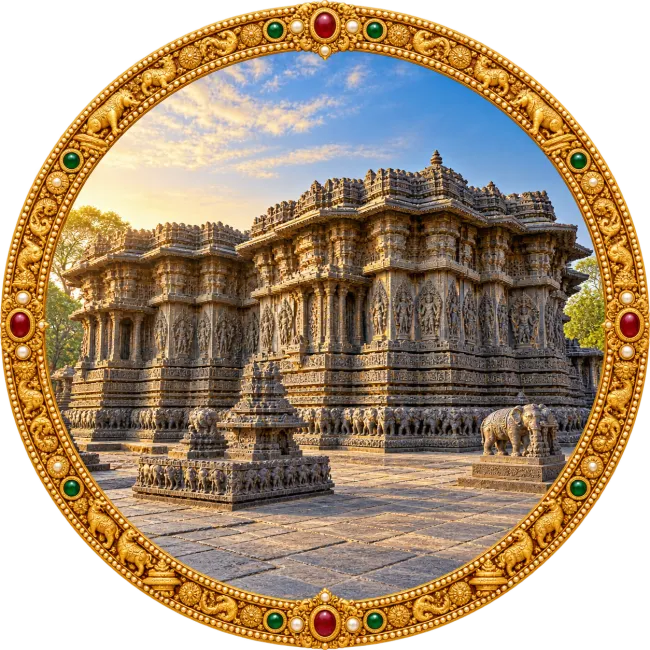
Hoysaleswara Temple, Halebidu
Hoysaleswara Temple in Halebidu, Karnataka, is one of the greatest architectural achievements of the Hoysala dynasty. Dedicated to Lord Shiva, the temple is renowned for its twin sanctums, enormous Nandi statues, star-shaped platform and extraordinarily detailed sculptures carved into dark soapstone.
Construction began in 1121 CE during the reign of Hoysala king Vishnuvardhana. The monument reflects the artistic, religious and political importance of Halebidu, which was then known as Dwarasamudra and served as the Hoysala capital. Today, the temple is preserved as an important heritage monument and forms part of the UNESCO-listed Sacred Ensembles of the Hoysalas.
About Hoysaleswara Temple
Hoysaleswara Temple is situated in Halebidu in Hassan district, Karnataka. The temple is dedicated to Lord Shiva and contains two principal sanctums.
The first shrine houses the Hoysaleswara Shiva Lingam, while the second contains the Shantaleswara Shiva Lingam. The names are associated with King Vishnuvardhana and Queen Shantala Devi.
Each sanctum has its own Nandi Mandapa containing a large stone image of Nandi, Lord Shiva’s sacred vehicle. The twin-shrine arrangement is one of the monument’s most important architectural features.
The temple is especially famous for its exterior walls, which are almost completely covered with sculptures. These carvings depict deities, dancers, musicians, animals, warriors and episodes from the Ramayana, Mahabharata and Bhagavata Purana.
When and Who Built Hoysaleswara Temple?
Construction of Hoysaleswara Temple began in 1121 CE during the reign of King Vishnuvardhana of the Hoysala dynasty.
The project was commissioned by Ketamalla, a wealthy official and administrator serving under King Vishnuvardhana. Ketamalla dedicated the twin shrines to Hoysaleswara and Shantaleswara.
Hoysaleswara is associated with the king, while Shantaleswara is connected with Queen Shantala Devi. The queen was highly accomplished in dance, music and religious learning and is remembered as an important patron of the arts.
The temple took several decades to develop. Successive artists, administrators and patrons contributed to the halls, sculptures, gateways and subsidiary structures.
Although the main temple was substantially constructed during the twelfth century, some architectural elements remained incomplete. The absence of the original superstructures above the sanctums is also connected with later damage and deterioration.
Halebidu and the Hoysala Capital
Halebidu was originally known as Dwarasamudra. It became the capital of the Hoysala Empire and developed into a prosperous city containing palaces, temples, lakes and administrative buildings.
The Hoysalas ruled significant parts of southern India between the eleventh and fourteenth centuries. They supported Hinduism, Jainism, literature, music, architecture and temple-based education.
Dwarasamudra suffered repeated attacks during the fourteenth century, including invasions by armies associated with the Delhi Sultanate. The city was plundered, and several structures were damaged.
After the decline of the capital, the settlement came to be known as Halebidu, meaning “old city” or “ruined city” in Kannada.
Despite the loss of many structures, Hoysaleswara Temple survived as an extraordinary record of Hoysala artistic achievement.
Religious Significance
Hoysaleswara Temple was originally a major centre of Shaivite worship. Lord Shiva was worshipped in the two sanctums as Hoysaleswara and Shantaleswara.
The twin shrines may be interpreted as representing:
Shiva and Shakti
The king and queen
Royal power and spiritual authority
Two complementary forms of Shaivite worship
Images of Vishnu, Brahma, Durga, Ganesha, Surya and other deities appear throughout the monument. This demonstrates that Hoysala artists incorporated multiple Hindu traditions within a temple dedicated principally to Shiva.
Although the monument does not operate with the full ritual schedule of an active pilgrimage temple, visitors may respectfully offer silent prayers from the permitted areas.
Hoysala Architecture
Hoysaleswara Temple is an outstanding example of mature Hoysala architecture. It is constructed primarily from chloritic schist, commonly called soapstone.
Soapstone is relatively soft when first quarried, allowing artisans to carve intricate details. It hardens gradually after exposure, helping the sculptures survive for centuries.
Important features of Hoysala architecture visible here include:
A raised star-shaped platform
Multiple projecting wall surfaces
Horizontal sculptural friezes
Lathe-turned pillars
Decorated ceilings
Twin sanctums
Separate Nandi Mandapas
Narrative sculptures
Highly detailed jewellery and clothing
The monument appears different from each angle because of its complex outer-wall projections and continuous sculptural bands.
Twin Shiva Shrines
Hoysaleswara Temple is a dvikuta temple, meaning it has two principal sanctums.
Hoysaleswara Shrine
The Hoysaleswara sanctum contains a Shiva Lingam associated with King Vishnuvardhana and the Hoysala royal tradition.
A large Nandi sits in a separate pavilion facing the shrine. The Nandi is polished and decorated with carved necklaces, bells and ornaments.
Shantaleswara Shrine
The Shantaleswara sanctum is associated with Queen Shantala Devi. It also houses a Shiva Lingam and has a separate Nandi Mandapa.
The twin arrangement gives the temple a balanced plan. The two sections are connected internally through shared halls and passages.
Nandi Mandapas
The temple has two massive Nandi statues, each positioned directly before one of the Shiva sanctums.
The Nandis are carved from stone and polished to create a smooth surface. Their ornaments, folds of skin, facial expressions and ceremonial decorations are rendered with remarkable precision.
The larger Nandi is counted among the most impressive monolithic Nandi images in Karnataka. Visitors should not climb onto, lean against or touch the sculptures unnecessarily.
Exterior Sculptural Friezes
The lower exterior walls contain several horizontal bands of sculpture. Each band carries a different symbolic theme.
The sequence commonly includes:
Elephants representing strength and stability
Lions representing courage
Horses representing speed and movement
Floral scrolls representing beauty and continuity
Mythical creatures representing divine imagination
Swans representing purity
Narrative scenes from Hindu epics
Hundreds of elephants appear in the lowest band, and each is carved with different details.
Above the horizontal friezes are larger sculptures of deities, guardians, dancers and mythological events.
Ramayana and Mahabharata Sculptures
The temple walls present detailed visual narratives from India’s great epics.
Ramayana scenes include:
Rama’s forest journey
Sita’s abduction
Hanuman’s meeting with Rama
The battle against Ravana
Vanara warriors
Episodes involving Sugriva and Vali
Mahabharata scenes include:
The Pandavas
Bhima’s battles
Arjuna with his bow
Krishna guiding the heroes
Episodes from the Kurukshetra War
Divine weapons and celestial beings
Visitors who wish to understand the stories should move slowly along the exterior walls in a clockwise direction.
Important Sculptures
Shiva as Nataraja
Lord Shiva is depicted performing the cosmic dance. Multiple arms, flowing ornaments and surrounding attendants create a sense of movement within the stone.
Gajasurasamhara
Shiva is shown destroying the elephant demon. The sculpture represents victory over arrogance and uncontrolled power.
Andhakasura Vadha
This sculpture portrays Shiva defeating the demon Andhaka. Its complex arrangement demonstrates the extraordinary skill of Hoysala artists.
Durga as Mahishasura Mardini
Goddess Durga is depicted defeating the buffalo demon Mahishasura. The scene symbolises the victory of righteousness over evil.
Narasimha
Lord Vishnu appears as Narasimha, destroying Hiranyakashipu while protecting Prahlada.
Krishna
Several sculptures show Krishna’s childhood activities, his battles and episodes from the Bhagavata tradition.
Ravana Lifting Mount Kailash
Ravana is shown attempting to lift Mount Kailash while Shiva and Parvati sit above. The composition combines power, movement and divine authority.
Interior Pillars and Ceilings
The interior halls contain polished, lathe-turned pillars. Their geometric precision is a defining feature of Hoysala architecture.
Some pillars have smooth surfaces, while others contain rings, grooves and decorative bands. The polishing creates a reflective appearance even in limited light.
The ceilings display carved lotuses, geometric patterns and floral designs. Each ceiling composition is arranged differently, encouraging visitors to look upward while exploring the halls.
Several free-standing sculptures and decorative elements were damaged or removed over time, but the surviving interior remains architecturally impressive.
Hoysaleswara Temple Timings
As Hoysaleswara Temple is primarily a protected heritage monument, its schedule is based on visitor access rather than a complete daily Puja cycle.
The monument remains open throughout the day. Access may be regulated during conservation work, official events or exceptional weather conditions.
Puja and Aarti at Hoysaleswara Temple
Hoysaleswara Temple does not follow a publicly announced daily schedule of Abhishekam, morning Aarti and evening Aarti comparable to a fully active pilgrimage temple.
The Shiva Lingams remain inside the twin sanctums, but the site is primarily managed and preserved as a historical monument.
Visitors may offer silent prayers from the permitted area. Lighting lamps, pouring liquids over the Lingams, placing flowers directly on sculptures or performing independent rituals should not be attempted without permission.
The best time for a quiet devotional visit is from 7:00 AM to 9:00 AM, before large tourist groups arrive.
UNESCO Recognition
Hoysaleswara Temple is included in the Sacred Ensembles of the Hoysalas, which received UNESCO World Heritage recognition in 2023.
The group highlights three outstanding Hoysala temple complexes:
Hoysaleswara Temple at Halebidu
Chennakeshava Temple at Belur
Keshava Temple at Somanathapura
The recognition acknowledges the remarkable architecture, sculptural detail and cultural importance of the Hoysala tradition.
Visitors should remember that the monument is not merely a sightseeing location but an internationally significant heritage site requiring careful preservation.
Festivals and Cultural Importance
Because the temple is primarily preserved as a monument, it does not conduct an extensive annual festival calendar like a major active shrine.
However, Halebidu and nearby temples observe regional celebrations associated with:
Maha Shivaratri
Hoysala heritage programmes
Kannada cultural events
Classical dance and music
Archaeological and educational activities
Special cultural programmes may be organised in the wider heritage area with official permission. Such events do not form part of a fixed daily schedule.
Entry Fee and Visit Duration
Indian and international visitors should follow the entry arrangements displayed at the monument. Ticket requirements may apply to selected protected areas, museums or organised services.
A complete visit to Hoysaleswara Temple requires 2 to 3 hours. Architecture enthusiasts may need more time to study the friezes, epic narratives, Nandi sculptures and interior pillars.
Visitors planning to explore the archaeological museum, Kedareshwara Temple and Jain Basadis should reserve half a day for Halebidu.
Dress Code and Visitor Rules
There is no elaborate ceremonial dress requirement for general monument entry, but visitors should wear clean and respectful clothing because the structure remains a sacred Shiva temple.
Comfortable walking footwear is recommended for exploring the exterior grounds. Footwear may need to be removed before entering the main temple halls or sanctum area.
Visitors must not:
Touch or scratch the sculptures
Apply oil, kumkum or paint to carved surfaces
Climb onto the platform walls or Nandi statues
Use flash close to delicate artwork
Write names on the monument
Leave food or plastic waste
Move beyond restricted barriers
Conduct unauthorised commercial photography
Children should remain under adult supervision.
Photography Guidelines
Photography is generally suitable in the exterior areas, subject to displayed rules. Tripods, drones, commercial equipment and professional shoots may require prior permission.
Visitors should avoid touching sculptures while taking photographs. Flash should not be used inside dark halls if restrictions are displayed.
Morning and late-afternoon light reveal the depth of the wall carvings particularly well. Side lighting creates shadows that make jewellery, facial expressions and narrative details easier to observe.
Best Time to Visit
October to February is the most comfortable season for visiting Halebidu. The weather is suitable for walking around the large stone complex.
The best morning period is from 7:00 AM to 10:00 AM. The best evening period is from 4:00 PM to 6:00 PM.
The midday sun can make outdoor exploration uncomfortable. During the monsoon, the surrounding landscape becomes green, but visitors should carry rain protection because parts of the complex are exposed.
How to Reach Hoysaleswara Temple
By Air
Kempegowda International Airport in Bengaluru is the nearest major international airport. Mysuru Airport and Mangaluru International Airport are other options depending on available flights.
Taxis and buses can be used for the onward journey to Hassan and Halebidu.
By Train
Hassan Railway Station is the nearest major railway station. It has connections with Bengaluru, Mysuru, Mangaluru and other Karnataka cities.
Buses and taxis are available from Hassan to Halebidu.
By Road
Halebidu is well connected by road with Hassan, Belur, Chikkamagaluru, Bengaluru and Mysuru.
Regular buses operate from Hassan and Belur. Hiring a taxi is convenient for travellers planning to visit Belur, Halebidu and Belavadi on the same day.
Nearby Places to Visit
Visitors may also explore:
Archaeological Museum, Halebidu
Kedareshwara Temple
Parshvanatha Basadi
Shantinatha Basadi
Adinatha Basadi
Hulikere Kalyani
Chennakeshava Temple, Belur
Veera Narayana Temple, Belavadi
Yagachi Dam
Shravanabelagola
Chikkamagaluru
Mullayanagiri
Archaeological Museum
The archaeological museum near Hoysaleswara Temple preserves sculptures, inscriptions and architectural fragments recovered from Halebidu and the surrounding region.
The collection helps visitors understand the original scale of Dwarasamudra and the artistic traditions of the Hoysala period.
Museum hours may differ from the monument’s opening time. Visitors should check the displayed schedule at the site.
Suggested Heritage Circuit
A convenient heritage circuit can include:
Hoysaleswara Temple, Halebidu
Archaeological Museum
Jain Basadis
Kedareshwara Temple
Chennakeshava Temple, Belur
Veera Narayana Temple, Belavadi
A full day is required to explore this circuit without rushing.
Visitor Guidelines
Begin with a clockwise walk around the exterior platform. The narrative bands are easier to understand when viewed in sequence.
Hire an authorised guide if you want detailed explanations of the sculptures and epic scenes. The temple contains thousands of figures that can be overlooked without guidance.
Carry drinking water, a cap and sun protection. Avoid placing bags, bottles or hands against carved walls.
Visit during morning or late afternoon because angled sunlight reveals the sculpture more effectively than overhead midday light.
Conclusion
Hoysaleswara Temple at Halebidu is a masterpiece of Hoysala art and one of Karnataka’s most important historical monuments. Constructed from 1121 CE under King Vishnuvardhana and commissioned by Ketamalla, the temple reflects the extraordinary skill of medieval Indian architects and sculptors.
Its twin Shiva sanctums, polished Nandis, star-shaped plan, epic narratives and detailed soapstone carvings preserve the cultural memory of the Hoysala capital. A visit to Hoysaleswara Temple offers a profound experience of sacred architecture, history and artistic excellence.