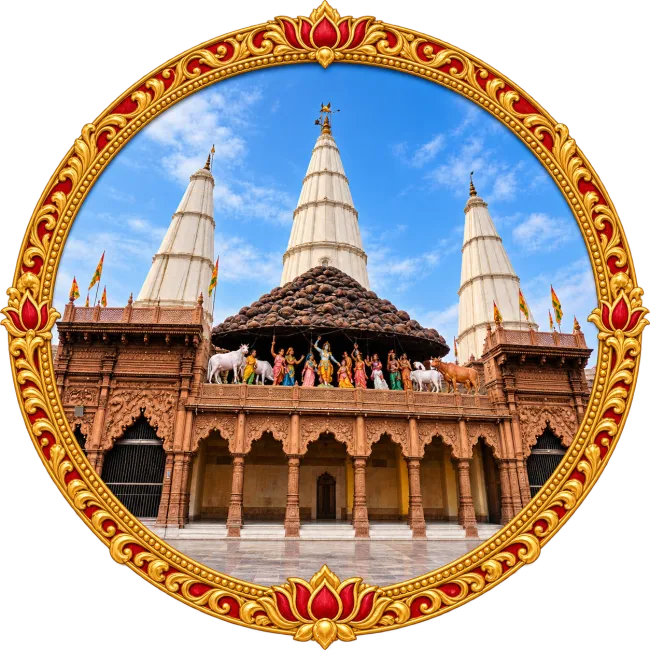
Giriraj Ji Temple
Giriraj Ji Temple in Govardhan is one of the most sacred Krishna pilgrimage sites in the Mathura district of Uttar Pradesh. Popularly known as Daan Ghati Giriraj Ji Temple, it is dedicated to Giriraj Maharaj, the divine form of Govardhan Hill worshipped as Lord Krishna himself. The temple stands on the famous Govardhan Parikrama route and welcomes thousands of devotees seeking protection, prosperity, peace, and devotion.
According to Hindu tradition, Lord Krishna lifted Govardhan Hill on the little finger of his left hand and protected the people and cattle of Braj from the torrential rain sent by Lord Indra. Since then, Govardhan Hill has been revered as a living manifestation of Krishna. Devotees worship Giriraj Ji with milk, flowers, Tulsi leaves, sweets, and heartfelt prayers before beginning the sacred Govardhan Parikrama.
About Giriraj Ji Temple, Mathura
Giriraj Ji Temple is situated at Daan Ghati in Govardhan town, approximately 22 kilometres from Mathura. Giriraj Maharaj is worshipped here in the form of a sacred Govardhan stone. The deity is beautifully decorated with colourful clothes, flowers, jewellery, crowns, and sandalwood paste during daily rituals and festivals.
The temple is commonly called Daan Ghati Temple because the site is associated with the playful Daan Leela of Lord Krishna. According to Braj tradition, Krishna and his cowherd companions stopped Radha Rani and the gopis while they were carrying milk, butter, and curd. Krishna playfully demanded a tax, or daan, before allowing them to pass through the area. This divine pastime gave the place its name, Daan Ghati.
Giriraj Ji is worshipped at several sacred places across Govardhan, including Daan Ghati, Jatipura Mukharvind, and Mukut Mukharvind near Mansi Ganga. This article focuses on the famous Daan Ghati Giriraj Ji Temple, which is among the most visited temples in Govardhan.
History of Giriraj Ji Temple
The spiritual history of Giriraj Ji Temple is connected with the ancient worship of Govardhan Hill and the Krishna traditions of Braj Bhoomi. The temple marks the place associated with Krishna’s Daan Leela and has served as an important centre of Giriraj worship for generations.
The exact age of the original shrine is not recorded in a single accepted historical account. The sacred site existed as a place of worship long before the construction and expansion of the present temple structure. Over time, devotees, saints, local residents, and temple committees contributed to its renovation and development.
The organised administration and modern development of Daan Ghati Temple gained momentum during the twentieth century. A temple management committee associated with Shri Gopal Prasad Kaushik was formed during the 1970s to improve worship arrangements, pilgrim facilities, and the maintenance of the sacred site.
Govardhan has also been an important centre for Vaishnava saints and devotional traditions. Saints connected with the Pushtimarg and Gaudiya Vaishnava traditions spent time in the Govardhan region, meditating upon the divine pastimes of Radha and Krishna. Their teachings strengthened the practice of Govardhan worship and parikrama.
Story of Lord Krishna Lifting Govardhan Hill
According to the Bhagavata tradition, the people of Braj once prepared an elaborate ceremony to worship Lord Indra, the deity of rain. Young Krishna questioned the ritual and explained that the residents depended on Govardhan Hill, forests, cows, fields, and their own honest work. He encouraged them to worship Govardhan instead.
The people accepted Krishna’s guidance and offered large quantities of food to Govardhan Hill. Angered by this, Lord Indra sent powerful clouds and continuous rainfall over Braj. The rain became so severe that the homes, cattle, and people of the region were placed in danger.
To protect everyone, Krishna lifted Govardhan Hill on his little finger and held it like a vast umbrella. The residents of Braj and their cattle took shelter beneath the hill for seven days and seven nights. Realising Krishna’s divine power, Indra stopped the rain and asked for forgiveness.
This sacred event represents the victory of devotion over pride. It also teaches respect for nature, animals, mountains, water, and the environment. The festival of Govardhan Puja commemorates this divine pastime every year.
Religious Significance of Giriraj Ji Temple
Giriraj Ji Temple holds great significance for devotees of Lord Krishna. Govardhan Hill is not regarded merely as a geographical formation but as a living and compassionate form of the Lord.
Devotees believe that worshipping Giriraj Maharaj can:
- Protect the family from difficulties and negative influences.
- Bring peace, prosperity, and stability into life.
- Help fulfil righteous wishes.
- Strengthen devotion towards Radha and Krishna.
- Remove pride, fear, and mental distress.
- Bless devotees with spiritual progress.
- Grant the divine grace of Braj Bhoomi.
Many devotees begin their Govardhan Parikrama by taking darshan at Daan Ghati Temple. After completing the circumambulation, they return to offer gratitude to Giriraj Ji.
Architecture of Giriraj Ji Temple
Daan Ghati Giriraj Ji Temple reflects the devotional character of Braj architecture. Its elevated entrance, decorated façade, temple spire, colourful religious artwork, and sacred symbols make it a recognisable landmark in Govardhan.
The sanctum houses the sacred form of Giriraj Maharaj. The deity is decorated differently during daily shringar and major festivals. Floral arrangements, embroidered garments, crowns, garlands, peacock feathers, and jewellery create a beautiful devotional setting.
The temple complex includes space for devotees to stand during darshan and aarti. Separate areas are used for offerings, milk abhishek, prasad distribution, and other temple services. Since the temple is located beside a busy market and the parikrama route, the surroundings remain lively throughout the day.
The present structure has undergone renovation and expansion to accommodate the increasing number of pilgrims. During Govardhan Puja, Guru Purnima, and full-moon days, queue arrangements and crowd-control measures are introduced.
Giriraj Ji Temple Timings
The regular worship and darshan schedule of Daan Ghati Giriraj Ji Temple is as follows:
The morning darshan session concludes at 12:00 PM, while regular evening darshan begins at 4:00 PM. Shringar-related temple seva is performed at 2:00 PM.
Timings may be revised on Purnima, Govardhan Puja, Guru Purnima, Janmashtami, Holi, Adhik Maas, and other major celebrations. Devotees planning to visit during a festival should confirm the schedule at the temple office.
Daily Puja and Aarti
Daily worship begins with Mangala Aarti in the early morning. The sacred form of Giriraj Ji is awakened with prayers, lamps, bells, and devotional songs. The calm early-morning atmosphere makes Mangala Aarti one of the most spiritually rewarding experiences at the temple.
Dugdh Abhishek is performed during the morning. Devotees offer milk through the designated temple arrangement while reciting prayers to Giriraj Maharaj. The deity is later decorated for Shringar Darshan.
Sandhya Aarti takes place at 7:00 PM. Lamps are offered to Giriraj Ji while devotees sing bhajans and chant:
“Giriraj Maharaj Ki Jai”
“Shri Radhe Krishna”
“Govardhan Nath Ki Jai”
The illuminated temple and collective chanting create a deeply devotional atmosphere during the evening aarti.
Govardhan Parikrama
Govardhan Parikrama is the principal spiritual activity associated with Giriraj Ji Temple. The complete parikrama route is approximately 21 kilometres long and is traditionally described as a seven-kos journey.
Many pilgrims begin their parikrama from Daan Ghati Temple or Mansi Ganga. The route passes several sacred places connected with Radha, Krishna, the cowherd companions, and the saints of Braj.
Important places on the parikrama route include:
- Daan Ghati Temple
- Mansi Ganga
- Haridev Temple
- Chakleshwar Mahadev Temple
- Kusum Sarovar
- Radha Kund
- Shyam Kund
- Govind Kund
- Jatipura Mukharvind
- Anyor village
- Punchari Ka Lota
The complete walking parikrama generally requires five to seven hours, depending on the devotee’s pace, health, and time spent at different shrines. Some devotees walk barefoot, while others perform Dandavati Parikrama by offering full-body prostrations.
Pilgrims should carry drinking water, avoid plastic waste, and use designated channels for milk offerings. Removing stones from Govardhan Hill is considered improper because every Govardhan stone is treated as a sacred form of Giriraj Maharaj.
Major Festivals Celebrated at the Temple
Govardhan Puja and Annakoot
Govardhan Puja, celebrated on the day following Diwali, is the most important festival at Giriraj Ji Temple. A grand Annakoot consisting of numerous food preparations is offered to Giriraj Maharaj. Special shringar, Chhappan Bhog, aarti, bhajans, and prasad distribution take place throughout the celebration.
Guru Purnima and Mudiya Poono
Guru Purnima, locally known as Mudiya Poono, attracts an exceptionally large number of pilgrims. Devotees perform Govardhan Parikrama and visit the samadhi places of saints associated with Braj.
Janmashtami and Nandotsav
The birth of Lord Krishna is celebrated with devotional singing, decorated tableaux, special puja, and festive offerings. Nandotsav is observed the following day with great joy.
Holi
Holi celebrations in Govardhan reflect the colourful traditions of Braj. Devotees sing Krishna bhajans and participate in festive temple rituals.
Kartik Month
The sacred month of Kartik is highly auspicious for Govardhan Parikrama. Many devotees visit daily, light lamps, offer prayers, and perform circumambulation.
Adhik Maas
Adhik Maas, also known as Purushottam Maas, is considered particularly sacred for Krishna worship. Special darshan, bhog, and extended devotional programmes may be organised during this period.
Offerings and Prasad
Devotees may offer the following items to Giriraj Maharaj:
- Milk for Dugdh Abhishek
- Flowers and garlands
- Tulsi leaves
- Makhan and mishri
- Mathura peda
- Curd and sweets
- Dry fruits
- Seasonal fruits
- Clothes and decorative items
- Chhappan Bhog or Annakoot offerings
Offerings should be submitted through authorised temple counters or priests. Prasad is distributed after worship, subject to the daily temple arrangements. Devotees should avoid purchasing expensive puja packages from unauthorised individuals.
Entry Fee and Visit Duration
There is no entry fee for general darshan at Giriraj Ji Temple. Charges may apply for specific personal sevas, bhog, abhishek, or special offerings booked through authorised counters.
A regular temple visit requires 30 to 60 minutes. During Purnima and major festivals, waiting time may increase significantly. Devotees planning the complete Govardhan Parikrama should reserve at least five to seven hours.
Best Time to Visit
The most comfortable months to visit Giriraj Ji Temple are October to March, when the weather is suitable for temple visits and parikrama.
The best daily darshan periods are:
- Morning: 5:00 AM – 7:30 AM
- Evening: 4:30 PM – 6:30 PM
- Sandhya Aarti: 7:00 PM
Summer afternoons can be extremely hot. Devotees performing parikrama during summer should begin before sunrise or after sunset. Full-moon days offer a powerful devotional atmosphere but also attract heavy crowds.
Visitor Guidelines
- Wear modest and comfortable clothing.
- Remove footwear at the designated location.
- Follow queue and security instructions.
- Seek permission before photographing the sanctum.
- Do not touch the deity or sacred stones without permission.
- Use authorised counters for puja and donations.
- Keep personal belongings and mobile phones secure.
- Do not throw plastic, food waste, or puja materials on the parikrama route.
- Carry water and basic medicines during the parikrama.
- Elderly visitors should avoid the full parikrama during extreme weather.
- Respect cows, monkeys, saints, and fellow pilgrims.
- Do not remove stones or soil from Govardhan Hill.
How to Reach Giriraj Ji Temple
By Air
Agra Airport is the nearest operational airport and is approximately 65 kilometres from Govardhan. Indira Gandhi International Airport in Delhi, situated approximately 160 kilometres away, provides wider domestic and international connectivity. Taxis are available from both airports.
By Train
Mathura Junction is the nearest major railway station. It is well connected with Delhi, Agra, Jaipur, Mumbai, Lucknow, Varanasi, and several other cities. Govardhan also has a smaller railway station with limited train services.
From Mathura Junction, visitors can take a taxi, bus, shared vehicle, or auto-rickshaw to Govardhan.
By Road
Govardhan is connected by road with Mathura, Vrindavan, Barsana, Deeg, Bharatpur, and Agra. Government buses, private buses, taxis, and shared vehicles operate from Mathura.
Vehicles may be restricted near the temple and parikrama route on Purnima and major festival days. Visitors may need to walk or use an e-rickshaw from the designated parking area.
Nearby Sacred Places
Visitors can combine their temple visit with the following attractions:
- Mansi Ganga
- Haridev Temple
- Chakleshwar Mahadev Temple
- Kusum Sarovar
- Radha Kund and Shyam Kund
- Jatipura Mukharvind Temple
- Govind Kund
- Uddhav Kund
- Punchari Ka Lota
- Shri Krishna Janmabhoomi, Mathura
- Banke Bihari Temple, Vrindavan
- Prem Mandir, Vrindavan
Conclusion
Giriraj Ji Temple at Daan Ghati is one of the most spiritually significant destinations in Govardhan and the wider Braj region. Its association with Krishna’s Daan Leela, the lifting of Govardhan Hill, and the sacred Govardhan Parikrama makes it a deeply revered pilgrimage centre.
From the peaceful Mangala Aarti and morning Dugdh Abhishek to the devotional Sandhya Aarti, every ritual expresses love and surrender towards Giriraj Maharaj. A visit to the temple is not only an opportunity for darshan but also a chance to understand Krishna’s message of humility, environmental respect, protection, and unwavering devotion.