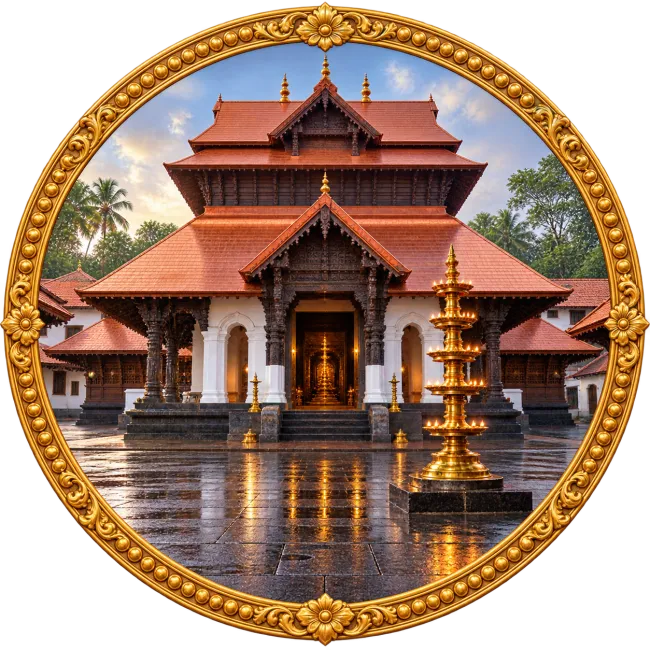
Ettumanoor Mahadeva Temple
Ettumanoor Mahadeva Temple in Kerala is one of the state’s most ancient and revered temples dedicated to Lord Shiva. Located in Ettumanoor in Kottayam district, the temple is famous for its powerful deity, traditional Kerala architecture, Pradosha Nritham mural and the magnificent Ezhara Ponnana—seven-and-a-half golden elephant figures.
Lord Shiva is worshipped here as Ettumanoorappan in a fierce yet compassionate form. Devotees visit the temple for health, protection, family welfare, prosperity and relief from obstacles. The temple also forms an important Shiva pilgrimage circuit with Vaikom Mahadeva Temple and Kaduthuruthy Mahadeva Temple.
About Ettumanoor Mahadeva Temple
Ettumanoor Mahadeva Temple is dedicated to Lord Shiva. The main deity is worshipped in the form of a Shiva Lingam inside a circular Sreekovil.
Ettumanoorappan is traditionally visualised as Lord Shiva after defeating the demon Khara, appearing with divine power and radiant energy.
The temple is known for:
The ancient Shiva Lingam
Ezhara Ponnana
Pradosha Nritham mural
Valiya Vilakku
Circular copper-roofed Sreekovil
Traditional wooden carvings
Annual Ezhara Ponnana procession
Connection with Vaikom and Kaduthuruthy temples
The temple follows strict Kerala Tantric traditions and a detailed daily worship schedule.
When and Who Built Ettumanoor Temple?
Ettumanoor is an ancient Shiva Kshetra whose spiritual origin is connected with Puranic traditions.
The present temple structure was substantially reconstructed in 1542 CE. The renovation preserved the ancient sanctum while adding architectural features visible today.
Regional rulers, the Travancore royal family and local devotees supported the temple’s worship, festivals and maintenance.
The Travancore rulers contributed ornaments, ritual objects and the famous Ezhara Ponnana. Artists and craftsmen created the temple’s murals, wooden carvings and metalwork during different historical periods.
The temple has undergone further restoration to preserve its traditional Kerala architecture and sacred artwork.
Legend of Khara
According to mythology, a demon named Khara received three sacred Shiva Lingams and travelled south while carrying them.
During his journey, he installed the three Lingams at:
Vaikom
Ettumanoor
Kaduthuruthy
He is believed to have held one Lingam in his right hand, another in his left hand and the third around his neck or in his mouth.
The three temples became powerful centres of Shiva worship. Devotees traditionally believe that receiving darshan at Vaikom, Ettumanoor and Kaduthuruthy on the same day before Ucha Puja brings exceptional spiritual merit.
The pilgrimage is especially popular during the Malayalam month of Vrischikam.
Legend of Parashurama
Another temple tradition associates Ettumanoor with Sage Parashurama.
After reclaiming Kerala from the sea, Parashurama established several Shiva temples and centres of Vedic worship.
He is believed to have consecrated or strengthened the worship of Shiva at Ettumanoor. The legend connects the temple with Kerala’s wider network of ancient Parashurama Kshetras.
Meaning of Ettumanoor
The name Ettumanoor has different traditional interpretations.
One explanation connects it with “Manoor,” meaning the land or place of deer, and “Ettu,” referring to a particular boundary or location.
Another tradition interprets the name through ancient local geography and the sacred settlement surrounding the Shiva shrine.
Whatever its linguistic origin, Ettumanoor has become inseparable from the worship of Lord Mahadeva, who is lovingly called Ettumanoorappan.
Religious Significance
Ettumanoorappan is worshipped for courage, health and divine protection.
Devotees visit the temple to pray for:
Good health and recovery from illness
Protection from danger
Relief from fear and anxiety
Family peace and prosperity
Marriage and marital harmony
Blessings for children
Professional success
Relief from repeated obstacles
Financial stability
Forgiveness for past actions
Spiritual wisdom
Liberation from negative influences
Mondays, Pradosham, Maha Shivaratri and the annual festival period are considered especially auspicious.
Main Deity and Other Shrines
Lord Ettumanoorappan
Lord Shiva is worshipped as Ettumanoorappan in the principal Sreekovil. Daily Abhishekam, Dhara, Archana, Naivedyam and Deepa Aradhana are performed.
Goddess Parvati
Goddess Parvati is worshipped as Shiva’s divine consort. Devotees pray to her for marriage, children and family welfare.
Lord Ganesha
Lord Ganesha is worshipped as the remover of obstacles. Devotees seek his blessings before beginning important rituals.
Other deities and sacred figures include:
Lord Sastha
Dakshinamurthy
Bhagavathy
Yakshi
Nagadevatas
Nandi
Guardian deities
Various manifestations of Shiva
Architecture of Ettumanoor Temple
Ettumanoor Mahadeva Temple is an outstanding example of Kerala temple architecture.
Circular Sreekovil
The principal sanctum has a circular form and is protected by a conical copper-plated roof.
The design is adapted to Kerala’s heavy rainfall while also reflecting traditional sacred geometry.
Gopuram
The entrance gateway follows the Kerala style, with a sloping roof, wooden structure and decorative carvings.
Chuttambalam
The covered enclosure surrounding the sanctum provides space for circumambulation, lamps and ritual activities.
Balikkalpura
The Balikkalpura contains the principal Bali stone, where offerings are ceremonially presented to guardian deities.
Wooden Carvings
The temple has fine wooden carvings depicting deities, floral patterns and scenes from Hindu mythology.
Pradosha Nritham Mural
Ettumanoor Temple is famous for its mural depicting Lord Shiva performing the Pradosha dance.
The painting is regarded as one of the finest surviving examples of traditional Kerala mural art.
Lord Shiva is shown in a powerful dancing form surrounded by divine beings, musicians and devotees.
The mural uses natural pigments and follows classical principles of Kerala painting. Visitors must not touch, photograph or use flash near protected artwork.
Ezhara Ponnana
Ezhara Ponnana means “seven-and-a-half golden elephants.” It consists of seven large elephant figures and one smaller figure.
The elephants are crafted from wood and covered with gold plates. They were offered by the Travancore royal family.
The smaller elephant is interpreted in different ways. It may represent a young elephant or symbolically complete the sacred group.
Ezhara Ponnana is displayed publicly during the annual festival. Thousands of devotees gather to witness the ceremonial Ezhunnallathu.
The figures remain securely preserved during the rest of the year.
Valiya Vilakku
Valiya Vilakku is a large ancient oil lamp located near the temple entrance.
It has remained an important part of temple worship for centuries. Devotees pour oil into the lamp and offer prayers.
The soot collected from the lamp is traditionally regarded as sacred. Devotees associate it with protection and healing blessings.
Visitors should make offerings only according to temple instructions and avoid touching hot or ritual sections of the lamp.
Ettumanoor Mahadeva Temple Timings
The regular daily schedule is:
Timings may be extended or reorganised during Ezhara Ponnana festival, Maha Shivaratri, Pradosham and other important occasions.
Morning Puja and Deepa Aradhana
The temple opens at 4:00 AM with Palliyunarthal and Nirmalya Darshan.
Morning Abhishekam is performed from 4:30 AM to 5:30 AM. The Shiva Lingam is worshipped with sacred water and other permitted offerings.
Usha Puja is conducted at 5:30 AM, followed by morning Deepa Aradhana at 6:00 AM.
Morning Seeveli takes place at 6:30 AM. The processional deity is ceremonially carried while offerings are made at the Bali stones.
The best morning darshan period is from 5:30 AM to 8:30 AM.
Dhara and Ucha Puja
Dhara is an important Shiva offering in which a continuous stream of sacred liquid is poured over the Shiva Lingam for a prescribed period.
Dhara and other special Shiva Pujas are generally performed from 8:30 AM to 10:00 AM.
Ucha Puja takes place at 11:00 AM, followed by Madhyahna Deepa Aradhana at 11:30 AM.
The morning session ends at 12:00 PM.
Evening Puja and Deepa Aradhana
The temple reopens at 5:00 PM. Evening Deepa Aradhana is performed at 6:30 PM.
The best evening darshan period is from 5:00 PM to 7:00 PM.
Athazha Puja is conducted at 7:30 PM, followed by night Deepa Aradhana at 8:00 PM.
The temple closes at 8:30 PM.
Annual Ezhara Ponnana Festival
The annual festival is celebrated during the Malayalam month of Kumbham.
The festival extends over several days and includes:
Flag hoisting
Special Abhishekam
Seeveli
Processions
Traditional music
Cultural performances
Ezhara Ponnana Ezhunnallathu
Arattu
The ceremonial display of Ezhara Ponnana is the principal attraction.
Large crowds gather to see the golden elephants and receive the blessings of Ettumanoorappan.
Maha Shivaratri
Maha Shivaratri is celebrated with fasting, Abhishekam, Rudra chanting and extended worship.
Devotees remain awake, chant Shiva’s names and offer bilva leaves.
The temple may remain open for extended hours according to the festival schedule.
Major Festivals
Other important observances include:
Pradosham
Thiruvathira
Mandala season
Kartika Deepam
Vishu
Navaratri
Ganesh Chaturthi
Ramayana month
Monthly Shivaratri
Special Puja arrangements may be introduced on major festival days.
Sevas and Offerings
Important temple Sevas include:
Dhara
Abhishekam
Rudrabhishekam
Mrityunjaya Homam
Ganapati Homam
Uma Maheshwara Puja
Sahasranama Archana
Koovala Mala offering
Chuttuvilakku
Valiya Vilakku oil offering
Annadanam donation
Festival sponsorship
Bilva leaves, flowers, ghee, oil, coconuts and sacred lamps are common offerings.
Seva tickets should be purchased only from authorised counters.
Prasadam
Common prasadam includes:
Sacred ash
Sandalwood paste
Flowers
Appam
Payasam
Blessed oil or ritual items
Prasadam should be collected from authorised counters. Devotees should follow the instructions given for sacred ash or lamp-related offerings.
Dress Code and Entry Rules
Ettumanoor Temple follows traditional Kerala dress customs.
Men should wear a mundu or dhoti. Shirts, T-shirts and upper garments must be removed before entering designated inner areas.
Women may wear:
Saree
Set mundu
Salwar kameez or churidar
Long traditional skirt with blouse
Visitors should follow the currently displayed dress instructions.
Only Hindus are permitted inside the main temple complex under the established entry traditions.
Footwear, mobile phones, cameras and large bags may be restricted. Photography is prohibited near the sanctum and murals.
Entry Fee and Visit Duration
General darshan is available without an entry fee. Separate charges apply to Dhara, Abhishekam, Homam and other Sevas.
A regular visit requires 1½ to 2 hours. Visitors exploring the murals, Valiya Vilakku and subsidiary shrines should keep additional time available.
Waiting times are longer on Mondays, Pradosham, Maha Shivaratri and the annual festival days.
Vaikom–Ettumanoor–Kaduthuruthy Pilgrimage
Devotees traditionally visit three major Shiva temples on the same morning:
Vaikom Mahadeva Temple
Ettumanoor Mahadeva Temple
Kaduthuruthy Mahadeva Temple
The pilgrimage should be completed before Ucha Puja according to local belief.
Those attempting the circuit should begin before sunrise, arrange reliable transport and check the opening schedule of all three temples.
Best Time to Visit
October to February is the most comfortable period for visiting Ettumanoor.
For peaceful darshan, visit between 5:30 AM and 8:00 AM on a weekday. Evening darshan from 5:00 PM to 7:00 PM allows visitors to attend Deepa Aradhana.
The annual Ezhara Ponnana festival offers a grand spiritual experience but attracts very large crowds.
How to Reach Ettumanoor Temple
By Air
Cochin International Airport is the nearest major airport. Taxis and buses are available from the airport to Ettumanoor.
By Train
Ettumanoor Railway Station is the nearest station. Kottayam Railway Station is the closest major railhead with wider connectivity.
Auto-rickshaws, buses and taxis are available from both stations.
By Road
Ettumanoor is well connected with Kottayam, Kochi, Vaikom, Pala and Thiruvananthapuram.
Government and private buses operate regularly. The temple is situated close to the main town area.
Nearby Places to Visit
Visitors may also explore:
Vaikom Mahadeva Temple
Kaduthuruthy Mahadeva Temple
Kumaranalloor Devi Temple
Thirunakkara Mahadeva Temple
Adityapuram Sun Temple
Kottayam
Kumarakom Bird Sanctuary
Vembanad Lake
Chottanikkara Bhagavathy Temple
Vagamon
Aruvikkuzhi Waterfalls
Visitor Guidelines
Confirm the dress requirements before joining the queue. Use changing rooms where available.
Deposit footwear, phones and cameras only at authorised counters. Preserve the token carefully.
Do not touch the Pradosha Nritham mural, ancient woodwork or ritual objects.
Purchase Dhara, Abhishekam and Homam tickets only from the official counter.
During the Ezhara Ponnana festival, follow crowd-control routes and do not attempt to touch the golden elephant figures.
Conclusion
Ettumanoor Mahadeva Temple is one of Kerala’s most important Shiva temples. Its ancient legends, 1542 reconstruction, Pradosha Nritham mural, Valiya Vilakku and Ezhara Ponnana give it an exceptional religious and cultural identity.
The temple’s connection with Vaikom and Kaduthuruthy also makes it part of a powerful Shiva pilgrimage circuit. A visit to Ettumanoor offers devotees an opportunity to seek health, protection, peace and the compassionate blessings of Lord Mahadeva.