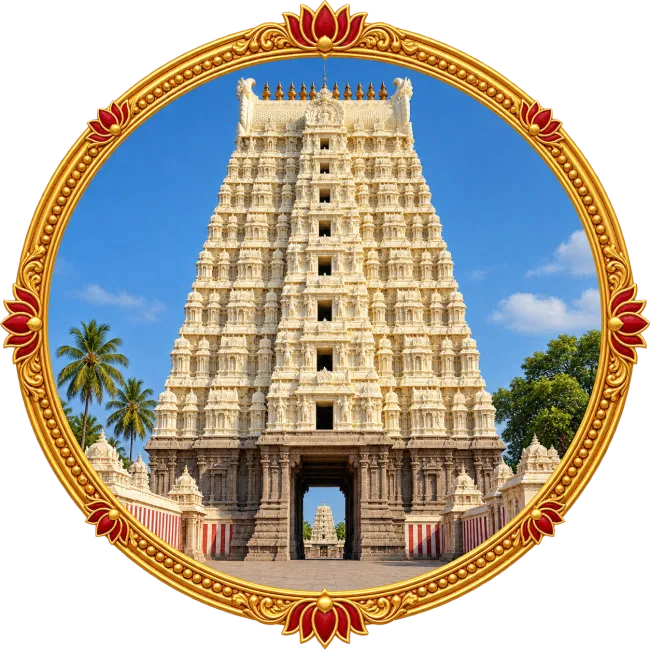
Ekambareswarar Temple, Kanchipuram
Visit Ekambareswarar Temple in Kanchipuram, one of South India’s most sacred Shiva temples and the Prithvi Sthalam representing the element of earth. The temple is famous for its sand Shiva Lingam, ancient mango tree, magnificent Rajagopuram and the legend of Goddess Parvati worshipping Lord Shiva beneath the tree.
The temple’s history extends back to the Pallava period, while the Cholas, Vijayanagara rulers and later dynasties expanded its present complex. Its towering entrance, spacious Prakarams and traditional Shaiva rituals make it one of Kanchipuram’s most important pilgrimage destinations.
About Ekambareswarar Temple
Ekambareswarar Temple is located in Kanchipuram, Tamil Nadu. The presiding deity is Lord Shiva, worshipped as Ekambareswarar, while Goddess Parvati is associated with the temple as Elavarkuzhali Amman.
The temple is one of the five Pancha Bhoota Sthalams, where Shiva represents the five natural elements:
- Earth – Ekambareswarar Temple, Kanchipuram
- Water – Jambukeswarar Temple, Thiruvanaikaval
- Fire – Arunachaleswarar Temple, Tiruvannamalai
- Air – Srikalahasteeswara Temple, Srikalahasti
- Space – Nataraja Temple, Chidambaram
At Kanchipuram, the Shiva Lingam represents Prithvi or earth. It is traditionally believed to have been created by Goddess Parvati using sand.
History of Ekambareswarar Temple
The religious history of Ekambareswarar Temple extends back for more than 1,300 years. The earliest structural development is associated with the Pallava rulers, who made Kanchipuram an important centre of religion, art and learning.
The temple was later expanded by the Imperial Cholas. Chola rulers contributed stone structures, inscriptions, land grants and arrangements for daily worship.
Further development took place under:
- Pandya rulers
- Vijayanagara kings
- Nayaka chiefs
- Local religious communities
The magnificent southern Rajagopuram was constructed during the reign of Vijayanagara emperor Krishnadevaraya in 1509. Rising approximately 59 metres, it is one of the tallest temple towers in South India.
The Vijayanagara rulers also contributed pillared halls, corridors and festival facilities.
Ekambareswarar Temple is praised in the Tevaram hymns of the Shaiva saints, making it a Paadal Petra Sthalam.
Mythology of Goddess Parvati and the Sand Lingam
According to temple mythology, Goddess Parvati once playfully covered Lord Shiva’s eyes with her hands.
Because Shiva’s eyes represent the sun and moon, the universe was temporarily covered in darkness. Lord Shiva instructed Parvati to descend to earth and perform penance.
Goddess Parvati arrived in Kanchipuram and sat beneath a mango tree. She created a Shiva Lingam from sand taken from the banks of the Kampa River and began worshipping it.
To test her devotion, Lord Shiva caused the river to flood. Parvati feared that the water would dissolve the sand Lingam, so she embraced it tightly.
Pleased by her devotion, Shiva appeared before her and accepted her as his consort. The marks of Parvati’s embrace are traditionally believed to remain upon the sacred Lingam.
Because the Lingam is made of earth, the temple became the Prithvi Sthalam among the Pancha Bhoota temples.
Meaning of the Name Ekambareswarar
The name Ekambareswarar is connected with the sacred mango tree:
- Eka means one.
- Amra means mango tree.
- Ishwara means Lord Shiva.
Ekambareswarar therefore means “Lord of the Single Mango Tree.”
The temple’s ancient mango tree is regarded as the place where Goddess Parvati performed her penance and worshipped the sand Lingam.
Sacred Mango Tree
The temple contains an ancient mango tree known as the Sthala Vriksha. It is traditionally believed to be thousands of years old.
The tree is associated with four branches that once produced mangoes of four different tastes. These branches symbolized the four Vedas:
- Rigveda
- Yajurveda
- Samaveda
- Atharvaveda
Devotees pray near the tree for:
- Marriage
- Children
- Family unity
- Fertility
- Health
- Fulfilment of wishes
The tree is carefully protected, and visitors should not touch, damage or remove any part of it.
Religious Significance of Ekambareswarar Temple
Ekambareswarar Temple represents stability, patience, fertility and connection with the earth.
Devotees visit the temple for:
- Blessings for marriage
- Removal of delays in marriage
- Birth and well-being of children
- Family peace and prosperity
- Stability in employment and business
- Recovery from illness
- Relief from land and property disputes
- Removal of obstacles
- Mental peace
- Spiritual growth
- Devotion to Lord Shiva
- Fulfilment of sincere wishes
Couples commonly pray to Lord Ekambareswarar and Goddess Parvati for a stable and harmonious marriage.
Main Deity and Prithvi Lingam
The principal deity is Lord Ekambareswarar, worshipped in the form of the Prithvi Lingam.
The Lingam is believed to have been made from sand by Goddess Parvati. Because water could damage the earthen form, direct water Abhishekam is not performed upon it in the usual manner.
The Lingam is protected with a special covering, and rituals are conducted according to established Agamic traditions. Abhishekam may be performed to the Avudaiyar, processional deities or other designated sacred forms.
Devotees receive darshan from outside the inner sanctum.
Goddess Elavarkuzhali Amman
Goddess Parvati is associated with the temple as Elavarkuzhali Amman, whose name refers to the goddess with beautiful hair.
However, Kanchipuram’s principal independent Shakti shrine is Kamakshi Amman Temple. Goddess Kamakshi is regarded as the central divine consort of Shiva temples throughout Kanchipuram.
The annual divine wedding festival symbolically unites Lord Ekambareswarar with Goddess Kamakshi.
Architecture of Ekambareswarar Temple
Ekambareswarar Temple is one of Kanchipuram’s largest temple complexes, covering approximately 25 acres.
Important architectural features include:
- Fifty-nine-metre Rajagopuram
- Multiple Prakarams
- Large stone Mandapams
- Thousand-Pillared Hall
- Sacred mango tree
- Sivaganga temple tank
- Long pillared corridors
- Ancient inscriptions
- Stone sculptures
- Shrines containing numerous Shiva Lingams
- Festival chariots and Vahana spaces
- Traditional temple kitchen
The tall Rajagopuram dominates the skyline of northern Kanchipuram.
Thousand-Pillared Hall
The temple’s Thousand-Pillared Hall reflects the architectural skill of the Vijayanagara period.
The hall contains rows of carved stone pillars and was traditionally used for:
- Religious ceremonies
- Festival gatherings
- Music and dance
- Processional arrangements
- Spiritual discourses
Visitors should avoid touching or damaging the carvings.
Sivaganga Temple Tank
The sacred temple tank is known as Sivaganga Tirtham. Water from the tank is used during selected rituals and festivals.
Devotees should enter the water only when temple authorities permit ritual bathing.
Ekambareswarar Temple Timings
Festival timings may differ during Maha Shivaratri, Panguni Uthiram and Brahmotsavam.
Morning Puja and Deepa Aradhana
The temple opens at 6:00 AM with Ushathkala Puja and Deepa Aradhana.
Lord Ekambareswarar is worshipped with:
- Bilva leaves
- Flowers
- Sandalwood paste
- Vibhuti
- Incense
- Ghee lamps
- Fruits
- Naivedyam
- Vedic chanting
Kalasanthi Puja is performed at 8:00 AM. The period between 6:30 AM and 8:00 AM is suitable for peaceful darshan.
Special Archana and Sevas
Special Archana and Sevas are generally conducted between 8:30 AM and 10:30 AM.
Devotees may arrange:
- Bilva Archana
- Rudra chanting
- Sahasranama Archana
- Somavara Puja
- Vastra Seva
- Ghee-lamp offering
- Marriage prayers
- Annadanam
Because the main Lingam is made of sand, Abhishekam is performed only according to the temple’s prescribed methods.
Uchikala Puja
Uchikala Puja is performed at 11:00 AM. Flowers, incense, lamps and Naivedyam are presented to the deity.
The morning session closes at 12:30 PM. Devotees should enter before 11:45 AM to complete darshan comfortably.
Evening Puja and Deepa Aradhana
The temple reopens at 4:00 PM.
Sayaraksha Puja and Deepa Aradhana are performed at 5:00 PM. Irandam Kala Puja takes place at 7:00 PM.
Ardha Jama Puja, the final worship of the day, is performed at 8:00 PM. The temple closes at 8:30 PM.
Panguni Uthiram Festival
Panguni Uthiram is the temple’s most important festival. It celebrates the divine marriage of Lord Ekambareswarar and Goddess Kamakshi.
The festival includes:
- Special Abhishekam
- Divine wedding ceremony
- Decorated processional deities
- Vahana processions
- Temple chariot
- Vedic chanting
- Music and devotional programmes
- Distribution of Prasadam
Couples and unmarried devotees attend the wedding ceremony to pray for marital happiness.
Other Major Festivals
Maha Shivaratri
Special Abhishekam and Puja are conducted throughout the night in four Kala periods.
Karthigai Deepam
The temple is illuminated with oil lamps during Karthigai Deepam.
Pradosham
Pradosha Puja is performed twice every lunar month. Nandi and Lord Shiva receive special worship.
Aippasi Festival
Special Shiva worship and processions are conducted during the Tamil month of Aippasi.
Thai Poosam
Festival rituals and processions are organized during Thai Poosam.
Tamil New Year
Special Alankaram and Puja are performed at the beginning of the Tamil year.
Mondays
Monday is considered especially auspicious for Lord Shiva. Shravan and Karthigai Mondays attract additional devotees.
Sevas and Offerings
Devotees may offer:
- Bilva leaves
- Flower garlands
- Vibhuti
- Sandalwood
- Fruits
- Coconut
- Ghee lamps
- White garments
- Rudraksha
- Silver Bilva leaves
- Annadanam sponsorship
- Festival Ubhayam
Important Sevas may include Bilva Archana, Sahasranama Archana, Rudra Parayanam and special marriage prayers.
All bookings should be made through official temple counters.
Prasadam
Temple Prasadam may include:
- Vibhuti
- Kumkum
- Puliyodarai
- Sakkarai Pongal
- Curd rice
- Sundal
- Fruits
- Panchamritam
Prasadam availability depends on the day and temple schedule.
Dress Code and Entry Rules
Visitors should wear clean and modest clothing.
Recommended clothing includes:
- Dhoti, Veshti or full-length trousers for men
- Saree, half-saree, Salwar Kameez or modest attire for women
- Traditional clothing for children
Shorts, sleeveless outfits and revealing clothing should be avoided.
Photography may be restricted near the sanctum. Mobile phones should remain silent.
Visitors must not touch the sand Lingam, ancient sculptures or sacred mango tree.
Entry Fee and Visit Duration
General darshan is free. Paid Archana, Seva and special-darshan tickets may be available.
A regular visit requires two to three hours. Visitors wishing to explore the Mandapams, Prakarams, tank and mango tree should keep three hours.
Festival darshan may require additional time.
Visitor Guidelines
- Remove footwear at the designated stand.
- Wear traditional and modest clothing.
- Check the Puja schedule before joining the queue.
- Do not pour water or milk directly on the sand Lingam.
- Do not touch the sacred mango tree.
- Follow photography restrictions.
- Keep mobile phones silent.
- Use official counters for Sevas and donations.
- Do not purchase access from unauthorized agents.
- Maintain silence near the sanctum.
- Keep the temple and tank clean.
- Carry drinking water during hot weather.
- Keep children and elderly devotees under supervision.
- Follow instructions from priests and security personnel.
Best Time to Visit
November to February is the best period for visiting Kanchipuram because the weather remains pleasant.
For peaceful darshan, visit between 6:30 AM and 8:00 AM.
Evening visitors should arrive between 4:30 PM and 5:00 PM to attend Sayaraksha Puja.
Panguni Uthiram offers the grandest devotional experience but attracts large crowds.
How to Reach Ekambareswarar Temple
By Air
Chennai International Airport is the nearest major airport, located approximately 75 kilometres from Kanchipuram.
By Train
Kanchipuram Railway Station is located a short distance from the temple. Train services connect Kanchipuram with Chennai, Chengalpattu, Arakkonam and other towns.
By Bus
Regular government and private buses connect Kanchipuram with Chennai, Vellore, Tirupati, Bengaluru and nearby cities.
By Road
Taxis, auto-rickshaws and private vehicles are available throughout Kanchipuram. Parking may be limited near the temple during festivals.
Nearby Places to Visit
- Kamakshi Amman Temple
- Kailasanathar Temple
- Varadaraja Perumal Temple
- Ulagalanda Perumal Temple
- Kumarakottam Murugan Temple
- Kanchi Kamakoti Peetham
- Vaikunta Perumal Temple
- Kachapeshwarar Temple
- Chitragupta Temple
- Kanchipuram Silk Markets
- Pandava Thoothar Perumal Temple
- Vilakkoli Perumal Temple
Conclusion
Ekambareswarar Temple is one of India’s most sacred Shiva temples and the Prithvi Sthalam among the Pancha Bhoota temples. Its sand Lingam, ancient mango tree and legend of Goddess Parvati’s penance give it a distinctive spiritual identity.
The temple’s Pallava and Chola heritage, Krishnadevaraya’s towering Rajagopuram and grand Panguni wedding festival preserve centuries of South Indian devotion and architecture.
Worshipping Lord Ekambareswarar is believed to provide stability, family prosperity and marital happiness. A visit to the temple offers devotees a profound experience of Lord Shiva as the eternal earth element.