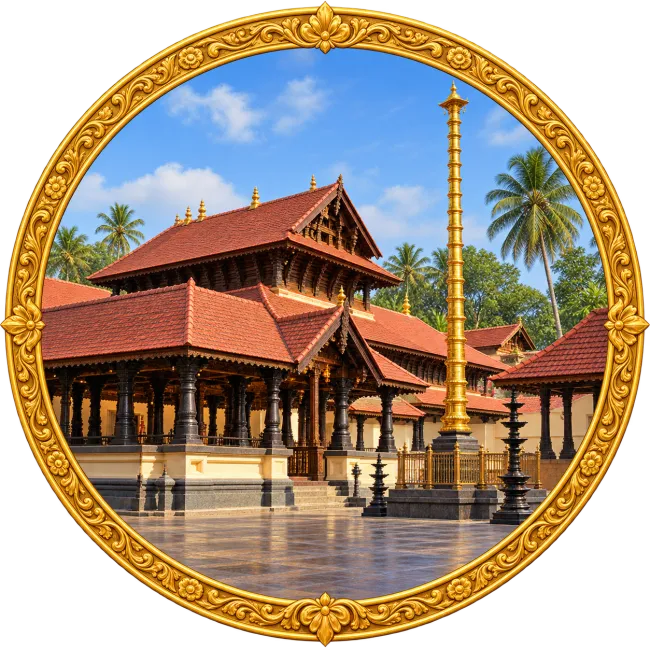
Chottanikkara Bhagavathy Temple, Kochi
Chottanikkara Bhagavathy Temple near Kochi is one of Kerala’s most revered temples dedicated to the Divine Mother. The presiding Goddess is worshipped as Rajarajeshwari and is believed to manifest as Saraswati in the morning, Lakshmi at noon and Durga in the evening.
The temple complex contains two important sacred areas: Melkavu, the principal shrine of Rajarajeshwari, and Keezhkavu, dedicated to Bhadrakali. The powerful Guruthi Puja performed at Keezhkavu is one of the temple’s most distinctive rituals.
About Chottanikkara Bhagavathy Temple
Chottanikkara Bhagavathy Temple is located in Chottanikkara in Ernakulam district, within the greater Kochi region.
The principal deity is Goddess Rajarajeshwari, worshipped together with Lord Vishnu on the same sacred pedestal. This combined presence is expressed through the famous devotional chant:
Amme Narayana, Devi Narayana, Lakshmi Narayana, Bhadre Narayana.
The Goddess is worshipped in three principal forms during different periods of the day:
Saraswati in the morning
Lakshmi at noon
Durga in the evening
The temple is especially visited by devotees seeking education, prosperity, family welfare, courage and relief from emotional or spiritual difficulties.
Traditional belief associates the temple with relief from disturbing influences and mental distress. Such spiritual practices should complement—not replace—professional medical or psychological treatment when needed.
When and Who Built Chottanikkara Temple?
Chottanikkara is an ancient Kavu and centre of Goddess worship whose origin is preserved mainly through temple legends.
The original sacred site developed around a naturally manifested laterite stone worshipped as the Divine Mother. A separate stone representing Lord Vishnu is installed on the same pedestal.
The shrine was expanded over different historical periods under local rulers, temple patrons and devotees of Kerala’s Shakti tradition.
The Cochin royal family and regional administrators supported the temple’s worship, festivals, property and renovation. Wooden halls, tiled roofs, enclosures, gateways and festival facilities were added gradually.
The present temple therefore developed over centuries rather than being constructed by a single ruler in one period.
Legend of Kannappan
According to a temple legend, a tribal hunter named Kannappan lived in the forested region of Chottanikkara. He regularly offered animal sacrifices to a fierce Goddess.
Kannappan had a young daughter whom he loved deeply. One day, he brought home a calf that he intended to sacrifice, but his daughter became attached to the animal and requested him to spare it.
The child later died, leaving Kannappan devastated. A holy person explained that the suffering of animals caused by his sacrifices had returned to him through karma.
Kannappan repented and abandoned animal sacrifice. The calf was then revealed as a divine manifestation connected with the Goddess.
The sacred location later became a centre of compassionate Goddess worship. The legend teaches repentance, nonviolence and the transformative power of devotion.
Legend of Vilwamangalam Swamiyar
Vilwamangalam Swamiyar, a revered saint in Kerala tradition, is closely associated with Chottanikkara.
According to the legend, he perceived the divine presence of Goddess Bhadrakali at Keezhkavu. He consecrated or revealed her presence at the lower shrine, establishing the worship that continues today.
The Goddess at Melkavu represents the benevolent form of Rajarajeshwari, while Keezhkavu Bhadrakali displays her fierce protective energy.
The two shrines together represent the compassionate and powerful aspects of the Divine Mother.
Main Goddess as Saraswati, Lakshmi and Durga
Chottanikkara Bhagavathy is worshipped in three forms during the day.
Saraswati in the Morning
In the morning, the Goddess is associated with Saraswati and is dressed in white. Students, musicians and artists pray for knowledge, memory and creative ability.
Lakshmi at Noon
At midday, she is worshipped as Lakshmi and is traditionally associated with red attire. Devotees seek prosperity, family welfare and material stability.
Durga in the Evening
In the evening, the Goddess is worshipped as Durga and is associated with blue or dark attire. Devotees pray for courage, protection and victory over difficulties.
These three forms unite knowledge, prosperity and strength within one divine presence.
Religious Significance
Chottanikkara Temple is one of Kerala’s most important centres of Shakti worship.
Devotees visit the temple to pray for:
Knowledge and educational success
Good memory and clear speech
Financial prosperity
Family peace
Marriage and marital harmony
Blessings for children
Courage and protection
Relief from fear and anxiety
Emotional stability
Recovery from difficult experiences
Spiritual discipline
Freedom from negative influences
Tuesdays, Fridays, full-moon days and Makom Nakshatra are considered especially auspicious.
Main Deity and Other Shrines
Goddess Rajarajeshwari
The principal deity is a naturally formed laterite stone worshipped as Rajarajeshwari. The Goddess does not appear in a conventional carved human form.
A golden Kavacham and elaborate decorations are used during worship, giving devotees a visible form for darshan.
Lord Vishnu
Lord Vishnu is worshipped on the same pedestal as the Goddess. This explains the repeated use of “Narayana” in the temple’s principal chant.
Keezhkavu Bhadrakali
The lower shrine is dedicated to Bhadrakali. Guruthi Puja is performed here every night.
Other deities and sacred figures include:
Lord Shiva
Lord Ganesha
Lord Subramanya
Dharma Shasta
Brahmarakshas
Nagadevatas
Guardian deities
Yakshi-related sacred traditions
Melkavu and Keezhkavu
Melkavu
Melkavu is the upper and principal temple complex. Goddess Rajarajeshwari is worshipped here with Lord Vishnu.
Most daily Pujas, Alankarams and public darshan take place at Melkavu.
Keezhkavu
Keezhkavu is the lower sacred grove dedicated to Bhadrakali. The shrine is associated with fierce protective worship.
The nightly Guruthi Puja is performed here after the main temple’s evening ceremonies.
Devotees generally receive darshan at Melkavu before attending Guruthi Puja at Keezhkavu.
Architecture of Chottanikkara Temple
The temple follows the traditional Kerala architectural style, designed for the region’s tropical climate and heavy rainfall.
Sreekovil
The Sreekovil houses Goddess Rajarajeshwari and Lord Vishnu. Its compact design, traditional lamps and gold decorations create a deeply sacred atmosphere.
Chuttambalam
The covered enclosure surrounding the sanctum provides space for circumambulation, lamps and daily rituals.
Sloping Roofs
Wooden structures and sloping tiled roofs protect the inner temple from heavy rain. Copper-plated elements add beauty and durability.
Deepastambham
Traditional lamp towers illuminate the courtyard during evening worship and festivals.
Sacred Trees and Grove
The temple’s Kavu tradition is reflected in the trees and protected natural spaces surrounding the shrines.
Chottanikkara Bhagavathy Temple Timings
The regular daily schedule is:
Timings may be extended or reorganised during Makom Thozhal, Navaratri, Mandala season and other important festivals.
Morning Puja and Deepa Aradhana
The temple opens at 4:00 AM with Nirmalya Darshan. Devotees see the Goddess with the floral decorations from the previous night.
Morning Abhishekam begins at 4:20 AM. Usha Puja is performed at 5:30 AM, followed by Deepa Aradhana at 6:00 AM.
Morning Seeveli is conducted at 6:30 AM. The processional deity is ceremonially carried while offerings are presented at designated points.
Pantheeradi Puja takes place at 8:00 AM. The best morning darshan period is from 5:30 AM to 9:00 AM.
During this period, the Goddess is principally worshipped as Saraswati.
Ucha Puja
Ucha Puja is performed at 11:00 AM. The Goddess is worshipped in her Lakshmi form, representing prosperity and abundance.
Madhyahna Deepa Aradhana takes place at 11:30 AM. The morning session ends at 12:00 PM.
Devotees seeking blessings for prosperity, employment or family welfare often prefer the midday worship.
Evening Puja and Deepa Aradhana
The temple reopens at 4:00 PM. During the evening, the Goddess is worshipped as Durga.
Evening Deepa Aradhana is performed at 6:30 PM. The best evening darshan period is from 4:30 PM to 6:30 PM.
Athazha Puja is conducted at 7:30 PM, followed by evening Seeveli at 8:00 PM.
Guruthi Puja at Keezhkavu takes place at 8:45 PM and concludes the day’s principal ceremonies.
Guruthi Puja
Guruthi Puja is the most distinctive nightly ritual at Chottanikkara. It is performed at the Keezhkavu Bhadrakali shrine.
A red-coloured liquid prepared from ritual ingredients is ceremonially offered to Bhadrakali. It represents the symbolic offering of negative energies, fear and destructive influences to the Goddess.
Devotees attend the ritual to pray for:
Protection from negative influences
Emotional strength
Relief from fear
Peace of mind
Courage during difficult periods
Spiritual purification
The ceremony can be intense and crowded. Visitors should remain calm, follow priestly instructions and avoid obstructing the ritual area.
Spiritual worship should not be used as a substitute for medical treatment. Those experiencing mental or emotional distress should also seek support from qualified healthcare professionals.
Makom Thozhal
Makom Thozhal is one of the most important annual events at Chottanikkara Temple. It is observed during the Malayalam month of Kumbham on the day of Makom Nakshatra.
According to tradition, Vilwamangalam Swamiyar received the divine vision of the Goddess in her complete splendour on this day.
Women attend Makom Thozhal to pray for:
A suitable marriage
Marital happiness
Family prosperity
Blessings for children
Protection and welfare
The Goddess appears in an exceptionally elaborate Alankaram. Very large crowds gather, and special queue arrangements are introduced.
Major Festivals
Kumbham Festival
The annual festival during the Malayalam month of Kumbham includes processions, special Puja, cultural programmes and Makom Thozhal.
Navaratri
The Goddess is worshipped as Durga, Lakshmi and Saraswati during the nine nights.
Books, musical instruments and educational materials are placed before the Goddess during Saraswati Puja.
Vijayadashami
Vidyarambham is performed for children beginning education.
Mandala Mahotsavam
Special worship is conducted during the Mandala season. Ayyappa pilgrims also visit the temple.
Thrikkarthika
The temple is decorated with lamps, and special Deepa Aradhana is offered to the Goddess.
Other observances include Vishu, full-moon worship and festival days associated with Bhadrakali.
Vidyarambham
Vidyarambham marks a child’s formal introduction to education. The ceremony is especially popular on Vijayadashami.
The child writes sacred letters in rice under the guidance of a priest, teacher or parent.
Families should register at the authorised counter, arrive before the reporting time and carry the required materials.
Traditional clothing is recommended for the child and accompanying family members.
Sevas and Offerings
Important temple Sevas include:
Guruthi Puja
Sathru Samhara Pushpanjali
Bhagyasooktham Pushpanjali
Aikyamathyam Pushpanjali
Saraswati Pushpanjali
Lakshmi Narayana Puja
Mrityunjaya Homam
Ganapati Homam
Palpayasam
Rakta Pushpanjali
Vidyarambham
Annadanam donation
Deepa Seva
Offerings should be booked only through authorised temple counters.
Prasadam
Common prasadam includes:
Palpayasam
Appam
Sacred kumkum
Turmeric
Flowers
Sandalwood paste
Blessed ritual items
Prasadam should be collected from authorised counters. Devotees should check the specified collection time for pre-booked offerings.
Dress Code and Entry Rules
Visitors should wear clean and modest clothing. Traditional Kerala attire is recommended.
Men may wear a mundu or dhoti. Shirts and upper garments may need to be removed before entering designated inner areas.
Women may wear a saree, set mundu, salwar kameez or another modest traditional outfit.
Footwear must be removed before entering. Mobile phones, cameras and large bags may be restricted near the sanctum.
Photography and videography are prohibited inside designated worship areas.
Alcohol, tobacco, leather articles and non-vegetarian food must not be carried inside.
Entry Fee and Visit Duration
General darshan is available without an entry fee. Separate charges apply to Guruthi, Pushpanjali, Homam and other Sevas.
A regular visit requires 1½ to 2 hours. Devotees attending evening Deepa Aradhana and Guruthi Puja should keep 3 to 4 hours available.
Waiting times are longer on Tuesdays, Fridays, Makom Nakshatra and festival days.
Best Time to Visit
October to February is the most comfortable period for visiting Chottanikkara.
For peaceful darshan, visit between 5:30 AM and 8:00 AM on a weekday. Evening visitors should arrive by 5:00 PM if they wish to attend Deepa Aradhana and remain for Guruthi Puja.
Makom Thozhal provides a grand spiritual experience but attracts exceptionally large crowds.
How to Reach Chottanikkara Temple
By Air
Cochin International Airport is the nearest airport. Taxis and buses are available from the airport to Chottanikkara.
By Train
Tripunithura Railway Station is one of the nearest stations. Ernakulam Junction and Ernakulam Town are the nearest major railway stations.
Buses, taxis and auto-rickshaws are available from Kochi and Tripunithura.
By Road
Chottanikkara is well connected with Kochi, Ernakulam, Tripunithura and nearby towns.
Government and private buses operate regularly. Taxis and app-based cabs are also available.
Nearby Places to Visit
Visitors may also explore:
Poornathrayeesa Temple, Tripunithura
Hill Palace Museum
Kaduthuruthy Mahadeva Temple
Ernakulathappan Temple
Sree Poornathrayeesa Temple
Vaikom Mahadeva Temple
Ettumanoor Mahadeva Temple
Mattancherry Palace
Paradesi Synagogue
Fort Kochi
Marine Drive, Kochi
Kerala Folklore Museum
Visitor Guidelines
Visit Melkavu before attending Guruthi Puja at Keezhkavu. Follow the queue and ritual order displayed at the temple.
Arrive early on Tuesdays, Fridays and Makom festival days. Purchase Seva tickets only from authorised counters.
Remain calm during Guruthi Puja and avoid touching ritual materials or crossing barriers.
Those seeking relief from psychological or emotional difficulties should combine spiritual support with qualified medical care.
Deposit footwear, mobile phones and large bags only at designated counters. Keep the token safely until collection.
Conclusion
Chottanikkara Bhagavathy Temple is one of Kerala’s most powerful centres of Goddess worship. Rajarajeshwari’s manifestations as Saraswati, Lakshmi and Durga represent knowledge, prosperity and protection.
The combined presence of the Goddess and Lord Vishnu, the fierce Bhadrakali shrine at Keezhkavu and the nightly Guruthi Puja give the temple a distinctive spiritual identity.
A visit to Chottanikkara offers devotees an opportunity to seek wisdom, family welfare, courage and the compassionate blessings of the Divine Mother.