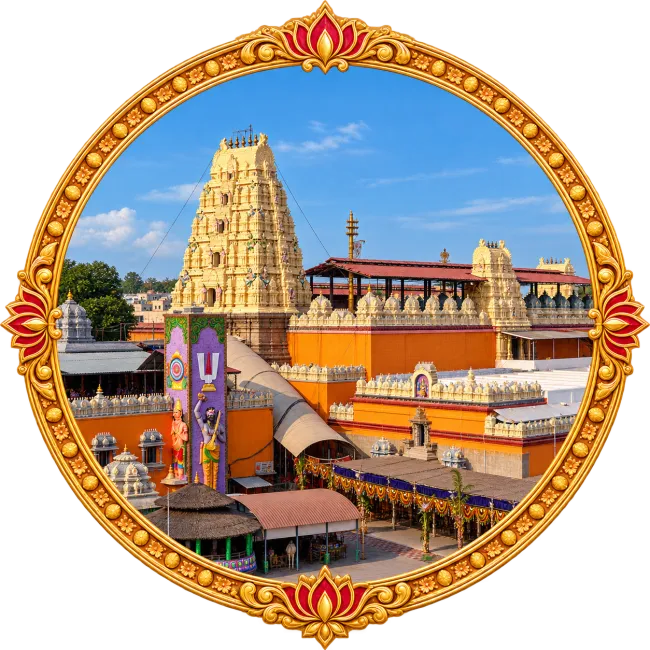
Bhadrachalam Sita Ramachandraswamy Temple
Bhadrachalam Sita Ramachandraswamy Temple in Telangana is one of India’s most revered temples dedicated to Lord Rama. Located on the banks of the Godavari River, the temple is popularly known as Dakshina Ayodhya—the Ayodhya of South India.
The principal deities are Lord Rama, Goddess Sita and Lord Lakshmana. The temple’s history is closely associated with the devotee-composer Bhakta Ramadasu, who constructed the shrine during the seventeenth century. Its grand Sri Rama Navami Kalyanotsavam attracts devotees from across India.
About Bhadrachalam Temple
Sri Sita Ramachandraswamy Temple is situated in Bhadrachalam in Bhadradri Kothagudem district, Telangana.
The temple stands on Bhadrachala Hill beside the Godavari River. The name Bhadrachalam means the hill of Bhadra, a sage who performed intense penance to receive Lord Rama’s darshan.
Lord Rama is worshipped here with Goddess Sita seated beside him and Lakshmana standing nearby. The form of Rama at Bhadrachalam combines the qualities of Lord Rama and Lord Vishnu.
The temple is known for:
Self-manifested deities
Association with Bhakta Ramadasu
Sri Rama Navami Kalyanotsavam
Nitya Kalyanam
Sacred Godavari River
Ramayana-related places near Bhadrachalam
Traditional Telugu devotional music
When and Who Built Bhadrachalam Temple?
The present Bhadrachalam Temple was constructed during the seventeenth century by Kancharla Gopanna, popularly known as Bhakta Ramadasu.
Gopanna served as a revenue officer or Tahsildar in the region during the reign of Abul Hasan Qutb Shah, also known as Tana Shah, the ruler of the Golconda Sultanate.
After seeing the simple condition of the existing shrine, Gopanna decided to construct a grand temple for Lord Rama. He used public revenue for the project, expecting to recover the amount through donations.
When the money was not repaid to the royal treasury, Gopanna was arrested and imprisoned at Golconda Fort. He remained in prison for several years, composing devotional songs and praying to Lord Rama.
According to tradition, Rama and Lakshmana appeared before Tana Shah in human form and repaid the amount using gold coins marked with Rama’s image.
The ruler realised Gopanna’s devotion, released him and supported the temple. The shrine later received patronage from regional rulers, devotees and administrators.
Pokala Dhammakka and the Discovery of the Deities
Before Bhakta Ramadasu constructed the present temple, a devoted woman named Pokala Dhammakka worshipped Lord Rama in the Bhadrachalam region.
According to tradition, Lord Rama appeared in her dream and revealed that sacred images were hidden within an anthill on Bhadrachala Hill.
Dhammakka searched the location and discovered the self-manifested images of Rama, Sita and Lakshmana. She cleaned the area, constructed a simple shelter and began regular worship.
Her devotion preserved the shrine until Bhakta Ramadasu built the larger temple. Dhammakka is therefore honoured as one of the earliest devotees associated with Bhadrachalam.
Legend of Bhadra
Bhadra was a devoted sage traditionally described as the son of Mount Meru and Menaka.
He performed severe penance on the banks of the Godavari and prayed for Lord Rama to appear before him.
Rama was unable to grant the requested darshan during his earthly incarnation. After completing the Rama Avatar, Lord Vishnu appeared before Bhadra in a form combining the qualities of Rama and Narayana.
The Lord appeared with Sita and Lakshmana and blessed Bhadra. The sage was transformed into the sacred hill known as Bhadragiri or Bhadrachalam.
This legend explains why the principal deity displays certain features associated with Vishnu while being worshipped as Lord Rama.
Unique Form of Lord Rama
The image of Rama at Bhadrachalam differs from conventional representations of the Ramayana.
Lord Rama is shown with four arms, reflecting his identity as Lord Vishnu. He holds divine weapons and symbols, including the conch and discus, while also carrying the bow and arrow associated with Rama.
Goddess Sita is positioned close to the Lord, while Lakshmana accompanies them.
The combined image represents:
Rama as the ideal king
Vishnu as the protector of the universe
Sita as divine Shakti
Lakshmana as perfect service and devotion
Why Is Bhadrachalam Called Dakshina Ayodhya?
Ayodhya is Lord Rama’s birthplace and royal capital. Bhadrachalam is called Dakshina Ayodhya because of its powerful association with Rama’s forest journey and the devotion of Bhadra, Dhammakka and Ramadasu.
The surrounding region contains places traditionally connected with the Ramayana, including Parnasala, where Rama, Sita and Lakshmana are believed to have stayed during their exile.
Bhadrachalam therefore became the principal Rama pilgrimage centre of South India.
Religious Significance
Lord Rama represents Dharma, courage, truth and ideal conduct. Goddess Sita represents patience, purity and strength, while Lakshmana symbolises service and loyalty.
Devotees visit the temple to pray for:
Family peace and harmony
Marriage and marital happiness
Blessings for children
Good health
Success in education
Professional growth
Protection from difficulties
Relief from financial problems
Courage and moral strength
Victory over injustice
Spiritual devotion
Fulfilment of vows
Sri Rama Navami, Vaikuntha Ekadashi and important festival days attract especially large crowds.
Main Deities and Shrines
Sri Sita Ramachandraswamy
Lord Rama and Goddess Sita are worshipped together in the principal sanctum. The Lord’s four-armed form reflects his identity as Vishnu.
Lord Lakshmana
Lakshmana stands beside Rama and Sita, representing loyalty, service and brotherly devotion.
Lord Hanuman
Hanuman is worshipped as the ideal devotee of Rama. Pilgrims pray for courage, strength and protection.
Other deities and sacred figures include:
Lord Ganesha
Garuda
Sudarshana
Alwar saints
Sri Ramanujacharya
Bhakta Ramadasu
Pokala Dhammakka
Various forms of Lord Vishnu
Architecture of Bhadrachalam Temple
Bhadrachalam Temple follows the South Indian Dravidian architectural style.
Rajagopuram
The entrance tower is decorated with sculptures of Lord Rama, Sita, Lakshmana, Hanuman and other divine figures.
Main Sanctum
The sanctum houses the self-manifested deities. Traditional lamps, flowers, Tulasi garlands and ornaments create a deeply devotional atmosphere.
Mandapams
The temple contains pillared halls used for Kalyanotsavam, special Sevas, devotional singing and festival ceremonies.
Gold-Plated Structures
Selected sacred structures and decorations contain gold-plated elements offered by rulers and devotees.
Bhadrachala Hill
The temple’s hilltop position provides a connection with the legend of Sage Bhadra. Steps and road access lead towards the temple.
Bhadrachalam Temple Timings
The regular daily schedule is:
Timings may be extended or reorganised during Sri Rama Navami, Vaikuntha Ekadashi, Teppotsavam and other major festivals.
Morning Puja and Aarti
The temple opens at 4:00 AM with Suprabhata Seva. Devotional hymns are recited to awaken Lord Rama, Sita and Lakshmana.
Balabhogam and morning Alankaram are performed from 4:30 AM to 5:00 AM. Public darshan begins at 5:00 AM.
Morning Aarti and Deepa Aradhana are conducted at 5:30 AM. Archana and special Pujas continue through the morning.
The best morning darshan period is from 5:30 AM to 9:00 AM.
Nitya Kalyanotsavam
Nitya Kalyanotsavam is one of the most popular Sevas at Bhadrachalam. It celebrates the divine marriage of Lord Rama and Goddess Sita.
The ceremony is performed from 9:30 AM to 11:30 AM. It includes:
Sankalpa
Ganapati worship
Invocation of the divine couple
Exchange of sacred garlands
Mangalasutra ceremony
Vedic chanting
Aarti
Distribution of prasadam
Married couples attend for harmony and family welfare. Unmarried devotees pray for a suitable marriage.
Participants should report before the scheduled time and follow the prescribed dress code.
Madhyahna Puja
Madhyahna Rajabhogam and Aarti are performed at 12:00 PM. Food is ceremonially offered to the deities.
Darshan may pause briefly during Naivedyam. The morning session ends at 1:00 PM.
Visitors arriving near midday should join the queue before 12:15 PM.
Evening Puja and Aarti
The temple reopens at 3:00 PM. Darbar Seva is conducted at 6:00 PM.
Evening Aarti and Deepa Aradhana are performed at 6:30 PM. The best evening darshan period is from 4:30 PM to 7:00 PM.
Night Puja takes place at 8:00 PM. Pavvalimpu Seva, the final resting ritual for the deities, is performed at 8:30 PM.
The temple closes at 9:00 PM.
Sri Rama Navami Kalyanotsavam
Sri Rama Navami is the grandest annual celebration at Bhadrachalam.
The celestial wedding of Rama and Sita is conducted with elaborate Vedic rituals. Silk garments, pearls and traditional wedding materials are offered to the divine couple.
The ceremony attracts devotees, spiritual leaders and official representatives. Large screens, special queues and extensive crowd arrangements are introduced.
The following day may include ceremonial events connected with Rama’s coronation, known as Pattabhishekam.
Vaikuntha Ekadashi
Vaikuntha Ekadashi is another major festival. Devotees observe fasting, chant Vishnu Sahasranama and enter through the ceremonial Vaikuntha Dwaram.
Special Alankaram, Puja and extended darshan are arranged.
Very large crowds gather, so pilgrims should book accommodation and transport in advance.
Major Festivals
Other important celebrations include:
Teppotsavam
Vasantha Pakshotsavam
Mukkoti Ekadashi
Dasara
Deepavali
Hanuman Jayanti
Krishna Janmashtami
Ugadi
Karthika month observances
Bhakta Ramadasu Jayanti
Devotional music and Ramadasu compositions form an important part of many celebrations.
Bhakta Ramadasu and Devotional Music
Bhakta Ramadasu composed many Telugu songs while imprisoned at Golconda Fort.
His compositions express:
Love for Lord Rama
Pain of separation
Complete surrender
Questions directed to the Lord
Faith during suffering
Gratitude after divine grace
His Keertanas remain central to Carnatic and Telugu devotional music. They are sung during festivals and cultural programmes at Bhadrachalam.
Sevas and Offerings
Important temple Sevas include:
Suprabhata Seva
Abhishekam
Sahasranama Archana
Nitya Kalyanotsavam
Darbar Seva
Pavvalimpu Seva
Tulasi Archana
Vahana Puja
Special Darshan
Annadanam donation
Festival sponsorship
Tulasi leaves, flowers, coconuts, fruits, silk garments and traditional wedding materials are common offerings.
Seva tickets should be purchased only through authorised counters.
Prasadam and Annadanam
Common prasadam includes:
Laddu
Pulihora
Chakrapongali
Tulasi
Sacred sandalwood paste
Other blessed food offerings
The temple provides Annadanam according to the daily schedule. Devotees should accept the meal respectfully and avoid food wastage.
Prasadam should be collected from designated counters only.
Godavari River and Sacred Bath
The Godavari River flows beside Bhadrachalam. Pilgrims traditionally bathe or wash their hands and feet before visiting the temple.
Visitors should use designated ghats and follow safety instructions. River currents and water levels can change during the monsoon.
Children and elderly pilgrims should remain under supervision. Soap and chemical products should not be used at sacred bathing points.
Dress Code and Entry Rules
Visitors should wear clean and modest traditional clothing.
Men may wear a dhoti, kurta-pyjama or full-length trousers with a shirt. Women may wear a saree, half-saree, salwar kameez or another modest outfit.
Traditional attire may be compulsory for Nitya Kalyanotsavam and selected Sevas.
Footwear must be removed before entry. Mobile phones, cameras and large bags may be restricted near the sanctum.
Photography and videography are prohibited in designated worship areas.
Alcohol, tobacco, leather articles and non-vegetarian food must not be carried inside.
Entry Fee and Visit Duration
General darshan is available without an entry fee. Separate charges apply to special darshan, Kalyanotsavam, Archana and other Sevas.
A regular visit requires 1½ to 2 hours. Devotees attending Nitya Kalyanotsavam should keep 3 to 4 hours available.
Waiting times are longer during Sri Rama Navami, Vaikuntha Ekadashi, weekends and public holidays.
Best Time to Visit
October to February is the most comfortable period for visiting Bhadrachalam.
For peaceful darshan, visit between 5:30 AM and 8:30 AM on a weekday. Evening darshan between 4:30 PM and 7:00 PM provides an opportunity to attend Aarti.
Sri Rama Navami offers the grandest festival experience but attracts exceptionally large crowds.
How to Reach Bhadrachalam Temple
By Air
Rajahmundry Airport is a convenient airport for Bhadrachalam. Vijayawada and Hyderabad airports are other options for travellers from distant cities.
By Train
Bhadrachalam Road Railway Station at Kothagudem is the nearest railway station. It is located away from the temple town, and buses and taxis are available for the remaining journey.
By Road
Bhadrachalam is connected with Hyderabad, Khammam, Kothagudem, Vijayawada, Rajahmundry and nearby towns.
Government and private buses operate regularly. Taxis and private vehicles can reach the temple town directly.
Nearby Places to Visit
Visitors may also explore:
Parnasala
Godavari River ghats
Abhaya Anjaneya Temple
Sri Rama Giri
Dummugudem
Kinnerasani Wildlife Sanctuary
Papi Hills
Bogatha Waterfall
Kothagudem
Sabari River region
Golconda Fort in Hyderabad, associated with Ramadasu’s imprisonment
Parnasala
Parnasala is a significant Ramayana-related destination near Bhadrachalam.
According to tradition, Rama, Sita and Lakshmana stayed here during their forest exile. The area contains locations associated with Sita’s daily activities and Ravana’s attempt to abduct her.
Parnasala is situated approximately 35 kilometres from Bhadrachalam and can be reached by road.
Visitor Guidelines
Book Nitya Kalyanotsavam and accommodation in advance during weekends and festivals.
Arrive before the Seva reporting time and carry valid identification. Preserve the booking receipt until the ceremony is completed.
Take a sacred bath only at designated Godavari ghats. Follow water-safety instructions.
Purchase Puja materials and Seva tickets only from authorised counters. Avoid agents promising unauthorised entry or faster darshan.
During Sri Rama Navami, follow special traffic routes, queue systems and security instructions.
Conclusion
Bhadrachalam Sita Ramachandraswamy Temple is one of India’s most important centres of Lord Rama worship. Its association with Sage Bhadra, Pokala Dhammakka and Bhakta Ramadasu gives it an exceptional devotional history.
The unique four-armed Rama deity, sacred Godavari setting, Nitya Kalyanam and grand Sri Rama Navami celebrations make Bhadrachalam worthy of its title, Dakshina Ayodhya.
A visit offers devotees an opportunity to seek courage, family welfare, righteous guidance and the compassionate blessings of Lord Rama and Goddess Sita.