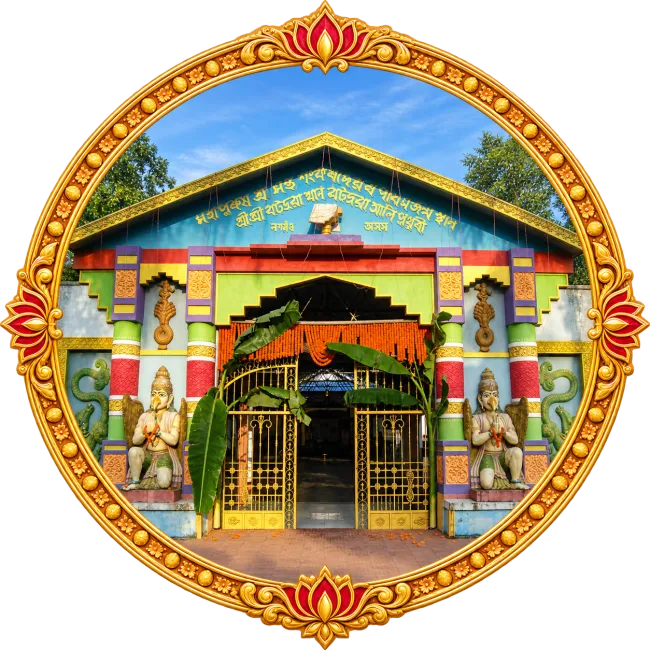
Batadrava Than, Nagaon
Batadrava Than, also known as Bordowa Than, is one of Assam’s most sacred Vaishnava institutions. Located at Bordowa in the Nagaon district, it is associated with the birthplace of Mahapurush Srimanta Sankardev, the great 15th–16th-century saint, poet, playwright and social reformer.
The Than is regarded as the birthplace of Assam’s Ekasarana Naam-Dharma tradition. Unlike an idol-centred Hindu temple, its religious life focuses on the Guru Asana, sacred scriptures, Naam-Prasanga, Kirtan, collective prayer and the teachings of Sankardev.
About Batadrava Than
Batadrava Than is situated at Bordowa, approximately 18 kilometres from Nagaon town. The term Than refers to a sacred Vaishnava institution established for prayer, religious teaching and community life.
Srimanta Sankardev was born in 1449 CE at Alipukhuri near Bordowa. He spent part of his early life in the region and later established a religious institution to spread devotion to Lord Krishna.
Batadrava Than is regarded as the earliest organised centre founded by Sankardev. It became the model for later Namghars and Satras across Assam.
When Was Batadrava Than Established and Who Established It?
Batadrava Than was established by Srimanta Sankardev during the late 15th century, after he returned from his first long pilgrimage across India. Its establishment is commonly associated with 1494 CE.
Sankardev organised the Than as a centre for:
Naam-Prasanga
Krishna devotion
Scriptural teaching
Kirtan
Bhaona
Music and dance
Community participation
Social and spiritual reform
The institution faced disruption during later conflicts and political changes. Its buildings were repaired, reconstructed and expanded by followers, Satradhikars, local communities and public authorities.
The present complex is therefore a combination of the original sacred tradition and later architectural development.
Srimanta Sankardev
Srimanta Sankardev was one of the most influential religious and cultural figures in Assam. He promoted Ekasarana Naam-Dharma, a devotional tradition centred on surrender to one supreme God, usually worshipped as Krishna or Narayana.
His contributions include:
Kirtan Ghoxa
Borgeet devotional songs
Ankiya Naat plays
Bhaona theatre
Sattriya dance
Brajavali literary expression
Namghar institutions
Social and community reform
Sankardev emphasised devotion, moral conduct, collective prayer and equality within the religious community.
Ekasarana Naam-Dharma
Ekasarana means taking refuge in one supreme deity. Sankardev taught devotion to Krishna through four central principles:
Deva – the one supreme God
Naam – the divine name
Guru – the spiritual teacher
Bhakat – the community of devotees
The tradition does not depend upon elaborate ritual sacrifice or a large sculpted idol. Sacred scripture, the Guru Asana and collective chanting occupy the central position.
For this reason, worship at Batadrava Than differs from the Puja and Aarti schedule of a conventional temple.
Guru Asana and Kirtan Ghar
The Kirtan Ghar is the principal congregational prayer hall. Devotees gather here for Naam-Prasanga, scripture recitation, Borgeet and religious discussion.
The Guru Asana is placed at the sacred centre of the prayer hall. It symbolically represents:
Lord Krishna
Sacred scripture
The Guru
The lineage of devotees
Worshippers bow before the Guru Asana and participate in collective prayer. The focus remains on the divine name and teachings rather than an anthropomorphic idol.
Religious Significance
Batadrava Than is sacred as Sankardev’s birthplace and the early centre of his religious movement.
Devotees visit to pray for:
Devotion and spiritual wisdom
Peace of mind
Family harmony
Success in education
Moral strength
Freedom from ego and anger
Community welfare
Guidance in difficult situations
Cultural and spiritual understanding
Students of Assamese literature, music, dance and theatre also visit because of Sankardev’s enormous cultural influence.
Architecture and Layout
The complex reflects the architecture of Assamese Satras and Namghars rather than the towered design of a conventional temple.
Important sections include:
Kirtan Ghar
Guru Asana
Monikut
Doul Mandir
Akashi Ganga
Sacred ponds
Pilgrim courtyard
Cultural and prayer spaces
Administrative buildings
Traditional gateways
The buildings generally have sloping roofs suited to Assam’s heavy rainfall. Open prayer spaces allow large congregations to participate in Naam-Prasanga.
Akashi Ganga
Akashi Ganga is a sacred water body associated with Batadrava Than. Devotees treat it with religious respect and may perform purification before entering the prayer areas.
Visitors should not use soap, throw offerings or dispose of plastic in the water.
Batadrava Than Timings
The Than follows a schedule based on Naam-Prasanga and congregational worship. Conventional idol-based Aarti is not its central practice.
Festival programmes, Bhaona performances and special congregational events can extend the closing time.
Morning Naam-Prasanga
Morning worship begins with cleaning and preparation of the Kirtan Ghar. Devotees gather before the Guru Asana for Naam-Prasanga.
The service can include:
Krishna Naam
Recitation from Kirtan Ghoxa
Bhagavata reading
Borgeet
Collective prayer
Guru Vandana
Moral and devotional instruction
Lamps and incense may be offered respectfully, but the ceremony should not be confused with the elaborate idol-based Aarti performed in many other temples.
Midday Bhog and Prasad
A vegetarian Bhog is offered according to Vaishnava customs. It may include rice, lentils, vegetables, Kheer and traditional Assamese preparations.
After the offering, prasad may be distributed among devotees. Arrangements depend on the day, festival and number of visitors.
Evening Naam-Prasanga
Evening worship begins with congregational Naam. Devotees sing the names of Krishna and participate in Borgeet and Kirtan.
The peaceful atmosphere of the Kirtan Ghar makes evening one of the best times to experience the living Vaishnava tradition of Batadrava.
Major Festivals
Doul Utsav
Doul Utsav is one of the largest celebrations at Batadrava Than. It commemorates the joyful and loving form of Lord Krishna.
The festival includes:
Naam-Kirtan
Procession
Faku colours
Borgeet
Bhaona
Bhog distribution
Community participation
Janmashtami
Krishna Janmashtami is celebrated with fasting, scripture recitation, Naam-Prasanga and devotional programmes.
Sankardev Tithi
The birth and death anniversaries of Srimanta Sankardev are observed with Naam, Borgeet, religious discussion and cultural performances.
Madhavdev Tithi
Srimanta Madhavdev, Sankardev’s principal disciple, is honoured through special prayer and devotional music.
Rasa Purnima
The Rasa tradition of Krishna is celebrated through prayer, music, drama and cultural performances.
Bhaona, Borgeet and Sattriya Heritage
Batadrava Than is deeply connected with three major cultural traditions created or developed by Sankardev.
Bhaona
Bhaona is a form of religious theatre based on stories from the Bhagavata, Ramayana and other sacred texts.
Borgeet
Borgeets are classical devotional songs composed by Sankardev and Madhavdev. They are performed in specific melodic modes.
Sattriya
Sattriya is a classical dance tradition that developed within Assam’s Satras and is used to communicate religious stories.
Offerings and Donations
Appropriate offerings include:
Flowers
Fruits
Tulsi leaves
Vegetarian food ingredients
Cloth for religious use
Lamps and incense
Donations for Bhog
Contributions to cultural activities
Monetary donations
Animal sacrifice, alcohol, tobacco and non-vegetarian offerings are prohibited.
Dress Code and Visitor Rules
Visitors should wear clean and modest clothing. Traditional Assamese or Indian attire is suitable but not compulsory.
Important rules include:
Remove footwear before entering the Kirtan Ghar.
Sit respectfully during Naam-Prasanga.
Avoid speaking during scripture recitation.
Do not touch the Guru Asana.
Follow photography restrictions.
Keep all water bodies clean.
Avoid alcohol, tobacco and non-vegetarian food.
Deposit donations only at authorised counters.
Respect the seating and prayer customs.
Do not interrupt Borgeet or Bhaona performances.
Entry Fee and Visit Duration
General entry is free. Donations may be made voluntarily through authorised channels.
A regular visit requires one to two hours. Visitors attending Naam-Prasanga, Bhog distribution or a cultural performance should reserve additional time.
During Doul Utsav and Sankardev Tithi, large gatherings can increase waiting and travel time.
Best Time to Visit
October to March is the most comfortable period for visiting Nagaon. The weather remains pleasant for exploring the complex.
Morning Naam-Prasanga and evening Kirtan provide the best spiritual experience. Visitors seeking a quieter visit should choose an ordinary weekday.
Doul Utsav offers the grandest celebration but attracts very large crowds.
How to Reach Batadrava Than
By Air
Lokpriya Gopinath Bordoloi International Airport in Guwahati is approximately 130 kilometres away. Tezpur Airport is another regional option.
By Train
Nagaon Railway Station is the nearest railhead. Chaparmukh Junction provides additional connections.
By Road
Bordowa is connected with Nagaon, Morigaon, Tezpur and Guwahati.
Accommodation and Facilities
Basic guest houses and pilgrim accommodation may be available near Bordowa. Nagaon provides a wider range of hotels and restaurants.
Facilities include:
Parking
Drinking water
Toilets
Shoe-storage area
Prasad distribution
Resting spaces
Local transport
Religious-book stalls
Nearby Places to Visit
Maha Mrityunjay Temple: A major modern Shiva shrine near Puranigudam.
Bordowa cultural sites: Places associated with Sankardev’s early life.
Laokhowa Wildlife Sanctuary: A wetland and forest ecosystem.
Samaguri Beel: A scenic wetland near Nagaon.
Kaliabor: A historic area near the Brahmaputra.
Kaziranga National Park: Famous for the one-horned rhinoceros.
Silghat: A riverside destination near Kaliabor.
Conclusion
Batadrava Than is the spiritual birthplace of Assam’s Ekasarana Naam-Dharma tradition. Established by Srimanta Sankardev in the late 15th century, it became the model for Namghars and Satras throughout Assam.
The Guru Asana, Kirtan Ghar, Naam-Prasanga, Borgeet and Bhaona traditions make it more than a temple—it is a living centre of devotion, culture, education and community life. Visitors come to Batadrava to seek peace, wisdom and a deeper understanding of Sankardev’s teachings.