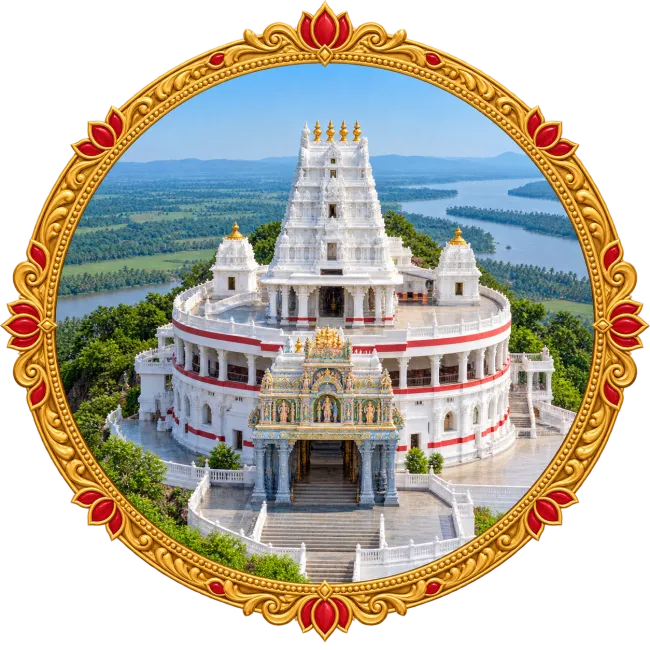
Annavaram Satyanarayana Temple
Annavaram Satyanarayana Temple is one of the most revered pilgrimage destinations in Andhra Pradesh. Located on Ratnagiri Hill in Annavaram, the temple is dedicated to Lord Vishnu as Sri Veera Venkata Satyanarayana Swamy. The Lord is worshipped here with Goddess Anantha Lakshmi and Lord Shiva, representing the unity of the principal Hindu traditions.
The temple is especially famous for Sri Satyanarayana Swamy Vratham, a sacred ceremony performed for prosperity, marriage, children, health and fulfilment of wishes. Thousands of families perform this Vratham at Annavaram every day, making it one of the most active centres of Satyanarayana worship in India.
About Annavaram Satyanarayana Temple
Annavaram Satyanarayana Temple is situated on Ratnagiri Hill beside the Pampa River in Kakinada district. The temple is officially known as Sri Veera Venkata Satyanarayana Swamy Vari Devasthanam.
The principal deity is Lord Satyanarayana, a benevolent form of Lord Vishnu. “Satya” means truth, while “Narayana” refers to Lord Vishnu. The deity therefore represents the divine power of truth, righteousness and protection.
An unusual feature of the temple is the combined presence of Lord Satyanarayana, Goddess Anantha Lakshmi and Lord Shiva within the principal shrine. This arrangement represents the unity of Vaishnavite and Shaivite worship.
Annavaram is considered one of the most important pilgrimage centres in Andhra Pradesh after Tirumala. Devotees visit the temple throughout the year, with especially large crowds on full-moon days, Ekadashi, weddings and festival occasions.
When and Who Built Annavaram Temple?
The origin of the present Annavaram Temple dates to 1891. Its establishment is closely associated with Raja Inuganti Venkata Ramanarayana Bahadur, the zamindar of the Gorsa and Kirlampudi estates.
According to temple tradition, Lord Satyanarayana appeared in a dream and revealed the location of his self-manifested deity on Ratnagiri Hill. A local devotee named Eeranki Prakasam also received a similar divine indication.
The sacred image was discovered beneath an Ankudu tree on the hill. Raja Ramanarayana Bahadur arranged for the deity to be installed and constructed the original temple in 1891.
The structure was reconstructed and expanded during 1933–1934. Further renovations, mandapams, gopurams, queue complexes, accommodation facilities and halls for Satyanarayana Vratham were added later.
The present temple therefore combines its nineteenth-century foundation with architectural additions made during the twentieth and twenty-first centuries.
Legend of Ratnagiri Hill
According to mythology, Mount Meru and his consort Menaka performed severe penance to Lord Vishnu and received two sons named Bhadra and Ratnakara.
Bhadra performed penance and requested Lord Vishnu to reside upon him. He was transformed into Bhadrachalam, where Lord Rama is worshipped as Sri Sita Ramachandra Swamy.
Ratnakara also performed penance to Lord Vishnu. Pleased with his devotion, Vishnu manifested upon Ratnakara as Sri Veera Venkata Satyanarayana Swamy. Ratnakara consequently became Ratnagiri Hill.
This legend connects Annavaram with Bhadrachalam and explains the sacred nature of Ratnagiri.
Discovery of the Deity
According to local tradition, Lord Satyanarayana appeared in the dreams of Raja Ramanarayana Bahadur and the devotee Eeranki Prakasam. The Lord instructed them to search for his image on Ratnagiri Hill.
Following the divine instructions, devotees searched near an Ankudu tree and discovered the deity. The image was ceremonially installed, and regular worship began.
The appearance of the Lord through a dream and the discovery of the deity are considered evidence of his self-manifested presence at Annavaram.
Religious Significance
Lord Satyanarayana represents truth, discipline, prosperity and divine protection. Devotees believe that sincere worship helps them overcome financial difficulties, family disagreements and delays in important life events.
People visit Annavaram to pray for:
Marriage and marital happiness
Blessings for children
Family peace and prosperity
Success in business and employment
Good health and recovery from illness
Education and examination success
Relief from financial difficulties
Completion of a new house
Success in a new venture
Fulfilment of vows
Spiritual wisdom and truthful living
Many families perform Satyanarayana Vratham after marriage, childbirth, purchasing a house, beginning a business or achieving an important goal.
Hari–Hara Unity at Annavaram
The temple represents harmony between the worship of Vishnu and Shiva. The main shrine includes Lord Satyanarayana, Goddess Anantha Lakshmi and Lord Shiva.
Lord Satyanarayana represents Vishnu, while Lord Shiva represents the Shaivite tradition. Goddess Anantha Lakshmi represents prosperity and divine energy.
The design of the deity and shrine is also interpreted as representing the Trimurti—Brahma, Vishnu and Shiva. This symbolism teaches that different manifestations of the divine ultimately belong to one supreme reality.
Devotees from different Hindu traditions therefore worship together at Annavaram without distinction.
Main Deities and Shrines
Sri Veera Venkata Satyanarayana Swamy
Lord Satyanarayana is the principal deity. He is worshipped as a form of Lord Vishnu who protects devotees and rewards truthful living.
Goddess Anantha Lakshmi
Goddess Anantha Lakshmi is worshipped as the divine consort of Lord Satyanarayana. Devotees pray to her for prosperity, family happiness and abundance.
Lord Shiva
Lord Shiva is enshrined with Satyanarayana Swamy, symbolising the unity of Hari and Hara.
Other important deities and shrines include:
Lord Ganesha
Lord Rama with Sita and Lakshmana
Lord Hanuman
Vana Durga
Kanaka Durga
Sri Krishna
Radha Devi
Navagrahas
Sun God
Bala Tripura Sundari
Other forms of Vishnu and Shakti
Devotees should visit the principal shrine before proceeding to the subsidiary shrines.
Architecture of Annavaram Temple
Annavaram Temple combines traditional South Indian architecture with symbolic design. The main structure is shaped like a chariot, representing the journey of the soul towards truth and liberation.
Chariot-Shaped Temple
The temple is designed as a chariot with symbolic wheels. The chariot represents the human body, while Lord Satyanarayana represents the divine guide directing life towards righteousness.
The four wheels are interpreted as the four Vedas or the four goals of human life—Dharma, Artha, Kama and Moksha.
Two-Level Sanctum
The main temple has two levels. The lower level contains the sacred Yantra and Peetham associated with the deity. The upper level houses Sri Veera Venkata Satyanarayana Swamy, Goddess Anantha Lakshmi and Lord Shiva.
This arrangement represents the relationship between spiritual energy, divine form and the visible world.
Gopurams and Mandapams
The temple has colourful gopurams decorated with sculptures of Vishnu, Lakshmi, Shiva and other deities. Spacious mandapams are used for Satyanarayana Vratham, Kalyanotsavam and devotional gatherings.
Large halls allow many families to perform the Vratham simultaneously under the guidance of temple priests.
Hilltop Setting
Ratnagiri Hill provides beautiful views of the surrounding countryside, Pampa River and nearby settlements. A motorable road and traditional steps connect the base of the hill with the temple.
Annavaram Satyanarayana Temple Timings
The regular temple and worship schedule is:
Temple timings and Vratham sessions may be reorganised on full-moon days, Ekadashi, Kalyanotsavam festivals and other crowded occasions.
Morning Puja and Harathi
The temple opens at 4:00 AM with Suprabhata Seva. Priests recite sacred hymns to awaken Lord Satyanarayana.
Abhishekam and Alankaram are performed from 4:30 AM to 5:30 AM. The deity is ceremonially worshipped and decorated with flowers, Tulasi garlands, silk garments and ornaments.
Morning Puja and Harathi are performed at 5:30 AM. Public darshan begins at 6:00 AM.
The best morning darshan period is from 6:30 AM to 9:30 AM. Devotees performing Satyanarayana Vratham should arrive before their allotted reporting time.
Sri Satyanarayana Swamy Vratham
Satyanarayana Vratham is the most important ritual performed at Annavaram. It is based on the Satyanarayana Vratha Katha, which teaches the importance of truth, devotion, gratitude and fulfilling promises.
The ceremony generally includes:
Sankalpa in the devotee’s name
Worship of Lord Ganesha
Kalasha Sthapana
Navagraha Puja
Worship of Lord Satyanarayana
Recitation of Satyanarayana Vratha Katha
Naivedyam
Harathi
Distribution of prasadam
The Vratham is performed from 6:00 AM to 6:00 PM in scheduled groups. Different ticket categories may be available based on the location, number of participants and facilities included.
Couples commonly perform the Vratham together. Families may also participate for marriage, childbirth, a new home, business success or fulfilment of a vow.
Traditional dress is recommended for participants. Devotees should arrive before the reporting time and follow the priest’s instructions throughout the ceremony.
Nitya Kalyanotsavam
Nitya Kalyanotsavam celebrates the divine wedding of Lord Satyanarayana and Goddess Anantha Lakshmi. It is performed at 9:30 AM.
Married couples attend for harmony, prosperity and family welfare. Unmarried devotees participate to seek blessings for a suitable marriage.
Advance booking or a separate ticket may be required. Participants should report early and follow the prescribed traditional dress code.
Evening Puja and Harathi
Evening Puja and Deepa Harathi are performed at 6:30 PM. Priests offer lamps, flowers, incense and Naivedyam before the deities.
The best evening darshan period is from 5:00 PM to 7:30 PM. Night darshan continues after the evening rituals.
Ekanta Seva is performed at 8:30 PM. The temple closes at 9:00 PM after the completion of the final rituals.
Major Festivals
Annual Kalyanotsavam
The divine wedding festival of Sri Satyanarayana Swamy and Anantha Lakshmi is celebrated with special rituals, processions and cultural programmes.
Kartika Masam
Kartika month is an important pilgrimage period because the temple represents both Vishnu and Shiva. Devotees light lamps, perform Vratham and offer prayers to both deities.
Vaikuntha Ekadashi
Special darshan and Vishnu worship are organised on Vaikuntha Ekadashi. Devotees observe fasting and chant the names of Lord Vishnu.
Full-Moon Days
Purnima is considered highly auspicious for Satyanarayana Vratham. A large number of families perform the ceremony on every full-moon day.
Ugadi
The Telugu New Year is celebrated through special decoration, Puja and Panchanga Shravanam.
Other festivals include Sri Rama Navami, Krishna Janmashtami, Deepavali, Sankranti and festive observances dedicated to Goddess Lakshmi.
Sevas and Offerings
Important sevas include:
Suprabhata Seva
Abhishekam
Sahasranama Archana
Satyanarayana Vratham
Nitya Kalyanotsavam
Laksha Tulasi Puja
Special Darshan
Vahana Puja
Homam
Annadanam donation
Festival sponsorship
Common offerings include Tulasi leaves, flowers, coconuts, fruits, silk garments and Vratham materials.
All seva tickets should be purchased only through authorised counters or the approved booking system.
Prasadam and Annadanam
The special prasadam associated with Satyanarayana Vratham is generally prepared from ingredients such as wheat semolina, sugar or jaggery, ghee, banana and cardamom.
Laddu and pulihora may also be available through temple prasadam counters. Sacred Tulasi and other blessed items are distributed after worship.
The temple provides annadanam to pilgrims in designated dining halls. Devotees may support this service through authorised donations.
Dress Code and Temple Rules
Traditional and modest clothing is recommended. Men may wear a dhoti, kurta-pyjama or full-length trousers with a shirt. Women may wear a saree, half-saree, salwar kameez or another modest Indian outfit.
Traditional dress is especially recommended for Satyanarayana Vratham and Kalyanotsavam.
Footwear must be removed before entering the temple. Mobile phones, cameras and large bags may be restricted within the inner complex. Photography is prohibited near the sanctum.
Alcohol, tobacco, leather articles and non-vegetarian food must not be carried inside.
Entry Fee and Visit Duration
General darshan is available without an entry fee. Separate charges apply for special darshan, Satyanarayana Vratham, Kalyanotsavam and other Arjitha Sevas.
A normal visit requires 1½ to 2 hours. Devotees performing the Vratham should keep 3 to 4 hours available for reporting, completing the ceremony and receiving darshan.
Waiting times are longer on full-moon days, Ekadashi, weekends and festival occasions.
Best Time to Visit
October to March is the most comfortable season for visiting Annavaram. The weather is suitable for hilltop darshan and nearby sightseeing.
For peaceful darshan, arrive between 6:30 AM and 9:00 AM on a weekday. The evening period from 5:00 PM to 7:30 PM is suitable for attending Deepa Harathi.
Purnima is spiritually significant for Satyanarayana Vratham, but devotees should expect larger crowds.
How to Reach Annavaram Temple
By Air
Rajahmundry Airport is the nearest convenient airport. Visakhapatnam International Airport is another suitable option. Taxis and buses are available from both cities.
By Train
Annavaram Railway Station is the nearest station and is situated close to the temple town. Trains connecting Visakhapatnam, Vijayawada, Rajahmundry and other cities stop here.
Auto-rickshaws, buses and taxis are available from the railway station to Ratnagiri Hill.
By Road
Annavaram is located near the national highway connecting Visakhapatnam and Vijayawada. Regular buses operate from Visakhapatnam, Kakinada, Rajahmundry, Tuni and other nearby cities.
Vehicles can travel up Ratnagiri Hill using the temple road. Devotees may also climb the traditional steps.
Nearby Places to Visit
Visitors may also explore:
Pampa River and reservoir
Thalupulamma Lova Temple
Tuni
Uppada Beach
Kakinada Beach
Samarlakota Kumararama Temple
Draksharamam Temple
Pithapuram Kukkuteswara Temple
Puruhutika Shakti Peetha
Coringa Wildlife Sanctuary
Visitor Guidelines
Book Satyanarayana Vratham and accommodation in advance if visiting on Purnima, Ekadashi or a public holiday.
Arrive before the reporting time for Vratham or Kalyanotsavam. Carry valid identification and retain the seva ticket until the ceremony is complete.
Deposit footwear, phones and large bags at authorised counters. Do not purchase tickets from unauthorised agents.
Complete darshan of the main deities after performing the Vratham. Respect the sanctity of the ceremony and remain seated while the priest recites the Vratha Katha.
Conclusion
Annavaram Satyanarayana Temple is one of Andhra Pradesh’s most beloved pilgrimage destinations. Its hilltop location, self-manifested deity, Hari–Hara symbolism and tradition of Satyanarayana Vratham give it exceptional religious significance.
The temple teaches the importance of truth, gratitude, devotion and the fulfilment of promises. Whether devotees visit for a family ceremony, marriage, prosperity or spiritual peace, Sri Veera Venkata Satyanarayana Swamy Temple offers a deeply uplifting and memorable experience.