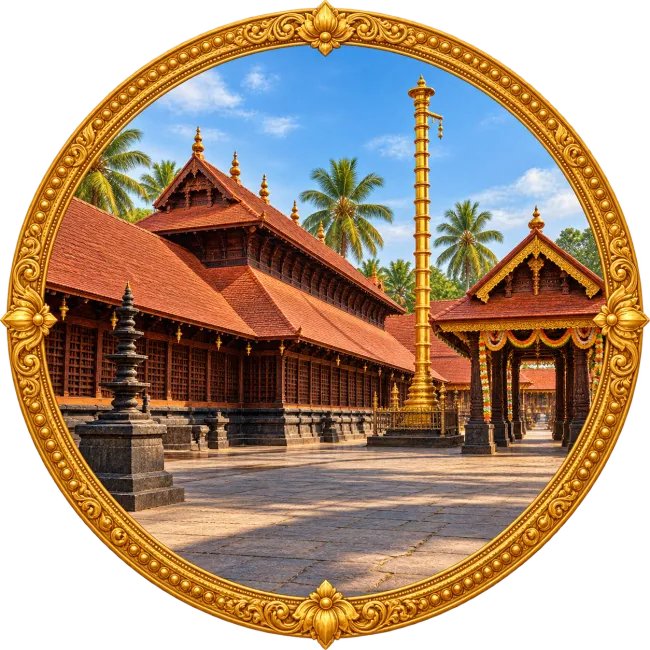
Ambalappuzha Sri Krishna Temple
Ambalappuzha Sri Krishna Temple in Kerala is one of the state’s most revered temples dedicated to Lord Krishna. The principal deity is worshipped as Parthasarathy, the divine charioteer who guided Arjuna during the Mahabharata war.
Located in Ambalappuzha in Alappuzha district, the temple is especially famous for Ambalappuzha Palpayasam, a sweet milk-and-rice preparation offered to Lord Krishna. Its Kerala-style architecture, traditional performing arts, royal history and connection with the Champakulam Moolam boat race make it an important pilgrimage destination.
About Ambalappuzha Sri Krishna Temple
Ambalappuzha Sri Krishna Temple is dedicated to Lord Krishna in his Parthasarathy form. The deity represents Krishna as Arjuna’s charioteer and spiritual guide.
Unlike images showing Krishna playing a flute, the Ambalappuzha deity is connected with the battlefield teachings of the Bhagavad Gita. The Lord is depicted holding symbols associated with his role as Parthasarathy.
The temple follows traditional Kerala Tantric practices. Daily worship begins before sunrise and includes Nirmalyam, Abhishekam, Usha Puja, Seeveli, Ucha Puja, evening Deepa Aradhana and Athazha Puja.
Ambalappuzha Temple is closely associated with music, dance, Velakali and Kerala’s boat-race culture.
When and Who Built Ambalappuzha Temple?
Ambalappuzha Sri Krishna Temple was constructed during the rule of the Chembakassery kingdom. Its establishment is traditionally associated with Pooradam Thirunal Devanarayanan Thampuran, the ruler of Chembakassery.
The temple was developed during the fifteenth and sixteenth centuries as an important royal and religious centre.
Chembakassery rulers supported daily worship, festivals, cultural performances and the famous Palpayasam offering. Land and resources were assigned for maintaining the temple and feeding devotees.
The kingdom was later absorbed into Travancore. The Travancore royal family continued to protect the temple and its traditions.
Different sections were renovated during later periods, but the complex retains the essential character of traditional Kerala architecture.
Legend of the Temple’s Establishment
According to tradition, the Chembakassery ruler and the royal priest were travelling by boat when they heard the sound of a flute near the Champakulam region.
They discovered a sacred image of Lord Krishna and decided to install it in a temple at Ambalappuzha.
The deity was ceremonially transported by boat through the waterways. Local people welcomed the procession with decorated boats, music and offerings.
This journey is commemorated through the Champakulam Moolam boat race and related temple traditions.
The legend reflects the close relationship between Lord Krishna, Ambalappuzha and Kerala’s waterways.
Lord Krishna as Parthasarathy
The word Parthasarathy combines two terms:
Partha: Another name for Arjuna
Sarathy: Charioteer
Parthasarathy therefore means the charioteer of Arjuna.
During the Mahabharata war, Krishna served as Arjuna’s charioteer. When Arjuna became distressed at the thought of fighting his relatives and teachers, Krishna taught him the principles of Dharma, selfless action, devotion and spiritual knowledge.
These teachings became the Bhagavad Gita.
The Ambalappuzha deity represents Krishna as a guide who leads devotees through confusion and difficult decisions.
Ambalappuzha Palpayasam
Ambalappuzha Palpayasam is the temple’s most famous offering. It is prepared using rice, milk and sugar according to a traditional method.
The Payasam has a distinctive taste and colour created through slow cooking. It is prepared in the temple kitchen and offered to Lord Krishna before distribution.
Devotees book Palpayasam for:
Fulfilment of vows
Family prosperity
Health and recovery
Marriage
Blessings for children
Gratitude after success
Special family occasions
Because demand is high, devotees should book the offering through authorised temple counters.
Chess and Rice Legend
The Palpayasam tradition is connected with a famous story about Lord Krishna and the Chembakassery ruler.
According to the legend, Krishna appeared before the king in the form of a travelling sage and challenged him to a game of chess.
The sage requested a simple reward if he won. He asked the king to place one grain of rice on the first square of the chessboard, two on the second, four on the third and continue doubling the amount on each square.
The king agreed, believing that the reward would be small. After losing the game, he discovered that the total quantity of rice required was enormous and beyond the resources of his kingdom.
The sage revealed himself as Lord Krishna. Instead of demanding immediate payment, he instructed the king to serve Palpayasam to devotees every day until the debt was fulfilled.
The daily Palpayasam tradition is therefore regarded as the continuation of the king’s sacred obligation to Krishna.
Guruvayur Connection
During a period of political conflict in Kerala, the sacred idol of Guruvayurappan was temporarily moved from Guruvayur for protection.
The deity was kept at Ambalappuzha Temple until it was safe to return. This historical tradition created a close spiritual connection between Ambalappuzha and Guruvayur.
Devotees regard both temples as important centres of Krishna worship, though their rituals and deity forms remain distinct.
Religious Significance
Lord Parthasarathy is worshipped as the divine guide who removes confusion and teaches the path of Dharma.
Devotees visit the temple to pray for:
Wisdom and correct decision-making
Success in education
Good health and long life
Family peace and prosperity
Marriage and marital harmony
Blessings for children
Professional growth
Relief from financial difficulties
Protection during journeys
Mental clarity
Devotion to Lord Krishna
Spiritual progress
Ekadashi, Ashtami Rohini, Vishu and important Krishna festival days are especially auspicious.
Main Deity and Other Shrines
Lord Parthasarathy
The principal deity is Lord Krishna in the form of Parthasarathy. The image represents courage, guidance and divine wisdom.
The deity is decorated with Tulasi garlands, flowers, silk garments and ornaments according to the daily ritual schedule.
Lord Ganesha
Lord Ganesha is worshipped as the remover of obstacles. Devotees pray before beginning major ceremonies.
Lord Shiva
The presence of Shiva reflects the inclusive traditions of Kerala temple worship.
Other sacred figures and shrines include:
Dharma Shasta
Bhagavathy
Nagadevatas
Guardian deities
Garuda
Hanuman-related sacred traditions
Architecture of Ambalappuzha Temple
The temple follows traditional Kerala architecture, characterised by sloping tiled roofs, wooden structures, stone foundations and enclosed courtyards.
Sreekovil
The Sreekovil houses Lord Parthasarathy. It is constructed as a compact sacred chamber protected by a sloping roof.
Traditional lamps illuminate the deity during worship.
Chuttambalam
The Chuttambalam surrounds the principal shrine and provides space for circumambulation, lamps and ritual activities.
Deepastambham
The Deepastambham holds rows of oil lamps and is illuminated during evening worship and festivals.
Koothambalam
The temple has facilities associated with traditional performance arts. Music, dance and ritual theatre form an important part of its cultural heritage.
Temple Pond
The sacred pond is used during Arattu and selected festival rituals. Visitors should use only authorised bathing areas.
Ambalappuzha Sri Krishna Temple Timings
The regular daily schedule is:
Timings may be extended or reorganised during the annual Ulsavam, Ashtami Rohini, Champakulam Moolam and other major occasions.
Morning Puja and Deepa Aradhana
The temple opens at 3:00 AM with Palliyunarthal, the ceremonial awakening of Lord Krishna.
Nirmalya Darshan is available at 3:30 AM. Morning Abhishekam is performed at 4:00 AM.
Usha Puja takes place at 5:00 AM, followed by morning Deepa Aradhana at 5:30 AM.
Ethirettu Puja is conducted at 6:00 AM, and morning Seeveli takes place at 7:00 AM.
The best morning darshan period is from 5:00 AM to 8:00 AM.
Pantheeradi and Ucha Puja
Pantheeradi Puja is performed at 8:00 AM. Its name is connected with the traditional measurement of the sun’s shadow.
Ucha Puja, the principal midday worship, takes place at 11:30 AM. Food and sacred offerings are presented to Lord Parthasarathy.
Madhyahna Deepa Aradhana follows at 11:45 AM. The morning session ends at 12:00 PM.
Evening Puja and Deepa Aradhana
The temple reopens at 5:00 PM. Evening Deepa Aradhana is performed at 6:30 PM.
Rows of oil lamps illuminate the temple, creating a peaceful devotional atmosphere.
Evening Seeveli is conducted at 7:00 PM. Athazha Puja, the final worship of the day, takes place at 7:30 PM.
The temple closes at 8:00 PM.
Champakulam Moolam Boat Race
The Champakulam Moolam boat race is one of Kerala’s oldest traditional boat races.
It commemorates the ceremonial journey of the Krishna idol from the Champakulam region to Ambalappuzha.
Decorated snake boats and other traditional boats participate in the event. Music, processions and religious ceremonies accompany the celebration.
The boat race is held on Moolam Nakshatra during the Malayalam month of Mithunam.
Annual Ulsavam
The temple’s annual festival is celebrated during the Malayalam month of Meenam.
The festival generally extends for several days and includes:
Flag hoisting
Special Puja
Processions
Seeveli
Cultural programmes
Velakali
Arattu
Traditional percussion performances
The concluding Arattu involves a ceremonial bath of the processional deity.
Velakali
Velakali is a traditional martial dance performed during the Ambalappuzha temple festival.
Dancers dressed as warriors carry shields and sticks while moving rhythmically to drums and traditional music.
The performance symbolically represents warriors preparing for battle. It is closely connected with the temple’s royal and cultural history.
Ambalappuzha is one of the principal centres where Velakali has been preserved.
Major Festivals
Ashtami Rohini
Ashtami Rohini celebrates the birth of Lord Krishna. Special Alankaram, Puja and devotional programmes are organised.
Guruvayur Ekadashi Observances
Special Vishnu worship and fasting are observed during important Ekadashi dates.
Vishu
Devotees attend Vishukkani Darshan and seek blessings for the new year.
Pallipana
Pallipana is a traditional ritual performed at prescribed intervals. It includes sacred songs, offerings and ceremonies connected with temple traditions.
Kalabham
Kalabham involves the ceremonial application of sandalwood paste and other sacred materials to the deity.
Other festivals include Kuchela Dinam, Sri Krishna Jayanti and Mandala season observances.
Sevas and Offerings
Important temple Sevas include:
Ambalappuzha Palpayasam
Udayasthamana Puja
Tulabharam
Sahasranama Archana
Pushpanjali
Chuttuvilakku
Kalabhabhishekam
Palabhishekam
Ganapati Homam
Deepa Seva
Annadanam donation
Festival sponsorship
All offerings should be booked through authorised counters.
Prasadam
The principal prasadam is Ambalappuzha Palpayasam.
Other prasadam may include:
Appam
Ada
Tulasi
Sacred sandalwood paste
Flowers
Payasam prepared for selected offerings
Palpayasam has a scheduled collection procedure. Devotees should preserve the booking receipt and collect it from the designated counter at the allotted time.
Dress Code and Entry Rules
Ambalappuzha Temple follows traditional Kerala dress customs.
Men should wear a mundu or dhoti. Shirts, T-shirts and upper garments may need to be removed before entering the inner temple area.
Women may wear:
Saree
Set mundu
Salwar kameez or churidar
Long traditional skirt with blouse
Visitors should follow the currently displayed dress instructions.
Footwear, mobile phones, cameras and large bags may be restricted inside. Photography and videography are prohibited near the sanctum.
Only eligible devotees under the temple’s established entry traditions may enter the inner complex.
Entry Fee and Visit Duration
General darshan is available without an entry fee. Separate charges apply to Palpayasam, Archana, Abhishekam and other Sevas.
A regular visit requires 1 to 1½ hours. Devotees collecting Palpayasam or attending a special Puja should keep 2 hours available.
Waiting times are longer on Ekadashi, Ashtami Rohini, festival days and public holidays.
Best Time to Visit
October to February is the most comfortable period for visiting Ambalappuzha.
For peaceful darshan, visit between 5:00 AM and 8:00 AM on a weekday. Evening darshan from 5:00 PM to 7:00 PM provides an opportunity to attend Deepa Aradhana.
The annual Ulsavam and Champakulam Moolam boat race offer rich cultural experiences but attract larger crowds.
How to Reach Ambalappuzha Temple
By Air
Cochin International Airport is the nearest major airport. Thiruvananthapuram International Airport is another option.
Taxis, buses and trains connect both cities with Ambalappuzha.
By Train
Ambalappuzha Railway Station is the nearest station. It has connections with Alappuzha, Kochi, Kollam and Thiruvananthapuram.
Auto-rickshaws and taxis are available from the station.
By Road
Ambalappuzha is well connected with Alappuzha, Kochi, Haripad, Kayamkulam and Thiruvananthapuram.
Government and private buses operate regularly. Local taxis and auto-rickshaws are widely available.
Nearby Places to Visit
Visitors may also explore:
Ambalappuzha Beach
Alappuzha Backwaters
Alappuzha Beach
Mannarasala Nagaraja Temple
Haripad Subrahmanya Swamy Temple
Karumadi Kuttan
Pathiramanal Island
Krishnapuram Palace
Kuttanad
Arthunkal Basilica
Marari Beach
Chettikulangara Bhagavathy Temple
Visitor Guidelines
Book Palpayasam through authorised counters and collect it at the specified time. Demand can be high on weekends and festival dates.
Confirm the dress requirements before joining the queue. Use changing facilities where available.
Deposit footwear, phones and cameras only at authorised counters. Preserve the token carefully.
Maintain silence during Nirmalyam, Ucha Puja and Deepa Aradhana. Follow the directions of priests and temple staff.
During the Champakulam boat race, use designated viewing areas and follow water-safety instructions.
Conclusion
Ambalappuzha Sri Krishna Temple is an important centre of Parthasarathy worship and Kerala’s devotional culture. Its Chembakassery royal history, famous Palpayasam, chess legend, Velakali and connection with the Champakulam boat race give it a distinctive identity.
Lord Krishna is worshipped here as the divine charioteer who guides devotees through difficult choices. A visit to Ambalappuzha offers an opportunity to seek wisdom, family welfare, prosperity and the compassionate blessings of Lord Parthasarathy.