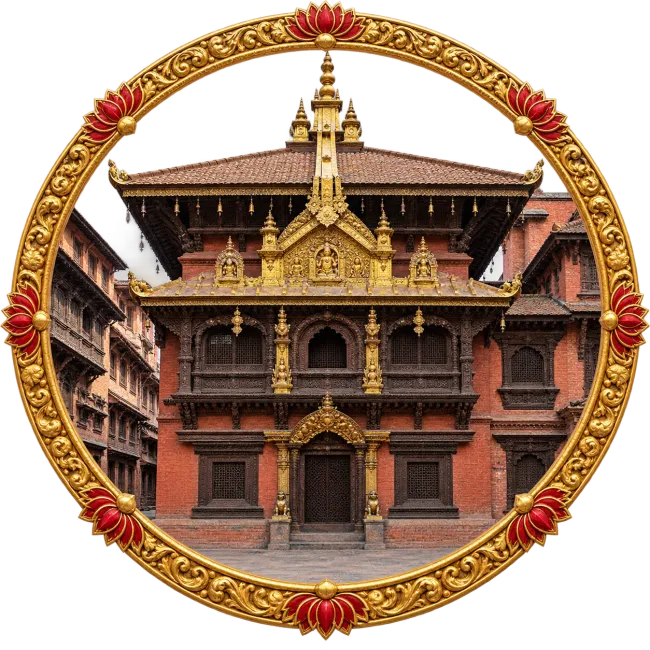
Akash Bhairav Temple, Kathmandu
Visit Akash Bhairav Temple in Indra Chowk, one of Kathmandu’s most revered shrines dedicated to Lord Bhairav. Situated within a busy traditional market, the temple is known for its large blue-coloured image of Akash Bhairav, beautiful Newari architecture and association with the first Kirati king, Yalambar.
Akash Bhairav is worshipped as the guardian of Kathmandu and the divine protector of the sky. The temple becomes especially important during Indra Jatra, when the deity is ceremonially displayed and decorated for public worship.
About Akash Bhairav Temple
Akash Bhairav Temple is located at Indra Chowk in the historic centre of Kathmandu. The shrine stands along the traditional walking route connecting Ason Market with Kathmandu Durbar Square.
The presiding deity is Akash Bhairav, a powerful manifestation of Lord Shiva. The name can be understood as:
Akash means sky or space.
Bhairav refers to the fierce and protective manifestation of Shiva.
Akash Bhairav is therefore worshipped as the guardian of the sky and protector of Kathmandu.
The deity is also called Aaju Dya by the local Newar community. Aaju means respected ancestor, while Dya means deity. This name reflects the belief that Akash Bhairav represents both a divine protector and an ancestral guardian.
History of Akash Bhairav Temple
The worship of Akash Bhairav is connected with the ancient Kirati period of Nepalese history. The deity is traditionally identified with King Yalambar, regarded as the first ruler of the Kirati dynasty.
The sacred image predates the present temple building. Worship of the deity continued as Kathmandu developed under the Licchavi and Malla rulers.
The present three-storeyed shrine developed during the Malla period between the 15th and 17th centuries. Kathmandu’s Malla rulers supported Bhairav worship because Lord Bhairav was regarded as a guardian of the city, royal authority and justice.
Local Newar communities maintained the temple and preserved its rituals through traditional Guthi organizations. The shrine was repaired and renovated several times while retaining its Newari architectural character.
Akash Bhairav continues to be worshipped as one of the principal guardian deities of Kathmandu.
Legend of King Yalambar
The most famous legend associated with Akash Bhairav connects the deity with King Yalambar, the first Kirati king.
According to local tradition, Yalambar was a brave and powerful warrior who possessed extraordinary military abilities. During the Mahabharata war, he travelled towards Kurukshetra with the intention of participating in the battle.
Yalambar declared that he would support whichever side appeared weaker. Lord Krishna understood that the king’s strength could repeatedly alter the balance of the war and prevent it from reaching a conclusion.
To protect Dharma and ensure the completion of the battle, Krishna tested Yalambar’s abilities. After recognizing his extraordinary power, Krishna separated the king’s head from his body.
Yalambar requested permission to witness the entire Mahabharata war. His head was placed at an elevated location from where he could observe the battlefield.
Because his head watched from the sky, he came to be associated with Akash Bhairav. Local tradition identifies the sacred head worshipped at Indra Chowk with King Yalambar.
This legend combines the Kirati history of Nepal with the religious traditions of Lord Bhairav.
Akash Bhairav as Protector of Kathmandu
Akash Bhairav is considered one of the principal guardian deities of Kathmandu. He is believed to watch over the city and protect residents from war, disasters, disease and negative forces.
Historically, rulers and military commanders worshipped Bhairav before important campaigns. Traders and business owners in Indra Chowk also seek his blessings for protection and prosperity.
Devotees visit Akash Bhairav Temple for:
- Protection from danger
- Courage and confidence
- Victory over difficulties
- Safety during travel
- Growth in business
- Success in employment
- Family peace and prosperity
- Protection from enemies
- Removal of negative influences
- Justice in important matters
- Fulfilment of sincere wishes
- Spiritual strength
The deity is also worshipped for the protection of Kathmandu’s markets, streets and traditional communities.
Main Deity of Akash Bhairav Temple
The principal deity is represented by a large sacred head with a blue face. The image has wide eyes, a powerful expression and elaborate ornaments.
The blue colour represents the vastness of the sky, cosmic power and the unlimited nature of the deity.
The image is decorated with:
- Silver and golden ornaments
- Flower garlands
- Traditional crowns
- Sacred cloth
- Vermilion
- Protective symbols
- Seasonal decorations
The deity’s fierce expression does not represent cruelty. Bhairav’s terrifying appearance is directed towards evil, injustice and negative forces. For sincere devotees, he is a compassionate guardian.
Architecture of Akash Bhairav Temple
Akash Bhairav Temple is a multi-storeyed structure built in the traditional Newari style. It is integrated into the dense historic market of Indra Chowk.
Important architectural features include:
- Three-storeyed Newari structure
- Traditional brick construction
- Intricately carved wooden windows
- Decorative wooden supports
- Metal and gilded ornaments
- Small balconies
- Traditional tiled roof
- Sacred bells
- Ground-level worship area
- Upper chamber containing the main deity
The building appears different from a conventional standalone temple because shops and market activities surround it.
The carved windows and wooden details demonstrate the craftsmanship associated with Kathmandu’s Malla-period architecture.
Akash Bhairav Temple Timings
The temple may remain open for extended hours during Indra Jatra, Bhairav Ashtami, Dashain and other Newari festivals.
Morning Puja and Aarti
The temple opens at 6:00 AM. Priests clean and prepare the worship area before presenting the first offerings to Akash Bhairav.
Morning Aarti is performed at 6:30 AM. The deity is worshipped with:
- Flowers and garlands
- Vermilion
- Rice and grains
- Incense
- Oil lamps
- Sacred water
- Fruits and sweets
- Traditional Bhairav mantras
The period between 7:00 AM and 9:00 AM is suitable for peaceful darshan. Indra Chowk becomes increasingly crowded as the market opens later in the morning.
Special Puja
Special pujas are generally arranged between 7:00 AM and 11:00 AM. Devotees may perform worship for protection, business growth, legal matters and victory over obstacles.
A special Bhairav Puja may include:
- Sankalp
- Kalash worship
- Bhairav Mantra recitation
- Flower offerings
- Mustard-oil lamps
- Rice and vermilion
- Bhog
- Protective sacred thread
- Distribution of prasad
Special ceremonies should be arranged through authorized temple priests.
Bhog and Traditional Offerings
Bhog is offered to Akash Bhairav at 12:00 PM. The offering may include fruits, sweets, rice, beaten rice and traditional Newari food items.
Certain Newari Bhairav traditions may include ritual offerings of alcohol, eggs, fish or meat. These offerings are presented only according to established temple customs and under the supervision of authorized priests.
Participation in such offerings is not compulsory. Devotees may present simple vegetarian offerings such as:
- Coconut
- Fruits
- Sweets
- Flowers
- Incense
- Mustard-oil lamps
Evening Puja and Aarti
Evening Puja begins at 6:30 PM, followed by Aarti at 7:00 PM.
Oil lamps are offered before Akash Bhairav while devotees recite prayers and ring the temple bells. The evening ceremony provides a distinct spiritual experience because the historic lanes and markets surrounding Indra Chowk remain illuminated.
Visitors should reach before 6:30 PM to attend the complete evening Puja and Aarti.
Indra Jatra Celebration
Indra Jatra is the most important festival associated with Akash Bhairav Temple. The festival is called Yenya in the Newar tradition and is one of Kathmandu’s largest cultural celebrations.
During Indra Jatra, the image of Akash Bhairav is ceremonially displayed and elaborately decorated with:
- Flower garlands
- Traditional ornaments
- Colourful cloth
- Sacred crowns
- Festival lights
- Ritual decorations
Large numbers of devotees gather at Indra Chowk to receive darshan.
The festival also includes:
- Kumari chariot procession
- Traditional masked dances
- Lakhey dance
- Bhairav worship
- Newari music
- Lighting of lamps
- Religious processions
- Worship of Lord Indra
- Community feasts
Akash Bhairav is worshipped for the protection of Kathmandu and the prosperity of its residents during the festival.
Other Major Festivals
Bhairav Ashtami
Special worship of Lord Bhairav is performed with lamps, flowers and protective mantras.
Dashain
Akash Bhairav is worshipped during Dashain for courage, protection and victory over negative forces.
Kali Puja
Special lamps and Bhairav prayers are offered during Kali Puja.
Maha Shivaratri
As a manifestation of Lord Shiva, Akash Bhairav receives special worship during Maha Shivaratri.
Newari Festivals
Traditional Newari communities perform several annual ceremonies connected with the guardian deities of Kathmandu.
Full-Moon and Ashtami Days
Purnima and Ashtami dates are considered suitable for special Bhairav worship.
Offerings and Prasad
Common offerings made at Akash Bhairav Temple include:
- Red and blue flowers
- Flower garlands
- Vermilion
- Mustard oil
- Oil lamps
- Incense sticks
- Rice and grains
- Beaten rice
- Fruits and sweets
- Coconut
- Red or blue cloth
- Protective sacred threads
- Monetary donations
Prasad may include fruits, sweets, flowers, vermilion and traditional food blessed during worship.
Devotees should present all ritual offerings through the authorized temple priests.
Entry Fee and Visit Duration
There is no entry fee for regular darshan at Akash Bhairav Temple. Charges may apply for special pujas and ceremonial materials.
A regular visit requires 30–60 minutes. Visitors combining the temple with Ason Market and Kathmandu Durbar Square should keep three to four hours.
During Indra Jatra, darshan may require additional time because Indra Chowk becomes extremely crowded.
Visitor Guidelines
- Wear modest and respectful clothing.
- Remove footwear at the designated area.
- Maintain silence near the principal shrine.
- Ask permission before taking close photographs.
- Photography may be restricted during rituals.
- Keep mobile phones on silent mode.
- Follow the designated darshan queue.
- Do not touch the sacred image or ornaments.
- Use authorized priests for special pujas.
- Do not block the narrow market lanes.
- Keep personal belongings secure.
- Respect traditional Newari ceremonies.
- Avoid carrying large bags during festivals.
- Keep children and elderly visitors under supervision.
- Follow instructions from temple officials and security personnel.
Best Time to Visit
October to March is the best period for exploring central Kathmandu because the weather remains pleasant.
For peaceful darshan, visit between 7:00 AM and 9:00 AM. Evening visitors should reach between 5:00 PM and 6:30 PM.
Indra Jatra is the most significant time to see the temple’s festival traditions, although the entire Indra Chowk area remains heavily crowded.
How to Reach Akash Bhairav Temple
By Air
Tribhuvan International Airport is the nearest airport. Visitors can hire a taxi to Kathmandu Durbar Square or a nearby drop-off point.
From Thamel
Indra Chowk is approximately 1 kilometre from Thamel. Walking is the easiest option because the route passes through Ason Market and traditional Kathmandu streets.
From Kathmandu Durbar Square
Akash Bhairav Temple is located within walking distance of Kathmandu Durbar Square. Visitors can walk through the historic market lanes to Indra Chowk.
From Ratna Park
Indra Chowk can be reached by walking, taxi or cycle-rickshaw from Ratna Park.
By Local Transport
Vehicles have limited access within the narrow market lanes. Visitors should get down near Ason, New Road or Kathmandu Durbar Square and continue on foot.
From India
Indian visitors can reach Kathmandu by air or enter Nepal through road-border points such as Raxaul–Birgunj and Sunauli–Bhairahawa.
Indian citizens should carry a valid passport or voter identity card and confirm transportation requirements before departure.
Nearby Places to Visit
- Indra Chowk
- Ason Market
- Seto Machhindranath Temple
- Kathmandu Durbar Square
- Taleju Bhawani Temple
- Hanuman Dhoka Palace
- Kumari Ghar
- Kal Bhairav Temple
- Seto Bhairav
- Kasthamandap
- Jagannath Temple
- Freak Street
Conclusion
Akash Bhairav Temple is one of Kathmandu’s most important guardian shrines. Its connection with Kirati King Yalambar, Lord Shiva and the ancient Newari traditions of Kathmandu gives it a distinctive religious identity.
The temple’s three-storeyed architecture, large blue deity and central role in Indra Jatra make it an important spiritual and cultural destination.
Worshipping Akash Bhairav is believed to provide courage, protection and victory over difficulties. A visit to the temple also offers an opportunity to experience the living markets, heritage and devotional traditions of historic Kathmandu.