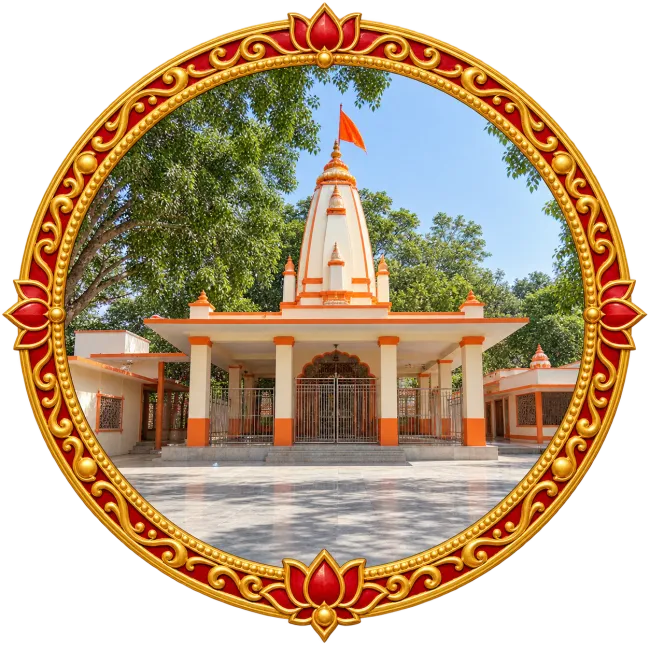
Ajoshi Mahavir Dham, Jaunpur
Visit Ajoshi Mahavir Dham in Jaunpur, an ancient and revered temple dedicated to Lord Hanuman. Located in Ajoshi village near Sikrara, the temple is known for its sacred Hanuman idol, seven-storey structure and traditions associated with Lord Hanuman’s journey while carrying the Sanjeevani mountain. Devotees visit the temple to seek courage, protection, good health and relief from difficulties. Budhwa Mangal, Shakti Parv and Hanuman Janmotsav are celebrated here with special worship, fairs and community feasts.
About Ajoshi Mahavir Dham
Ajoshi Mahavir Dham, also known as Pawan Mahavir Dham, is a famous Hanuman temple situated in Ajoshi village in the Sikrara area of Jaunpur district, Uttar Pradesh. The temple is regarded as an important Siddha Peeth of Lord Hanuman in the Purvanchal region.
The principal deity is a distinctive and ancient idol of Lord Hanuman. Devotees believe that the idol was discovered beneath the ground and later installed in a temple by Chandela ruler Raja Aajhu Rai.
A small mark can be seen near the chest of the idol. According to local religious tradition, this mark was caused by the arrow fired by Bharat at Lord Hanuman while the latter was carrying the Sanjeevani mountain towards Lanka.
Ajoshi Mahavir Dham is a Hindu temple dedicated to Lord Hanuman and should not be confused with a Jain temple dedicated to Bhagwan Mahavir. Here, the name “Mahavir” refers to Mahabali Hanuman, the courageous and devoted servant of Lord Rama.
History of Ajoshi Mahavir Dham
The history of Ajoshi Mahavir Dham is associated with the period of the Chandela rulers. According to local tradition, the area surrounding the present temple was once covered by a dense forest.
Raja Aajhu Rai, a Chandela ruler, was travelling with his soldiers to fight the Bhar rulers. When the royal procession reached this location, the king’s chariot suddenly stopped. Despite repeated attempts, the horses refused to move forward.
The king’s priest, Vamdev Mishra, examined the situation and concluded that a powerful spiritual presence was hidden beneath the ground. On the priest’s advice, the king ordered excavation at the site.
During the excavation, an ancient idol of Lord Hanuman was discovered. Raja Aajhu Rai worshipped the deity and ordered the construction of a temple for the sacred idol. He prayed to Lord Hanuman for success in the forthcoming battle.
According to tradition, Raja Aajhu Rai defeated the Bhar rulers. After returning victorious, he organized a special religious ceremony and a large bhandara at the temple. Regular worship of Lord Hanuman is believed to have continued at Ajoshi Dham from that period.
The temple was subsequently renovated and expanded through the collective contributions of local residents and devotees. Over time, the complex developed into an impressive seven-storey temple containing several additional shrines.
Who Built Ajoshi Mahavir Dham?
The original Ajoshi Mahavir Temple is traditionally associated with Chandela ruler Raja Aajhu Rai. It is believed that he constructed the first shrine and installed the discovered Hanuman idol after his priest Vamdev Mishra identified the divine presence at the site.
The present multi-storey temple is the result of later reconstruction and expansion supported by devotees, priests and residents of the surrounding villages. Therefore, Raja Aajhu Rai is remembered as the founder of the original shrine, while the modern temple complex was developed through public cooperation.
Connection with the Ramayana
Ajoshi Mahavir Dham is associated with an important episode from the Ramayana. During the battle between Lord Rama and Ravana, Lakshmana was severely injured by the powerful weapon used by Meghnad.
Lord Hanuman was sent to bring the life-saving Sanjeevani herb from the Himalayas. Unable to identify the herb, Hanuman lifted the entire mountain and flew towards Lanka.
When Hanuman passed over Ayodhya, Bharat saw a huge figure carrying a mountain through the sky. Believing that a demon might be approaching Ayodhya, Bharat fired an arrow at him.
The arrow struck Hanuman, causing him to fall to the ground while chanting the name of Lord Rama. When Bharat heard the words “Hey Ram,” he realized that the figure was a devotee of his brother.
According to local belief, the place where Hanuman fell is connected with Ajoshi Dham. The small mark near the chest of the temple’s Hanuman idol is traditionally regarded as the mark left by Bharat’s arrow.
This story forms part of the temple’s local religious tradition and contributes greatly to its spiritual importance.
Religious Significance of Ajoshi Mahavir Dham
Lord Hanuman represents courage, devotion, wisdom, strength, discipline and selfless service. Devotees believe that sincere worship at Ajoshi Mahavir Dham helps them overcome fear, obstacles and negative influences.
People visit the temple to pray for:
- Protection from difficulties and enemies
- Physical and emotional strength
- Relief from fear and negative thoughts
- Success in examinations and employment
- Family peace and prosperity
- Good health and recovery
- Removal of obstacles
- Freedom from harmful habits
- Courage during difficult situations
- Fulfilment of righteous wishes
Tuesday and Saturday are considered the most auspicious days for worshipping Lord Hanuman. Devotees recite the Hanuman Chalisa, Bajrang Baan and Sundarkand at the temple.
Architecture of Ajoshi Mahavir Dham
Ajoshi Mahavir Dham has developed into a large seven-storey temple complex. Its tall structure can be seen from a distance and serves as an important landmark for visitors travelling towards Ajoshi village.
The principal sanctum houses the ancient idol of Lord Hanuman. The deity is decorated with sindoor, flowers, garlands, silver ornaments, a crown and a ceremonial gada during important festivals.
The complex contains separate shrines dedicated to several Hindu deities, including:
- Lord Rama, Goddess Sita and Lakshmana
- Radha and Krishna
- Lord Shiva
- Goddess Durga
- Lord Ganesha in the Siddhivinayak form
- Sai Baba
The spacious temple premises are used for yajnas, bhajans, Sundarkand recitations, community marriages and bhandaras. During major celebrations, temporary stalls and a religious fair are organized outside the temple.
Ajoshi Mahavir Dham Timings
Regular Darshan Timings
Tuesday and Festival Timings
During Shakti Parv, Budhwa Mangal and Hanuman Janmotsav, the temple opens at 04:00 AM. The first special aarti is performed at 06:00 AM after the grand shringar of Lord Hanuman. Festival timings may be extended according to the number of devotees.
Daily Puja and Rituals
Daily worship begins with the cleaning and purification of the sanctum. The idol is decorated with sindoor, jasmine oil, flowers, garlands and sacred ornaments.
The principal rituals include:
- Mangala Aarti
- Sindoor Chola offering
- Flower and garland decoration
- Hanuman Chalisa recitation
- Bajrang Baan recitation
- Sundarkand Path
- Ramcharitmanas Path
- Bhog offering
- Evening aarti
- Prasadam distribution
Devotees may arrange a special Sundarkand Path, Hanuman Chalisa recitation or religious ceremony through the temple priests.
Offerings at Ajoshi Mahavir Dham
The following items are commonly offered to Lord Hanuman:
- Sindoor and jasmine oil
- Red or saffron cloth
- Red flowers and garlands
- Boondi laddoo
- Besan laddoo
- Jaggery and roasted gram
- Bananas and seasonal fruits
- Coconut
- Incense sticks
- Ghee lamps
- Sacred flag
- Betel leaves
Women also perform traditional Kadhai Puja during Budhwa Mangal and Shakti Parv. Halwa, puri and other food preparations are offered before being distributed as prasadam.
Visitors should submit ceremonial offerings at the designated place and follow the instructions of the temple priests.
Major Festivals and Celebrations
Budhwa Mangal
Budhwa Mangal is the most famous annual celebration at Ajoshi Mahavir Dham. It is observed on the first Tuesday following Nag Panchami.
According to a local tradition, an elderly woman once arrived late to worship Lord Hanuman after the temple doors had been closed. Her devotion was honoured, and the occasion later became associated with the celebration of Budhwa Mangal.
A large fair is organized on this day. The programme includes:
- Grand shringar of Lord Hanuman
- Mangala Aarti
- Hanuman Chalisa recitation
- Sundarkand Path
- Ramcharitmanas Path
- Kadhai Puja
- Bhajan and kirtan
- Prasadam distribution
- Community bhandara
Devotees from Jaunpur and neighbouring districts begin arriving before sunrise.
Shakti Parv
Shakti Parv is celebrated on the first Tuesday after Basant Panchami. It is the temple’s second major annual celebration.
The main doors are opened at 04:00 AM, followed by special shringar and the first aarti at 06:00 AM. Devotees participate in Kadhai Puja, religious recitations and devotional programmes.
Hanuman Janmotsav
Hanuman Janmotsav is celebrated with special puja, yajna, shringar, bhajans, kirtans and Maha Aarti. The temple remains crowded from morning until evening, and Mahaprasad is distributed among visitors.
Community marriage ceremonies may also be organized at the temple on this occasion.
Bada Mangal
The Tuesdays of Jyeshtha month are observed as Bada Mangal. Devotees offer sindoor, garlands and sweets to Lord Hanuman. Special Hanuman Chalisa and Sundarkand recitations are arranged.
Ram Navami
As Lord Hanuman is the greatest devotee of Lord Rama, Ram Navami is celebrated with Ramcharitmanas recitation, bhajans and worship of the Ram Darbar.
Tuesdays and Saturdays
Every Tuesday and Saturday, devotees visit for Hanuman Chalisa, aarti and special prayers. Tuesday generally receives the larger gathering because it is traditionally dedicated to Lord Hanuman.
Kadhai Puja at Ajoshi Dham
Kadhai Puja is an important local ritual performed during Budhwa Mangal and Shakti Parv. Devotees prepare a sacred food offering, usually halwa or another traditional preparation, in a kadhai.
The offering is first presented to Lord Hanuman and later distributed among family members and other devotees. Families perform this ceremony in gratitude after a wish is fulfilled or as a prayer for protection, prosperity and good health.
Best Time to Visit
October to March is suitable for a comfortable visit because the weather remains pleasant. Visitors interested in the temple’s principal traditions may plan their trip during Budhwa Mangal, Shakti Parv or Hanuman Janmotsav.
For peaceful darshan, visit between 07:00 AM and 09:00 AM on a weekday other than Tuesday. Tuesdays, Saturdays and festival days are considerably more crowded.
A regular visit takes one to two hours. More time should be kept during annual fairs and special celebrations.
How to Reach Ajoshi Mahavir Dham
By Road
Ajoshi Mahavir Dham is located in Ajoshi village, near Rukunpur and Belgahan, in the Sikrara–Mariyahu region of Jaunpur district. The temple is approximately 18–22 kilometres from Jaunpur city.
Visitors travelling from Jaunpur can reach the temple through Sikrara. Local buses, shared vehicles, auto-rickshaws and taxis are available, but a private vehicle or reserved taxi is more convenient.
By Train
Jaunpur City and Jaunpur Junction are the principal railway stations for visitors arriving from distant cities. Autos and taxis are available from both stations.
Mariyahu Railway Station and Bakhsha Railway Station are other options for reaching the Ajoshi area. Local road transport may be required from the station to the temple.
By Bus
Regular buses connect Jaunpur with Varanasi, Prayagraj, Lucknow, Azamgarh, Sultanpur and nearby towns. From Jaunpur bus stand, visitors can take local transport towards Sikrara and Ajoshi.
By Air
Lal Bahadur Shastri International Airport at Babatpur, Varanasi, is the nearest major airport. Visitors can hire a taxi from the airport to reach Ajoshi through Jaunpur.
Nearby Places to Visit
- Sheetala Mata Chaukiya Dham
- Trilochan Mahadev Temple
- Gauri Shankar Dham, Sujanganj
- Maa Sharda Shakti Peeth, Jaunpur
- Shahi Qila
- Shahi Bridge
- Atala Masjid
- Jaunpur city and Gomti River ghats
Visitor Guidelines
- Wear clean and respectful clothing.
- Remove footwear before entering the worship area.
- Maintain discipline while standing in the darshan queue.
- Offer sindoor and oil only at the designated place.
- Keep the temple premises clean.
- Do not leave plastic bags or containers near the sanctum.
- Seek permission before taking photographs.
- Keep children close during fairs and crowded festivals.
- Elderly devotees should avoid peak hours on Budhwa Mangal.
- Use designated parking areas.
- Do not hand donations to unauthorized individuals.
- Collect prasadam in an orderly manner.
Conclusion
Ajoshi Mahavir Dham is one of the most revered Hanuman temples in Jaunpur. Its history is associated with Chandela ruler Raja Aajhu Rai, who is believed to have discovered the ancient Hanuman idol and built the original shrine after receiving guidance from his priest, Vamdev Mishra.
The mark visible near the chest of the idol is connected with the Ramayana tradition in which Bharat struck Lord Hanuman with an arrow while Hanuman was carrying the Sanjeevani mountain. This belief gives the deity a distinctive identity and makes Ajoshi Dham an important centre of Ram and Hanuman devotion.
The seven-storey temple, additional shrines, daily worship, Shakti Parv, Budhwa Mangal and Hanuman Janmotsav attract devotees from across Purvanchal. Whether one visits for morning aarti, Sundarkand recitation or a major festival, Ajoshi Mahavir Dham offers a deeply devotional and spiritually uplifting experience.