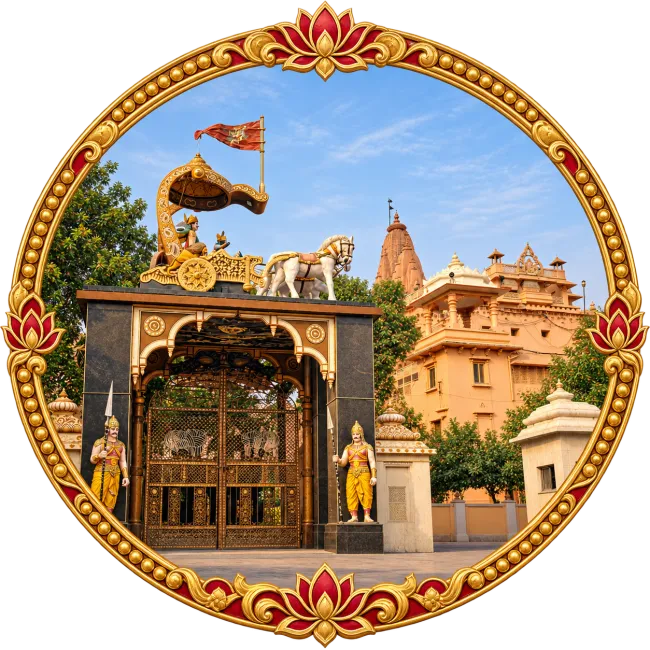
Shri Krishna Janmabhoomi Temple Mathura
Visit Shri Krishna Janmabhoomi Temple in Mathura, one of the most sacred pilgrimage destinations associated with Lord Krishna. The temple complex marks the traditional birthplace of Lord Krishna, where he is believed to have appeared in the prison of King Kansa as the eighth child of Devaki and Vasudeva. The complex includes the sacred Garbha Griha, Keshavdev Temple, Bhagavata Bhavan, Yogmaya Temple, Giriraj Ji Temple, and other shrines.
About Shri Krishna Janmabhoomi Temple
Shri Krishna Janmabhoomi, also known as Shri Krishna Janmasthan, is situated in the heart of Mathura, Uttar Pradesh. Mathura is one of Hinduism’s seven sacred cities and is internationally recognised as the birthplace of Lord Krishna.
The spiritual centre of the temple complex is the Garbha Griha, a chamber traditionally identified as the prison cell in which Lord Krishna appeared at midnight. According to Hindu tradition, King Kansa imprisoned his sister Devaki and her husband Vasudeva after hearing a prophecy that Devaki’s eighth child would cause his death.
Lord Krishna was born within the prison, but the guards fell asleep, the chains and prison doors opened, and Vasudeva carried the newborn child across the Yamuna River to Gokul. He exchanged Krishna with the newborn daughter of Nanda and Yashoda and returned to the prison.
The temple complex preserves the memory of this divine event through daily worship, aartis, bhog services, religious discourses, and grand festivals. Krishna Janmashtami is the most important celebration, attracting an enormous number of devotees from India and other countries.
History of Shri Krishna Janmabhoomi Temple
Shri Krishna Janmabhoomi has a long history of construction, destruction, and rebuilding. Religious tradition, inscriptions, historical accounts, and archaeological remains indicate that the site has been associated with the worship of Vasudeva-Krishna for centuries.
First Temple by Vajranabha
According to temple tradition, the first shrine at Lord Krishna’s birthplace was constructed by Vajranabha, the great-grandson of Lord Krishna. He is believed to have established several sacred images and temples at places associated with Krishna’s life in the Braj region.
This earliest shrine marked the place where Krishna was believed to have appeared before Devaki and Vasudeva.
Temple of Vasudeva-Krishna
An ancient inscription connected with a devotee named Vasu records the construction of a gateway and a sacred railing for a temple dedicated to Bhagavan Vasudeva. The inscription belongs to the early period of the Common Era and confirms that organised Vasudeva-Krishna worship existed in Mathura at that time.
Archaeological exploration in and around Katra Keshavdev has also uncovered ancient pottery, terracotta objects, sculptures, and architectural remains.
Reconstruction by Jajja
A Sanskrit inscription dated to 1150 records the construction of a Vishnu temple at Katra Keshavdev. The temple was built by a person named Jajja during the reign of Maharaja Vijayapala Deva.
This medieval temple became an important centre of Krishna worship before undergoing destruction during subsequent political conflicts.
Temple Built by Raja Veer Singh Deo Bundela
During the reign of Mughal emperor Jahangir, Raja Veer Singh Deo Bundela of Orchha constructed a grand Keshavdev Temple at the site in 1618. Built with red sandstone, the temple was considered one of the most magnificent religious structures of its time.
The structure was demolished in 1670 during the reign of Aurangzeb. The Shahi Eidgah was subsequently constructed beside and partly over the area associated with the earlier temple complex.
Modern Revival of Krishna Janmasthan
In 1815, the Katra Keshavdev property was purchased at an auction by Raja Patnimal of Banaras. During the 20th century, Pandit Madan Mohan Malaviya visited the sacred site and desired its restoration.
Industrialist and philanthropist Jugal Kishore Birla supported the project and purchased the Katra Keshavdev property in 1944. The Shri Krishna Janmabhoomi Trust was established on 21 February 1951 to oversee the restoration and development of the sacred site.
The Shri Krishna Janmasthan Seva Sansthan was later formed to manage worship, festivals, pilgrim services, and other activities within the complex.
Who Built the Present Temple and When?
The current Krishna Janmasthan complex was developed during the 20th century through the combined efforts of Pandit Madan Mohan Malaviya, Jugal Kishore Birla, Ramkrishna Dalmia, Jaidayal Dalmia, and numerous devotees.
The present Keshavdev Temple was built by industrialist Ramkrishna Dalmia in memory of his mother, Jadiadevi Dalmia. It was completed and opened for worship in 1958.
Construction of the Bhagavata Bhavan began on 11 February 1965. The consecration ceremony of its sacred deities was held on 12 February 1982. The completed Bhagavata Bhavan became one of the main attractions of the modern temple complex.
Therefore, the present complex does not belong to a single construction date. It represents different historical phases, beginning with the traditional shrine established by Vajranabha and continuing through the medieval temples and the modern reconstruction undertaken between the 1950s and 1982.
Religious Significance of Krishna Janmabhoomi
Shri Krishna Janmabhoomi is revered as the place where Lord Vishnu appeared in his eighth incarnation as Lord Krishna. It is one of the most sacred Vaishnava pilgrimage destinations in India.
The Garbha Griha is believed to mark the exact area of Kansa’s prison where Krishna appeared before Devaki and Vasudeva. Devotees regard the chamber as a place of divine liberation because Krishna’s birth brought an end to fear, injustice, and tyranny.
Pilgrims visit the temple to pray for:
- Devotion to Lord Krishna
- Peace and happiness within the family
- Protection of children
- Freedom from fear and anxiety
- Success in education and career
- Strength during difficult circumstances
- Relief from obstacles
- Prosperity and wellbeing
- Spiritual wisdom
- Liberation from negative tendencies
The site is also significant because it brings together several aspects of Krishna worship, including Bal Krishna, Keshavdev, Radha-Krishna, Yogmaya, Giriraj Ji, and the teachings of the Bhagavad Gita and Shrimad Bhagavatam.
Main Temples inside the Krishna Janmasthan Complex
Garbha Griha
The Garbha Griha is the spiritual heart of Shri Krishna Janmabhoomi. It is traditionally identified as the prison chamber where Lord Krishna was born.
The chamber has a simple and deeply devotional atmosphere. A raised sacred platform marks the birthplace. Religious paintings and representations illustrate the appearance of Lord Krishna before Devaki and Vasudeva.
Unlike a conventional temple sanctum, the Garbha Griha preserves the appearance of an ancient underground chamber. Devotees offer prayers, bow before the sacred platform, and remember Krishna’s divine birth.
Keshavdev Temple
Keshavdev is one of the principal names of Lord Krishna. The present Keshavdev Temple was completed in 1958 and serves as an important centre of daily worship.
Mangala Aarti, bhog services, Rajbhog Aarti, evening aarti, and Shayan Aarti are performed here. The temple becomes especially beautiful during Janmashtami, Holi, and other Krishna festivals.
Bhagavata Bhavan
Bhagavata Bhavan is one of the largest structures in the complex. Its construction began in 1965, and the consecration ceremony was completed in 1982.
The main shrine contains approximately six-foot-tall images of Shri Radha and Krishna. Other shrines include:
- Lord Jagannath, Balabhadra, and Subhadra
- Lord Rama, Goddess Sita, and Lakshmana
- Lord Hanuman
- Goddess Durga
- Lord Shiva
- Shri Chaitanya Mahaprabhu
- Garuda
The walls of the parikrama path contain the complete text of the Bhagavad Gita engraved on copper plates. The ceilings, pillars, and walls display paintings depicting Krishna’s life, devotees, saints, and important events from Hindu scriptures.
Yogmaya Temple
The Yogmaya Temple is dedicated to the divine girl born to Yashoda and exchanged with Krishna after his birth. When Kansa attempted to kill her, she manifested in her eight-armed divine form and warned him that the child destined to destroy him had already been born elsewhere.
The shrine is situated close to the entrance of the sacred prison chamber.
Giriraj Ji Temple
Giriraj Ji represents Govardhan Hill, which Lord Krishna lifted to protect the residents of Braj from torrential rain. Devotees worship Giriraj Ji and pray for protection, devotion, and the strength to overcome difficulties.
Architecture of Shri Krishna Janmabhoomi
The temple complex combines modern North Indian temple architecture with elements inspired by ancient Braj traditions. Red sandstone, marble, carved pillars, high ceilings, painted panels, devotional sculptures, and traditional shikharas define its appearance.
The Garbha Griha has a restrained design that reflects its identity as an ancient prison chamber. Bhagavata Bhavan, in contrast, is a large and elaborately decorated structure designed to accommodate many devotees.
Important architectural and artistic features include:
- The underground-style birth chamber
- Marble flooring and sacred platforms
- Red sandstone construction
- Large prayer halls
- Images of Radha and Krishna
- Paintings depicting Krishna’s life
- Bhagavad Gita verses engraved on copper plates
- Shrines dedicated to several Hindu deities
- Spacious parikrama paths
- Decorative ceilings, pillars, and arches
The temple’s architecture is intended not only for worship but also for presenting the life, teachings, and divine activities of Lord Krishna.
Shri Krishna Janmabhoomi Temple Timings
The Garbha Griha and the other temples within the complex follow different schedules.
Summer Darshan Timings
Winter Darshan Timings
The Garbha Griha may remain available for continuous darshan for longer hours than Keshavdev Temple, Bhagavata Bhavan, Yogmaya Temple, and Giriraj Ji Temple.
Festival timings are different from the regular schedule. On Janmashtami, Holi, Radhashtami, and other major occasions, entry routes, aarti times, darshan arrangements, and closing times are modified for crowd management.
Puja, Bhog and Aarti Timings
Summer Schedule
Winter Schedule
Devotees should reach the security checkpoint at least 45 minutes before their preferred aarti. Entry can take longer on weekends, Ekadashi, public holidays, and festival days.
Best Time for Darshan
The best morning darshan time is between 7:00 AM and 9:00 AM. During these hours, devotees can attend the morning worship and visit the major shrines before the crowd becomes heavy.
The best evening darshan time is:
- Summer: 4:30 PM – 6:30 PM
- Winter: 3:30 PM – 5:30 PM
Visitors who want a peaceful darshan should avoid weekends, public holidays, Janmashtami, Holi, and the busiest hours of the evening.
Krishna Janmashtami Celebration
Krishna Janmashtami is the largest festival celebrated at Shri Krishna Janmabhoomi. The entire complex is decorated with flowers, lights, fabrics, and special tableaux depicting events from Krishna’s life.
The principal celebration takes place at midnight, the traditional time of Krishna’s birth. Important rituals include:
- Panchamrit Mahabhishek
- Midnight birth ceremony
- Shringar of Bal Krishna
- Special Janmotsav Aarti
- Recitation of Vedic mantras
- Bhagavat Katha
- Jhulan ceremony
- Bhajan and kirtan
- Distribution of Panchamrit and prasad
- Nandotsav celebrations
The regular temple schedule should not be followed on Janmashtami. Special entry routes, restricted zones, barricades, and crowd-control arrangements are introduced for the festival.
Other Important Festivals
Major festivals celebrated at the temple include:
- Holi
- Radhashtami
- Govardhan Puja
- Annakoot
- Nandotsav
- Sharad Purnima
- Diwali
- Gita Jayanti
- Akshaya Tritiya
- Basant Panchami
- Jhulan Yatra
- Kartik Purnima
Holi is celebrated with colours, flowers, devotional songs, and traditional Braj festivities. During Govardhan Puja and Annakoot, a large variety of food preparations is offered to Lord Krishna.
Offerings and Prasad
Common offerings include:
- Flowers and garlands
- Tulsi leaves
- Butter and mishri
- Milk products
- Fruits
- Peda
- Dry fruits
- Yellow clothes
- Peacock feathers
- Flutes
- Religious ornaments
Mathura peda is one of the most popular forms of prasad. Devotees should purchase offerings from authorised counters and follow security instructions concerning items allowed inside the complex.
Entry Fee and Visit Duration
General entry to Shri Krishna Janmabhoomi Temple is free.
A complete visit generally requires 1.5 to 2.5 hours because the complex contains several temples and involves multiple security checks. On weekends and festivals, devotees may require 3 hours or more.
No payment should be made to unauthorised individuals promising special or faster darshan.
Security Rules and Prohibited Items
Shri Krishna Janmabhoomi is a high-security religious complex. Visitors undergo metal-detector screening and physical checking before entry.
Items generally prohibited inside include:
- Mobile phones
- Cameras and video equipment
- Smartwatches and electronic devices
- Bags, backpacks, and suitcases
- Earphones and power banks
- Food and beverages
- Weapons and sharp objects
- Tobacco, cigarettes, and intoxicants
- Leather bags and other restricted leather articles
Rules concerning wallets, belts, keys, pens, and small personal belongings may be enforced according to the security arrangements in effect on the day of the visit.
Visitors should carry as few belongings as possible. Deposit restricted articles at the authorised cloakroom before joining the security queue. Photography and videography are prohibited within the secured temple complex.
A valid photo identity document should be carried in case security personnel request it.
Visitor Guidelines
- Wear modest and respectful clothing.
- Carry only essential items.
- Deposit electronic devices before entering.
- Follow the designated entry and exit routes.
- Cooperate with all security checks.
- Maintain silence inside the Garbha Griha.
- Do not touch the sacred platform or deities.
- Avoid carrying food into the complex.
- Follow the queue without pushing.
- Keep children and elderly visitors close.
- Do not photograph restricted areas.
- Use only authorised donation and prasad counters.
- Arrive early during weekends and festivals.
How to Reach Shri Krishna Janmabhoomi
By Train
Mathura Junction is the nearest major railway station and is approximately 3 to 4 kilometres from the temple. It is well connected with Delhi, Agra, Jaipur, Mumbai, Ahmedabad, Kolkata, Varanasi, and several other cities.
Auto-rickshaws, e-rickshaws, and taxis are available from the station.
By Road
Mathura is connected with Delhi, Agra, Noida, Faridabad, Jaipur, Bharatpur, and nearby cities. National Highway 19 and the Yamuna Expressway provide convenient road access.
UPSRTC buses and private buses operate regularly to Mathura. Local e-rickshaws and auto-rickshaws can be used to reach Janmabhoomi Marg.
By Air
Agra Airport is the nearest operational airport. Delhi’s Indira Gandhi International Airport provides wider domestic and international connectivity.
Travellers can reach Mathura from Delhi by train, bus, taxi, or the Yamuna Expressway.
Nearby Places to Visit
Visitors may also explore:
- Dwarkadhish Temple
- Vishram Ghat
- Potra Kund
- Bhuteshwar Mahadev Temple
- Kans Qila
- Gita Mandir
- Raman Reti
- Gokul
- Mahavan
- Govardhan Hill
- Prem Mandir
- Banke Bihari Temple
- ISKCON Temple Vrindavan
Conclusion
Shri Krishna Janmabhoomi is more than a temple—it is the sacred centre of Krishna devotion in Mathura. The Garbha Griha preserves the memory of Krishna’s divine birth, while Keshavdev Temple, Bhagavata Bhavan, Yogmaya Temple, and Giriraj Ji Temple present different aspects of his life and teachings.
The site’s history extends from the traditional shrine built by Vajranabha to the medieval Keshavdev temples and the modern complex developed through the efforts of Pandit Madan Mohan Malaviya, Jugal Kishore Birla, and the Dalmia family.
Whether a devotee comes to attend Mangala Aarti, visit the sacred prison chamber, participate in Janmashtami, study the Bhagavad Gita inscriptions, or simply experience the atmosphere of Krishna’s birthplace, Shri Krishna Janmabhoomi offers a deeply meaningful spiritual experience.