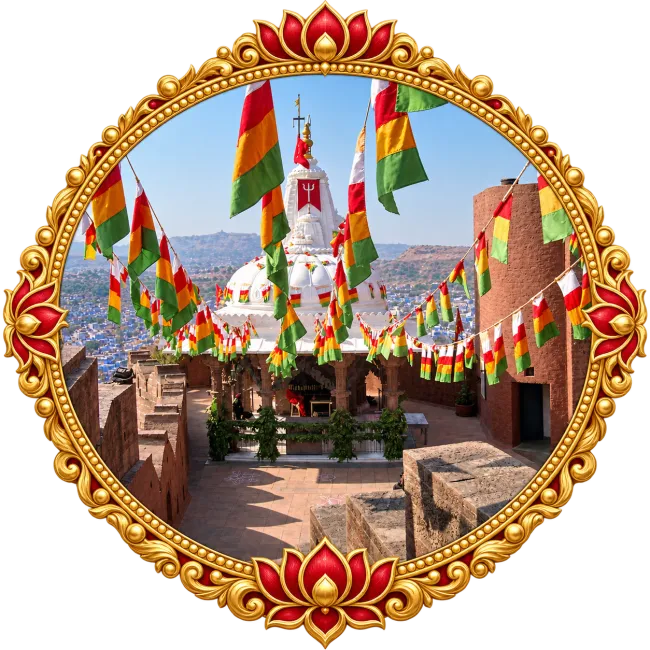
Chamunda Mata Temple
Visit Chamunda Mata Temple in Jodhpur, a revered Shakti shrine situated at the southern end of the magnificent Mehrangarh Fort. Dedicated to Goddess Chamunda, a powerful manifestation of Goddess Durga, the temple is closely connected with the history of the Rathore rulers of Marwar. Rao Jodha brought the sacred idol from Mandore and installed it at Mehrangarh Fort in 1460. The goddess is worshipped as the Ishta Devi of the Jodhpur royal family and the protective deity of the city.
About Chamunda Mata Temple, Jodhpur
Chamunda Mata Temple is located within Mehrangarh Fort, one of Rajasthan’s largest and most impressive forts. The shrine stands close to the southern ramparts and offers panoramic views of Jodhpur’s blue-painted houses, historic old city and surrounding desert landscape.
The temple is dedicated to Goddess Chamunda, a fierce and protective form of Adi Shakti. She is associated with courage, protection, divine justice and victory over negative forces. Devotees affectionately call her Chamunda Mata Ji.
Goddess Chamunda was originally worshipped by the Parihar rulers of Mandore. After Rao Jodha established Jodhpur and began constructing Mehrangarh Fort, he brought the goddess’s idol from Mandore and installed it inside the new fort.
The shrine subsequently became closely associated with the Rathore royal family. The rulers of Marwar sought Mata Ji’s blessings before battles, coronations and important royal occasions. Even today, members of the former royal family and local residents worship Chamunda Mata as the divine protector of Jodhpur.
The temple becomes especially crowded during Chaitra Navratri, Sharadiya Navratri and Dussehra. Thousands of devotees climb to Mehrangarh Fort to offer prayers, participate in aarti and seek the blessings of Mata Ji.
History of Chamunda Mata Temple
The history of Chamunda Mata Temple is connected with Rao Jodha, the founder of Jodhpur. Before Jodhpur was established, Mandore served as the capital of the Rathore rulers of Marwar.
Rao Jodha founded the city of Jodhpur in 1459 and began developing Mehrangarh Fort on Bhaurcheeria Hill. As part of establishing his new capital, he brought the sacred idol of Chamunda Mata from Mandore in 1460.
The goddess had been worshipped by the earlier Parihar rulers of Mandore. Rao Jodha accepted Chamunda Mata as his Ishta Devi and installed her idol inside Mehrangarh Fort. A shrine was constructed at the southern end of the fort, from where the goddess was believed to protect the royal family, the fort and the entire city.
The Rathore rulers regularly worshipped Chamunda Mata and sought her blessings before military campaigns and important decisions. Over time, the goddess’s worship extended beyond the royal family, and residents of Jodhpur began regarding her as the guardian deity of their city.
The temple has witnessed several phases of repair and development over the centuries. However, it continues to retain its historical identity as a fifteenth-century shrine within Mehrangarh Fort.
In 2008, a tragic stampede took place near the temple during the first day of Navratri. Following the incident, additional crowd-management and security arrangements were introduced. Visitors should follow designated queues, avoid rushing and comply with instructions issued by the temple and fort authorities.
Who Built Chamunda Mata Temple?
Chamunda Mata Temple was established by Rao Jodha in 1460. Rao Jodha was the founder of Jodhpur and the ruler responsible for beginning the construction of Mehrangarh Fort.
He brought the idol of Goddess Chamunda from Mandore, the former capital of Marwar, and installed it at the southern end of Mehrangarh Fort. The shrine was established to honour the goddess as his personal deity and the protector of the newly founded city.
Although the temple has undergone repairs and improvements under later Rathore rulers, its foundation and the installation of the principal deity are credited to Rao Jodha.
Religious Significance of Chamunda Mata Temple
Goddess Chamunda is worshipped as a powerful form of Goddess Durga. According to Hindu religious tradition, the name Chamunda is derived from Chanda and Munda, two powerful demons defeated by the goddess.
Chamunda Mata represents the destruction of arrogance, fear, injustice and negative forces. Her fierce appearance symbolises divine power used to protect devotees and restore righteousness.
At Mehrangarh Fort, Chamunda Mata holds three important religious identities:
- Ishta Devi of Rao Jodha
- Royal deity of the Rathore rulers
- Guardian goddess of Jodhpur
Devotees believe that Mata Ji protects them from danger, removes fear and provides courage during difficult situations. Families visit the temple to pray for health, prosperity, marital happiness, children and success in important work.
Many devotees offer a red chunari, coconut and shringar after their prayers are fulfilled. Some families also organise special puja during Navratri or before auspicious occasions.
Architecture of Chamunda Mata Temple
Chamunda Mata Temple has a relatively modest architectural design compared with the massive palaces and courtyards of Mehrangarh Fort. Its importance lies primarily in its religious history, sacred deity and dramatic position overlooking Jodhpur.
The temple is constructed using locally available stone, allowing it to blend naturally with the fort’s walls and ramparts. The main sanctum contains the sacred idol of Chamunda Mata, decorated with garments, jewellery, flowers, sindoor and a traditional crown.
The temple complex contains:
- Main sanctum of Chamunda Mata
- Small prayer and gathering areas
- Bells offered by devotees
- Platforms used during religious ceremonies
- Fort ramparts overlooking Jodhpur
- Pathways connecting the temple with the fort museum
The shrine’s elevated location reinforces the goddess’s identity as the protector of the city. From the surrounding ramparts, visitors can see the famous blue houses of Jodhpur, Jaswant Thada, the old city and the distant desert landscape.
The temple can be approached through the fort’s rampart trail. Visitors pass through historic gateways, courtyards and museum sections before reaching the shrine.
Chamunda Mata Temple Timings
Temple worship hours and general tourist access through Mehrangarh Fort follow different schedules. Devotees using authorised religious access may be allowed during the temple’s extended worship hours, while regular tourists generally enter according to the fort and museum schedule.
Temple Worship and Darshan Timings
Mehrangarh Fort Visitor Timings
Regular tourists should plan their visit between 9:00 AM and 5:00 PM because the temple is situated within the controlled Mehrangarh Fort complex. Early-morning and post-fort-hours access may be regulated separately for local devotees.
During Navratri, the temple may remain open until 10:00 PM under special crowd-management arrangements. Timings can change during festivals and royal or religious ceremonies.
Best Time for Darshan
For regular visitors entering through Mehrangarh Fort, the best time for darshan is between 9:00 AM and 11:00 AM. The weather is comparatively comfortable and the fort is usually less crowded than during the afternoon.
Local devotees wishing to attend the morning aarti should reach the designated religious entry before 8:30 AM and follow the access instructions issued by temple authorities.
The evening aarti takes place 20 minutes before sunset. Because sunset time changes throughout the year, devotees should confirm the day’s aarti schedule at the temple or fort entrance.
October to March is the best season to visit Jodhpur because the weather is cooler. Summer afternoons can be extremely hot, particularly on the exposed pathways and ramparts of Mehrangarh Fort.
Navratri offers the most devotional atmosphere but also attracts very large crowds. Visitors looking for peaceful darshan should choose a regular weekday instead.
Daily Puja and Aarti
Daily worship begins with the opening of the sanctum and preparation of the deity. Mata Ji is bathed ceremonially, dressed in sacred garments and decorated with jewellery, flowers, sindoor and a crown.
Morning aarti is performed at 8:30 AM. Priests offer lamps, incense, flowers and prayers while devotees sing traditional hymns in praise of Chamunda Mata.
Bhog is offered to the goddess during the day. The form of prasad may vary according to the occasion and temple arrangements.
Evening aarti is conducted 20 minutes before sunset. The ceremony is particularly beautiful because the lamps inside the shrine are illuminated as the sun sets over Jodhpur. The sound of bells and chanting combines with the panoramic city view to create a memorable devotional experience.
Popular prayers recited by devotees include:
- Durga Chalisa
- Chamunda Mata Aarti
- Devi Kavach
- Argala Stotram
- Durga Saptashati verses
- Navarna Mantra
- Om Aim Hreem Kleem Chamundayai Vichche
Major Festivals Celebrated at the Temple
Sharadiya Navratri
Sharadiya Navratri is the most important festival at Chamunda Mata Temple. The shrine is decorated with flowers, colourful fabrics and lights. Thousands of devotees visit throughout the nine days.
Special aarti, bhajans, puja and religious programmes are organised. Queue barriers, security checks and separate routes may be arranged to manage the crowds.
Chaitra Navratri
Chaitra Navratri is also celebrated with special worship. Devotees observe fasts and offer chunari, coconuts, flowers and shringar items to Mata Ji.
Dussehra
Dussehra holds special importance because Chamunda Mata is associated with divine victory over negative forces. Members of the royal family have traditionally worshipped the goddess on this occasion.
Durga Ashtami and Navami
Durga Ashtami and Navami attract a large number of devotees. Special puja, havan and kanya pujan may be organised as part of the Navratri celebrations.
Diwali
During Diwali, lamps are lit in the temple, and devotees pray for protection, happiness and prosperity.
Offerings and Prasad
Devotees offer traditional Shakti worship materials to Chamunda Mata.
Common offerings include:
- Red chunari
- Coconut
- Flowers and garlands
- Sindoor
- Bangles
- Red sacred thread
- Fruits
- Sweets
- Incense sticks
- Ghee for lamps
- Mata Ji’s shringar items
Prasad is distributed after worship according to temple arrangements. Devotees should use authorised counters and avoid paying unauthorised individuals for special darshan or puja.
During Navratri, visitors should carry only the permitted quantity of offerings because security and crowd-control restrictions may apply.
Entry Fee and Visit Duration
There is no separate fee for worshipping at Chamunda Mata Temple. However, regular visitors entering through the Mehrangarh Fort museum route must purchase the applicable fort ticket.
Current general fort admission charges include:
Ticket rates may be revised by the Mehrangarh Museum Trust. Children up to the prescribed age may receive free entry under the applicable rules.
A temple-only visit through the regular fort route requires one to two hours. Visitors exploring the complete fort, museum galleries, palaces, ramparts and temple should reserve three to four hours.
How to Reach Chamunda Mata Temple
By Air
Jodhpur Airport is approximately 7 kilometres from Mehrangarh Fort. Taxis and app-based cabs are available outside the airport.
By Train
Jodhpur Junction is approximately 5 kilometres from the fort. Auto-rickshaws, taxis and local vehicles are readily available outside the station.
By Road
Jodhpur is connected with Jaipur, Jaisalmer, Udaipur, Bikaner, Ajmer, Ahmedabad and Delhi by government and private buses.
Mehrangarh Fort can be reached by taxi, auto-rickshaw or private vehicle. The final approach road is steep and winding, so visitors should use a vehicle in good condition.
Inside Mehrangarh Fort
After entering the fort, visitors can follow the museum and rampart trail to reach Chamunda Mata Temple. An elevator is available for part of the ascent, but some walking and steps may still be required.
Nearby Places to Visit
Mehrangarh Fort
The temple is situated inside Mehrangarh Fort. Visitors can explore Moti Mahal, Phool Mahal, Sheesh Mahal, royal galleries, historic weapons and decorated courtyards.
Jaswant Thada
Jaswant Thada is a beautiful white-marble memorial constructed in memory of Maharaja Jaswant Singh II. It is located close to the fort.
Rao Jodha Desert Rock Park
This ecological park showcases the natural vegetation and rocky landscape of the Thar Desert.
Clock Tower and Sardar Market
The historic Clock Tower and colourful Sardar Market are popular for spices, textiles, handicrafts and traditional snacks.
Mandore Gardens
Mandore Gardens contains historic cenotaphs, temples and monuments connected with the former capital of Marwar. It is also associated with the original location of Chamunda Mata’s idol.
Umaid Bhawan Palace
Umaid Bhawan Palace is one of Jodhpur’s most prominent landmarks and contains a museum displaying royal artefacts.
Visitor Guidelines
- Wear modest clothing suitable for a religious place.
- Remove footwear before entering the temple.
- Follow the official route and security instructions.
- Do not rush or push in the queue.
- Avoid carrying large bags during Navratri.
- Keep children and elderly family members close in crowded areas.
- Do not touch the deity or sacred objects without permission.
- Photography may be restricted inside the sanctum.
- Use authorised counters for tickets, donations and offerings.
- Carry drinking water, particularly during summer.
- Wear comfortable footwear for walking inside the fort.
- Avoid exposed ramparts during extreme heat.
- Confirm evening aarti access because fort visitor gates normally close at 5:00 PM.
- Visitors with mobility difficulties may use the fort elevator, but some walking is still required.
- Follow special crowd-control arrangements during Navratri and Dussehra.
Conclusion
Chamunda Mata Temple is one of Jodhpur’s most historically and spiritually important shrines. Established by Rao Jodha in 1460 after he brought the sacred idol from Mandore, the temple has remained closely connected with the Rathore rulers and the people of Marwar.
Goddess Chamunda is worshipped as the Ishta Devi of the royal family and the guardian deity of Jodhpur. Her temple’s location on the southern ramparts of Mehrangarh Fort symbolises divine protection over the fort and the Blue City below.
The combination of Shakti worship, fifteenth-century history, royal traditions and panoramic city views makes Chamunda Mata Temple a memorable destination. Visitors can seek Mata Ji’s blessings while also exploring the magnificent palaces, galleries and ramparts of Mehrangarh Fort.