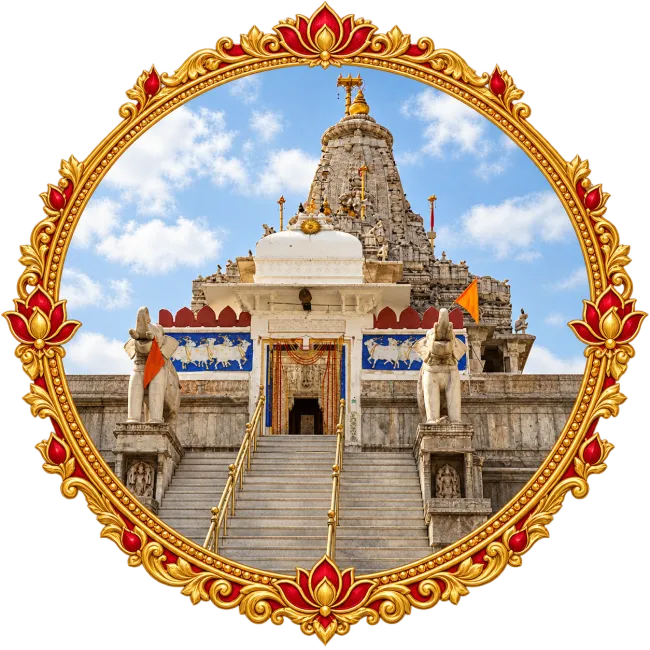
Jagdish Temple, Udaipur
Visit Jagdish Temple in Udaipur, one of Rajasthan’s most magnificent and historically important temples dedicated to Lord Vishnu. Located near the City Palace in the heart of Udaipur’s old city, the temple is admired for its towering shikhara, carved pillars, detailed stone sculptures and peaceful spiritual atmosphere. Built in 1651 by Maharana Jagat Singh I, it remains an active place of worship and an outstanding example of Indo-Aryan and Maru-Gurjara temple architecture.
About Jagdish Temple, Udaipur
Jagdish Temple is a famous Hindu temple situated at Jagdish Chowk, close to the Badi Pol entrance of the Udaipur City Palace. The temple is dedicated to Lord Vishnu, worshipped here as Jagannath Rai or Jagdish Ji, meaning the Lord of the Universe.
The temple was originally known as Jagannath Rai Temple. Over time, it became popularly known as Jagdish Temple, partly because it was constructed during the reign of Maharana Jagat Singh I.
The main sanctum contains an impressive four-armed image of Lord Vishnu carved from a single piece of black stone. The deity holds the traditional symbols associated with Vishnu and is beautifully decorated with garments, jewellery, flowers and sacred ornaments during daily worship.
Jagdish Temple has remained an active place of worship since its completion in the seventeenth century. It is also one of the largest and most architecturally significant temples in Udaipur. Its central location allows visitors to combine their temple visit with the City Palace, Lake Pichola, Bagore Ki Haveli and other historic attractions.
History of Jagdish Temple
Jagdish Temple was constructed in 1651 during the reign of Maharana Jagat Singh I, who ruled Mewar from 1628 to 1652. Maharana Jagat Singh I belonged to the Sisodia dynasty, which played an important role in protecting and developing the religious and cultural heritage of Mewar.
The temple was commissioned as a grand place of worship dedicated to Lord Vishnu. It is believed that approximately 1.5 million rupees were spent on its construction, which was an enormous amount during the seventeenth century. Skilled architects, sculptors and stone artisans were employed to create the three-storey structure, its towering shikhara and hundreds of detailed carvings.
The temple was originally called Jagannath Rai Temple. The name referred to Lord Vishnu as the Lord of the Universe. In later years, the temple came to be known as Jagdish Temple.
During the Mughal invasion of Mewar in 1680, the temple faced a serious threat. Traditional accounts remember Naru Ji Barhath and his companions for defending the temple against Mughal forces. A painting and inscription associated with their sacrifice can be seen within the temple premises.
Despite periods of political conflict, the temple survived and remained an important centre of Vaishnava worship. The rulers of Mewar and the people of Udaipur continued to protect and maintain it.
Today, Jagdish Temple is more than 375 years old and continues to serve as a major religious and cultural landmark. Regular puja, aarti, festivals and devotional ceremonies are performed according to established Vaishnava traditions.
Who Built Jagdish Temple?
Jagdish Temple was built by Maharana Jagat Singh I of Mewar in 1651. He commissioned the temple during his reign and dedicated it to Lord Vishnu.
The temple was designed as a royal shrine close to the City Palace. Its grand scale, elevated platform and intricate sculptures reflect both the devotion of Maharana Jagat Singh I and the artistic excellence of seventeenth-century Mewar.
Although the names of all individual architects and artisans are not widely documented, the structure demonstrates the advanced skills of Rajasthan’s traditional stone carvers. Its artistic design incorporates features of Indo-Aryan, Nagara and Maru-Gurjara architecture.
Religious Significance of Jagdish Temple
Jagdish Temple is dedicated to Lord Vishnu, who is regarded as the preserver and protector of the universe. The name Jagdish combines “Jagat,” meaning the universe, and “Ish,” meaning Lord. Therefore, Jagdish means Lord of the Universe.
The four-armed black-stone deity in the main sanctum represents Lord Vishnu. Devotees pray here for peace, prosperity, protection, family welfare and spiritual progress.
The deity’s four arms symbolise divine power and Lord Vishnu’s control over the different directions of the universe. His traditional symbols represent righteousness, spiritual awakening, protection and the destruction of negative forces.
A brass image of Garuda, the divine vehicle and devoted follower of Lord Vishnu, stands in front of the main shrine. Garuda is shown facing the sanctum in a posture of complete devotion.
The temple follows the Panchayatana arrangement, in which the main deity is surrounded by four subsidiary shrines. These shrines are associated with Lord Shiva, Goddess Shakti, Lord Ganesha and Surya Dev. This arrangement represents harmony among different traditions within Hinduism.
Architecture of Jagdish Temple
Jagdish Temple is an outstanding example of Indo-Aryan and Maru-Gurjara architecture. It stands on a high raised platform and dominates the skyline of Udaipur’s old city.
Visitors must climb 32 marble steps to reach the main temple platform. Near the top of the staircase is a brass image of Garuda facing Lord Vishnu’s sanctum.
The temple is a three-storey structure with a richly decorated shikhara rising above the main sanctum. The main spire is approximately 79 feet high and can be seen from several points in the surrounding old city.
The exterior walls are covered with detailed stone carvings portraying:
- Hindu gods and goddesses
- Musicians playing traditional instruments
- Dancers in graceful poses
- Elephants and horses
- Floral and geometric designs
- Celestial beings
- Scenes connected with Hindu religious traditions
Rows of carved elephants can be seen near the lower part of the temple. They symbolically appear to support the massive structure. Above them are sculptures of horsemen, musicians, dancers and divine figures.
The central mandapa contains carved pillars, decorated ceilings and spaces where devotees gather for aarti and prayer. The main sanctum is connected to the mandapa and contains the black-stone image of Lord Vishnu.
The architecture balances religious symbolism with artistic detail. Every level of the temple contains sculptures that represent devotion, music, dance, nature and different aspects of life.
Main Deity and Other Shrines
The principal deity is a four-armed image of Lord Vishnu carved from a single piece of black stone. The idol is decorated differently throughout the day according to the scheduled worship ceremony.
The four smaller shrines surrounding the main sanctum are dedicated to:
- Lord Ganesha
- Lord Shiva
- Goddess Shakti
- Surya Dev
The brass Garuda image is another important attraction. Since Garuda is the vehicle and devoted servant of Lord Vishnu, the statue faces the main sanctum with folded hands.
Together, these shrines form a balanced sacred complex in which Lord Vishnu occupies the central position.
Jagdish Temple Timings
Jagdish Temple generally opens in two daily sessions. A short afternoon closure takes place between the morning and evening darshan periods.
Aarti and darshan timings may be adjusted during major festivals, seasonal changes and special temple ceremonies.
Best Time for Darshan
The best time for a peaceful darshan is between 6:00 AM and 7:30 AM. The atmosphere is calm, the temperature is comfortable and the temple receives fewer tourists during this period.
Devotees who wish to attend the first prayer of the day should arrive before 4:30 AM for Mangala Aarti. The Mangala Aarti provides an opportunity to see the deity during the sacred early-morning worship.
For those interested in the temple’s decorated form, the period after Shringar Aarti is suitable. Visitors can come between 11:00 AM and 11:30 AM, before preparations begin for Rajbhog.
The evening period between 5:30 PM and 7:45 PM is ideal for attending Gwal and Sandhya Aarti. The sound of bells and devotional singing creates a beautiful atmosphere, although this is also a busy time.
October to March is the most comfortable season to visit Udaipur. Early morning and evening visits are recommended during summer.
Daily Puja and Aarti
Several aartis are performed at Jagdish Temple throughout the day. Each ceremony represents a different stage in the deity’s daily routine.
Mangala Aarti
Mangala Aarti is the first worship ceremony of the day. It is conducted from 4:30 AM to 5:00 AM and symbolically awakens the deity.
Dhoop Aarti
Dhoop Aarti takes place from 7:45 AM to 9:00 AM. Incense, lamps and prayers are offered to Lord Vishnu.
Shringar Aarti
Shringar Aarti is performed from 10:15 AM to 11:00 AM. During this ceremony, the deity is adorned with beautiful garments, ornaments, flowers and seasonal decorations.
Rajbhog Aarti
Rajbhog Aarti is conducted from 11:30 AM to 12:00 PM. A complete meal is ceremonially offered to Lord Vishnu before the afternoon rest period.
Gwal Aarti
Gwal Aarti takes place from 5:30 PM to 6:00 PM after the temple reopens. The ritual is connected symbolically with the return of the Lord after the afternoon period.
Sandhya Aarti
Sandhya Aarti is performed from 6:30 PM to 7:45 PM. It is one of the most popular ceremonies, featuring devotional chanting, bells, lamps and collective prayer.
Shayan Aarti
Shayan Aarti is the final ceremony of the day. It takes place from 8:15 PM to 8:45 PM and prepares the deity for the night’s rest.
Major Festivals Celebrated at Jagdish Temple
Jagannath Rath Yatra
Jagannath Rath Yatra is the most important annual celebration associated with Jagdish Temple. The deity is placed on a beautifully decorated chariot and taken through the streets of Udaipur.
Thousands of devotees participate in the procession. The route is decorated, devotional groups perform bhajans and people gather at Jagdish Chowk to receive the Lord’s blessings.
Janmashtami
Janmashtami celebrates the birth of Lord Krishna, an incarnation of Lord Vishnu. The temple is decorated with flowers and lights, and special prayers continue until midnight.
Diwali
During Diwali, the temple is illuminated with lamps. Devotees worship Lord Vishnu and Goddess Lakshmi for prosperity, peace and happiness.
Holi
Holi is celebrated with devotional songs, special decoration and traditional offerings. The festivities represent joy and the victory of devotion.
Ram Navami
Ram Navami celebrates the birth of Lord Rama, another incarnation of Lord Vishnu. Special recitations, bhajans and pujas are organised.
Vaikuntha Ekadashi and Other Ekadashis
Ekadashi days have special importance in Vaishnava worship. Devotees observe fasts, recite Vishnu mantras and attend the temple for darshan.
Offerings and Prasad
Devotees commonly offer flowers, tulsi leaves, fruits, sweets and sacred cloth to Lord Vishnu. Tulsi leaves are especially important in Vaishnava worship and are included in many offerings.
Common offerings include:
- Tulsi leaves
- Flowers and garlands
- Fruits
- Mishri
- Dry fruits
- Sweets
- Yellow cloth
- Ghee for lamps
- Donations for temple services
Prasad is distributed after selected worship ceremonies. Visitors should use authorised counters or follow the instructions of temple priests while presenting offerings.
Entry Fee and Visit Duration
There is no entry fee for regular darshan at Jagdish Temple. Devotees and tourists can enter the temple free of charge.
A normal visit requires 45 minutes to one hour. Visitors who wish to attend aarti, observe the architecture and visit all subsidiary shrines should keep one to two hours available.
The temple has 32 steps and does not provide easy access to the main platform for people with serious mobility difficulties. Senior citizens should climb slowly and use assistance when required.
How to Reach Jagdish Temple
By Air
Maharana Pratap Airport is the nearest airport and is situated approximately 23 kilometres from Jagdish Temple. Taxis and app-based cabs are available from the airport.
By Train
Udaipur City Railway Station is approximately 3 kilometres from the temple. Auto-rickshaws and taxis are available outside the station.
By Road
Udaipur is connected with Jaipur, Ahmedabad, Jodhpur, Kota, Chittorgarh and other cities by regular government and private buses.
Jagdish Temple is situated in the old city near the City Palace. The surrounding lanes are narrow, and vehicle access may be restricted. Walking or using a local auto-rickshaw is often more convenient.
Nearby Places to Visit
City Palace
The City Palace is located within walking distance of Jagdish Temple. It is known for its royal courtyards, balconies, museums and views of Lake Pichola.
Lake Pichola
Lake Pichola is one of Udaipur’s most famous lakes. Visitors can enjoy boat rides and views of Jag Mandir and the Lake Palace.
Bagore Ki Haveli
Bagore Ki Haveli is a historic mansion near Gangaur Ghat. It contains museum galleries and hosts traditional cultural performances.
Gangaur Ghat
Gangaur Ghat is a beautiful lakeside location close to the temple. It is especially attractive during sunrise and evening.
Saheliyon Ki Bari
Saheliyon Ki Bari is a historic garden known for fountains, lotus pools, marble pavilions and green surroundings.
Fateh Sagar Lake
Fateh Sagar Lake is a popular place for boating, sightseeing and evening walks.
Visitor Guidelines
- Wear modest clothing suitable for a religious place.
- Deposit footwear at the designated area before climbing the temple steps.
- Climb the 32 steps carefully, particularly during rain.
- Maintain silence near the main sanctum.
- Do not touch the deity, sculptures or sacred objects.
- Photography may be restricted inside the sanctum.
- Follow the queue and instructions provided by temple staff.
- Avoid carrying large bags into the temple.
- Use authorised counters for donations and offerings.
- Keep the temple stairs and surroundings clean.
- Visit early in the morning to avoid heavy tourist crowds.
- Respect worshippers during aarti and religious ceremonies.
- Check the festival schedule before visiting during Rath Yatra or Janmashtami.
Conclusion
Jagdish Temple is one of Udaipur’s finest combinations of devotion, history and architecture. Built by Maharana Jagat Singh I in 1651, the temple has remained an active centre of Lord Vishnu worship for more than three and a half centuries.
Its four-armed black-stone deity, 79-foot shikhara, 32 marble steps, brass Garuda image and intricate stone carvings reflect the religious and artistic heritage of Mewar. Daily ceremonies ranging from Mangala Aarti to Shayan Aarti allow devotees to experience different forms of traditional Vaishnava worship.
Located close to the City Palace and Lake Pichola, Jagdish Temple is easily included in an Udaipur sightseeing itinerary. Whether one visits for prayer, architecture, history or the grand Rath Yatra, the temple offers a memorable experience filled with spiritual devotion and the cultural richness of Rajasthan.