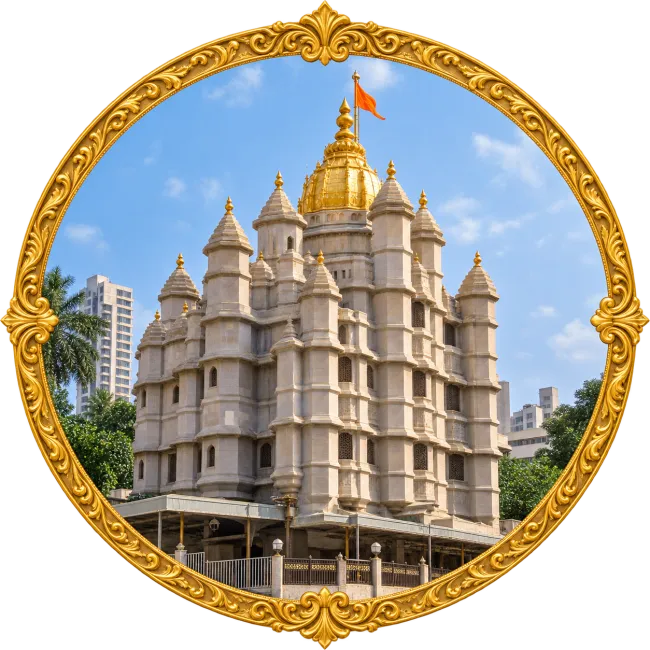
Siddhivinayak Temple, Mumbai
Visit Siddhivinayak Temple in Mumbai—one of India’s most revered temples dedicated to Lord Ganesha. Located in Prabhadevi, the temple is famous for its right-trunked black-stone idol, golden dome, daily aartis and belief in the wish-fulfilling blessings of Shri Siddhivinayak. Devotees visit the shrine to pray for success, wisdom, prosperity and the removal of obstacles.
About Siddhivinayak Temple, Mumbai
Shree Siddhivinayak Ganapati Mandir is located in Prabhadevi, Mumbai, Maharashtra. It is dedicated to Lord Ganesha, worshipped here in the powerful Siddhivinayak form.
The temple was originally consecrated on 19 November 1801. It was established through the devotion of Deubai Patil and constructed by Laxman Vithu Patil.
The original temple was a small structure containing a black-stone idol of Lord Ganesha. Over time, the shrine developed into a major pilgrimage centre visited by devotees from India and other countries.
The temple is presently administered by Shree Siddhivinayak Ganapati Temple Trust, which also undertakes medical, educational and charitable activities.
History of Siddhivinayak Temple
Siddhivinayak Temple was consecrated on Thursday, 19 November 1801. Deubai Patil, a wealthy and deeply religious woman, provided the support for its construction, while the temple was built by Laxman Vithu Patil.
According to temple tradition, Deubai Patil did not have children. She prayed that Lord Ganesha should bless other childless women and fulfil the sincere wishes of devotees visiting the shrine.
The original temple consisted of a small sanctum, a hall, an open courtyard and a water tank. As the temple’s reputation increased, the number of devotees also grew.
A major renovation began in 1990 and was completed within three years. The renovated temple was designed by architect Sharad Athale and constructed using marble and pink granite. The crown installation and Kumbhabhishek ceremony took place on 13 June 1994.
The sacred original idol remained undisturbed and was carefully preserved throughout the renovation.
Who Built Siddhivinayak Temple?
Siddhivinayak Temple was built by Laxman Vithu Patil with the support and devotion of Deubai Patil. The original shrine was consecrated on 19 November 1801.
The present multi-storeyed structure was designed by architect Sharad Athale of SK Athale & Associates. Its reconstruction began in 1990 and was completed in 1993, followed by the crown installation and Kumbhabhishek in June 1994.
Religious Significance of Siddhivinayak Temple
Lord Ganesha is traditionally worshipped before beginning a new task, business, journey, marriage or religious ceremony. He is known as Vighnaharta, the remover of obstacles, and Siddhivinayak, the giver of success and fulfilment.
Devotees visit Siddhivinayak Temple to pray for:
- Success in education and career
- Growth in business
- Marriage and family happiness
- Good health
- Protection during travel
- Peace and prosperity
- Removal of obstacles
- Fulfilment of sincere wishes
- Wisdom and spiritual progress
Tuesday is considered especially sacred for Lord Ganesha. The temple receives very large crowds on Tuesdays, Sankashti Chaturthi, Vinayaki Chaturthi and Angaraki Chaturthi.
Main Deity of Siddhivinayak Temple
The principal deity is Shri Siddhivinayak Ganapati. The sacred idol is carved from a single piece of black stone and measures 2.5 feet in height and 2 feet in width.
The idol’s trunk bends towards the right, which makes it different from most commonly worshipped Ganesha idols. Right-trunked Ganesha forms are considered spiritually powerful and are worshipped through disciplined rituals.
Lord Siddhivinayak has four hands:
- The upper-right hand holds a lotus.
- The upper-left hand holds an axe.
- The lower-right hand holds a rosary.
- The lower-left hand holds a bowl of modaks.
A sacred thread resembling a serpent appears across the deity’s body. An eye resembling Lord Shiva’s third eye is carved on Ganesha’s forehead.
The images of Riddhi and Siddhi are positioned on either side of Lord Ganesha. They represent prosperity, success, spiritual power and fulfilment.
Architecture of Siddhivinayak Temple
The present Siddhivinayak Temple is a multiangular, six-storeyed structure designed to accommodate large numbers of devotees.
Its architecture was inspired by traditional Indian temples while being adapted to Mumbai’s humid coastal climate and heavy monsoon conditions.
Important architectural features include:
- Six-storeyed temple structure
- Main gold-plated central dome
- Multiple smaller gold and Panchadhatu crowns
- Marble and pink-granite construction
- Spacious sanctum and prayer hall
- Three principal entrances
- Mezzanine floor for puja and darshan
- Elevated viewing arrangements
- Temple library
- Administrative offices
- Dedicated kitchen for Maha Naivedya
- Modern security and crowd-management systems
The temple’s design allows devotees to have darshan from the main hall and mezzanine floor during crowded occasions.
Golden Dome and Temple Crowns
The temple is crowned with a large gold-plated dome that represents the divine power and presence of Shri Siddhivinayak.
The summit contains a group of 47 gold-plated crowns. The main crown is 12 feet high and is surrounded by smaller crowns of different sizes.
Devotees who cannot enter the main hall during extremely crowded periods sometimes offer prayers after viewing the golden dome.
Siddhivinayak Temple Timings: Wednesday to Monday
The following schedule applies from Wednesday to Monday:
The sanctum doors remain closed after Shej Aarti.
Siddhivinayak Temple Tuesday Timings
Tuesday has a separate schedule because it is the principal weekly day of worship for Lord Ganesha.
During the night puja from 08:45 PM to 10:10 PM, darshan may only be possible from a distance.
Daily Aarti Timings
Wednesday to Monday
Tuesday
Best Darshan Time
The best time for peaceful darshan from Wednesday to Monday is between 06:00 AM and 08:00 AM.
Afternoon darshan between 01:30 PM and 04:00 PM may also have shorter queues on regular weekdays.
Tuesday is the busiest day. Devotees visiting on Tuesday should arrive before 03:15 AM for early darshan or keep sufficient time for the queue.
Weekends, public holidays, Ganesh Chaturthi and Angaraki Chaturthi attract exceptionally large crowds.
Vinayaki Chaturthi Timings
The schedule on Vinayaki Chaturthi is:
Devotees are not permitted inside the main temple area from 07:30 AM to 01:00 PM during Maha Abhishek. Darshan resumes after 01:00 PM.
Sankashti Chaturthi Timings
On Sankashti Chaturthi, the temple schedule is connected with the moonrise time.
- Early darshan begins at 04:30 AM.
- Kakad Aarti is performed from 05:00 AM to 05:30 AM.
- Morning darshan continues from 05:30 AM to 12:00 PM.
- Naivedya is offered from 12:05 PM to 12:30 PM.
- Special puja and abhishek begin 90 minutes before moonrise.
- The principal night aarti is performed after moonrise.
- Shej Aarti is performed after the special rituals.
Since moonrise changes on every Sankashti Chaturthi, visitors should confirm the date-specific schedule before travelling.
Puja and Seva at Siddhivinayak Temple
The temple conducts different pujas under the guidance of authorised priests. The puja-booking counter remains open daily from 07:00 AM to 07:00 PM outside Siddhi Gate.
Important pujas include:
- Aavartan Panchamrut Puja
- Shodashopchar Puja
- Ashirvachan Puja
- Shri Satyanarayan Mahapuja
- Shri Satya Vinayak Mahapuja
- Atharvashirsha Sahasravartan
- Sahasra Namavali
- Atharvashirsha Havan
- Two-wheeler vehicle puja
- Four-wheeler vehicle puja
Advance booking may be required for special pujas and personalised religious services.
Puja Timings and Charges
Puja charges and availability can be revised. Devotees should confirm the current amount through the authorised booking counter before making payment.
Offerings at Siddhivinayak Temple
Devotees commonly offer:
- Modaks
- Laddoos
- Coconuts
- Durva grass
- Red flowers
- Garlands
- Fruits
- Sindoor
- Ganesh Vastra
- Donations
- Naivedya
- Participation in puja and seva
Durva grass and red flowers are considered especially sacred in the worship of Lord Ganesha.
Offerings should be purchased or submitted only through authorised channels. Security personnel may restrict specific items during crowded events.
Prasad at Siddhivinayak Temple
Modak and laddoo are the principal forms of prasad associated with Lord Siddhivinayak.
Prasad may also be provided to devotees participating in booked pujas. Depending on the selected seva, it may include:
- Laddoos
- Coconut
- Banana
- Vibhuti
- Pedhas
- Sheera
- Dry fruits
- Ganesh Vastra
- Photograph of Lord Siddhivinayak
Visitors should purchase prasad only from authorised counters.
Major Festivals Celebrated at the Temple
Ganesh Chaturthi
Ganesh Chaturthi is the most important festival celebrated at Siddhivinayak Temple. The deity is beautifully decorated, and special puja, abhishek and aarti are performed.
Large numbers of devotees visit throughout the festival.
Maghi Ganesh Jayanti
Maghi Ganesh Jayanti celebrates the birth of Lord Ganesha according to the Hindu calendar. Special puja, Rath Shobha Yatra and aarti are organised.
Angaraki Chaturthi
When Sankashti Chaturthi falls on a Tuesday, it is known as Angaraki Chaturthi. This is considered one of the most auspicious occasions for Siddhivinayak worship.
The temple opens early, and very large crowds gather for darshan.
Vinayaki Chaturthi
Vinayaki Chaturthi is observed during Shukla Paksha. Maha Abhishek, Naivedya and special puja are performed.
Sankashti Chaturthi
Devotees observe a fast and worship Lord Ganesha on Sankashti Chaturthi. The fast is traditionally broken after viewing the Moon and completing the evening puja.
Gudi Padwa
The Maharashtrian New Year is celebrated with special decoration and prayers for prosperity.
Diwali
The temple is decorated with lamps, flowers and lights during Diwali. Devotees pray for success, wealth and family happiness.
Tuesday Darshan
Tuesday is dedicated to Lord Ganesha and is the busiest day at Siddhivinayak Temple.
Many devotees walk barefoot to the temple during the early hours of Tuesday. The practice is considered an expression of faith and surrender, but it is voluntary.
Visitors should expect longer queues and stricter crowd-control arrangements on Tuesdays. Early-morning darshan begins at 03:15 AM.
Entry Fee and Darshan Booking
General entry and darshan at Siddhivinayak Temple are free.
Charges apply to selected pujas, sevas and personalised darshan services. Devotees should use only authorised counters or the official booking system.
A valid photo identity document may be required for booked services.
Recommended Visit Duration
A regular weekday visit requires 30 to 90 minutes, depending on the queue.
Tuesday darshan may require 2 to 4 hours. Waiting time can be longer on Angaraki Chaturthi, Ganesh Chaturthi and public holidays.
Visitors attending a booked puja should arrive at the reporting time mentioned in their confirmation.
Best Time to Visit
The temple can be visited throughout the year. November to February offers the most comfortable weather in Mumbai.
Ganesh Chaturthi provides the most festive experience, while ordinary weekday mornings are better for peaceful darshan.
Visitors should avoid peak office-traffic periods if travelling by road.
Dress Code
Visitors are required to wear culturally appropriate and respectful clothing.
The temple requests devotees not to enter in revealing, indecent or unsuitable attire. Traditional Indian clothing or modest formal attire is recommended.
Footwear must be removed and deposited at the stand outside the temple entrance.
Security and Photography Rules
Visitors must undergo security screening before entering the temple.
Important guidelines include:
- Keep mobile phones switched off inside the temple.
- Photography is restricted inside the sanctum.
- Remove footwear before entering.
- Avoid carrying large bags.
- Do not bring sharp objects or inflammable materials.
- Follow the designated queue.
- Cooperate with temple staff and security personnel.
- Do not touch the deity or sanctum decorations.
- Keep children and elderly family members together.
- Follow special entry instructions during festivals.
Professional photography and commercial recording require prior permission.
Charitable Activities
Shree Siddhivinayak Ganapati Temple Trust undertakes several social-service initiatives, including:
- Medical financial assistance
- Dialysis services
- Educational support
- Book-bank facilities
- Scholarships
- Support for hospitals
- Library and study facilities
- Assistance during emergencies
- Donations to social-welfare projects
The temple library contains thousands of books covering religion, literature, medicine, engineering and other subjects.
Facilities Available at the Temple
Facilities may include:
- Organised darshan queues
- Shoe-storage stands
- Drinking water
- Toilets
- Security screening
- Puja-booking counter
- Prasad counters
- Donation counters
- Wheelchair assistance
- Medical support
- Temple library
- Help desk
- Live-darshan service
- Online puja booking
- Personalised darshan booking
Parking near the temple is limited, particularly on Tuesdays and festival days. Public transport is recommended.
How to Reach Siddhivinayak Temple
The temple is located on SK Bole Road in Prabhadevi, Mumbai, Maharashtra – 400028.
By Metro
Siddhivinayak Metro Station on Mumbai Metro Aqua Line 3 is the nearest metro station. The station is located close to the temple and provides convenient access from different parts of Mumbai.
By Local Train
The nearest suburban railway stations are:
Taxis, buses and auto-rickshaws are available from the stations where local regulations permit.
By Air
Chhatrapati Shivaji Maharaj International Airport is approximately 12 kilometres from the temple.
Travel time depends on traffic conditions. Taxis, app-based cabs and Metro services can be used from the airport.
By Road
BEST buses, black-and-yellow taxis and app-based cabs connect Prabhadevi with other areas of Mumbai.
Visitors arriving by private vehicle should use authorised parking areas because parking immediately outside the temple is restricted.
Nearby Places to Visit
Shivaji Park
Shivaji Park is one of Mumbai’s most famous public grounds and is closely associated with the city’s cultural and political history.
Chaityabhoomi
Chaityabhoomi is the memorial of Dr. B. R. Ambedkar and an important place of pilgrimage for his followers.
Dadar Beach
Dadar Beach offers views of the Arabian Sea and the Bandra–Worli Sea Link.
Worli Sea Face
Worli Sea Face is a popular waterfront promenade known for sea views and evening walks.
Shree Mahalaxmi Temple
Mahalaxmi Temple is one of Mumbai’s most revered shrines and is dedicated to Goddess Lakshmi.
Haji Ali Dargah
Haji Ali Dargah is a prominent religious monument situated on an islet off the Mumbai coast.
Bandra–Worli Sea Link
The Bandra–Worli Sea Link is a major architectural landmark connecting central and western Mumbai.
Shree Mumbadevi Temple
Mumbadevi Temple is dedicated to Goddess Mumba, after whom the city of Mumbai is named.
Important Tips for Visitors
- Wednesday to Monday, Kakad Aarti begins at 05:30 AM.
- Tuesday early darshan begins at 03:15 AM.
- Tuesday is the busiest day of the week.
- Visit between 06:00 AM and 08:00 AM for peaceful weekday darshan.
- Check special schedules for Sankashti and Vinayaki Chaturthi.
- Keep mobile phones switched off inside the temple.
- Wear culturally appropriate and modest clothing.
- Remove footwear at the designated stand.
- Use public transport because parking is limited.
- Purchase prasad only from authorised counters.
- Book special pujas through authorised channels.
- Keep the receipt for every paid service and donation.
- Do not trust agents promising shortcut darshan.
- Carry a valid photo identity document for booked pujas.
- Keep additional time on Tuesdays and festival days.
- Siddhivinayak Metro Station is the most convenient Metro stop.
Conclusion
Siddhivinayak Temple in Mumbai is a powerful centre of faith dedicated to Lord Ganesha. Built by Laxman Vithu Patil with the devotion and support of Deubai Patil, the temple was consecrated on 19 November 1801.
Its sacred right-trunked black-stone idol, golden dome, daily aartis and centuries-old tradition attract millions of devotees. Whether praying for success, beginning a new journey or seeking relief from obstacles, visitors experience a strong sense of hope and devotion in the presence of Shri Siddhivinayak.