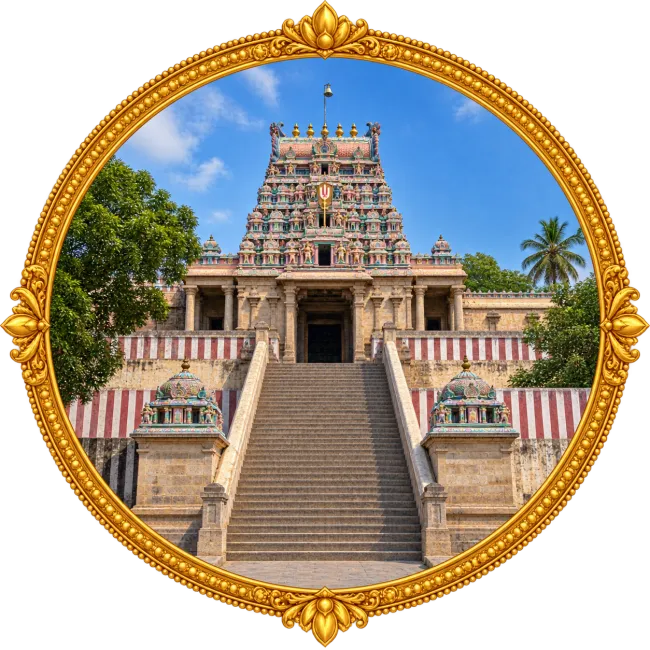
Swamimalai Murugan Temple, Tamil Nadu
Visit Swamimalai Murugan Temple, also known as Arulmigu Swaminatha Swamy Temple, one of the six sacred abodes of Lord Murugan. Located near Kumbakonam in Thanjavur district, Tamil Nadu, the temple is famous for the legend in which Lord Murugan taught the meaning of the sacred Pranava Mantra “Om” to his father, Lord Shiva.
The temple is situated on a small hillock and is known for its sixty sacred steps, traditional Tamil architecture, ancient rituals and peaceful devotional atmosphere.
About Swamimalai Murugan Temple
Swamimalai Murugan Temple is one of the six Arupadai Veedu temples dedicated to Lord Murugan. The temple is situated on a hill approximately 60 feet high, while the shrines of Lord Shiva and Goddess Parvati are located at the foothill.
The presiding deity is Lord Swaminatha Swamy, a form of Lord Murugan. He is also worshipped as the divine teacher who explained the meaning of the Pranava Mantra to Lord Shiva.
The name “Swaminatha” means “the Lord who is the teacher.” This unique story gives Swamimalai a special place among Murugan temples.
Devotees visit Swamimalai to seek wisdom, knowledge, success in education, career progress, spiritual strength and relief from obstacles. The temple is also an important pilgrimage destination for devotees visiting the Kumbakonam temple region.
History of Swamimalai Murugan Temple
Swamimalai is an ancient Murugan pilgrimage centre with a history connected to Tamil religious traditions. The temple has been expanded and renovated by different rulers and devotees over several centuries.
The present temple complex reflects the architectural and religious contributions of the Chola period and later South Indian rulers. The shrine has also received support from local kings, temple administrators and religious institutions.
The temple contains traditional hilltop and foothill shrines. Lord Swaminatha is worshipped at the top of the hill, while Lord Sundareswarar and Goddess Meenakshi are worshipped at the lower level.
The temple has undergone several renovation and consecration works over time. Its worship continues under the administration of the Hindu Religious and Charitable Endowments Department of the Government of Tamil Nadu.
Legend of Swamimalai Temple
According to Hindu mythology, Lord Brahma once visited Mount Kailash. Lord Murugan asked him the meaning of the Pranava Mantra “Om.”
Lord Brahma could not provide a satisfactory explanation. Lord Murugan then imprisoned Brahma and began performing the duties of creation himself.
Lord Shiva noticed that the process of creation had stopped and asked Murugan to release Brahma. Murugan agreed, but Lord Shiva then asked him whether he knew the meaning of the Pranava Mantra.
Lord Murugan replied that he knew its meaning. When Lord Shiva asked him to explain it, Murugan said that he could reveal the secret only if Lord Shiva accepted him as his student.
Lord Shiva agreed and respectfully listened to Lord Murugan, who explained the meaning of “Om” in his father’s ear. Because Murugan became the teacher of Lord Shiva, he came to be known as Swaminatha Swamy.
This legend represents the idea that wisdom is not limited by age, status or family relationship. The person who possesses knowledge becomes the teacher, regardless of age.
Religious Significance of Swamimalai Temple
Swamimalai is one of the six sacred abodes of Lord Murugan, known as Arupadai Veedu. It represents the divine wisdom and teaching aspect of Lord Murugan.
Devotees visit the temple to pray for:
- Knowledge and wisdom
- Success in education
- Better concentration
- Career growth
- Removal of obstacles
- Courage and confidence
- Family welfare
- Spiritual progress
- Relief from confusion and fear
- Fulfilment of personal wishes
Students and parents frequently visit the temple before examinations, educational admissions and important academic decisions.
Main Deity of Swamimalai Temple
The main deity is Lord Swaminatha Swamy, a youthful form of Lord Murugan. He is worshipped as the teacher of Lord Shiva and the divine master of Pranava Mantra.
Lord Swaminatha is traditionally depicted holding the Vel, the sacred spear representing wisdom, courage and the destruction of ignorance.
The deity receives different alankarams during the day. Special decorations are performed during festivals, important pujas and ceremonial processions.
Foothill Shrine
At the foothill, devotees can worship Lord Sundareswarar and Goddess Meenakshi. The presence of Shiva and Parvati below Lord Murugan symbolises the relationship between the divine parents and their son who became their teacher.
The foothill shrine is an important part of the temple pilgrimage. Devotees traditionally worship the deities at the lower level before climbing the sixty steps to the hilltop shrine.
The Sixty Sacred Steps
The temple is reached through sixty steps, each representing one year of the traditional Tamil calendar cycle.
The steps have religious and symbolic importance. Devotees climb them with prayers and devotion before reaching the shrine of Lord Swaminatha.
The climb is manageable for most visitors, but elderly devotees and people with health conditions should use available assistance and take adequate rest.
Architecture of Swamimalai Temple
Swamimalai Temple follows the traditional Dravidian style of South Indian temple architecture.
Hilltop Shrine
The shrine of Lord Swaminatha is situated on top of the hillock. The elevated position gives the temple a distinct visual identity and spiritual atmosphere.
Foothill Temple
The shrines of Lord Sundareswarar and Goddess Meenakshi are located at the foothill. This lower section contains mandapams, entrance structures and other shrines.
Gopuram
The temple entrance is decorated with a traditional gopuram containing sculptural representations of Hindu deities and mythological scenes.
Mandapams
The temple has several mandapams used for daily worship, processional activities, special pujas and festival ceremonies.
Sculptures and Carvings
The pillars and walls contain carvings depicting Lord Murugan, Lord Shiva, Goddess Parvati, Lord Ganesha, divine guardians and other figures from Hindu mythology.
Swamimalai Murugan Temple Timings
The temple remains open in two daily sessions, with a break in the afternoon.
Timings may change during festivals, special pujas, temple renovation work and other religious occasions.
Daily Puja and Aarti Timings
The exact duration of darshan may be affected by the puja schedule. Devotees wishing to attend a specific aarti should reach the temple before the ritual begins.
Morning and Evening Aarti
The morning worship begins with Viswaroopa Puja between 6:00 AM and 7:00 AM. This is the first major worship of the day and is considered an auspicious time for darshan.
The evening aarti is performed during Sayaraksha Puja from 5:00 PM to 6:00 PM. Additional evening worship takes place during Irandamkala Puja.
The final night worship is performed during Ardhajama Puja from 9:00 PM to 9:30 PM.
Religious Practices at Swamimalai Temple
Devotees participate in several religious activities, including:
- Abhishekam
- Archana
- Vel offering
- Milk offering
- Kavadi offering
- Ghee lamp offering
- Tonsure
- Vastram offering
- Special darshan
- Hill-step pilgrimage
- Prayer for educational success
- Worship at the foothill Shiva shrine
- Worship at the hilltop Murugan shrine
Students and families commonly perform special archana for knowledge, concentration and academic success.
Offerings at Swamimalai Temple
Devotees commonly offer:
- Flowers
- Milk
- Fruits
- Coconut
- Sandalwood paste
- Ghee lamps
- Vel replicas
- Kavadi
- New clothes
- Panchamirtham
- Monetary donations
- Special archana
- Abhishekam materials
Offerings should be submitted only at authorised counters or designated locations.
Prasad at Swamimalai Temple
After darshan, devotees may receive sacred ash, kumkum and other blessed offerings.
Common prasadam items include:
- Panchamirtham
- Sweet pongal
- Puliyodarai
- Laddu
- Vada
- Milk-based prasadam
- Abhishekam prasadam
- Vibhooti
Prasadam availability may differ according to the day and festival schedule.
Major Festivals Celebrated
Thai Poosam
Thai Poosam is one of the most important festivals celebrated for Lord Murugan. Devotees carry Kavadi, offer milk pots and perform special prayers during the festival.
Vaikasi Visakam
Vaikasi Visakam celebrates the birth of Lord Murugan. Special abhishekams, decorations and processions are organised.
Kanda Sashti
Kanda Sashti is dedicated to Lord Murugan’s victory over evil. Devotees observe fasting and participate in special worship during the six-day celebration.
Panguni Uthiram
Panguni Uthiram is associated with divine marriage celebrations. Special rituals are performed for Lord Murugan, Goddess Valli and Goddess Deivanai.
Skanda Sashti
Skanda Sashti includes devotional chanting, special pujas and religious ceremonies dedicated to Lord Murugan.
Karthigai Deepam
Karthigai Deepam is celebrated by lighting lamps and offering prayers to Lord Murugan.
Other important occasions include Tamil New Year, monthly Sashti, monthly Karthigai, Navaratri and festival processions.
Best Time to Visit Swamimalai Temple
The best season to visit Swamimalai is from October to March, when the weather is comparatively pleasant.
Early morning is suitable for devotees who want to climb the steps peacefully and attend Viswaroopa Puja.
Evening is suitable for visitors who wish to attend Sayaraksha Puja and experience the temple’s devotional atmosphere.
The temple receives larger crowds during:
- Thai Poosam
- Kanda Sashti
- Vaikasi Visakam
- Panguni Uthiram
- Karthigai Deepam
- Weekends
- Public holidays
Recommended Visit Duration
Visitors should keep additional time for parking, queues, puja bookings and prasadam collection.
Entry Fee and Special Darshan
General entry to Swamimalai Temple is free. Separate charges may apply for:
- Special darshan
- Abhishekam
- Archana
- Special pujas
- Tonsure
- Prasadam
- Vastram offerings
- Other temple services
Ticket charges and availability may change according to the temple administration.
Dress Code
Devotees should wear clean, modest and respectful clothing.
Recommended clothing includes:
- Dhoti or veshti for men
- Kurta-pyjama
- Saree
- Salwar kameez
- Traditional Indian clothing
- Comfortable clothing for climbing the steps
Visitors should avoid shorts, sleeveless clothing and revealing outfits.
Photography and Security
Photography may be restricted inside the sanctum and other sacred areas. Visitors should follow the instructions displayed by the temple administration.
Mobile phones, cameras and large bags may not be permitted in certain sections. Restricted belongings should be deposited at authorised counters.
Visitors should not carry:
- Alcohol
- Tobacco products
- Non-vegetarian food
- Sharp objects
- Large bags
- Unauthorised cameras
- Prohibited electronic devices
How to Reach Swamimalai Murugan Temple
By Air
Tiruchirappalli International Airport is the nearest major airport. It is connected with Chennai, Bengaluru, Hyderabad, Delhi and other cities.
Taxis and buses are available from the airport to Kumbakonam and Swamimalai.
By Train
Kumbakonam Railway Station is the nearest major railway station. Swamimalai is located approximately 8 kilometres from Kumbakonam.
Auto-rickshaws, taxis and local buses are available from the railway station.
By Road
Swamimalai is well connected by road with Kumbakonam, Thanjavur, Mayiladuthurai, Tiruchirappalli and other towns in Tamil Nadu.
Government buses, private buses, taxis and auto-rickshaws are available from Kumbakonam to Swamimalai.
Nearby Places to Visit
Kumbakonam Temples
Kumbakonam is known for several ancient temples, including Adi Kumbeswarar Temple, Sarangapani Temple and Chakrapani Temple.
Darasuram Airavatesvara Temple
The Airavatesvara Temple at Darasuram is a famous Chola-era temple known for its detailed stone carvings and architectural beauty.
Thanjavur Brihadeeswarar Temple
Brihadeeswarar Temple is a magnificent Chola temple dedicated to Lord Shiva and is located within travelling distance of Swamimalai.
Thiruvidaimarudur Mahalingaswamy Temple
This historic Shiva temple is an important pilgrimage destination near Kumbakonam.
Uppiliappan Temple
Uppiliappan Temple is a prominent Vaishnava temple located near Kumbakonam and dedicated to Lord Vishnu.
Patteeswaram Dhenupureeswarar Temple
This ancient Shiva temple is known for its religious importance, sculptures and connection with Goddess Durga.
Facilities Available
Facilities available for devotees include:
- Footwear counters
- Puja booking counters
- Prasadam counters
- Drinking water
- Public toilets
- Resting areas
- Medical assistance
- Parking facilities
- Local transport
- Hotels and guest houses
- Shops selling flowers and puja materials
Facilities may become crowded during festivals and public holidays.
Important Tips for Devotees
- Reach early for Viswaroopa Puja and peaceful darshan.
- Wear comfortable clothing for climbing the sixty steps.
- Elderly visitors should take adequate rest while climbing.
- Use authorised counters for puja and prasadam.
- Carry limited valuables and avoid large bags.
- Follow the temple queue system.
- Maintain silence inside the sanctum and mandapams.
- Do not touch sculptures or sacred objects.
- Keep children under supervision on the hill steps.
- Confirm festival-day timings before visiting.
- Avoid unauthorised agents offering special darshan or puja services.
- Respect the traditional dress code and temple customs.
Conclusion
Swamimalai Murugan Temple is one of the most sacred and spiritually significant temples dedicated to Lord Murugan. Its unique legend of Murugan becoming the teacher of Lord Shiva gives it a special place among the six Arupadai Veedu temples.
The sixty sacred steps, hilltop shrine, foothill temples, ancient architecture, daily pujas and peaceful devotional atmosphere make Swamimalai an important pilgrimage destination. A visit to this temple offers devotees the opportunity to pray for wisdom, knowledge, courage and the divine blessings of Lord Swaminatha Swamy.