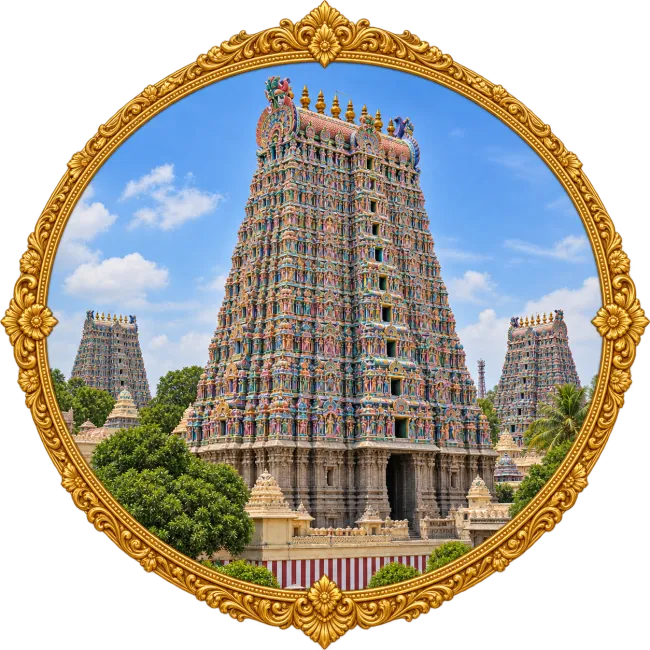
Meenakshi Amman Temple, Madurai
Visit Meenakshi Amman Temple in Madurai, one of India’s most celebrated temples dedicated to Goddess Meenakshi and Lord Sundareswarar. Located in the heart of the historic city, the temple is famous for its colourful gopurams, ancient traditions, sacred Golden Lotus Tank, intricately carved halls, and the grand celestial wedding celebrated during the Chithirai Festival.
About Meenakshi Amman Temple
Meenakshi Amman Temple, officially known as Arulmigu Meenakshi Sundareswarar Temple, is situated on the southern bank of the Vaigai River in Madurai, Tamil Nadu.
The temple is dedicated to Goddess Meenakshi, a manifestation of Goddess Parvati, and Lord Sundareswarar, a form of Lord Shiva. Unlike most Shiva temples where Lord Shiva is the principal deity, Goddess Meenakshi occupies the central position in the religious traditions of this temple.
The temple is an active place of worship and one of the most important spiritual and cultural landmarks of Tamil Nadu. Daily pujas, aartis, processions, abhishekam, and festival rituals are performed according to traditional Shaivite customs.
History of Meenakshi Amman Temple
The religious origins of Meenakshi Amman Temple are associated with ancient Madurai and the Pandya dynasty. The temple is believed to have existed in an early form for nearly 2,000 years.
Ancient Tamil devotional literature and the hymns of Shaivite saints mention Madurai as an important centre of Lord Shiva’s worship. The temple is also classified as a Paadal Petra Sthalam because it is praised in the sacred Tevaram hymns.
A large part of the earlier temple complex suffered damage during invasions in the 14th century. The temple was subsequently restored and expanded under the Vijayanagara rulers and the Madurai Nayaks.
The present architectural form developed mainly between the 16th and 17th centuries. Vishwanatha Nayak, Ariyanatha Mudaliar, Tirumalai Nayak, and other rulers and patrons contributed to its gopurams, mandapams, corridors, sculptures, shrines, and festival traditions.
Tirumalai Nayak, who ruled Madurai from 1623 to 1659, made important contributions to the temple and strengthened the celebration of the Chithirai Festival.
Legend of Goddess Meenakshi
According to sacred tradition, King Malayadhwaja Pandya and Queen Kanchanamalai performed a yajna because they did not have a child. A divine girl emerged from the sacred fire.
The child had three breasts, and the king was concerned by her unusual appearance. A divine voice declared that the third breast would disappear when she met her destined husband.
The princess was named Tadaatagai and was trained in administration, warfare, and statecraft. She later became the ruler of Madurai and led military campaigns in different directions.
When she reached Mount Kailash and saw Lord Shiva, her third breast disappeared. She realised that Shiva was her destined husband. Lord Shiva came to Madurai as Sundareswarar, meaning “the Beautiful Lord,” and married her.
After the celestial wedding, Goddess Meenakshi and Lord Sundareswarar ruled Madurai together. Their divine marriage remains the central theme of the temple’s famous Chithirai Festival.
Significance of Meenakshi Amman Temple
Meenakshi Amman Temple represents the divine union of Shiva and Shakti. Goddess Meenakshi symbolises courage, wisdom, compassion, fertility, and responsible leadership, while Lord Sundareswarar represents consciousness, spiritual knowledge, and divine grace.
Devotees visit the temple to pray for:
- A happy and harmonious marriage
- Blessings for unmarried devotees
- Peace and understanding between couples
- Health and well-being
- Prosperity within the family
- Courage and confidence
- Wisdom and spiritual growth
- Success in important responsibilities
- Protection from difficulties
- Blessings for children
The temple also serves as an important centre of Tamil religion, music, dance, sculpture, literature, and cultural traditions.
Main Deities of the Temple
Goddess Meenakshi
Goddess Meenakshi is the principal deity of the temple. Her name is commonly interpreted as “the goddess with fish-shaped eyes,” symbolising compassionate awareness and constant protection.
The sacred image represents the goddess standing gracefully with a parrot associated with the lotus held in her right hand. She is adorned with silk clothes, flowers, jewellery, and different decorative forms throughout the year.
Lord Sundareswarar
Lord Shiva is worshipped as Sundareswarar or Somasundarar. His shrine is located within the temple complex and is larger in physical area, although Goddess Meenakshi holds the primary ceremonial position.
Lord Sundareswarar is worshipped in the form of a Shiva Lingam. Devotees visit both principal shrines to complete their darshan.
Architecture of Meenakshi Amman Temple
Meenakshi Amman Temple is a remarkable example of Dravidian architecture. The complex covers an extensive area and contains monumental gateways, sacred shrines, pillared halls, corridors, sculptures, paintings, and a temple tank.
The city of Madurai developed around the temple in a pattern traditionally compared to a lotus with radiating petals. Streets surrounding the temple are named after Tamil months and are used for religious processions.
Gopurams of the Temple
The temple complex has 14 gopurams or gateway towers. The outer gopurams are covered with thousands of colourful stucco figures representing Hindu deities, celestial beings, saints, guardians, animals, and stories from sacred traditions.
The southern gopuram is the tallest gateway of the complex and rises to more than 50 metres. The four major outer towers serve as prominent landmarks visible from different parts of central Madurai.
The sculptures are periodically cleaned, repaired, and repainted while maintaining their traditional appearance.
Hall of a Thousand Pillars
The famous Thousand Pillar Hall is one of the temple’s most impressive architectural features. Despite its traditional name, the hall contains 985 carved pillars.
Each pillar displays detailed sculptural work associated with Hindu mythology, deities, guardians, animals, and legendary figures. The hall also contains an art museum presenting sculptures, images, and information about the temple’s history.
Musical pillars located near the hall are known for producing different sounds when carefully tapped. Visitors should not touch them unless expressly permitted.
Golden Lotus Tank
The sacred temple tank is known as Potramarai Kulam, meaning the Golden Lotus Tank. It occupies an important place within the temple complex.
According to tradition, Lord Shiva blessed this tank and declared that no aquatic life would grow in it. A golden lotus structure can be seen in the water.
The surrounding corridors offer views of the gopurams and provide devotees with a peaceful space for prayer and reflection.
Other Important Features
The temple complex contains numerous shrines and mandapams, including:
- Meenakshi Amman Shrine
- Sundareswarar Shrine
- Mukkuruny Vinayagar Shrine
- Nataraja Shrine
- Kilikoondu Mandapam
- Ashta Shakti Mandapam
- Kambathadi Mandapam
- Oonjal Mandapam
- Thousand Pillar Hall
- Golden Lotus Tank
The Nataraja form worshipped in the temple is traditionally associated with the Silver Hall or Velli Ambalam.
Meenakshi Amman Temple Timings
Darshan Timings
Daily Puja and Aarti Timings
Puja and darshan timings may change during the Chithirai Festival, Navratri, Aavani Moola Festival, Float Festival, and other special occasions.
Palliyarai Puja
Palliyarai Puja is one of the temple’s most significant daily ceremonies. During this night ritual, the processional image of Lord Sundareswarar is ceremonially carried to the chamber of Goddess Meenakshi.
The procession is accompanied by lamps, traditional music, chanting, and devotional worship. It symbolises the divine companionship of Meenakshi and Sundareswarar.
Visitors interested in attending this ceremony should enter the temple sufficiently early because security checks and queues may require additional time.
Best Time for Darshan
The best time for a peaceful darshan is between 5:00 AM and 7:30 AM. The weather is pleasant and the temple generally has fewer visitors during the early morning.
Evening between 4:00 PM and 6:30 PM is suitable for devotees wishing to attend the Maalai Puja and experience the illuminated temple complex.
Fridays, weekends, festival days, and auspicious occasions generally attract larger crowds.
Puja and Religious Activities
Daily and special religious activities include:
- Abhishekam
- Alankaram of the deities
- Naivedyam
- Deepa Aradhana
- Morning and evening puja
- Palliyarai procession
- Friday worship of Goddess Meenakshi
- Pradosham rituals
- Special festival processions
- Golden chariot procession
- Marriage-related prayers
- Archana in the names of devotees
Special puja and darshan arrangements should be booked only through authorised temple counters.
Offerings at Meenakshi Amman Temple
Common offerings include:
- Flowers and garlands
- Lotus flowers
- Turmeric
- Kumkum
- Coconut
- Fruits
- Silk clothes
- Ghee lamps
- Sacred bangles
- Mangalsutra-related offerings
- Naivedyam
- Bilva leaves for Lord Sundareswarar
Visitors should follow temple instructions regarding permitted offerings and restricted items.
Prasad at Meenakshi Amman Temple
Devotees may receive kumkum, sacred ash, flowers, or food prasad after worship.
Kumkum is particularly associated with Goddess Meenakshi, while vibhuti is connected with Lord Sundareswarar. Both are accepted respectfully as symbols of divine blessings.
Prasad may also be available from authorised counters inside or near the temple complex.
Major Festivals Celebrated
Chithirai Festival
The Chithirai Festival is the grandest celebration associated with Meenakshi Amman Temple. It is celebrated during the Tamil month of Chithirai, generally falling in April or May.
The festival includes:
- Coronation of Goddess Meenakshi
- Processions of the deities
- Meenakshi Thirukalyanam
- Temple car procession
- Ethir Sevai
- Entry of Lord Kallazhagar into the Vaigai River
The celestial wedding of Goddess Meenakshi and Lord Sundareswarar is the principal attraction.
Navratri
Goddess Meenakshi is worshipped in different decorative forms during Navratri. Special pujas, cultural programmes, devotional music, and traditional displays are organised.
Aavani Moola Festival
This festival celebrates the sacred divine plays of Lord Sundareswarar, traditionally known as the Thiruvilaiyadal stories.
Float Festival
The annual Float Festival is celebrated at Vandiyur Mariamman Teppakulam. The decorated processional deities of Meenakshi and Sundareswarar are carried on an illuminated float across the temple tank.
Maha Shivaratri
Special pujas, abhishekam, chanting, and night worship are performed for Lord Sundareswarar during Maha Shivaratri.
Fridays and Aadi Month
Fridays are considered especially auspicious for worshipping Goddess Meenakshi. Fridays during the Tamil months of Aadi and Thai attract many devotees.
Dress Code
Visitors should wear modest clothing suitable for an active place of worship.
Traditional Indian attire is preferred. Clothing that exposes the shoulders or knees should be avoided. Footwear must be removed before entering the temple.
Entry and Darshan Arrangements
General entry to the temple is available without an admission charge. Paid special-darshan arrangements may also be available through authorised counters.
Separate entry arrangements may apply to the Meenakshi and Sundareswarar shrines. Ticket prices and queue systems can change during festivals and crowded periods.
Photography and Security Guidelines
Visitors must pass through security checks before entering the temple. Restrictions may apply to mobile phones, cameras, electronic devices, bags, and other belongings.
Photography is prohibited in sacred and restricted areas. Visitors should use authorised storage facilities when instructed and follow all directions displayed at the entrances.
Best Season to Visit
The best season to visit Meenakshi Amman Temple is from October to March, when Madurai’s weather is more comfortable.
The Chithirai Festival offers the grandest cultural experience but also attracts extremely large crowds. Devotees seeking a peaceful visit should choose a regular weekday outside the major festival period.
Recommended Visit Duration
Visitors should keep two to three hours to explore the temple properly. This allows sufficient time for:
- Security checks
- Darshan of Goddess Meenakshi
- Darshan of Lord Sundareswarar
- Visiting subsidiary shrines
- Seeing the Golden Lotus Tank
- Exploring the Thousand Pillar Hall
- Observing the gopurams and sculptures
Additional time may be required on Fridays, weekends, and festival days.
How to Reach Meenakshi Amman Temple
The temple is located in the centre of Madurai and is accessible by air, train, bus, and road.
By Air
Madurai International Airport is the nearest airport. Taxis and buses are available from the airport to the temple area.
By Train
Madurai Junction is the nearest major railway station. It is connected with Chennai, Coimbatore, Tiruchirappalli, Rameswaram, Bengaluru, Thiruvananthapuram, and other cities.
Auto-rickshaws, taxis, buses, and app-based cabs are available from the railway station.
By Road
Madurai is connected with Chennai, Coimbatore, Tiruchirappalli, Rameswaram, Kanyakumari, Bengaluru, and other cities through national and state highways.
Visitors can reach the temple using:
- City bus
- Auto-rickshaw
- Taxi
- App-based cab
- Private vehicle
Vehicle access may be restricted in the streets immediately surrounding the temple. Visitors should use designated parking areas and walk to the entrance.
Nearby Places to Visit
Visitors may also explore:
- Thirumalai Nayakkar Palace
- Koodal Azhagar Temple
- Gandhi Memorial Museum
- Vandiyur Mariamman Teppakulam
- Thiruparankundram Murugan Temple
- Alagar Kovil
- Pazhamudircholai Murugan Temple
- Puthu Mandapam
- St. Mary’s Cathedral
- Samanar Hills
Facilities for Visitors
Facilities available at or near the temple include:
- Footwear deposit counters
- Cloakrooms
- Drinking-water facilities
- Public washrooms
- Prasad counters
- Puja and darshan ticket counters
- Wheelchair assistance
- Local guides
- Restaurants and hotels
- Flower and devotional-item shops
- Parking in designated areas
Availability and access may change during festivals and high-security periods.
Important Tips for Visitors
- Wear modest and respectful clothing.
- Avoid carrying large bags and unnecessary electronic devices.
- Follow current mobile-phone and camera restrictions.
- Remove footwear before entering the temple.
- Purchase puja and darshan tickets only from authorised counters.
- Keep mobile phones silent wherever they are permitted.
- Do not touch sculptures, paintings, or sacred objects.
- Maintain cleanliness inside the temple complex.
- Keep personal belongings secure.
- Enter early if attending a particular puja.
- Avoid the afternoon closure between 12:30 PM and 4:00 PM.
- Confirm festival schedules before planning a special visit.
- Follow the instructions of security personnel and temple authorities.
Conclusion
Meenakshi Amman Temple in Madurai is a magnificent centre of devotion, history, architecture, sculpture, and Tamil culture. Dedicated to Goddess Meenakshi and Lord Sundareswarar, the temple represents the sacred union of Shiva and Shakti.
Its towering gopurams, ancient legends, Golden Lotus Tank, Thousand Pillar Hall, daily rituals, and grand Chithirai Festival make it one of India’s most unforgettable spiritual destinations.